Radon Sensor (Rn): The Practical Guide to Technology, Readings, and Selection
A radon sensor (often sold as a radon detector or continuous radon monitor) measures the activity concentration of radon in air—typically radon-222—and reports it in Bq/m³ or pCi/L. Unlike combustible or toxic gas sensors that detect molecules via chemical reactions or IR absorption, radon sensing is radiation measurement: sensors detect the alpha particles emitted by radon (or its decay products) and convert counts into a concentration.
Radon matters because it can accumulate indoors, and public health agencies recommend taking action when levels exceed defined guidance thresholds. EPA recommends fixing homes at 4 pCi/L (150 Bq/m³) and considering action at 2–4 pCi/L.
Radon Units: pCi/L vs Bq/m³ (and Conversion)
Most countries use Bq/m³; the U.S. commonly uses pCi/L. A standard conversion used in radon guidance is:
- 1 pCi/L = 37 Bq/m³
This conversion is useful when comparing action levels across regions.
Radon “Action Levels” and Reference Levels
Different jurisdictions use different thresholds for “take action” guidance:
- United States (EPA): fix at ≥4 pCi/L (150 Bq/m³); consider fixing at 2–4 pCi/L (75–150 Bq/m³).
- WHO: proposes a reference level of 100 Bq/m³ (with flexibility if not achievable).
- Canada (Health Canada): take corrective action if the average annual level exceeds 200 Bq/m³.
Why this matters for sensor choice: if your goal is compliance or building management, you’ll want a device that reports in the unit your region uses and provides an average over an appropriate time window (short-term trend vs long-term average).
How a Radon Sensor Works
All radon sensors follow the same basic chain:
- Air exchange into a measurement chamber (diffusion or pumped)
- Radon decay occurs (or radon progeny form)
- Alpha events are detected (directly or indirectly)
- A microcontroller converts counts → Bq/m³ or pCi/L, often with temperature/humidity compensation and averaging.
The key difference between products is how the alpha activity is detected.
Radon Sensor Types: Passive Tests vs Active Continuous Sensors
1) Passive radon “test” devices (not real-time sensors)
These are widely used for home screening and compliance testing.
EPA explains that long-term tests remain in the home for more than 90 days, and commonly use alpha track or electret detectors.
Passive methods table
| Method | What it is | Best for | Limitations |
|---|---|---|---|
| Charcoal (short-term) | Adsorbs radon; lab analysis | Quick screening | Sensitive to humidity; not a true “sensor” |
| Alpha track (long-term) | Tracks alpha damage on film | Best estimate of annual average | Slow; needs lab |
| Electret (short/long) | Electret ion chamber; lab/reading | Flexible duration | Still not “real-time” |
(For SEO pages, including this table helps users understand why a continuous radon sensor is different from a mail-in kit.)
2) Continuous Radon Monitors (CRMs) = real “radon sensors”
CRMs provide ongoing readings and are used in:
- homes (consumer monitors)
- professional testing/mitigation verification
- research/environmental monitoring
- building management / IAQ platforms
There are three technology families you’ll see most often:
Winsen Radon Sensor
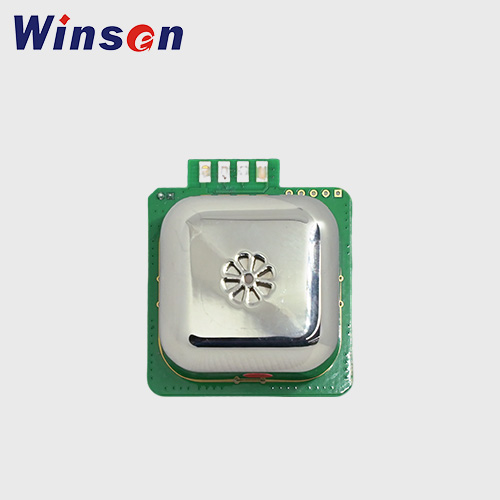
Technology A: Electrostatic Collection + Solid-State Alpha Detector (PIN photodiode)
This is one of the most common principles in higher-performance monitors: radon enters a chamber; after decay, positively charged progeny (e.g., Po-218) are electrostatically collected onto a detector (often a silicon detector), and alpha energies are counted.
A published example describes an electrostatic collection cell with a silicon surface barrier detector mounted in the chamber.
Modern research instruments also describe electrostatic collection of charged progeny onto a semiconductor detector surface to achieve alpha energy spectra.
Why this approach is popular
- High sensitivity for indoor levels
- Potential for alpha energy discrimination (helps separate radon/thoron/progeny in some designs)
- Strong fit for continuous monitoring
Practical caveat (real-world performance)
Electrostatic collection efficiency can be influenced by environmental conditions (notably humidity), because charge neutralization affects how many progeny are collected—an active research topic in improving monitor robustness.
Technology B: Pulsed Ionization Chamber (Ion Pulse IC)
Ionization chambers measure the ionization created by alpha particles. A recent paper summarizes that a pulse ionization chamber can measure radon by detecting induced charge changes and may be less susceptible to sample contamination.
Why this approach is used
- Robust measurement principle
- Good candidate for professional devices and engineering-focused designs
Technology C: Scintillation “Lucas Cell” + Photomultiplier (PMT)
This classic approach uses a chamber coated with a scintillator such as ZnS(Ag). Alpha particles generate light pulses; a PMT counts them. A ScienceDirect paper describes the principle as counting photons produced when alpha particles interact with the ZnS(Ag) scintillator, with a PM tube counting events.
A commercial manual also describes a radon monitor based on ZnS(Ag) scintillation (Lucas cell) with a PMT registering alpha decays.
Where it’s common
- Laboratory and professional instruments
- Calibration work and research monitoring
Which Radon Sensor Technology Should You Choose?
Quick selection table
| Use case | Recommended sensor type | Why |
|---|---|---|
| Home “always-on” monitoring | Consumer CRM (solid-state alpha or similar) | Daily/weekly trend + long-term average |
| Professional inspections & mitigation verification | CRM with documented test protocols | Better control of method and reporting |
| Research / low-level environmental monitoring | High-sensitivity electrostatic/alpha spectrometry or scintillation systems | Lower detection limit and better characterization |
| OEM IAQ device integration | Module-like CRM platform with stable airflow + calibration approach | Easier integration + predictable performance |
Key Specs to Compare (What Actually Matters)
When writing a product page or choosing a radon sensor for a project, highlight these specs clearly:
- Measurement unit: Bq/m³ and/or pCi/L
- Conversion clarity: include “1 pCi/L = 37 Bq/m³” in documentation
- Response time / averaging windows: 1-day, 7-day, long-term average (important for user trust)
- Detection limit / sensitivity: especially important near 100–200 Bq/m³ decision zones
- Environmental tolerance: humidity/temperature behavior (especially for electrostatic designs)
- Air handling: diffusion vs pumped; filter maintenance
- Calibration/verification: ability to validate performance and stability over time
- Data & integration: local display vs app; API/export options for building systems
OEM / Product Integration Notes (If You Build Smart IAQ Devices)
If you manufacture IAQ monitors, smart building gateways, or safety devices:
- Radon sensing is not a typical gas sensor (it’s radiation counting), so it needs a dedicated chamber + detector + airflow design.
- Most successful products bundle radon with standard IAQ sensors (CO₂, VOC, temperature, humidity) for a complete “health + comfort” story—while treating radon as a specialized measurement with clear averaging logic and guidance thresholds (EPA/WHO/Canada).
FAQ
What is a radon sensor measuring?
It measures radon activity concentration in air, reported in Bq/m³ or pCi/L. A standard conversion is 1 pCi/L = 37 Bq/m³.
What radon level is “too high”?
EPA recommends fixing homes at 4 pCi/L (150 Bq/m³) and considering action at 2–4 pCi/L.
Is WHO’s recommended level different?
WHO proposes a reference level of 100 Bq/m³ (with flexibility by country).
What’s the difference between a radon test kit and a radon sensor?
A test kit is usually passive and lab-read; a sensor/CRM provides continuous readings and trends. EPA notes long-term tests are >90 days and often use alpha track or electret devices.
Which radon sensor technology is most common?
Many CRMs use solid-state alpha detection with electrostatic collection; others use ionization chambers or scintillation (Lucas cell) designs depending on performance and application.