
WINSEN SMART AIR CONDITIONER SENSING

Air Conditioner Air Quality Sensor Solutions for Smart AC

Build smarter air conditioners with Winsen PM2.5, VOC, odor-related air quality, temperature, humidity, CO2 and formaldehyde sensor modules. Support air quality monitoring, intelligent comfort control and advanced smart AC functions with flexible OEM sensing solutions.

PM2.5 / Dust VOC / Odor Temperature & Humidity CO2 / HCHO Multi-in-One IAQ Smart AC Integration
Modern residential living room with wall mounted air conditioner for smart air quality sensing solutions
Air Quality Awareness

Monitor particles and selected gaseous pollutants inside air-conditioned spaces.

Comfort Monitoring

Provide temperature and humidity data for intelligent indoor climate control.

Integrated Sensing

Select compact multi-parameter modules for space-constrained indoor AC units.

OEM Development

Integrate environmental measurements with AC controllers and optional functions.

SMART AIR CONDITIONING

Why Air Quality Sensors Matter in Smart Air Conditioners

Modern air conditioners increasingly combine temperature control with environmental monitoring and optional air treatment features. Sensor data allows manufacturers to provide more information about indoor conditions and develop additional smart AC functions.

From Cooling Equipment to Intelligent Indoor Comfort

Conventional split air conditioners primarily cool or heat and recirculate indoor air. By adding suitable environmental sensors, OEM manufacturers can extend the information available to the air conditioner controller and user interface.

  • Temperature and humidity: measure indoor environmental conditions for comfort-related functions.
  • PM2.5 monitoring: provide particulate concentration data for air quality display.
  • VOC and odor-related response: support gaseous air quality trend monitoring.
  • Optional CO₂ and HCHO: expand the sensing capabilities of selected smart AC products.
  • Smart operation: use sensor measurements in OEM-defined display, ventilation or air-treatment functions.
SMART AC SENSING FUNCTIONS

Monitoring, Control and Air Treatment

These three capabilities are related, but they are not interchangeable.

  • Monitoring: sensors measure selected environmental parameters.
  • Control: the AC controller interprets the data and selects equipment responses.
  • Air treatment: filtration, purification or outdoor-air ventilation requires appropriate hardware.
Adding an air quality sensor alone does not turn a conventional recirculating air conditioner into an air purifier or a fresh-air ventilation system.
AIR CONDITIONER SENSOR PARAMETERS

Which Air Quality Parameters Can a Smart Air Conditioner Monitor?

Different AC product lines require different sensing functions. Temperature and humidity are common environmental parameters, while particulate matter, VOC, CO₂ and formaldehyde sensing can support selected advanced product features.

PM

PM2.5 & Dust

Laser particle sensors provide airborne particle measurements for air quality displays and compatible purification-related functions.

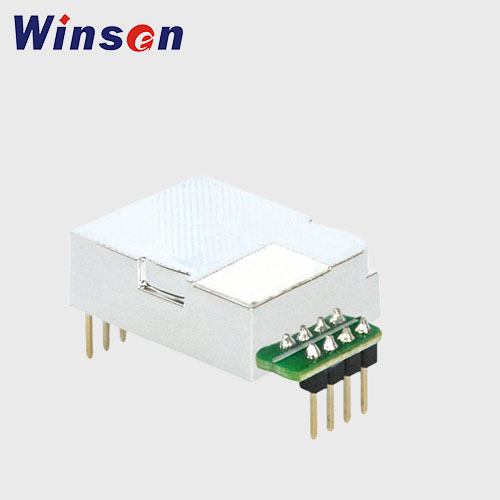
ZH10-F / ZH10-VHT
VOC

VOC & Odor-Related Gases

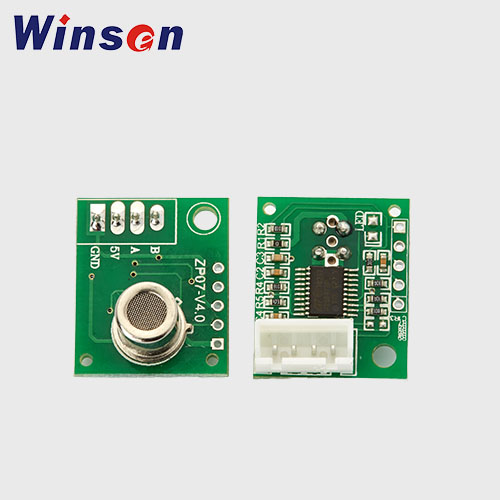
Semiconductor sensors respond to selected volatile organic compounds and other gases associated with indoor air quality changes.

ZP07 / ZPS20 / ZH10-VHT
T&H

Temperature & Humidity

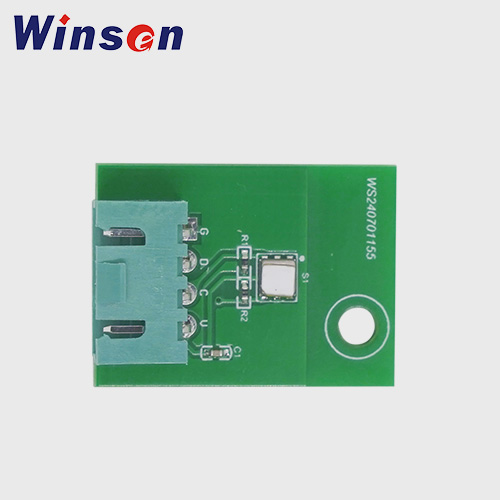
Digital environmental sensors provide temperature and relative humidity measurements for comfort monitoring and control.

ZS13A / ZPS20
CO₂

Carbon Dioxide

CO₂ sensing adds information related to ventilation conditions in occupied rooms, particularly for compatible fresh-air AC designs.

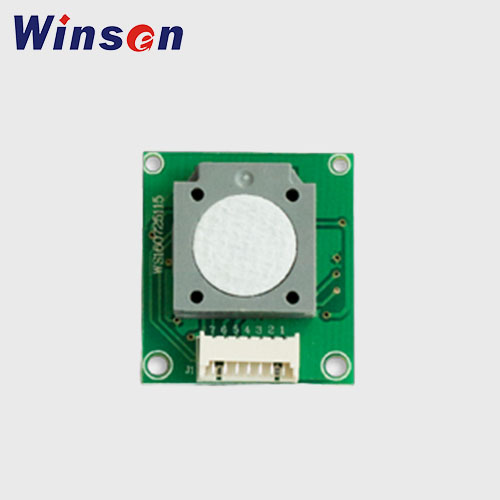
MH-Z19E / ZPHS01C
HCHO

Formaldehyde

Dedicated electrochemical formaldehyde sensing provides HCHO measurements in AC products with this feature.

ZE08K-CH2O / ZPHS01C HCHO Version
IAQ

Multi-Parameter Sensing

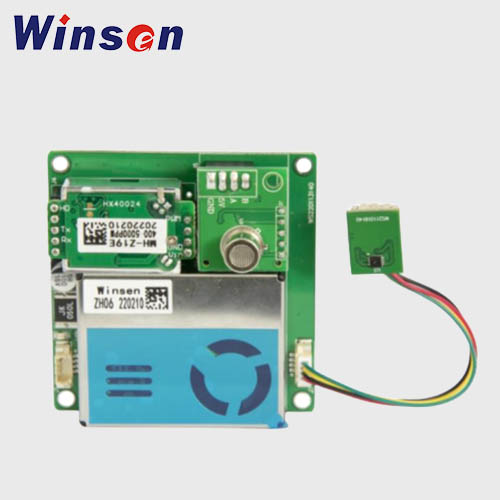
Integrated modules combine several environmental measurements to support feature-rich smart AC designs.

ZH10-VHT / ZPHS01C
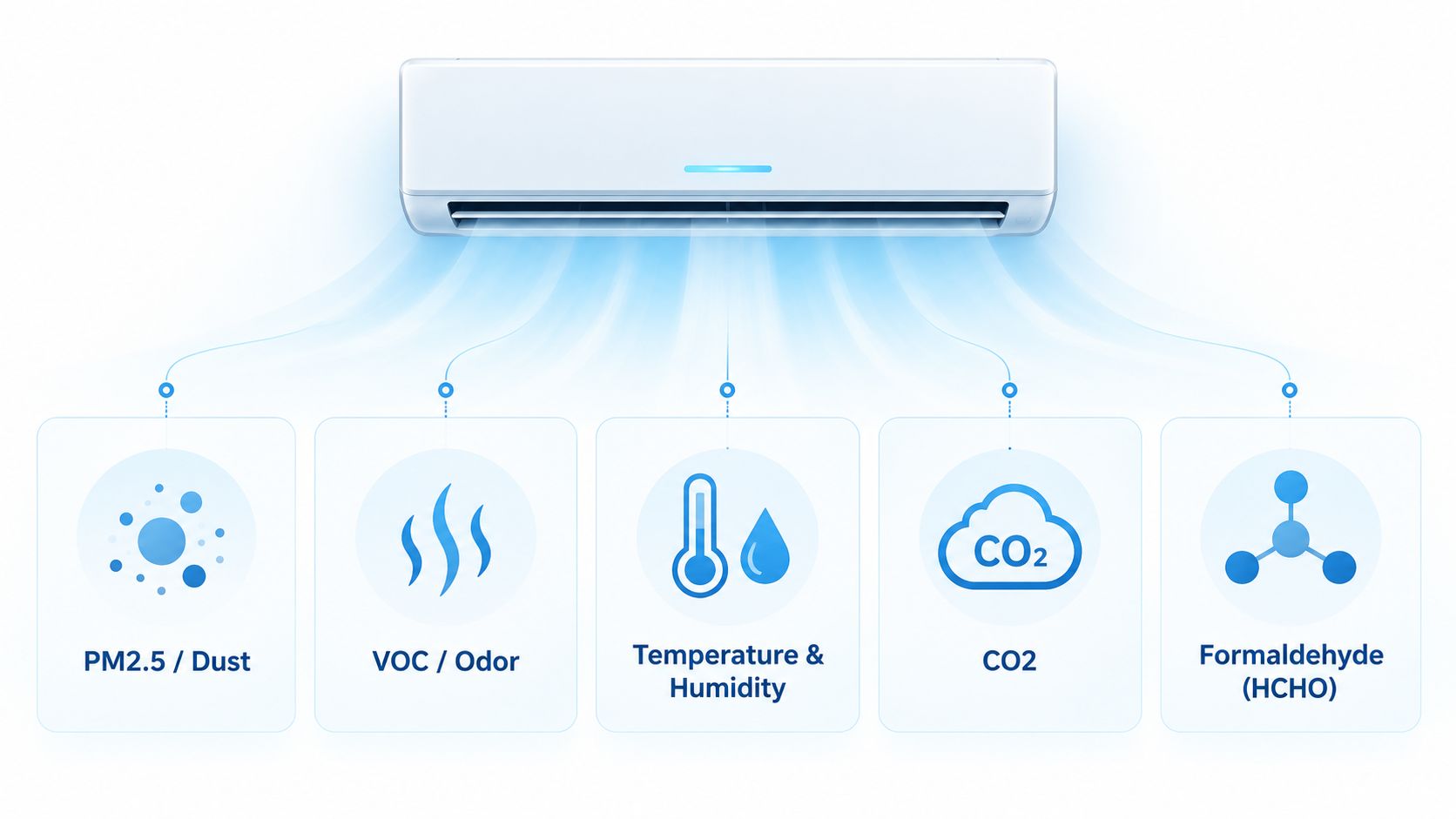
Smart air conditioner air quality sensing parameters including PM2.5 VOC temperature humidity CO2 and formaldehyde
Different parameters require suitable sensing technologies. The illustration describes monitoring functions rather than specific sensor installation positions.
VOC and HCHO are different: broad semiconductor VOC response should not be treated as equivalent to dedicated formaldehyde concentration measurement.
SENSOR-TO-AC CONTROL

How Air Quality Sensor Data Supports Smart AC Functions

The air conditioner controller receives measurements from compatible sensors. Manufacturers may use this data for environmental displays, comfort-related control and optional purification or ventilation features.

STEP 01

Air Quality Sensing

Measure selected PM, VOC, T&H, CO₂ or HCHO parameters.

STEP 02

Controller Processing

Acquire sensor data and apply OEM-defined processing and control logic.

STEP 03

AC System Response

Provide environmental display, operating mode adjustment or supported air-treatment functions.

STEP 04

Ongoing Monitoring

Continue measuring indoor conditions and updating system data.

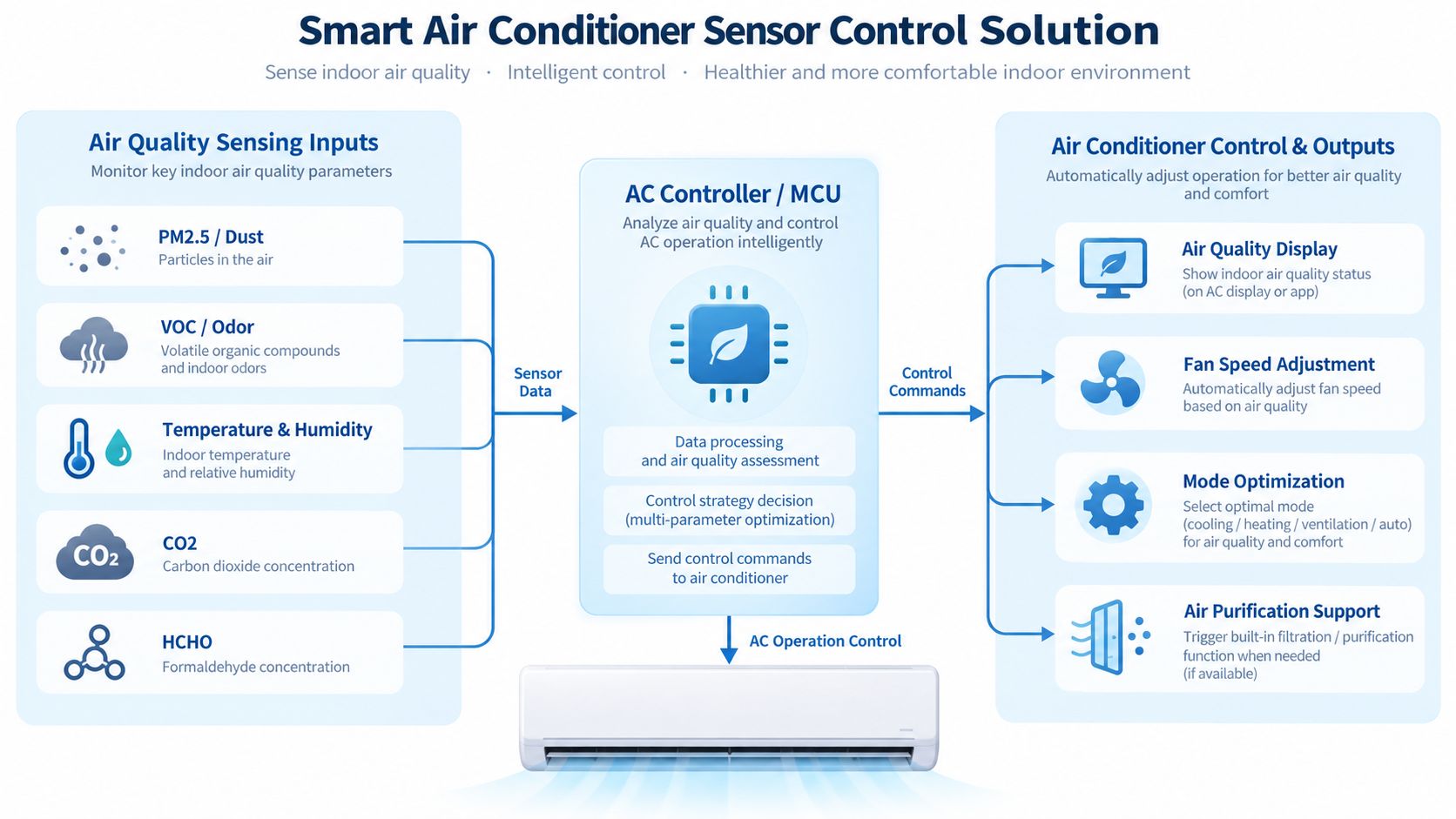
Conceptual smart air conditioner architecture showing environmental sensors AC controller air quality display fan control and optional air purification
Conceptual smart AC sensing and control architecture. Fan-speed responses, operating modes and air purification functions depend on the finished air conditioner design.
Controller responsibility: Winsen sensors provide environmental data. The AC manufacturer defines communication, display, thresholds, operating logic and system responses.
SMART AC APPLICATIONS

Sensor Configurations for Different Air Conditioner Functions

The sensing architecture can be adapted to different air conditioner product designs, from basic indoor climate monitoring to advanced air quality displays and multi-parameter sensing.

CONFIGURATION 01

Comfort-Focused Air Conditioning

Temperature and relative humidity sensing for conventional AC comfort monitoring and compatible control systems.

Suggested: ZS13A

CONFIGURATION 02

AC with PM Monitoring

Add particulate matter monitoring to an indoor AC system with an air quality indicator or display.

Suggested: ZH10-F

CONFIGURATION 03

Air Purification-Enabled Smart AC

Combine particle and gaseous air quality data with optional purification features where supported.

Suggested: ZH10-VHT

CONFIGURATION 04

Advanced Multi-Parameter Smart AC

Integrate PM2.5, CO₂, temperature/humidity and a selected HCHO or VOC sensing configuration.

Suggested: ZPHS01C

Application scope: Optional purification or fresh-air functions require matching equipment hardware and finished-device validation.
SENSOR ARCHITECTURE

Dedicated Sensors vs. Multi-in-One Modules for Air Conditioners

Smart air conditioners may use several individual sensing modules or one integrated IAQ module. The choice depends on the required parameters, available space, electrical connections and mechanical design.

Dedicated Sensor Architecture

Combine separate temperature, particle and gaseous air quality sensing modules.

  • Flexible parameter selection
  • Independent module positioning
  • Parameter-specific upgrade options
  • Different electrical output choices
  • Suitable for customized AC platforms

Example combination:
ZS13A + ZH10-F + ZP07

Multi-in-One Sensor Architecture

Use a module combining several environmental measurements within one sensing assembly.

  • Reduced number of separate modules
  • Compact module options
  • Potentially simpler host connections
  • Simplified mechanical planning
  • Suitable for integrated smart AC products

Example modules:
ZH10-VHT / ZPHS01C

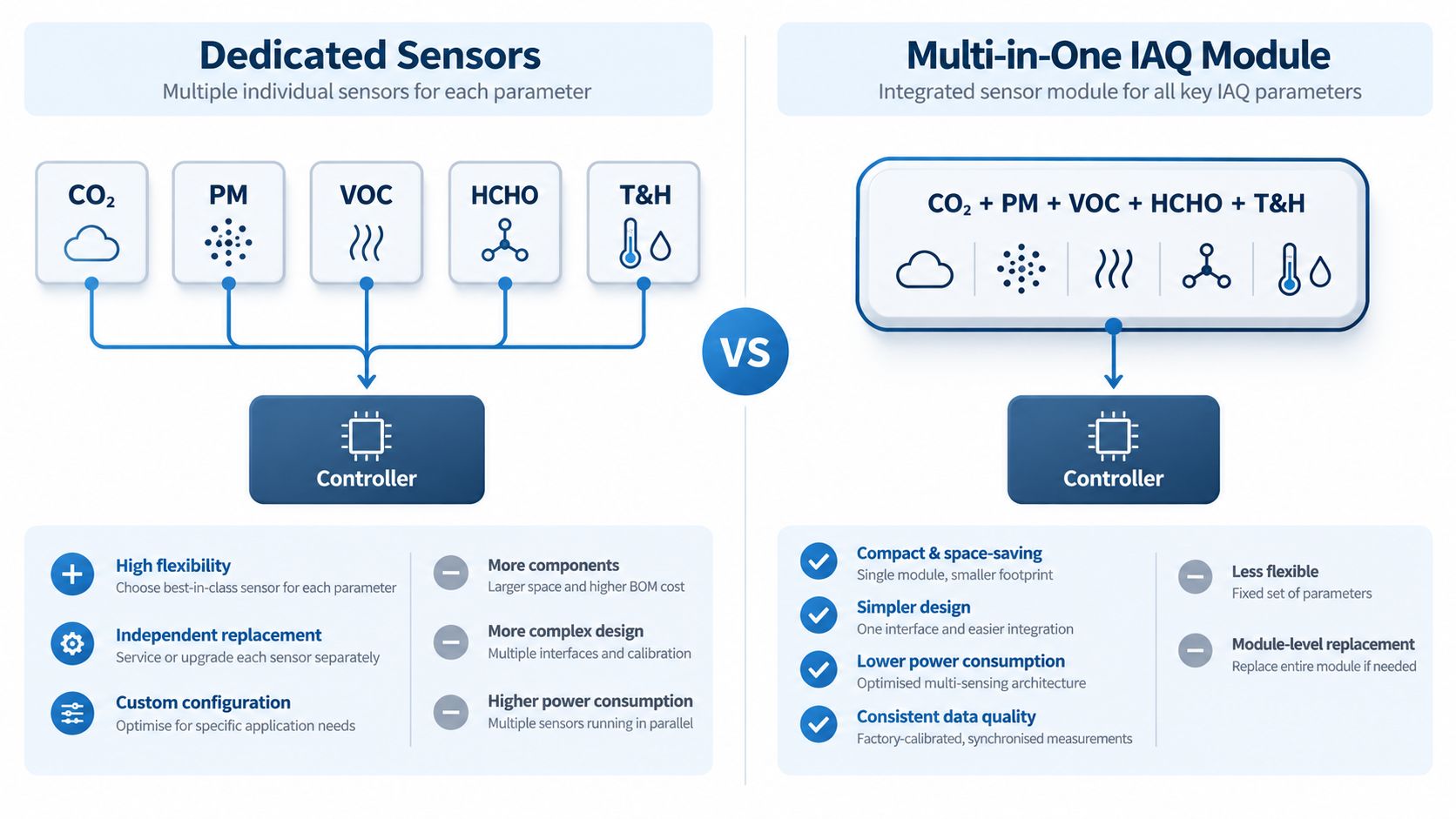
Comparison of dedicated air quality sensors and multi-in-one IAQ modules for air conditioner OEM designs
Both architectures require mechanical, electrical and environmental validation in the finished air conditioner.
FEATURED WINSEN AC SENSORS

Featured Multi-in-One Air Quality Sensors for Smart AC

Integrated air quality modules are suitable for OEM projects requiring several sensing functions in a compact assembly. Winsen offers different configurations for air conditioner development.

ZPHS01C configuration: Users select the HCHO version or the VOC version. The two sensing functions are not available simultaneously in the same standard configuration.
DEDICATED AIR CONDITIONER SENSORS

Recommended Winsen Sensors for Custom Smart AC Designs

For air conditioner manufacturers who prefer independent sensor selection, Winsen offers temperature/humidity, particulate matter, air quality, formaldehyde and CO₂ sensing modules.

TEMPERATURE & HUMIDITY Winsen ZS13A temperature and humidity sensor

ZS13A Temperature & Humidity Sensor

Digital temperature and humidity sensor for room comfort monitoring and air conditioner control electronics.

  • Target Temperature / Relative Humidity
  • Temp. -40°C to 85°C
  • Humidity 0–100% RH
  • Output I²C
LASER PARTICLE SENSOR Winsen ZH10-F laser dust sensor

ZH10-F Laser Dust Sensor

Compact laser particle sensor for PM monitoring and air quality display functions in smart air conditioners.

  • Target PM1.0 / PM2.5 / PM10
  • Range 0–1000 μg/m³
  • Principle Laser scattering
  • Output UART / PWM
AIR QUALITY LEVEL Winsen ZP07 air quality detection module

ZP07 Air Quality Detection Module

Semiconductor gas module providing graded gaseous pollution signals for AC air quality indication and compatible control functions.

  • Target Broad gaseous pollution response
  • Signal 0–3 grade pollution output
  • Principle Semiconductor
  • Output TTL level
VOC + T&H MODULE Winsen ZPS20 digital VOC temperature humidity module

ZPS20 Digital Air Quality Module

Integrated semiconductor VOC-related sensing with temperature and humidity for air conditioners and other smart appliances.

  • Target VOC-related gases, T&H
  • Range 0–10 mg/m³
  • VOC Index 0–500
  • Output I²C
FORMALDEHYDE SENSOR Winsen ZE08K-CH2O formaldehyde sensing module

ZE08K-CH2O Formaldehyde Sensor

Dedicated electrochemical HCHO sensing module for air conditioners requiring formaldehyde concentration monitoring.

  • Target Formaldehyde (HCHO)
  • Range 0–5 ppm
  • Principle Electrochemical
  • Output UART / Analog / PWM
NDIR CO₂ SENSOR Winsen MH-Z19E NDIR carbon dioxide module

MH-Z19E NDIR CO₂ Sensor

NDIR carbon dioxide module for extended indoor air quality monitoring and compatible fresh-air air conditioner designs.

  • Target CO₂
  • Range 400–10000 ppm optional
  • Principle NDIR
  • Output UART / PWM
AIR CONDITIONER OEM SELECTION

How to Choose Sensors for Different Smart Air Conditioner Designs

Start with the sensing and control functions required by the finished AC product. Then select the appropriate sensor modules based on dimensions, interfaces and equipment architecture.

AC Product Type Sensing Requirement Suggested Winsen Products OEM Consideration
Basic Split Air Conditioner Temperature and humidity monitoring ZS13A Consider internal temperature gradients, sensor position and controller compatibility.
AC with PM Monitoring PM1.0 / PM2.5 / PM10 measurement ZH10-F Evaluate sampling airflow, dust accumulation and humidity.
AC with Air Quality Level Display General gaseous pollution grading ZP07 Suitable for 0–3 grade pollution indication, not selective concentration analysis.
AC with VOC & T&H Monitoring VOC-related response, temperature, humidity ZPS20 Evaluate broad gas sensitivity, interference and environmental effects.
Compact Multi-Function Smart AC PM2.5, VOC, temperature and humidity ZH10-VHT Integrated module reduces the need for separate sensing components.
Formaldehyde Monitoring AC Dedicated HCHO measurement ZE08K-CH2O Use dedicated HCHO measurement rather than a general VOC signal.
AC with Fresh-Air Monitoring CO₂ monitoring MH-Z19E A CO₂ sensor supplies data. Outdoor-air ventilation requires appropriate equipment.
Advanced Integrated IAQ AC PM2.5, CO₂, T&H, HCHO or VOC ZPHS01C Confirm the HCHO or VOC configuration and mechanical integration.
Selection guidance: These combinations are reference configurations for OEM development. Final module selection requires confirmation of the latest datasheets and finished-device testing.
OEM INTEGRATION SUPPORT

Air Quality Sensor Integration for Air Conditioner Manufacturers

Integrating sensors into an air conditioner requires careful consideration of the actual indoor unit, control electronics, airflow and operating environment.

  • Select the required sensing parameters for the AC product.
  • Match model-specific digital or analog interfaces to the MCU.
  • Consider air sampling, internal heat sources and enclosure geometry.
  • Evaluate humidity exposure, condensation and dust accumulation.
  • Account for sensor warm-up, response and maintenance requirements.
  • Validate sensing performance in actual operating modes.
Illustrative air conditioner research and development environment for air quality sensor OEM integration
Conceptual air conditioner engineering and integration scene. It does not represent a specific Winsen customer project or product testing facility.

Representative Air Sampling

Sensor placement should reflect the intended monitored environment. Airflow near the AC unit may differ from general room conditions.

Humidity & Condensation

Indoor AC units may experience temperature gradients and high humidity. Avoid exposing sensors to condensation or conditions outside their rated limits.

Particle Sensor Maintenance

Particle sensing depends on suitable air sampling. Consider dust accumulation, inlet obstruction and appropriate maintenance in the finished product.

Electrical Integration

Confirm working voltage, logic levels, communication protocols and connector design for each selected module.

Control & Display Logic

The manufacturer defines measurement processing, air quality indicators, fan responses and optional smart control functions.

Finished-Device Validation

Verify sensor performance under realistic cooling, heating, fan speed and environmental conditions before mass production.

MORE WINSEN AIR QUALITY SOLUTIONS

Explore More Indoor Air Quality Sensor Solutions

Winsen provides sensing modules for air conditioners and a broader range of indoor air quality, HVAC and smart air purification applications.

Air conditioner manufacturers developing refrigerant leakage protection can also explore Winsen's Refrigerant Sensor Solutions for refrigerant-specific safety sensing requirements.
FREQUENTLY ASKED QUESTIONS

Air Conditioner Air Quality Sensor FAQs

Common questions about PM2.5, VOC, CO₂, formaldehyde and environmental sensing in smart air conditioners.

What air quality sensors can be integrated into smart air conditioners?

Depending on product requirements, smart air conditioners may incorporate temperature, humidity, PM2.5, VOC-related air quality, CO₂ and formaldehyde sensors. Manufacturers select the appropriate combination according to the functions of the finished unit.

How can a PM2.5 sensor be used in an air conditioner?

A PM2.5 sensor measures airborne particle concentration. The measurements may support an air quality display and compatible purification or control functions. The actual particle removal capability depends on the air conditioner's filtration or treatment hardware.

Can air conditioner VOC sensors detect indoor odors?

Some semiconductor gas sensors respond to selected gases associated with indoor odors and volatile organic compounds. They do not necessarily identify or quantify every odor-causing compound.

Can a CO₂ sensor help an air conditioner improve ventilation?

A CO₂ sensor provides carbon dioxide concentration measurements that may inform ventilation-related functions. A conventional recirculating air conditioner does not introduce outdoor air solely because it contains a CO₂ sensor.

Can VOC sensors replace formaldehyde sensors?

No, not when dedicated formaldehyde concentration measurement is required. Broad VOC sensing and electrochemical HCHO sensing have different measurement characteristics.

What is the difference between ZH10-F and ZH10-VHT?

ZH10-F focuses on particle measurements including PM1.0, PM2.5 and PM10. ZH10-VHT combines PM2.5, VOC, temperature and humidity functions within an integrated module.

Can ZPHS01C detect HCHO and VOC simultaneously?

No. Standard ZPHS01C modules are configured with either HCHO sensing or VOC sensing. These functions are not simultaneous in the same standard version.

Where should an air quality sensor be installed inside an AC unit?

The appropriate location depends on the monitored parameter, airflow, enclosure, heat sources and moisture conditions. Final positioning must be verified by the air conditioner manufacturer.

Does Winsen support customized air conditioner sensor integration?

Winsen supports model selection, interface discussions and application-level technical communication for air conditioner equipment manufacturers.

Find the Right Air Quality Sensor for Your Smart AC Project

Tell us your air conditioner application, required sensing parameters, electrical interface, module dimensions and environmental conditions. Winsen can help you evaluate suitable dedicated sensors and integrated air quality modules for your OEM project.

Leading gas sensing Solution supplier

Our Hot Products

ANY QUESTIONS?

Frequent Asked Questions

Professional manufacturer of gas sensors, global sensing solutions provider with over 30 years of experience. Top quality guarantee, Excellent service, Customized products, Fast delivery!

Reference lead times: 1-15 days after receiving deposit depending on volume. The actual lead time can be confirmed with Winsen Order Processing Dept.

Winsen will recommend the most appropriate way of transportation (express, air, sea, train, etc.) according to customer's requirement on cost and time.

T/T, Paypal, West Union, Credit Card, etc.

MOQ is different depending on product models. Please contact Winsen sales for details.

Customer LOGO and packing design are acceptable.
Customized design and function will be provided without extra charge (including molding fee).

Sample order is acceptable and the fees will be borne by buyer.

Winsen has a complete and strict flow for offline sensors: aging-reject defective-sampling inspection-issue reports-finished ingoing...outgoing.

All Winsen products go through strict inspections and tests to make sure they are 100% qualified before shipping out.

ppm: parts per million
ppb: parts per billion
VOL: volume ratio
LEL: lower explosive limit
NDIR: Non-Dispersive Infra-Red

CONTACT US

LET'S TALK

Request Consultation