
WINSEN CO₂ SENSING FOR SMART VENTILATION

CO₂ Sensor Solutions for Demand-Controlled Ventilation

Build smarter demand-controlled ventilation (DCV) systems with Winsen NDIR and photoacoustic CO₂ sensor modules. Support occupancy-responsive ventilation strategies, VAV control systems and building automation equipment with reliable environmental measurement inputs.

CO₂-Based Ventilation Demand-Controlled Ventilation NDIR / PAS CO₂ VAV & HVAC Building Automation OEM Integration
Modern office meeting room representing CO2 based demand controlled ventilation
CO₂ Monitoring

Measure indoor CO₂ concentrations to inform ventilation demand.

Responsive Ventilation

Adapt HVAC operation to changing building use and occupancy conditions.

Energy Management

Support ventilation strategies that avoid unnecessary overventilation.

OEM Integration

Choose embedded NDIR or PAS CO₂ modules for HVAC controllers.

DEMAND-CONTROLLED VENTILATION

What Is Demand-Controlled Ventilation and How Does It Work?

Demand-controlled ventilation (DCV) is a ventilation control strategy that adjusts outdoor-air delivery according to changing ventilation needs. In suitable occupied spaces, indoor CO₂ measurements can provide useful information for determining how ventilation demand changes over time.

Ventilation That Responds to Building Use

Offices, classrooms, conference rooms and multipurpose spaces may have very different occupancy levels throughout the day. A fixed ventilation schedule does not always reflect these changes.

  • Continuous measurement: CO₂ sensors provide updated concentration information.
  • Demand evaluation: the controller interprets the readings together with building operating conditions.
  • Airflow adjustment: the HVAC system can regulate ventilation within its programmed limits.
  • Ongoing feedback: subsequent measurements help evaluate the control response.
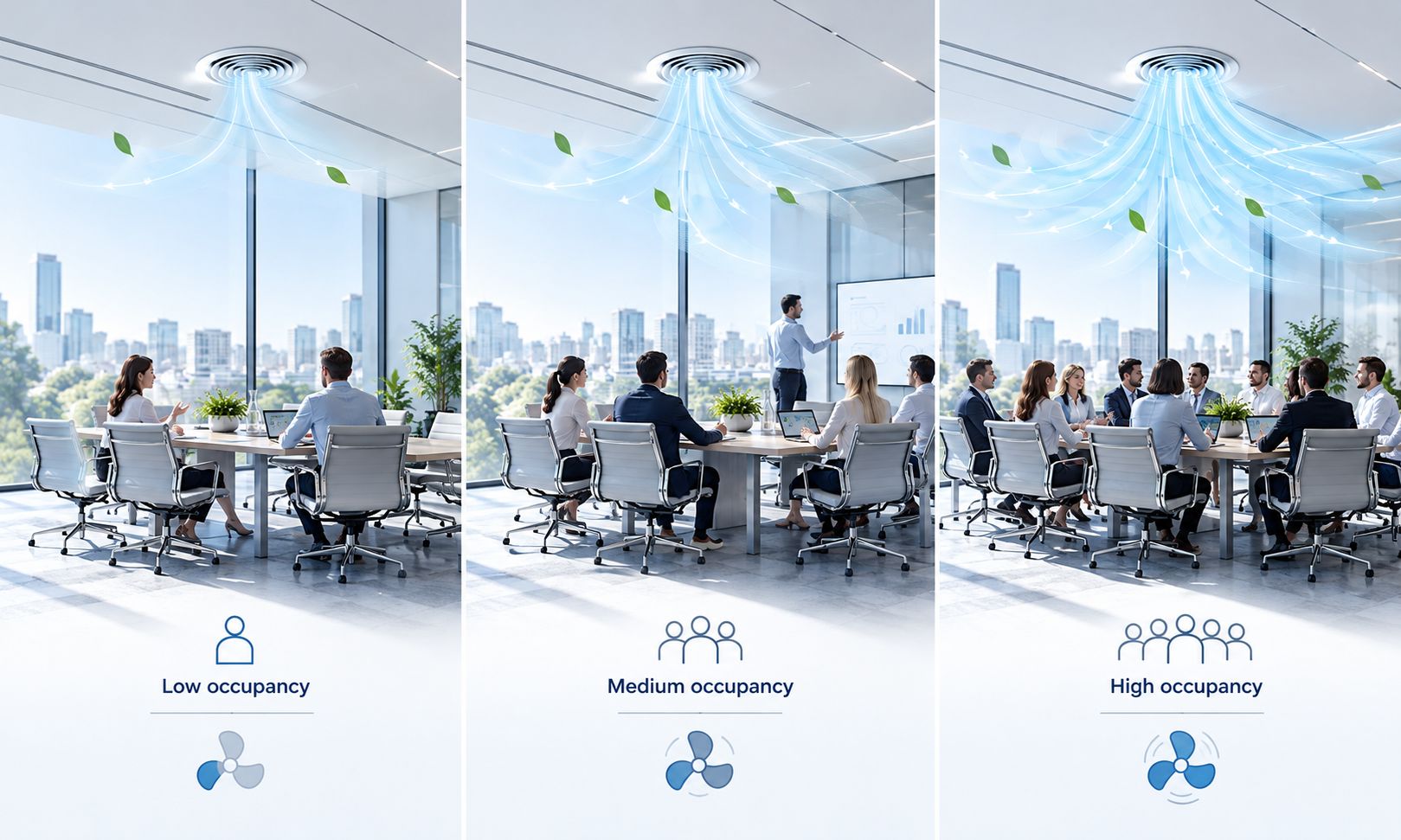
Illustrative comparison of changing occupancy and ventilation demand in office meeting rooms
Conceptual illustration of changing occupancy and ventilation needs. Actual airflow requirements must be calculated according to the applicable building design criteria.
Important distinction: CO₂ concentration can be used as an indirect indicator of ventilation demand in certain occupied environments. A CO₂ sensor does not directly count people or measure every indoor air pollutant.
CO₂-BASED VENTILATION CONTROL

Why CO₂ Sensors Are Important for DCV Systems

CO₂ sensors provide a continuously measurable input that can be used in occupancy-responsive ventilation algorithms. For equipment manufacturers, sensor stability, measurement range, response characteristics and electrical integration are important selection factors.

01

Ventilation Demand Information

CO₂ levels can reflect the balance between indoor CO₂ generation and outdoor-air ventilation under suitable operating conditions.

02

Measurement Stability

Consistent CO₂ measurement supports repeatable control decisions over changing operating conditions.

03

Controller Compatibility

Embedded CO₂ modules provide digital or model-specific outputs for integration into HVAC electronics.

04

Environmental Compensation

Temperature-related effects and other operating conditions should be considered during sensor and controller design.

05

Long-Term Operation

Sensor calibration, drift management and maintenance planning help support dependable long-term ventilation monitoring.

06

Flexible Sensor Technology

Winsen provides both NDIR and photoacoustic CO₂ options for different embedded HVAC monitoring designs.

DCV SYSTEM ARCHITECTURE

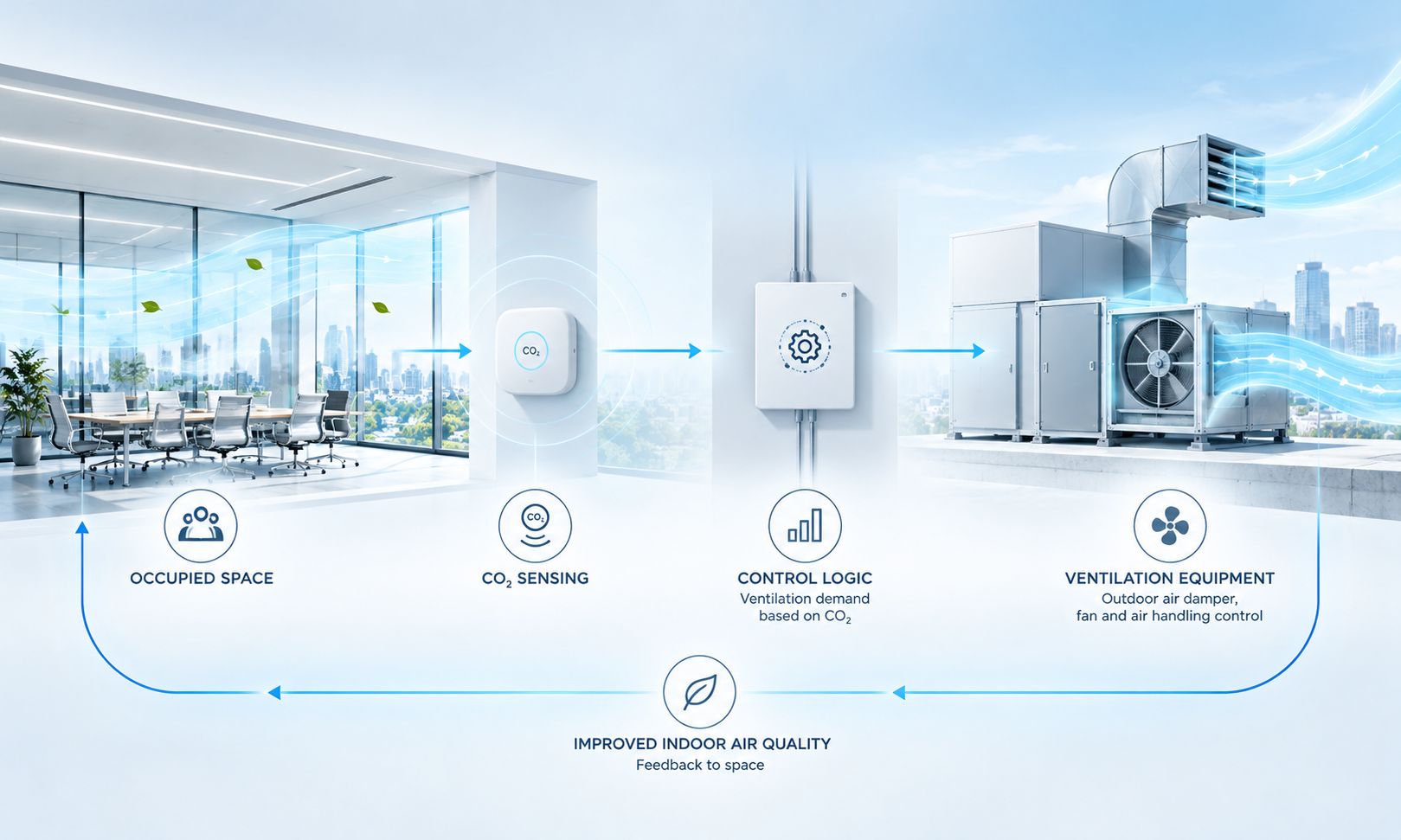
CO₂-Based Demand-Controlled Ventilation Architecture

Winsen CO₂ sensor modules provide concentration measurements to the host controller. The HVAC manufacturer or system integrator defines control algorithms and how ventilation equipment responds to changing measured conditions.

STEP 01

CO₂ Measurement

The sensor measures indoor CO₂ concentration at the designated sampling location.

STEP 02

Controller Processing

The controller evaluates concentration changes against the programmed ventilation strategy.

STEP 03

Ventilation Adjustment

The HVAC system adjusts compatible fans, outdoor-air dampers or airflow control equipment as designed.

STEP 04

Continuous Monitoring

Updated measurements provide feedback for ongoing control and system monitoring.

CO2 sensing controller ventilation equipment and feedback architecture for demand controlled ventilation
Conceptual CO₂-based ventilation control architecture. Actual sensor placement, airflow control, controller interfaces and operating limits must be validated for each HVAC system.
Building Management System (BMS) integration: Winsen's embedded CO₂ modules provide model-specific electrical outputs. Where BACnet, Modbus or other building automation protocols are required, the HVAC controller or a compatible gateway provides the appropriate interface.
VENTILATION CONTROL STRATEGY

Constant Ventilation vs. Demand-Controlled Ventilation

Conventional fixed-airflow operation and demand-controlled ventilation use different control strategies. DCV can help reduce unnecessary ventilation when demand is lower, while still requiring the system to meet its applicable outdoor-air and indoor environmental requirements.

Fixed Ventilation Operation

Ventilation may operate at a predefined airflow or according to a fixed operating schedule.

  • Predetermined operating airflow
  • Simple controller requirements
  • Limited response to changing occupancy
  • Potential overventilation during low-demand periods
  • Actual performance depends on system design

Demand-Controlled Ventilation

Ventilation airflow is adjusted according to suitable demand indicators and programmed building control requirements.

  • CO₂ concentration as a possible control input
  • Responsive operation as building use changes
  • Potential reduction of unnecessary air treatment
  • Requires properly designed control algorithms
  • Must maintain applicable minimum ventilation
Energy-saving consideration: Actual energy savings depend on climate, occupancy patterns, system type, outdoor-air requirements and control configuration. No fixed energy-saving percentage is assumed for this solution.
WINSEN CO₂ SENSOR PORTFOLIO

Recommended Winsen CO₂ Sensors for Demand-Controlled Ventilation

Winsen offers NDIR and photoacoustic CO₂ sensor modules for embedded indoor environmental monitoring and ventilation controller applications. Select the appropriate module according to range, size, electrical interface and system requirements.

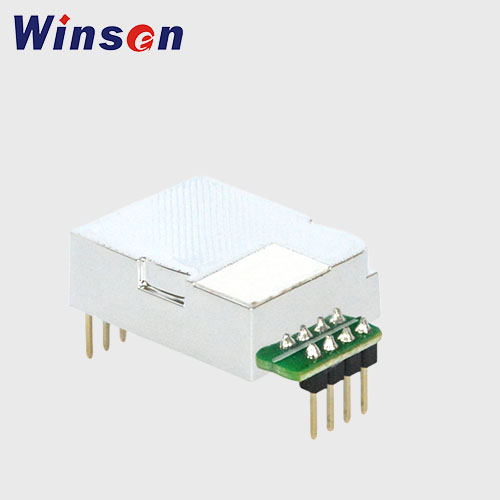
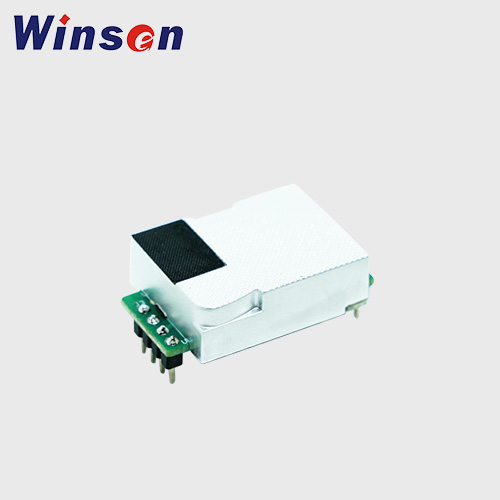
NDIR CO₂ MODULE Winsen MH-Z1911A NDIR carbon dioxide sensor module

MH-Z1911A NDIR CO₂ Sensor

Compact NDIR CO₂ module for indoor environmental monitoring, HVAC controllers and ventilation demand sensing applications.

  • Target Carbon dioxide (CO₂)
  • Range 400–10000 ppm optional
  • Principle NDIR
  • Output UART / PWM
  • Size 32.9 × 19.7 × 8.6 mm
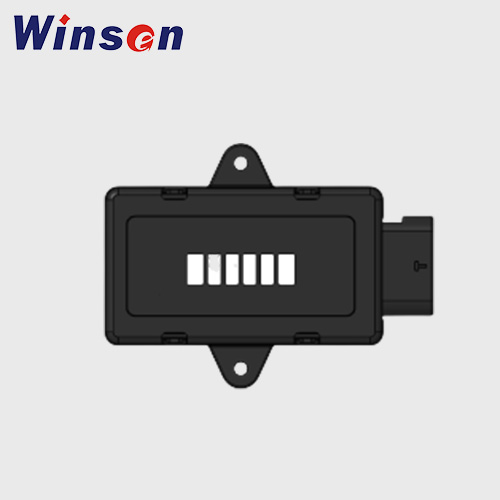
NDIR CO₂ MODULE Winsen MH-Z19E infrared CO2 sensor module

MH-Z19E NDIR CO₂ Sensor

NDIR carbon dioxide sensor with temperature compensation and UART/PWM output options for ventilation and HVAC monitoring equipment.

  • Target Carbon dioxide (CO₂)
  • Range 400–10000 ppm optional
  • Principle NDIR
  • Output UART / PWM
  • Size 32.9 × 19.7 × 8.6 mm
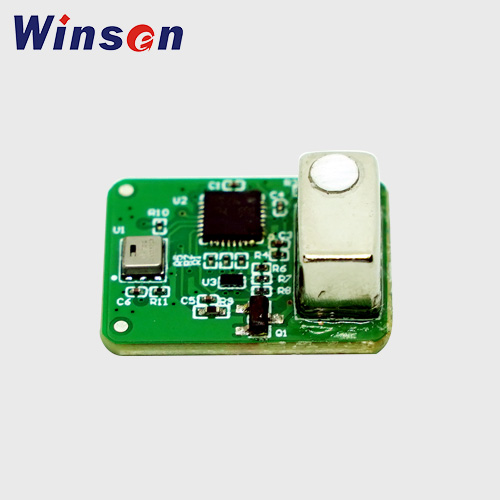
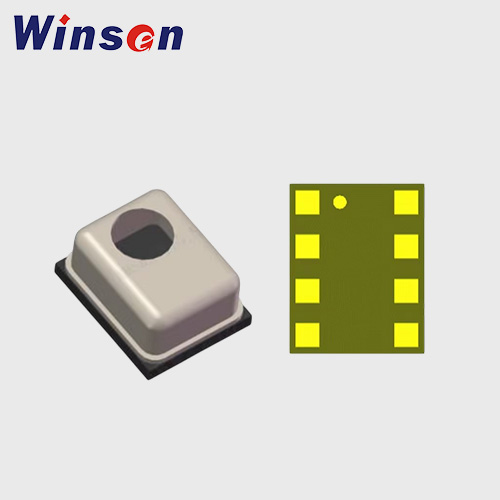
PHOTOACOUSTIC CO₂ Winsen H101-CO2-Z8S-U-40kP photoacoustic PAS carbon dioxide sensor

PAS CO₂ Sensor

H101-CO2-Z8S-U-40kP photoacoustic CO₂ sensor for compact embedded environmental monitoring and ventilation controller designs.

  • Target Carbon dioxide (CO₂)
  • Range 400–5000 ppm; expandable to 40000 ppm
  • Principle Photoacoustic (PAS)
  • Output UART (TTL 3.3 V)
  • Size 20 × 15 × 7.8 mm
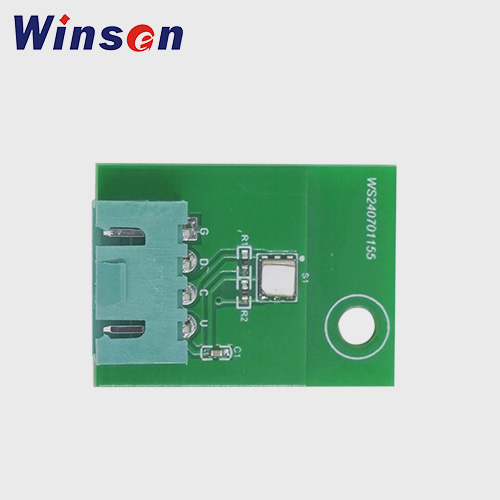
Winsen ZS13A temperature and humidity sensor module
AUXILIARY ENVIRONMENTAL SENSING

ZS13A Temperature & Humidity Sensor

DCV equipment may also require temperature and relative humidity measurements for indoor climate monitoring or other HVAC control functions. ZS13A offers calibrated digital temperature and humidity sensing with a standard I²C output.

Temperature: -40°C to 85°C Humidity: 0–100% RH I²C Digital Output HVAC / Room Monitoring
Alternative models: MH-Z19C is another NDIR CO₂ option, while ZS21 provides an additional digital temperature and humidity sensing option. Please confirm current model availability and the latest documentation before final selection.
CO₂ SENSOR SELECTION

NDIR vs. Photoacoustic CO₂ Sensors for DCV Applications

Both non-dispersive infrared (NDIR) and photoacoustic sensing (PAS) can be used for CO₂ measurement. The choice should be based on actual module specifications and the requirements of the target HVAC product.

Selection Item MH-Z1911A MH-Z19E PAS CO₂
Detection Principle NDIR NDIR Photoacoustic (PAS)
Target CO₂ CO₂ CO₂
Detection Range 400–10000 ppm optional 400–10000 ppm optional 400–5000 ppm, expandable to 40000 ppm
Output UART / PWM UART / PWM UART (TTL 3.3 V)
Dimensions 32.9 × 19.7 × 8.6 mm 32.9 × 19.7 × 8.6 mm 20 × 15 × 7.8 mm
Typical Selection Direction Embedded HVAC and room CO₂ monitoring HVAC and ventilation controller platforms Compact CO₂ monitoring electronics
Product Details View MH-Z1911A → View MH-Z19E → View PAS CO₂ →
Selection guidance: Different measurement principles should not be ranked by principle alone. Compare the latest datasheets for measurement accuracy, response, calibration, environmental limits, power requirements and lifecycle performance under your actual application conditions.
TYPICAL DCV APPLICATIONS

CO₂-Based Ventilation Monitoring for Variable-Occupancy Spaces

Demand-controlled ventilation is particularly relevant where occupancy and ventilation requirements change during the day. Winsen CO₂ modules can be evaluated as sensing components within suitable HVAC and building automation products.

Conference & Meeting Rooms

CO₂ monitoring provides data for ventilation strategies in spaces with intermittent and changing occupancy.

Commercial Office Buildings

Integrate CO₂ sensing into office HVAC control equipment for ventilation demand evaluation.

Schools & Classrooms

Indoor CO₂ monitoring can support classroom ventilation control, subject to applicable building requirements.

Training Rooms

Monitor CO₂ in spaces with scheduled sessions and varying occupancy throughout the day.

Auditoriums & Public Spaces

Environmental sensing can provide useful inputs for ventilation control where building occupancy varies.

VAV & HVAC Controllers

Integrate embedded CO₂ sensors into control electronics for compatible variable-air-volume and building ventilation systems.

OEM ENGINEERING SUPPORT

CO₂ Sensor Integration for DCV and HVAC Controllers

Developing a CO₂-based ventilation controller involves sensor selection, signal processing, environmental measurement and appropriate HVAC control design.

  • Select the CO₂ sensor according to target range and measurement requirements.
  • Match sensor voltage, output and logic level to the controller electronics.
  • Evaluate sensor response and signal processing within the ventilation strategy.
  • Consider measurement location, temperature, humidity and calibration conditions.
  • Define controller handling for invalid measurements or sensor communication faults.
  • Validate ventilation operation against the applicable building design requirements.
Conceptual engineering workspace for HVAC CO2 sensing and demand controlled ventilation controller integration
Illustrative HVAC controller development environment. Any equipment shown is conceptual and does not represent a specific Winsen product or customer project.

Representative CO₂ Measurement

Select a sampling location that represents the intended monitored zone. Avoid assuming that every duct or room position provides identical readings.

Outdoor CO₂ Background

Indoor CO₂ interpretation may require consideration of outdoor background concentration and changes in building operating conditions.

Sensor Startup & Response

Consider warm-up time, measurement response and signal filtering when implementing controller algorithms.

Calibration & Drift

Follow model-specific calibration recommendations and consider the actual exposure environment throughout the product lifetime.

Minimum Ventilation

Demand-controlled operation must maintain the applicable ventilation requirements even during periods of low measured demand.

System Fault Handling

Define suitable responses to sensor faults, communication interruptions and abnormal measurements at the equipment-controller level.

About CO₂ thresholds: A fixed indoor CO₂ level such as 1000 ppm should not be presented as a universal compliance threshold for all buildings. Control setpoints should follow the relevant ventilation design and applicable requirements.
WINSEN INDOOR AIR QUALITY SOLUTIONS

Explore More Environmental Sensing Solutions

Winsen provides sensors for CO₂-based ventilation control and a wider range of HVAC, fresh-air and indoor air quality monitoring applications.

Compare additional CO₂ module options in Winsen's CO₂ Sensor Selection Guide .
FREQUENTLY ASKED QUESTIONS

Demand-Controlled Ventilation Sensor FAQs

Common questions about CO₂-based ventilation control, NDIR and photoacoustic sensors, VAV applications and HVAC OEM integration.

What is demand-controlled ventilation (DCV)?

Demand-controlled ventilation is a control strategy that adjusts outdoor-air ventilation according to changing demand. CO₂ concentration is one possible input for occupancy-responsive ventilation strategies.

Why are CO₂ sensors used in demand-controlled ventilation?

CO₂ measurements can provide useful information about changes in ventilation demand in occupied spaces. A compatible controller interprets these measurements together with other system and building inputs.

Can a CO₂ sensor directly measure occupancy?

No. A CO₂ sensor measures carbon dioxide concentration, not the exact number of occupants. CO₂ measurements may be used to infer changes in ventilation demand under suitable conditions.

Is 1000 ppm CO₂ a universal ventilation limit?

No. A single CO₂ concentration value does not determine ventilation compliance for every building. The relevant ventilation requirements and control criteria depend on building use and design.

What is the difference between NDIR and photoacoustic CO₂ sensors?

NDIR sensors use infrared absorption to measure CO₂, while photoacoustic sensors detect an acoustic response associated with absorbed modulated light. Model selection should consider the required range, size, output and overall measurement specifications.

Can Winsen CO₂ modules connect directly to a BMS?

Winsen's embedded CO₂ modules provide model-specific electrical interfaces. Building Management System communication may be implemented through a compatible HVAC controller or gateway. Native BACnet or Modbus should not be assumed for the sensor module.

Can CO₂ sensors be used in VAV HVAC systems?

CO₂ measurements can serve as inputs to compatible Variable Air Volume (VAV) and HVAC control strategies. The VAV system controller implements airflow regulation and required ventilation limits.

Does DCV always reduce ventilation energy use?

DCV may reduce unnecessary ventilation and associated conditioning loads when appropriately designed. Actual energy performance depends on occupancy patterns, climate, system operation and required outdoor-air rates.

Does Winsen support CO₂ sensor integration for HVAC OEMs?

Winsen provides NDIR and photoacoustic CO₂ sensor modules and supports model selection, electrical interface discussions and application-level technical communication for equipment manufacturers.

Find the Right CO₂ Sensor for Your DCV Project

Tell us your HVAC or ventilation controller application, required CO₂ measurement range, module dimensions, electrical interface and operating conditions. Winsen can help evaluate suitable NDIR and PAS CO₂ sensor options for your OEM development project.

Leading gas sensing Solution supplier

Our Hot Products

ANY QUESTIONS?

Frequent Asked Questions

Professional manufacturer of gas sensors, global sensing solutions provider with over 30 years of experience. Top quality guarantee, Excellent service, Customized products, Fast delivery!

Reference lead times: 1-15 days after receiving deposit depending on volume. The actual lead time can be confirmed with Winsen Order Processing Dept.

Winsen will recommend the most appropriate way of transportation (express, air, sea, train, etc.) according to customer's requirement on cost and time.

T/T, Paypal, West Union, Credit Card, etc.

MOQ is different depending on product models. Please contact Winsen sales for details.

Customer LOGO and packing design are acceptable.
Customized design and function will be provided without extra charge (including molding fee).

Sample order is acceptable and the fees will be borne by buyer.

Winsen has a complete and strict flow for offline sensors: aging-reject defective-sampling inspection-issue reports-finished ingoing...outgoing.

All Winsen products go through strict inspections and tests to make sure they are 100% qualified before shipping out.

ppm: parts per million
ppb: parts per billion
VOL: volume ratio
LEL: lower explosive limit
NDIR: Non-Dispersive Infra-Red

CONTACT US

LET'S TALK

Request Consultation