Winsen Showcases Automotive Sensor Solutions at SAECCE 2026
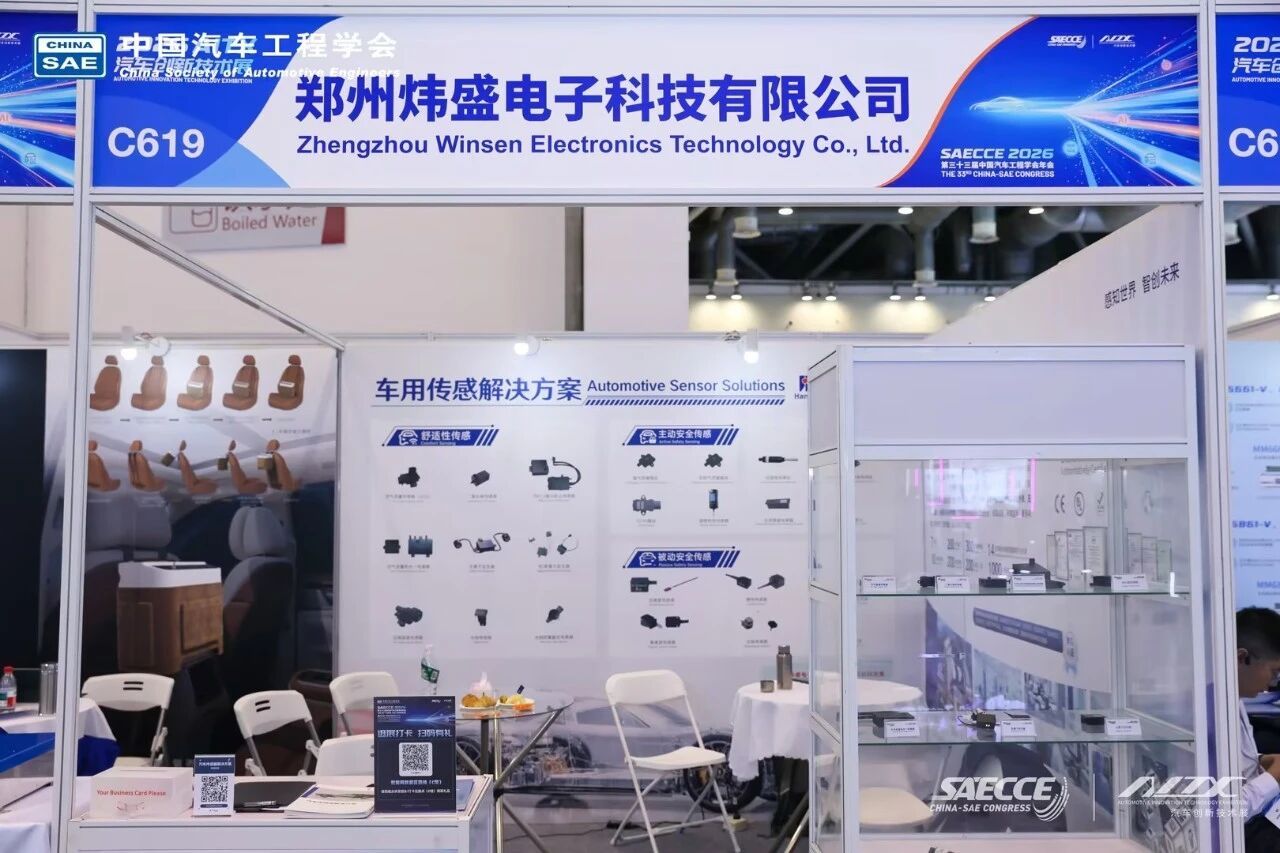
From October 28 to 30, 2026, the 33rd China SAE Congress & Exhibition (SAECCE 2026), organized by the Society of Automotive Engineers of China, was held at the Suzhou International Expo Centre.
As a provider of sensor solutions, Winsen showcased its automotive sensor portfolio at Booth C619, highlighting sensing technologies and products for smart cabin air quality, active and passive vehicle safety, electric vehicle (EV) battery safety, and thermal management.
During the exhibition, we connected with automotive manufacturers, component suppliers, and industry professionals to exchange insights on emerging vehicle technologies and discuss how advanced sensing solutions can support safer, smarter, and more comfortable vehicles.
1. Automotive Sensors for a More Intelligent and Safer Driving Experience
As the automotive industry continues to evolve toward electrification, intelligence, and connectivity, sensors are becoming increasingly important across vehicle systems.
Beyond traditional engine and environmental monitoring, automotive sensing now extends to cabin air quality, passenger comfort, battery safety, gas leakage detection, thermal management, and intelligent vehicle functions.
At SAECCE 2026, we presented a portfolio covering multiple automotive application areas, demonstrating how different sensing technologies can address specific requirements throughout the vehicle.
Our automotive sensor portfolio focuses on three major directions:
- Comfort Sensing: Monitoring cabin air quality and environmental conditions to support a healthier and more comfortable driving experience.
- Active Safety Sensing: Detecting potential hazards such as hydrogen, combustible gas, refrigerant, and other safety-related conditions.
- Passive and Intelligent Sensing: Supporting vehicle functions through acceleration, inertial, displacement, rain, light, and in-cabin presence sensing.
By combining different sensing technologies and product configurations, we aim to provide automotive customers with more flexible options for system development and integration.
2. Smart Cabin Air Quality and Comfort Sensing
A comfortable driving environment depends on more than temperature control. Air quality, carbon dioxide concentration, particulate matter, volatile organic compounds (VOCs), and odor-related conditions can all influence the in-cabin environment.
As smart cockpits and intelligent HVAC systems continue to develop, automotive manufacturers are placing greater emphasis on integrated air quality monitoring.
Winsen provides automotive sensing products for several key cabin monitoring requirements:
- Air Quality Monitoring: Detection of selected gaseous pollutants to support intelligent air quality management.
- CO₂ Monitoring: Measurement of carbon dioxide concentration for cabin ventilation and HVAC control.
- PM2.5 Detection: Monitoring of particulate matter to support cabin air purification systems.
- VOC and Odor Monitoring: Detection of selected volatile compounds and odor-related gases.
- Temperature and Humidity Monitoring: Providing environmental information for cabin comfort management.
- Ion Generation: Supporting automotive air purification and cabin comfort applications.
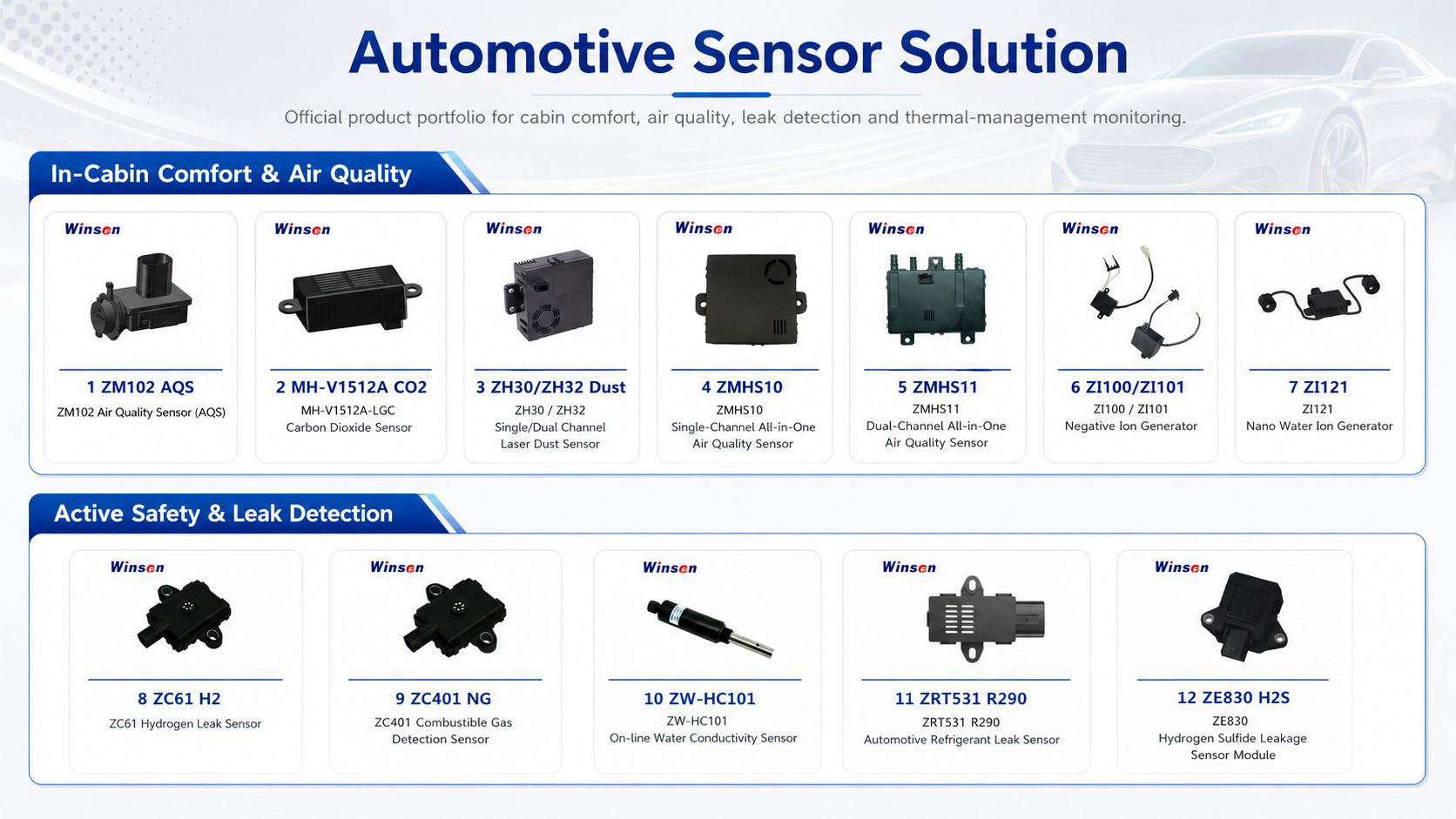
Our product portfolio includes the ZM102 Air Quality Sensor, MH-V1512A-LGC Carbon Dioxide Sensor, ZH30/ZH32 Laser Dust Sensors, and ZMHS10/ZMHS11 All-in-One Air Quality Sensors.
For OEM projects, distributed sensing modules and integrated multi-in-one solutions offer different approaches to system design. Separate sensors can provide flexibility in placement and detection targets, while integrated modules can help reduce wiring complexity, save installation space, and simplify system integration.
Explore our Automotive Sensor Product Range for more information about available cabin air quality sensing products.
3. EV Battery Safety and Early Warning Sensing
Battery safety is a critical consideration in the development of electric vehicles and advanced energy systems.
Abnormal battery conditions may be accompanied by changes in temperature and the release of gases, aerosols, or smoke. Monitoring relevant indicators can provide additional information for battery safety management and early warning system design.
Winsen's automotive sensor solutions cover several battery safety monitoring directions, including:
- Battery thermal runaway-related monitoring
- Aerosol and smoke detection
- Hydrogen leakage detection
- Hydrogen sulfide (H₂S) monitoring
- Multi-parameter environmental sensing
Different sensing technologies can contribute complementary information to a battery monitoring system. The selection of detection targets and sensor configurations should be based on battery chemistry, system architecture, installation conditions, and the specific safety requirements of the application.
As battery technologies continue to evolve, including the development of solid-state batteries, reliable gas and environmental monitoring will remain an important consideration for automotive safety engineering.
Our goal is to support automotive customers in exploring suitable sensing configurations for battery systems and related safety applications.
4. Hydrogen, Combustible Gas and Refrigerant Leak Detection
Gas leakage monitoring is another important part of automotive safety, particularly as hydrogen fuel cell vehicles, gas-fueled vehicles, and advanced thermal management systems continue to develop.
Different vehicle systems involve different target gases and operating environments. Sensor selection therefore needs to consider the gas being monitored, expected concentration range, installation location, and system integration requirements.
Winsen provides sensing products for several automotive gas safety applications:
Hydrogen Leak Detection
Hydrogen leakage monitoring is important for fuel cell vehicles and hydrogen-related vehicle systems. The ZC61 Hydrogen Leak Sensor is designed for hydrogen detection applications.
Combustible Gas Detection
For vehicles using natural gas or other combustible fuels, gas leakage monitoring can support vehicle safety system design. The ZC401 Combustible Gas Detection Sensor addresses applications involving natural gas, liquefied gas, coal gas, alkanes, and other flammable gases.
Automotive Refrigerant Leak Detection
Refrigerant leakage monitoring is relevant to vehicle thermal management and air conditioning systems. The ZRT531 R290 Automotive Refrigerant Leak Sensor supports R290 detection applications.
Hydrogen Sulfide Monitoring
H₂S monitoring is another relevant sensing direction in automotive and battery-related safety applications. Winsen's ZE830 Hydrogen Sulfide Leakage Sensor Module provides an option for H₂S monitoring.
These sensing solutions can be selected according to the target gas and vehicle application, helping OEMs develop monitoring systems that address specific safety requirements.
5. Thermal Management and Intelligent Vehicle Sensing
Automotive sensing extends beyond air quality and gas detection. Thermal management, environmental perception, and intelligent vehicle functions also rely on accurate sensor information.
For electric vehicles, cooling system monitoring is an important part of thermal management. Winsen's ZW-HC101 On-line Water Conductivity Sensor is designed for coolant conductivity monitoring, providing information that can support cooling system management.
Our automotive sensing portfolio also covers intelligent vehicle applications, including:
- Rain and Light Detection: Supporting automatic lighting and weather-related vehicle functions.
- In-Cabin Presence Sensing: Supporting life-form and presence detection applications.
- Anti-Intrusion Sensing: Providing sensing capabilities for vehicle interior monitoring.
- Acceleration and Inertial Sensing: Supporting vehicle motion and safety-related monitoring.
- Displacement and Seat-Belt Tension Sensing: Addressing selected passive safety sensing requirements.
These application directions demonstrate the expanding role of sensors in modern vehicles. From cabin comfort to vehicle dynamics and safety-related functions, sensing technologies help provide information for intelligent vehicle systems.
6. Supporting Automotive OEMs with Application-Oriented Sensor Solutions
Automotive sensor development requires more than selecting a detection principle. Product dimensions, installation positions, target parameters, environmental conditions, communication interfaces, and system architecture all influence the final solution.
At Winsen, we work across different sensing technologies and automotive application areas to support customers in identifying suitable products for their projects.
Our automotive product portfolio includes different sensing principles and configurations, with selected products supporting communication or output options such as LIN, CAN, PWM, and analog signals.
For OEM and Tier 1 projects, the appropriate product configuration should be evaluated according to the specific vehicle platform and integration requirements.
Whether the application involves smart cabin air quality monitoring, EV battery safety, hydrogen leakage detection, refrigerant monitoring, or thermal management, our team is ready to discuss product selection and application requirements with automotive partners.
Explore our Automotive Sensor Solutions to learn more about application scenarios and sensing configurations.
Moving Forward with Automotive Sensing Innovation
SAECCE 2026 provided a valuable opportunity for us to connect with automotive industry professionals, present our sensing solutions, and exchange ideas on the future of intelligent vehicle development.
The conversations at Booth C619 reflected the growing demand for reliable sensing technologies across smart cabins, electrified powertrains, battery safety, and vehicle environmental monitoring.
Looking ahead, Winsen will continue to strengthen its automotive sensing capabilities, advance product development, and work closely with industry partners to address evolving vehicle application requirements.
From healthier cabins to safer battery systems and smarter vehicle functions, Winsen is committed to making sensing technology an integral part of the future of mobility.
Interested in automotive sensor integration or OEM cooperation?
Visit our Automotive Sensor Product Range or Automotive Sensor Solutions to explore our products and application capabilities.