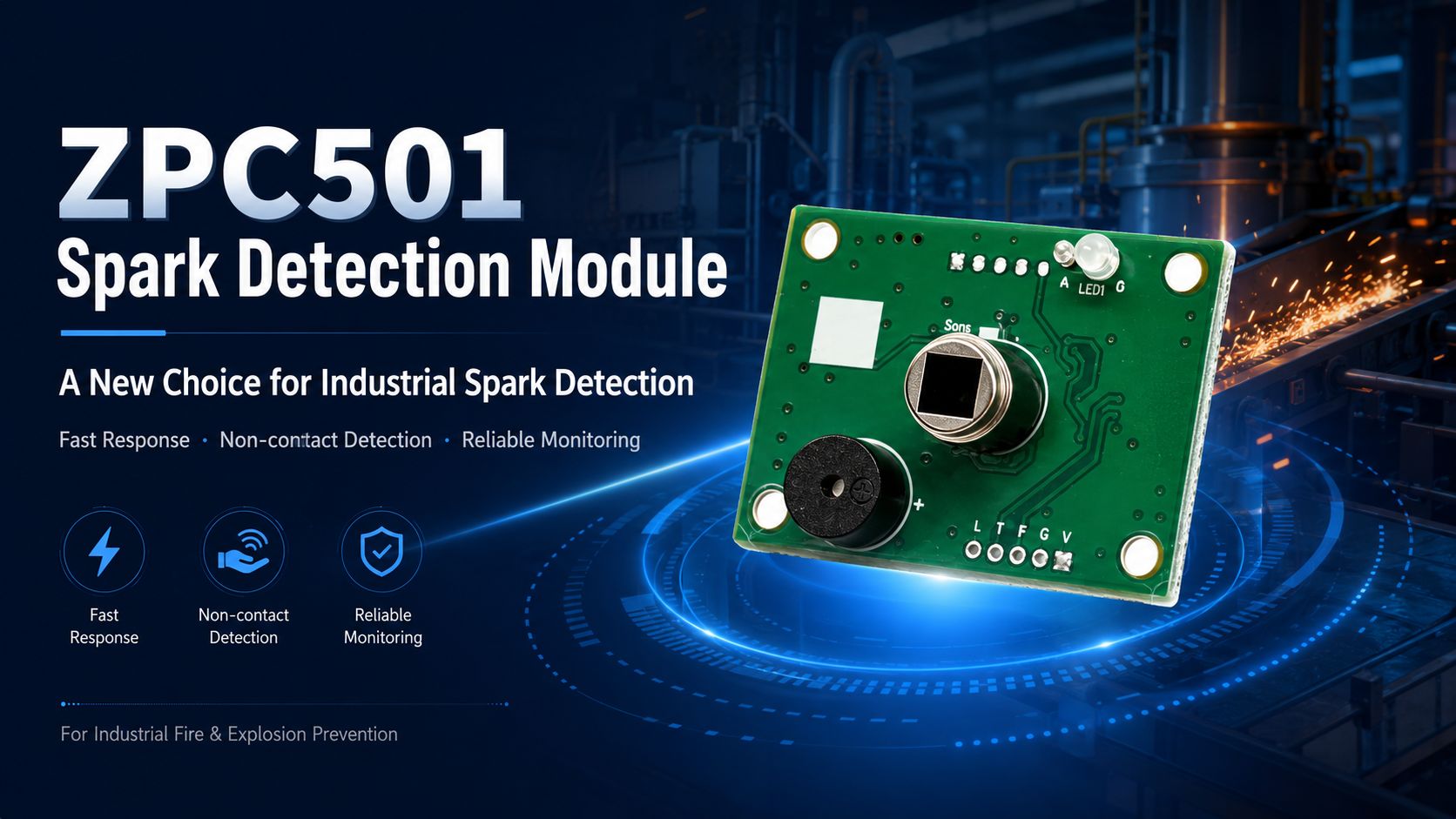
ZPC501 Spark Detection Module: A New Solution for Industrial Fire and Explosion Prevention
A spark that is almost invisible to the human eye can become the starting point of a serious industrial fire or dust explosion.
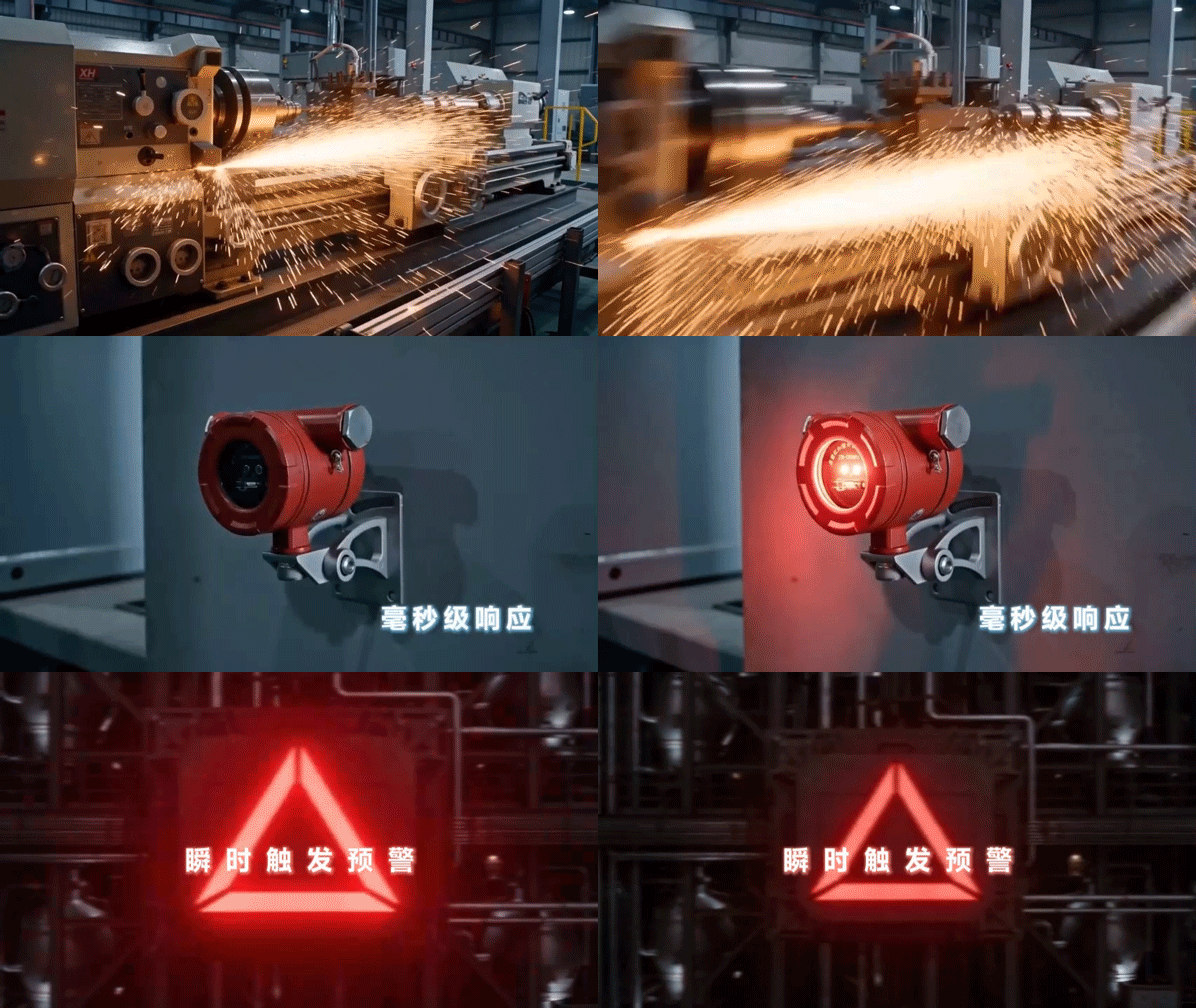
Metal cutting, welding, grinding, equipment friction and electrostatic discharge can all generate high-temperature particles or sparks during normal production. When these ignition sources enter environments containing wood dust, grain dust, chemical powders, textile fibers or other combustible materials, they may trigger rapid combustion, fire propagation or explosion.
For this reason, spark detection is becoming an important preventive layer in modern industrial safety systems.
To support equipment manufacturers and system integrators with a more flexible and locally supported sensing solution, Winsen has introduced the ZPC501 spark detection series, available as both a core sensor and an integrated detection module.
The ZPC501 is designed to help industrial systems identify spark radiation rapidly, enabling earlier warning and faster protective action before an ignition source reaches a high-risk area.
Why Industrial Spark Detection Matters
Industrial fires do not always begin with visible flames.
In many material-processing and conveying systems, small hot particles may travel at high speed through:
- pneumatic conveying pipes;
- dust extraction ducts;
- production lines;
- material transfer channels;
- filtration systems;
- silos and storage equipment.
These sparks may originate from:
- cutting and grinding processes;
- damaged bearings;
- metal impact;
- friction between mechanical components;
- static discharge;
- overheated equipment;
- foreign metal objects entering production machinery.
The spark itself may be small, but the surrounding combustible material can amplify the risk dramatically.
Wood dust, flour, grain particles, coal dust, textile fibers and chemical powders often have large surface areas and can ignite quickly when dispersed in air. If an ignition source reaches a dust collector, filter, silo or enclosed conveying system, the result may be a fast-spreading fire or secondary explosion.
Spark detection helps move safety protection further upstream—from reacting to an established fire to identifying the ignition source at an earlier stage.
From Fire Alarm to Early Risk Prevention
Traditional fire detection systems often respond after smoke, heat or visible flame has already developed.
Spark detection focuses on an earlier stage.
A properly integrated spark detection system can identify hot particles or spark radiation inside a production or conveying line and send a warning signal to the control system. Depending on the overall system design, this signal may be used to activate:
- alarms;
- extinguishing devices;
- diversion gates;
- material shutoff systems;
- ventilation controls;
- emergency equipment shutdown;
- remote monitoring platforms.
The earlier the ignition source is detected, the more time the protection system has to prevent it from reaching downstream combustible material.
This makes spark detection especially valuable in continuous production environments where material moves quickly and manual inspection cannot provide real-time coverage.
How Photoelectric Spark Detection Works
Sparks release characteristic optical radiation while they form and move through the detection area.
Photoelectric spark detection technology continuously monitors the target region and converts this optical radiation—particularly infrared radiation—into an electrical signal.
The basic process includes four stages:
- A spark enters the monitored area.
- The optical sensing element receives the spark radiation.
- The photoelectric material converts the light signal into an electrical signal.
- The internal circuit and recognition algorithm determine whether a valid spark event has occurred.
This non-contact sensing method is especially suitable for detecting fast-moving ignition particles in industrial ducts and material-handling systems.
Compared with visual inspection or slower indirect detection methods, photoelectric spark sensing provides several important advantages:
- rapid response;
- non-contact detection;
- high sensitivity;
- suitability for fast-moving targets;
- continuous online monitoring;
- easier integration into automated safety systems.
Introducing the Winsen ZPC501 Spark Detection Series
The ZPC501 series is developed for industrial spark detection and fire-risk prevention applications.
Based on Winsen’s experience in photoelectric sensing technology, the series provides customers with two flexible product forms:
- core spark detection sensor;
- integrated spark detection module.
This enables customers at different development stages to select the solution that best matches their electronics capability, mechanical structure and system-integration requirements.
The core sensor is suitable for manufacturers developing their own signal-processing and control systems.
The module solution is designed to simplify integration by combining the sensing element with the required detection and signal-processing functions.
A More Flexible Localized Supply Solution
Industrial safety equipment manufacturers often face challenges when relying heavily on imported sensing components, including:
- higher procurement costs;
- long delivery cycles;
- limited customization;
- slower technical communication;
- supply-chain uncertainty;
- difficulty adapting the product to local equipment structures.
The ZPC501 series is supported by an independently developed technology and manufacturing platform. From core component development to product production, the supply chain is more controllable, helping customers shorten development and delivery cycles.
For OEM customers, this provides practical benefits such as:
- more responsive technical support;
- greater product-development flexibility;
- reduced supply risk;
- improved cost control;
- easier customization for different markets.
Patented Technology for Reliable Detection
The core technology used in the ZPC501 series has received a national invention patent.
The technical route has been developed and validated to support stable spark detection performance and long-term operation in industrial applications.
For industrial safety equipment, this is important because the sensing component must operate continuously and provide consistent output under changing working conditions.
Reliable detection depends not only on sensitivity, but also on:
- stable optical response;
- signal-recognition accuracy;
- environmental adaptability;
- production consistency;
- long-term operating reliability.
These factors are considered throughout the design and manufacturing process of the ZPC501 series.
Sensor and Module Options for Different Development Needs
Different customers require different levels of integration.
ZPC501 Sensor Solution
The core sensor solution is suitable for customers that already have:
- their own signal-conditioning circuit;
- embedded control algorithms;
- established hardware platforms;
- customized communication requirements.
It gives engineering teams greater freedom to develop a proprietary spark detector around the sensing component.
ZPC501 Module Solution
The module version is suitable for customers that need:
- easier integration;
- reduced circuit-development workload;
- faster prototyping;
- shorter time to market;
- more standardized output and installation.
By offering both product forms, Winsen can support projects ranging from initial product development to complete industrial safety system integration.
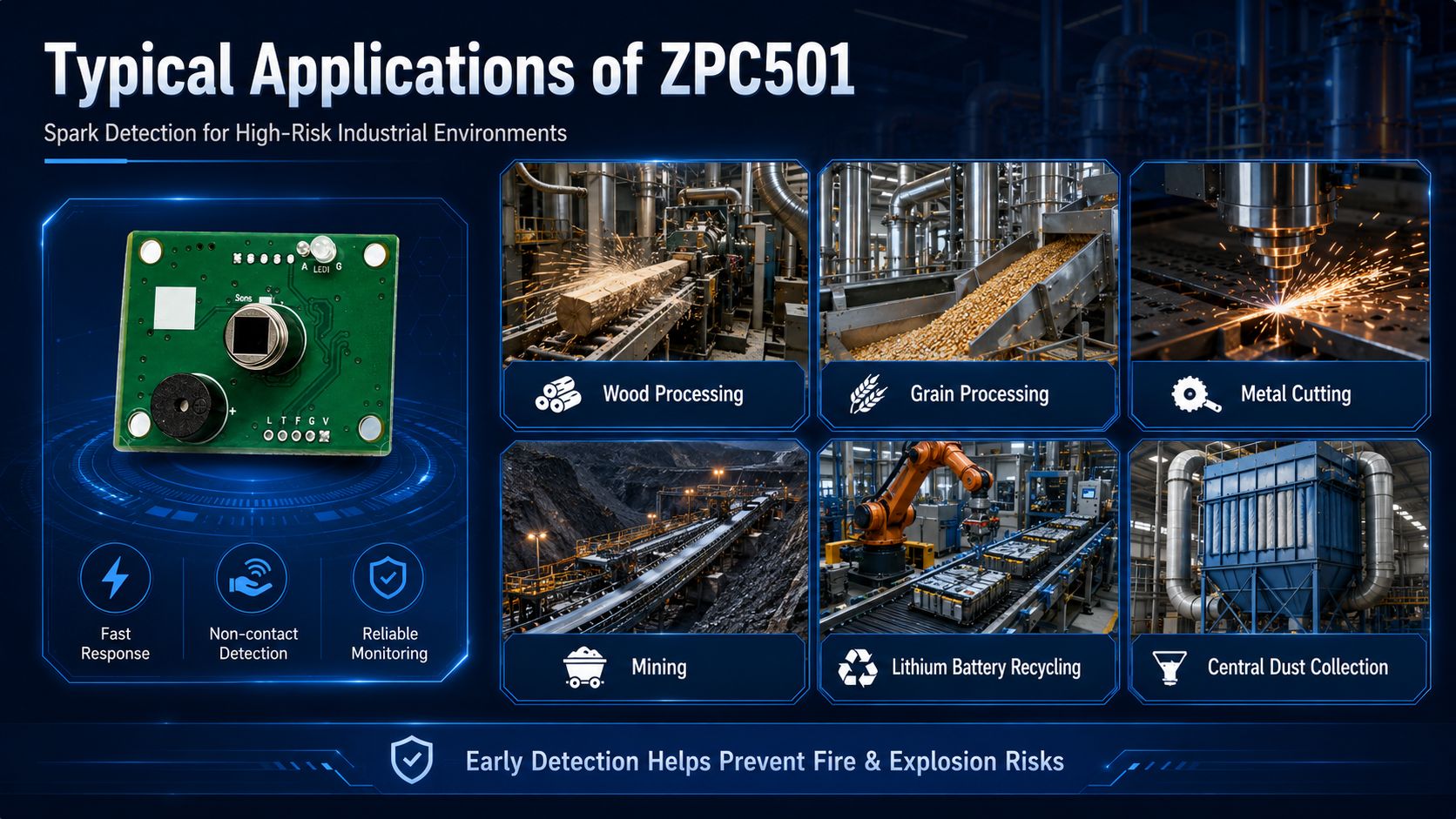
Typical Applications of Industrial Spark Detection
Woodworking and Wood Processing
Woodworking systems generate large quantities of sawdust and fine wood particles. Cutting blades, damaged bearings, friction and foreign metal objects may create sparks that are carried into extraction ducts or dust collectors.
Spark detection can be deployed in:
- woodworking production lines;
- sawdust conveying systems;
- sanding equipment;
- dust extraction ducts;
- central dust collectors;
- wood-chip processing systems.
Early detection helps prevent sparks from entering filters, silos or dust-storage areas.
Grain and Food Processing
Grain dust, flour and agricultural particles can form combustible dust clouds in enclosed equipment.
Potential spark sources include mechanical friction, overheated bearings, metal contamination and static electricity.
Typical monitoring locations include:
- grain conveyors;
- flour mills;
- feed-processing equipment;
- pneumatic transfer pipes;
- storage silos;
- dust collection systems.
Continuous spark monitoring provides an additional layer of protection for high-throughput grain-processing facilities.
Metal Cutting and Grinding
Metal cutting, welding and grinding naturally produce sparks.
In open work areas, these sparks may be visible and manageable. However, when sparks enter adjacent dust extraction systems or reach combustible materials, the risk increases.
ZPC501 can support spark-monitoring systems for:
- laser cutting equipment;
- plasma cutting systems;
- grinding stations;
- welding fume extraction;
- metal-processing ventilation;
- centralized dust collection.
Mining and Coal Handling
Mining operations involve coal dust, mineral dust, conveyors, crushers and heavy mechanical equipment.
Friction, impact or equipment faults may create hot particles that enter material-handling systems.
Spark detection can be used in:
- coal conveying lines;
- crushing equipment;
- mine ventilation systems;
- mineral-processing plants;
- dust-removal ducts;
- enclosed transfer stations.
Lithium Battery Recycling
Lithium battery recycling includes crushing, sorting and material-separation processes that may create heat, sparks or electrical risks.
At the same time, battery materials and residual energy may increase fire hazards.
Potential applications include:
- battery crushing lines;
- recycling conveyors;
- powder collection systems;
- ventilation ducts;
- material separation equipment;
- centralized dust extraction.
Spark detection can work together with gas, smoke, temperature and flame sensors to create a more complete multi-parameter safety monitoring system.
Central Dust Collection Systems
Central dust collectors are common in woodworking, metal processing, food production, chemical processing and other industrial facilities.
Because they collect combustible particles from multiple production areas, they may also concentrate fire and explosion risks.
Installing spark detectors in upstream ducts helps identify ignition particles before they reach the collector.
This allows the system to respond earlier and may help isolate or suppress the risk before it enters the main filtration unit.
Recommended Installation Considerations
A spark detector must be correctly matched to the application environment.
Engineering teams should consider:
- installation location;
- duct diameter;
- material movement direction;
- expected spark speed;
- detection distance;
- background light conditions;
- dust concentration;
- ambient temperature;
- required field of view;
- system response logic;
- maintenance accessibility.
The detector should be positioned where spark radiation can reach the sensing area without unnecessary obstruction.
For conveying systems, the distance between the detection point and the extinguishing or diversion device should also provide enough time for the system to respond before the spark reaches the protected equipment.
Final installation design should be based on actual operating conditions, material speed and system layout.
Building a Multi-Sensor Industrial Fire Prevention System
Spark detection is an important preventive technology, but industrial safety is strongest when multiple sensing methods work together.
A complete system may include:
| Risk Signal | Sensing Technology | Main Purpose |
|---|---|---|
| High-temperature particles | Spark detector | Identify moving ignition sources |
| Abnormal equipment heating | Temperature sensor | Detect overheating trends |
| Early combustion particles | Smoke sensor | Identify smoldering or developing fire |
| Combustible gas accumulation | Gas sensor | Detect flammable leakage or decomposition gases |
| Open flame | Flame sensor | Confirm rapid fire development |
| Pressure change | Pressure sensor | Monitor explosions or process abnormalities |
Multi-sensor fusion helps the control system evaluate risk from different dimensions and reduces dependence on a single alarm signal.
Customer Value of the ZPC501 Series
| Customer Need | ZPC501 Value |
|---|---|
| Earlier fire-risk detection | Detects spark radiation before visible fire develops |
| Fast system response | Suitable for rapidly moving sparks in industrial processes |
| Non-contact monitoring | No physical contact with the moving material |
| Flexible product development | Available as sensor and module solutions |
| Localized supply support | Helps reduce procurement and delivery uncertainty |
| Customized integration | Can be adapted to different structures and detection needs |
| Industrial application coverage | Suitable for multiple high-risk production environments |
| Long-term cooperation | Technical support for OEM equipment and safety-system projects |
From Imported Components to a More Responsive Development Platform
For industrial equipment manufacturers, component selection affects more than product cost.
It also influences:
- development speed;
- testing efficiency;
- production planning;
- supply continuity;
- customization capability;
- after-sales technical support.
The ZPC501 series provides customers with an alternative spark detection platform supported by local R&D, production and application engineering.
This helps customers develop differentiated products while maintaining greater control over project schedules and supply-chain planning.
FAQ
What is an industrial spark detector?
An industrial spark detector identifies optical radiation produced by hot sparks or glowing particles inside production lines, ducts and material-conveying systems.
What technology does ZPC501 use?
ZPC501 uses photoelectric detection technology to convert characteristic spark radiation into electrical signals for rapid recognition.
Is spark detection the same as flame detection?
No. Spark detection focuses on small, often fast-moving ignition particles before a developed flame appears. Flame detection identifies characteristic radiation from an established flame.
Where can ZPC501 be installed?
It can be integrated into material-conveying lines, dust extraction ducts, industrial equipment and other areas where sparks may travel toward combustible materials.
Is ZPC501 available only as a finished module?
No. Winsen can provide both a core sensor and a module solution to support different development requirements.
Which industries can use ZPC501?
Typical industries include woodworking, grain processing, metal cutting, mining, lithium battery recycling and centralized dust collection.
Can the product be customized?
Yes. Customization can be discussed based on installation space, detection distance, equipment structure and system-integration requirements.
Conclusion: Detect the Spark Before It Becomes a Fire
Industrial safety is not only about improving emergency response. It is about identifying danger earlier.
A spark may last only a moment, but its consequences can be severe when combustible dust or materials are present.
The Winsen ZPC501 spark detection series uses photoelectric sensing technology to support rapid, non-contact monitoring of industrial sparks. With sensor and module options, independently developed technology, patented core design and flexible customization support, it provides equipment manufacturers with a practical solution for industrial fire and explosion prevention.
The ZPC501 series is now available.
For technical specifications, sample evaluation or application support, please contact Winsen.