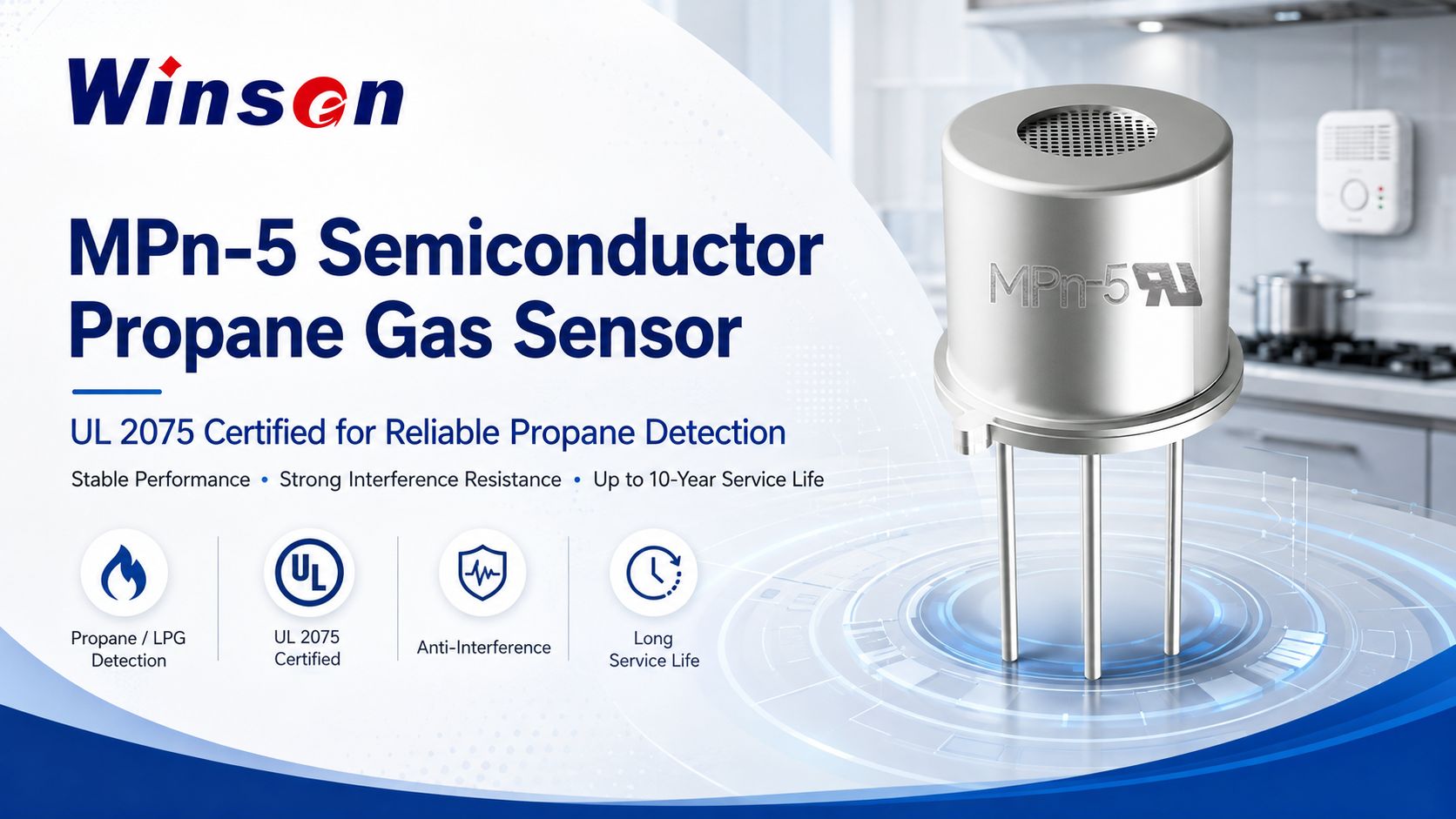
MPn-5 Semiconductor Propane Gas Sensor Achieves UL 2075 Certification
For propane and LPG gas detection, the sensor is the first component responsible for recognizing a potential leak.
A reliable propane sensor must do more than simply respond when combustible gas is present. It must maintain stable sensitivity through temperature and humidity changes, resist common environmental interferents, support long-term continuous operation and provide consistent performance throughout the intended service life of the gas alarm.
Our MPn-5 Semiconductor Propane Gas Sensor has achieved UL 2075 certification, providing OEM gas alarm manufacturers with a new sensing option for propane and liquefied gas detection applications. The sensor combines high sensitivity to C3H8, enhanced interference resistance, a compact metal-cap package and a designed service life of up to 10 years.
For manufacturers developing residential, commercial or industrial propane gas detectors, this certification represents an important step toward building reliable products for international markets.
What Is UL 2075 and Why Does It Matter for Propane Detection?
UL 2075 is the Standard for Gas and Vapor Detectors and Sensors.
Its scope includes fixed, portable and transportable toxic and combustible gas and vapor detectors and sensors intended for ordinary locations. For combustible gas sensing, the standard covers combustible gas sensors with detection capability up to and including the lower explosive limit. ([UL Standards Online][2])
For OEM gas detector manufacturers, UL certification provides an independent reference when evaluating a sensing component for safety-related applications.
It is particularly relevant because combustible gas sensing involves more than initial sensitivity under laboratory conditions. The sensing component must deliver dependable performance while operating continuously in real environments where temperature, humidity and interfering substances can vary.
The MPn-5 product page now lists UL 2075 as its certification and identifies the sensor for propane/liquefied-gas detection with a 0–5250 ppm range.
UL certification of the sensing component does not automatically mean that a complete gas alarm or detector is UL certified. OEM manufacturers must still design, test and certify the finished product according to the standards applicable to the intended market and application.
MPn-5: A Semiconductor Sensor Designed for Propane and LPG Detection
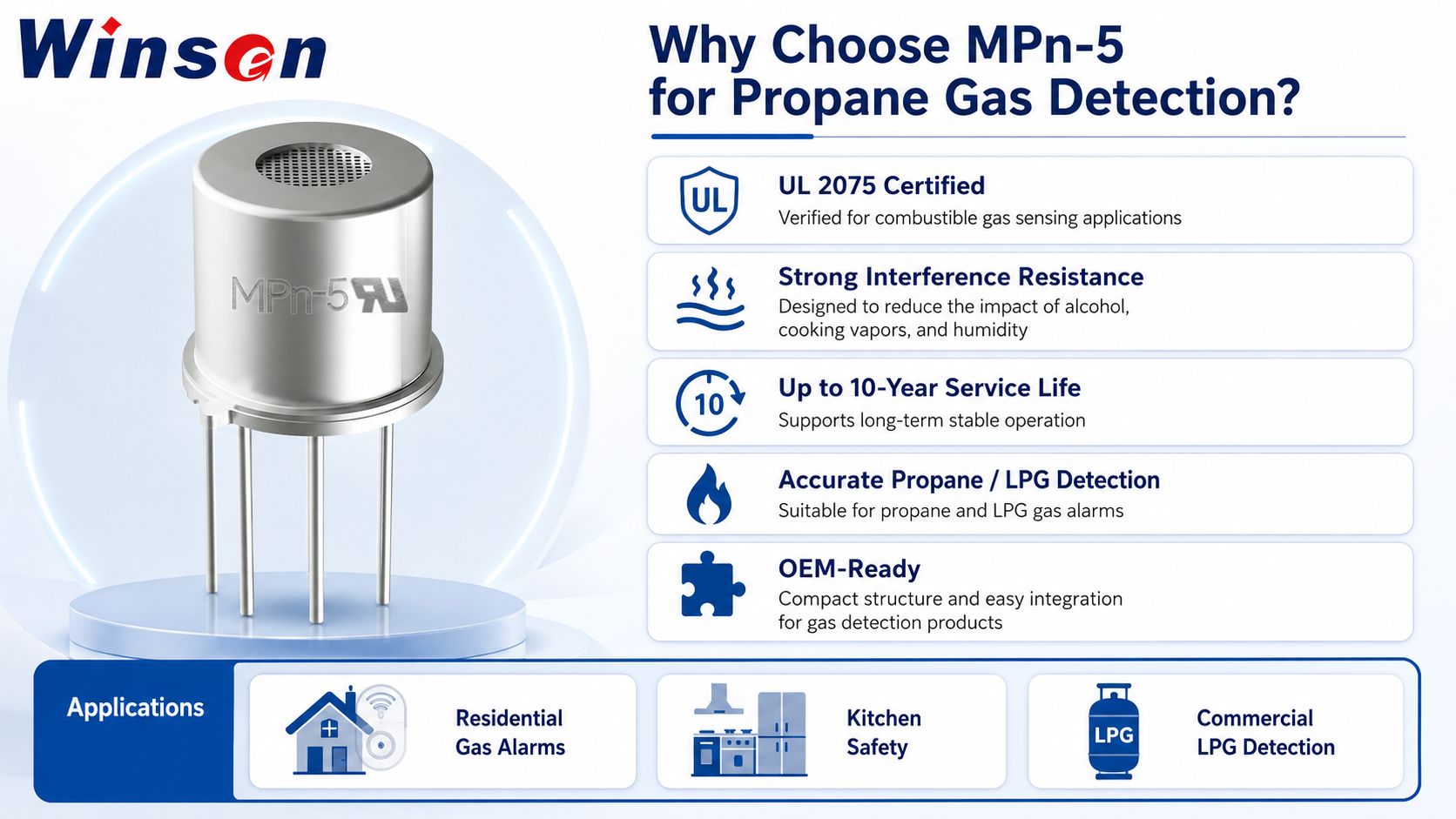
MPn-5 is a metal oxide semiconductor gas sensor developed for propane (C3H8) and liquefied gas detection.
The sensor uses a multi-layer thick-film manufacturing process. The heating electrode, measuring electrode and metal oxide semiconductor gas-sensitive layer are integrated on an Al2O3 ceramic substrate and protected by a metal housing.
When propane reaches the gas-sensitive material, its conductivity changes according to the gas concentration.
The detector circuit measures this conductivity change and converts it into an electrical signal that can be processed by the gas alarm controller.
This mature sensing architecture provides several important advantages for OEM gas detector development:
- high sensitivity to propane;
- strong electrical signal response;
- compact mechanical structure;
- straightforward measurement circuitry;
- suitability for continuous gas monitoring;
- cost-effective integration for high-volume gas alarm production.
Key Specifications of MPn-5
| Parameter | MPn-5 |
|---|---|
| Target Gas | Propane / Liquefied Gas |
| Chemical Formula | C3H8 |
| Detection Principle | Semiconductor |
| Detection Range | 0–5250 ppm |
| Sensor Type | Flat Surfaced |
| Encapsulation | Metal Cap |
| Loop Voltage | ≤24 V DC |
| Heater Voltage | 5 V ± 0.1 V AC or DC |
| Heater Consumption | 305 ± 25 mW |
| Heater Current | 61 ± 5 mA |
| Sensitive Resistance | 1 kΩ–20 kΩ at 2000 ppm C3H8 |
| Sensitivity | Rs (air) / Rs (2000 ppm C3H8) ≥ 8 |
| Concentration Slope | ≤0.6 |
| Preheat Time | ≥48 hours |
| Service Life | 10 Years |
| Certification | UL 2075 |
These specifications are taken from the current official MPn-5 product page.
Strong Interference Resistance for Real Gas Alarm Environments
A propane sensor rarely operates in a controlled laboratory after it is integrated into a finished product.
Residential kitchens, commercial food-service areas and other LPG-use environments can contain many environmental factors unrelated to an actual gas leak, including:
- alcohol;
- cooking vapors;
- humidity changes;
- cleaning products;
- temperature fluctuations;
- other household volatile substances.
A sensing element that reacts strongly to these conditions can increase the risk of nuisance alarms or unstable detector performance.
For this reason, MPn-5 has been developed with enhanced resistance to common household interferents. The current product specifications specifically identify reduced cross-sensitivity to alcohol and design optimization against cooking vapors and humidity-related interference.
For gas alarm manufacturers, improved interference resistance can contribute to:
- fewer unnecessary alarms;
- more stable baseline behavior;
- more reliable alarm-threshold judgment;
- improved long-term detector performance;
- better end-user experience.
This becomes particularly important for propane detectors installed close to kitchens or other environments where the sensor may be continuously exposed to changing background conditions.
Up to 10-Year Service Life for Long-Term Gas Safety
Gas alarms are expected to remain continuously active for many years.
Unlike many electronic components that operate intermittently, the gas sensing element must continuously monitor the surrounding environment even though an actual gas leak may occur only rarely.
This makes long-term stability one of the most important factors when selecting a propane sensor.
MPn-5 is designed for a 10-year service life under the specified operating conditions. Its official product specifications list both a 10-year lifespan and excellent long-term stability among the key product characteristics.
Our long-term stability evaluation under a 2000 ppm propane environment with RL = 4.7 kΩ showed no obvious downward trend in sensor output during the test period.
For OEM gas alarm manufacturers, a longer sensor service life can help support:
- longer finished-product operating cycles;
- lower sensor replacement frequency;
- reduced maintenance requirements;
- improved long-term detection consistency;
- better matching between sensor lifetime and detector design life.
Long Life Requires Complete System Engineering
A 10-year sensor alone does not automatically create a 10-year gas alarm.
The complete detector should also be designed around:
- stable heater power;
- ageing characteristics;
- environmental compensation;
- alarm-threshold algorithms;
- enclosure airflow;
- PCB reliability;
- power-supply stability;
- periodic product self-testing.
The performance of the sensing element and the design of the finished alarm must work together to achieve reliable long-term gas safety.
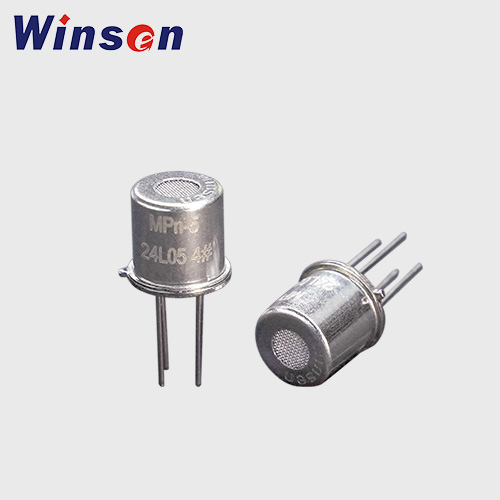
MPn-5 Semiconductor Propane Sensor | UL 2075 Certified
- Propane (C3H8) / Liquefied Gas
- 0~5250ppm
- Read More
Why Semiconductor Technology Remains Important for Propane Gas Alarms
Multiple sensing technologies can be used for combustible gas detection, including:
- semiconductor;
- catalytic combustion;
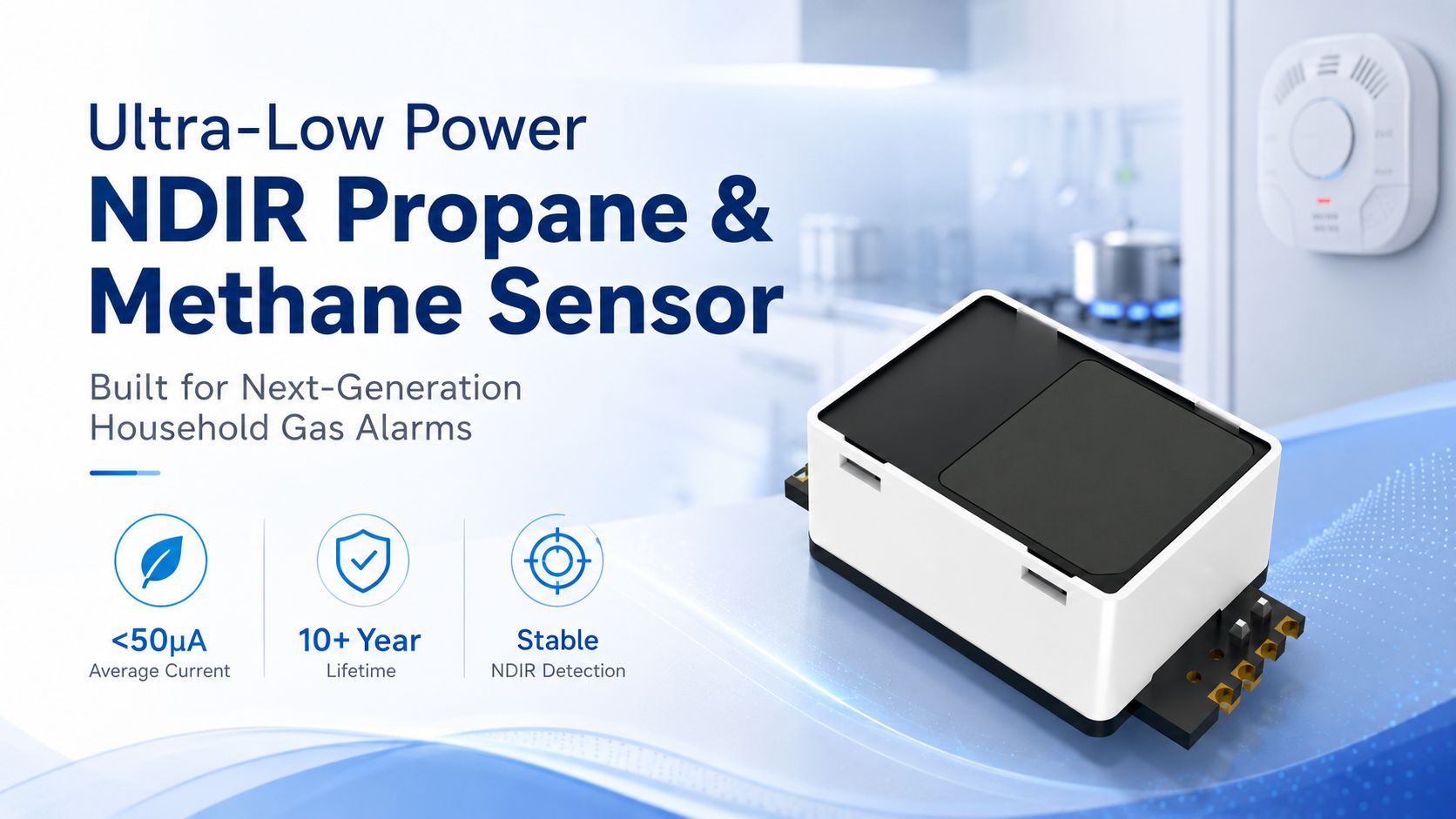
- NDIR infrared;
- laser-based optical sensing.
Each technology has its own advantages.
Semiconductor technology remains particularly valuable in mass-market propane and LPG alarms because it can combine:
High sensitivity + compact size + mature technology + scalable manufacturing + competitive system cost
For manufacturers producing high-volume residential or commercial alarms, this combination can provide an attractive balance between detection performance and product economics.
The MPn-5 further strengthens this platform with UL 2075 certification and a designed service life of up to 10 years.
MPn-5 vs NDIR Propane Sensors: Which One Should OEMs Choose?
We provide multiple combustible gas sensing technologies because one sensing principle cannot optimally serve every product.
| Requirement | MPn-5 Semiconductor Sensor | NDIR Propane Sensor |
|---|---|---|
| Propane / LPG Detection | Yes | Yes |
| Technology | Metal Oxide Semiconductor | Infrared Absorption |
| Product Cost Positioning | Competitive | Higher |
| Compact Integration | Excellent | Good |
| Target Gas Selectivity | Good | Very High |
| Poisoning Resistance | Enhanced | Excellent |
| Long-Life Capability | Up to 10 Years | Excellent |
| Measurement Circuit | Relatively Simple | Optical + Processing Circuit |
| Typical Positioning | Mainstream Gas Alarms | Premium Gas Detection |
| High-Volume OEM Projects | Excellent Fit | Application Dependent |
For mainstream propane alarms where cost efficiency, mature technology, compact integration and long-term operation are priorities, MPn-5 provides a strong solution.
For premium applications where highly selective optical detection and exceptional poisoning resistance are the primary requirements, an NDIR propane sensor may be more appropriate.
This gives OEM manufacturers the flexibility to select the sensing technology according to the positioning of the finished product rather than forcing every application onto the same technical route.
Typical MPn-5 Applications
The MPn-5 product platform is suitable for a broad range of propane and LPG detection equipment.
Residential LPG Gas Alarms
LPG cylinders remain widely used for domestic cooking in many markets.
Potential leakage points include:
- cylinder valves;
- pressure regulators;
- hoses;
- gas appliance connectors;
- kitchen gas pipelines.
A propane-sensitive sensor can provide the core sensing function required by a residential gas leak alarm.
Commercial Kitchen Gas Detection
Restaurants, hotels, cafeterias and commercial kitchens may use LPG cylinders or centralized propane supply systems.
Continuous monitoring can be deployed around:
- cooking equipment;
- gas cylinder areas;
- regulator installations;
- gas pipelines;
- gas storage locations.
LPG Storage and Utility Areas
Propane leak detection may also be needed around:
- cylinder storage facilities;
- gas utility rooms;
- distribution equipment;
- commercial LPG installations.
Smart Gas Safety Products
MPn-5 can also serve as the sensing core inside:
- connected propane alarms;
- smart-home gas detectors;
- gas valve linkage systems;
- fire and gas safety terminals;
- multi-function home safety devices.
OEM Combustible Gas Detection Equipment
The compact metal-cap structure makes the sensor suitable for equipment manufacturers developing custom propane or combustible gas detector platforms.
The official product page specifically identifies propane gas leak alarms, liquefied-gas leak monitoring devices, residential and commercial gas detectors, factory detection systems and OEM gas detection equipment among the intended applications.
A More Controllable Supply Chain for OEM Manufacturers
For a gas alarm manufacturer, choosing a sensor is not only a technical decision.
It is also a long-term supply-chain decision.
Once a sensor has been qualified in a safety product, replacing it may require:
- circuit changes;
- software modification;
- calibration changes;
- additional reliability testing;
- certification work;
- production-line adjustment.
Stable sensor supply therefore matters throughout the complete lifecycle of the gas alarm.
We maintain in-house control over key materials and manufacturing processes for MPn-5, helping support stable product quality, supply continuity and lead-time management.
Our gas sensor development and manufacturing capabilities cover key stages including:
- sensing-material development;
- ceramic substrate processing;
- sensing-element design;
- thick-film manufacturing;
- packaging;
- performance testing;
- reliability verification;
- mass-production quality control.
This manufacturing foundation also allows us to respond more efficiently to OEM projects requiring long-term supply and application engineering support.
OEM Integration Considerations
Selecting the correct sensor is only the first step in developing a reliable propane alarm.
Several system-level factors should be considered during product design.
Detector Placement
Propane is denser than air and may accumulate in lower areas under many leakage conditions.
The finished detector installation position should be determined according to the appliance, room structure and applicable local requirements.
Enclosure Airflow
The enclosure must allow leaking gas to reach the sensor.
A housing designed mainly around appearance without considering gas diffusion can increase response time.
Sensor openings should therefore be designed together with:
- air diffusion paths;
- dust protection;
- insect protection;
- mechanical protection;
- electronics layout.
Sensor Preheating
The MPn-5 specification defines a preheat time of not less than 48 hours under the standard test conditions.
OEM manufacturers should consider the sensor ageing and stabilization process during production calibration and finished-product testing.
Product Calibration
The sensor is fully tested before shipment, but the current Winsen technical guidance recommends that customers perform appropriate ageing and calibration after the sensor has stabilized in the finished-device application.
This allows the alarm algorithm to account for:
- enclosure structure;
- measurement circuit;
- operating environment;
- sensor installation position;
- finished-product requirements.
Environmental Validation
A production-ready gas alarm should be evaluated under realistic operating conditions, including:
- temperature cycling;
- humidity changes;
- long-term ageing;
- target-gas exposure;
- alcohol interference;
- cooking vapor;
- baseline stability;
- repeated alarm testing.
Component certification provides an important technical foundation, while complete-product reliability ultimately depends on the full sensing, electronics, software and mechanical system.
More Than One Propane Sensor Technology
The MPn-5 is part of our broader combustible gas sensor portfolio.
We provide multiple sensing principles for methane, propane, LPG and other combustible gases, including:
- semiconductor gas sensors;
- catalytic sensors;
- infrared combustible gas sensors;
- laser methane sensors;
- integrated combustible gas modules.
This means OEM customers can evaluate sensor technologies according to their actual priorities:
- product cost;
- power consumption;
- selectivity;
- service life;
- operating environment;
- alarm architecture;
- target market.
Rather than offering a single sensing route, we can support customers from initial technology selection through prototype evaluation and mass production.
Frequently Asked Questions
Is MPn-5 specifically designed for propane?
Yes. MPn-5 provides high sensitivity to propane (C3H8) and is designed for propane and liquefied-gas detection applications.
Is MPn-5 UL 2075 certified?
Yes. UL 2075 is listed as the certification for the MPn-5 on its current product page.
What is the detection range?
The published detection range is 0–5250 ppm propane/liquefied gas.
What is the expected service life?
The MPn-5 specification lists a 10-year lifespan under its specified operating and application conditions.
What is the heater power consumption?
The published heater consumption is 305 ± 25 mW, with a heater current of 61 ± 5 mA.
Does MPn-5 resist alcohol interference?
The product is designed with reduced cross-sensitivity to alcohol and enhanced resistance to common household interferents, including cooking vapors and humidity changes.
Can MPn-5 be used in residential LPG alarms?
Yes. Residential propane and liquefied-gas leak detectors are among its primary intended applications.
Is the sensor calibrated before shipment?
The sensing element is tested before shipment but is not supplied as a fully calibrated finished detector. OEM manufacturers should perform appropriate ageing and finished-device calibration based on their actual circuit, enclosure and application conditions.
Does using MPn-5 make my finished gas alarm UL certified?
No. UL certification of the sensor does not automatically certify the complete detector. The finished product must meet the certification requirements applicable to its own design and target market.
Reliable Propane Detection Starts with a Reliable Sensor
A propane alarm may remain silent for years before the moment it is truly needed.
That is precisely why long-term sensor reliability matters.
The MPn-5 Semiconductor Propane Gas Sensor combines:
- UL 2075 certification
- 0–5250 ppm propane detection
- high sensitivity to C3H8
- up to 10-year service life
- enhanced anti-interference capability
- stable long-term sensing performance
- compact metal-cap packaging
- controlled core materials and manufacturing processes
Together, these characteristics provide gas alarm manufacturers with a practical sensing platform for residential, commercial and OEM propane detection products.
For customers developing a new propane or LPG gas alarm, we can support sensor evaluation, circuit matching, sample testing and OEM integration.
View the product:
MPn-5 Semiconductor Propane Sensor – UL 2075 Certified
Explore related solutions:
Combustible Gas Sensors