Extreme Heatwaves Are Reshaping the Air Conditioning Market: Why Environmental Sensing Matters
Extreme heat is changing the way people think about air conditioning.
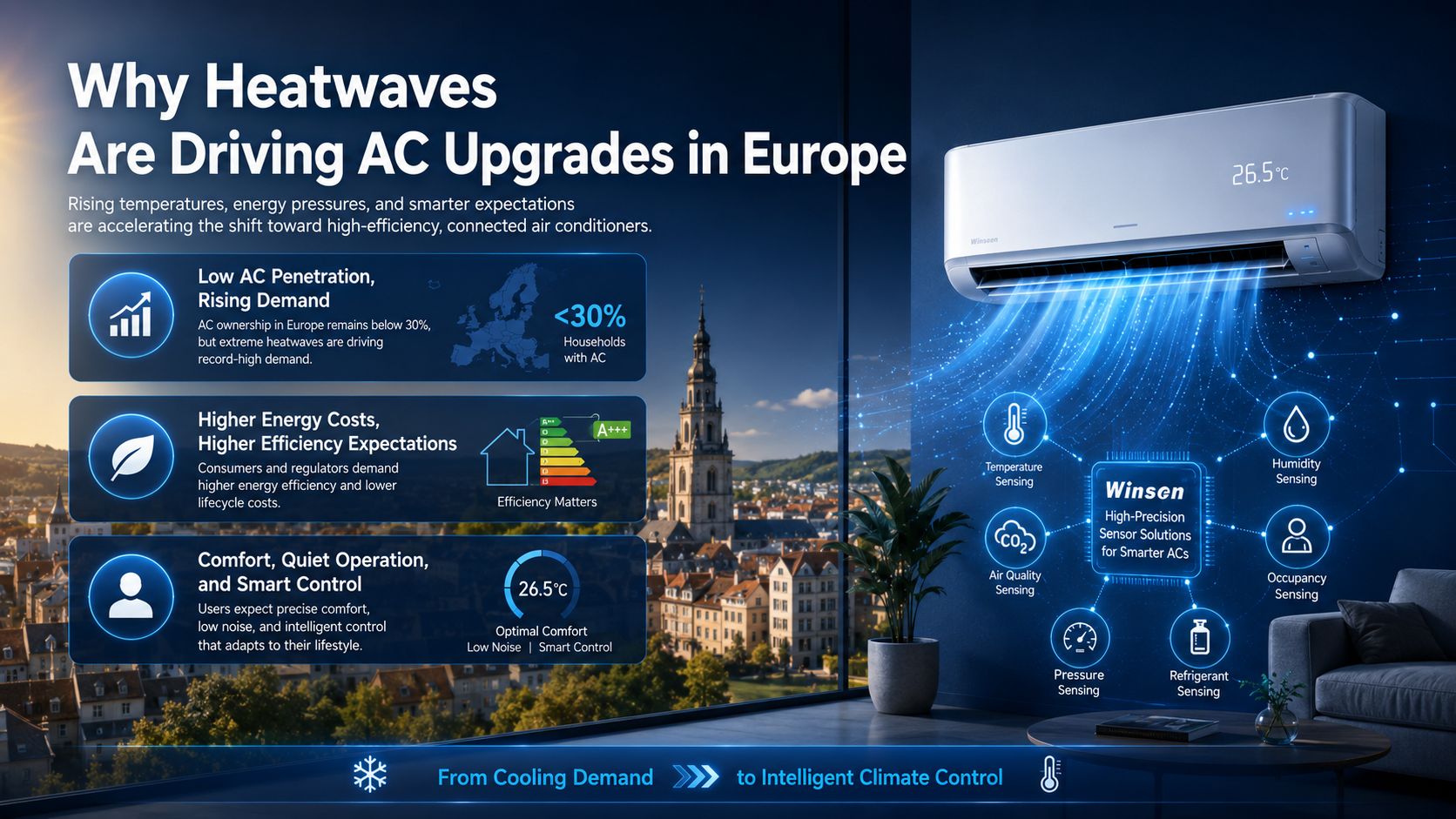
In recent summers, many European regions have experienced long periods of high temperature, with heatwaves pushing household cooling demand to new levels. For markets that traditionally relied more on building insulation, natural ventilation and mild summer climates, air conditioning is gradually shifting from an optional comfort product to an important part of modern living.
However, the growth of the air conditioning market is not only about selling more cooling equipment. It also reflects a deeper change in the HVAC industry.
As climate conditions become more complex and energy efficiency requirements continue to rise, the competitiveness of an air conditioner is no longer defined only by how fast it cools. It is increasingly defined by how accurately the system can sense the environment, understand operating conditions and adjust intelligently.
For modern HVAC manufacturers, environmental sensing is becoming a new competitive edge.
Heatwaves Are Accelerating HVAC Demand
In Europe and many other regions, extreme heat is making consumers reassess the value of air conditioning.
Historically, air conditioner penetration in parts of Europe has been lower than in Asia or North America. This was related to climate habits, building structures, energy policies and consumer preferences. But as heatwaves become more frequent and intense, more households, offices, hotels and public buildings are considering cooling systems as essential infrastructure for comfort and safety.
At the same time, European consumers and regulators place strong emphasis on energy efficiency, operating cost, indoor comfort and environmental impact. This means that HVAC products cannot compete only on cooling capacity.
A successful air conditioning product must also deliver:
- lower energy consumption
- stable indoor comfort
- quiet operation
- reliable long-term performance
- healthier indoor air
- intelligent control under changing conditions
This is where sensors become essential.
The Real Competition Is No Longer Cooling Alone
For many years, air conditioner competition focused mainly on compressor performance, cooling speed and basic energy efficiency.
Today, the competition is shifting toward comprehensive system capability.
A next-generation air conditioner must be able to answer questions such as:
- What is the indoor temperature and humidity now?
- Is the room occupied?
- Is the indoor CO₂ level too high?
- Is the air quality healthy?
- Is the refrigerant system operating safely?
- Is the pressure condition stable?
- How can the system balance comfort and energy savings?
These questions cannot be answered by the compressor alone. They require a sensing network distributed across the indoor unit, outdoor unit, refrigerant circuit and indoor environment.
In other words, the future of air conditioning depends on the ability to sense, decide and control.
High Efficiency Starts with Accurate Environmental Sensing
Energy-saving operation is not only achieved by using high-efficiency hardware. It also depends on accurate data.
When an air conditioner can monitor environmental and system conditions in real time, it can adjust operation more intelligently. Instead of running at a fixed mode, the system can dynamically control compressor output, fan speed, airflow direction, fresh air volume and protection logic based on actual conditions.
A more intelligent air conditioner may use sensor data to:
- maintain stable comfort with less energy
- avoid overcooling or overheating
- reduce unnecessary compressor operation
- adjust operation based on room occupancy
- improve indoor air freshness
- detect abnormal system pressure
- warn of refrigerant leakage earlier
- support predictive maintenance
This transforms the air conditioner from a simple cooling device into an intelligent climate control system.
Key Sensors for Intelligent Air Conditioning Systems
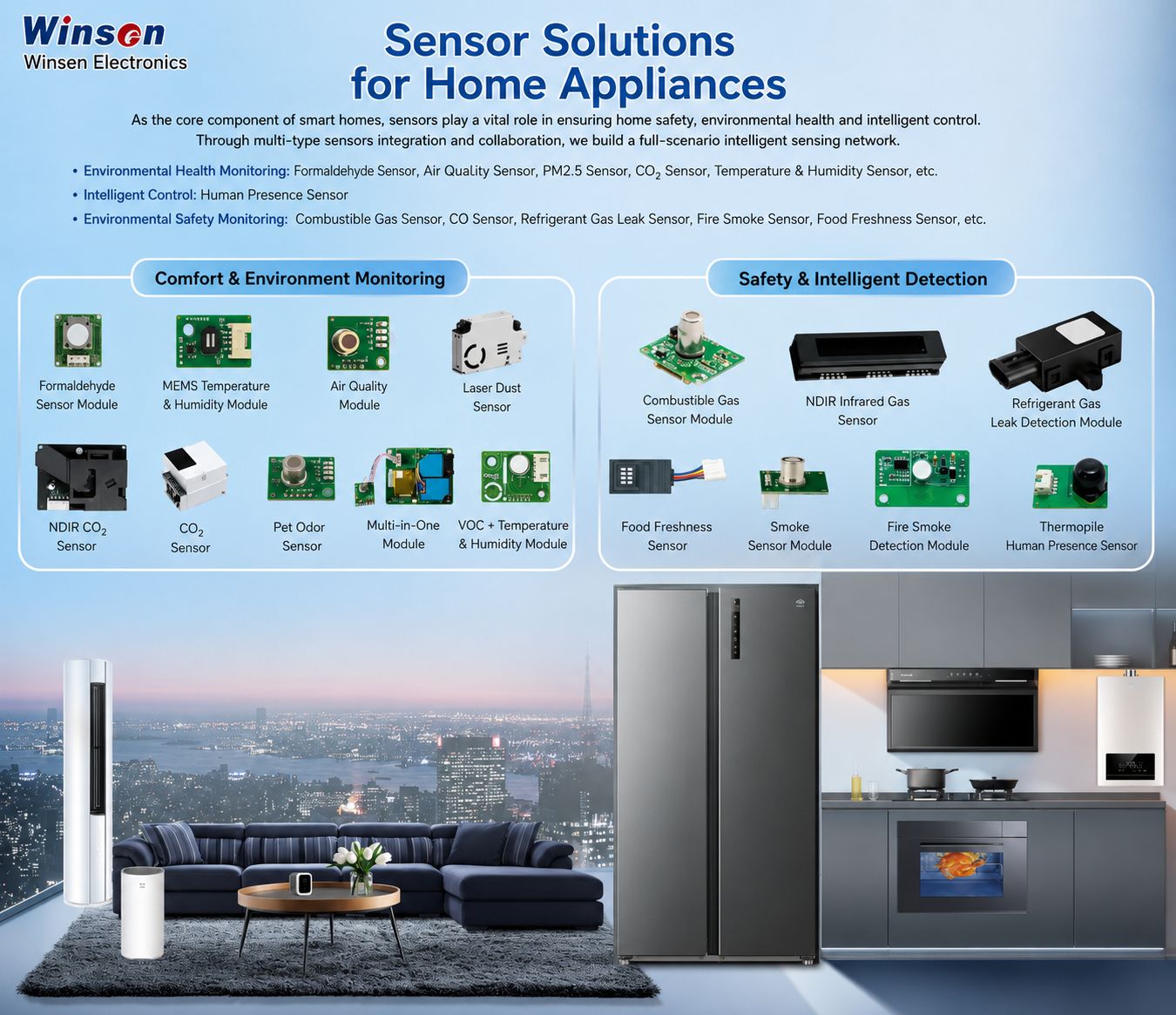
Winsen provides multiple sensor solutions that can be used in smart air conditioners, heat pumps, fresh air systems, VRF systems and commercial HVAC equipment.
1. Temperature and Humidity Sensors
Temperature and humidity are the basic parameters of comfort control.
Accurate temperature and humidity sensing allows the air conditioner to understand the real indoor environment and adjust cooling, heating, dehumidification or ventilation strategies accordingly.
Application value:
- comfort control
- humidity management
- dehumidification optimization
- anti-condensation support
- energy-saving operation
For high-efficiency HVAC systems, stable temperature and humidity data is the foundation of intelligent control.
2. CO₂ Sensors
When indoor spaces are occupied for long periods, CO₂ concentration may rise quickly. High CO₂ levels can indicate poor ventilation and may affect comfort, concentration and indoor air quality.
CO₂ sensing helps HVAC systems determine when fresh air ventilation is needed.
Application value:
- demand-controlled ventilation
- fresh air system optimization
- classroom, office and hotel air quality management
- energy-saving ventilation control
- healthier indoor environments
By adjusting fresh air volume based on real CO₂ levels, HVAC systems can balance indoor air freshness and energy consumption.
3. Air Quality Sensors
Modern consumers are increasingly concerned about indoor air quality. In addition to temperature, they care about particulate matter, VOCs, odors and overall air cleanliness.
Air quality sensors can detect indoor pollutants and provide data for purification, ventilation and filtration control.
Application value:
- PM2.5 monitoring
- VOC detection
- air purification control
- smart fresh air linkage
- healthy indoor air management
For premium air conditioning products, air quality sensing helps create a stronger health-focused user experience.
4. Refrigerant Leak Sensors
As low-GWP refrigerants such as R32, R454B and R290 are increasingly used in air conditioners and heat pumps, refrigerant leak detection is becoming more important.
Some new refrigerants are mildly flammable or flammable, so early leak detection helps improve system safety and compliance readiness.
Application value:
- refrigerant leakage warning
- HVAC safety protection
- heat pump system monitoring
- VRF and commercial refrigeration safety
- support for low-GWP refrigerant applications
Winsen provides refrigerant sensing solutions based on different technology routes, helping manufacturers select suitable sensors according to refrigerant type, system design and application requirements.
5. Pressure Sensors
Pressure sensing is critical for monitoring the operating status of HVAC and refrigeration systems.
By measuring pressure in the refrigerant circuit or related system points, the control unit can better understand load conditions, detect abnormalities and protect key components.
Application value:
- compressor protection
- refrigerant circuit monitoring
- system stability evaluation
- fault diagnosis
- energy efficiency optimization
Reliable pressure data helps HVAC systems operate safely and efficiently under changing ambient conditions.
6. Occupancy and Presence Sensing
Occupancy sensing allows an HVAC system to understand whether a space is being used.
When no one is present, the system can reduce output or enter an energy-saving mode. When occupants return, the system can restore comfort quickly.
Application value:
- smart energy saving
- room-by-room comfort control
- hotel and office HVAC management
- intelligent building automation
- improved user experience
Occupancy-based control is especially useful in smart homes, commercial buildings and hospitality environments.
From Europe to the World: Sensing Power Shapes the Future of HVAC
The European heatwave is only one example. Around the world, extreme heat, high humidity, cold waves and unstable weather patterns are making HVAC operating environments more complex.
At the same time, global energy policies are becoming stricter. Consumers also expect better comfort, cleaner air, lower noise and lower electricity bills.
This creates a clear direction for HVAC innovation:
Future air conditioners must not only cool faster.
They must sense more accurately, control more intelligently and operate more efficiently.
Environmental sensing will support HVAC systems in achieving:
- better comfort
- higher energy efficiency
- healthier indoor air
- stronger system reliability
- safer refrigerant management
- smarter control logic
- lower lifecycle operating cost
Winsen Sensor Solutions for Smarter Air Conditioning
As a professional sensor solution provider, Winsen offers a wide range of sensing technologies for HVAC and smart appliance manufacturers.
Our sensor solutions can support:
- temperature and humidity monitoring
- CO₂ concentration detection
- air quality monitoring
- refrigerant leak detection
- pressure monitoring
- smart environmental control
- HVAC system safety protection
With multiple sensing technology platforms and application-oriented engineering experience, we help customers build smarter, safer and more energy-efficient air conditioning products.
For OEM and ODM customers, we can support sensor selection, technical communication and application matching according to target product structure, gas type, control strategy and operating environment.
Application Value for HVAC Manufacturers
| HVAC Manufacturer Need | Sensor Value |
|---|---|
| Higher energy efficiency | Real-time sensing supports adaptive operation |
| Better indoor comfort | Temperature, humidity and occupancy data enable precise control |
| Healthier indoor air | CO₂ and air quality sensors support ventilation and purification |
| System safety | Refrigerant and pressure sensors help detect abnormal conditions |
| Smart product differentiation | Multi-parameter sensing improves product intelligence |
| Lower lifecycle cost | Early warning and optimized control reduce waste and maintenance risk |
| Market readiness | Supports the trend toward high-efficiency and low-GWP HVAC systems |
Conclusion: Environmental Sensing Is the New HVAC Competitiveness
Extreme heat is accelerating global demand for air conditioning, but market growth alone does not define the future of the HVAC industry.
The real change is that air conditioners are evolving from cooling equipment into intelligent environmental control systems.
In this new stage, sensors are no longer simple detection components. They are the foundation of smart HVAC decision-making.
By accurately sensing temperature, humidity, CO₂, air quality, refrigerant leakage, pressure and occupancy status, HVAC systems can respond to real conditions, optimize energy use and provide a more comfortable and healthier indoor environment.
Winsen will continue to provide reliable sensor solutions for global HVAC and smart appliance manufacturers, helping customers build the next generation of safer, greener and more intelligent air conditioning systems.