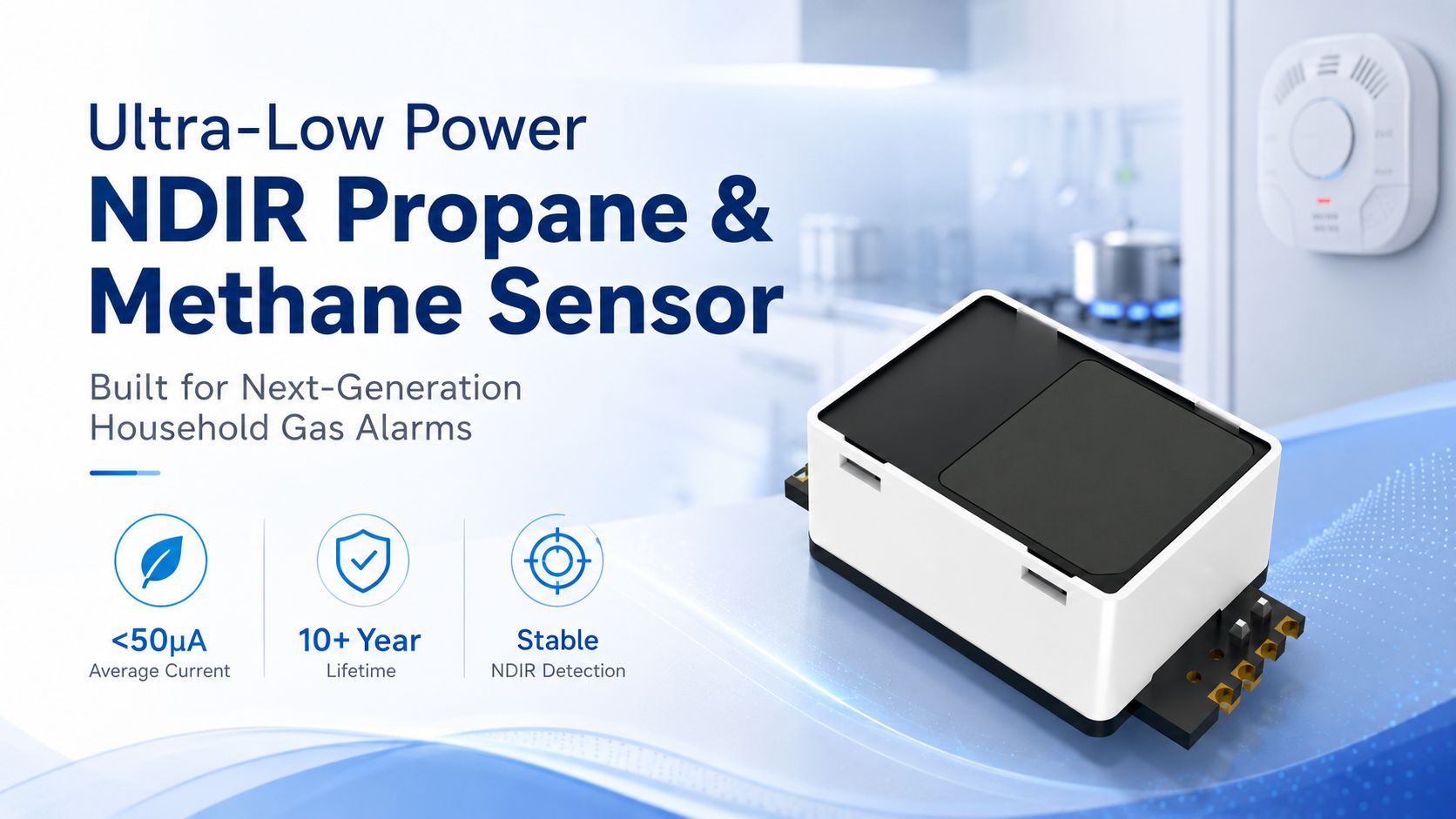
Ultra-Low Power NDIR Propane and Methane Sensor for Next-Generation Household Gas Alarms
The reputation of a household gas alarm ultimately depends on the performance of its core sensor.
A gas alarm installed in a kitchen, apartment, restaurant, or small commercial space must work continuously for years. It must respond reliably to real gas leakage, while reducing false alarms caused by cooking vapor, humidity, alcohol, oil fumes, or daily household interference.
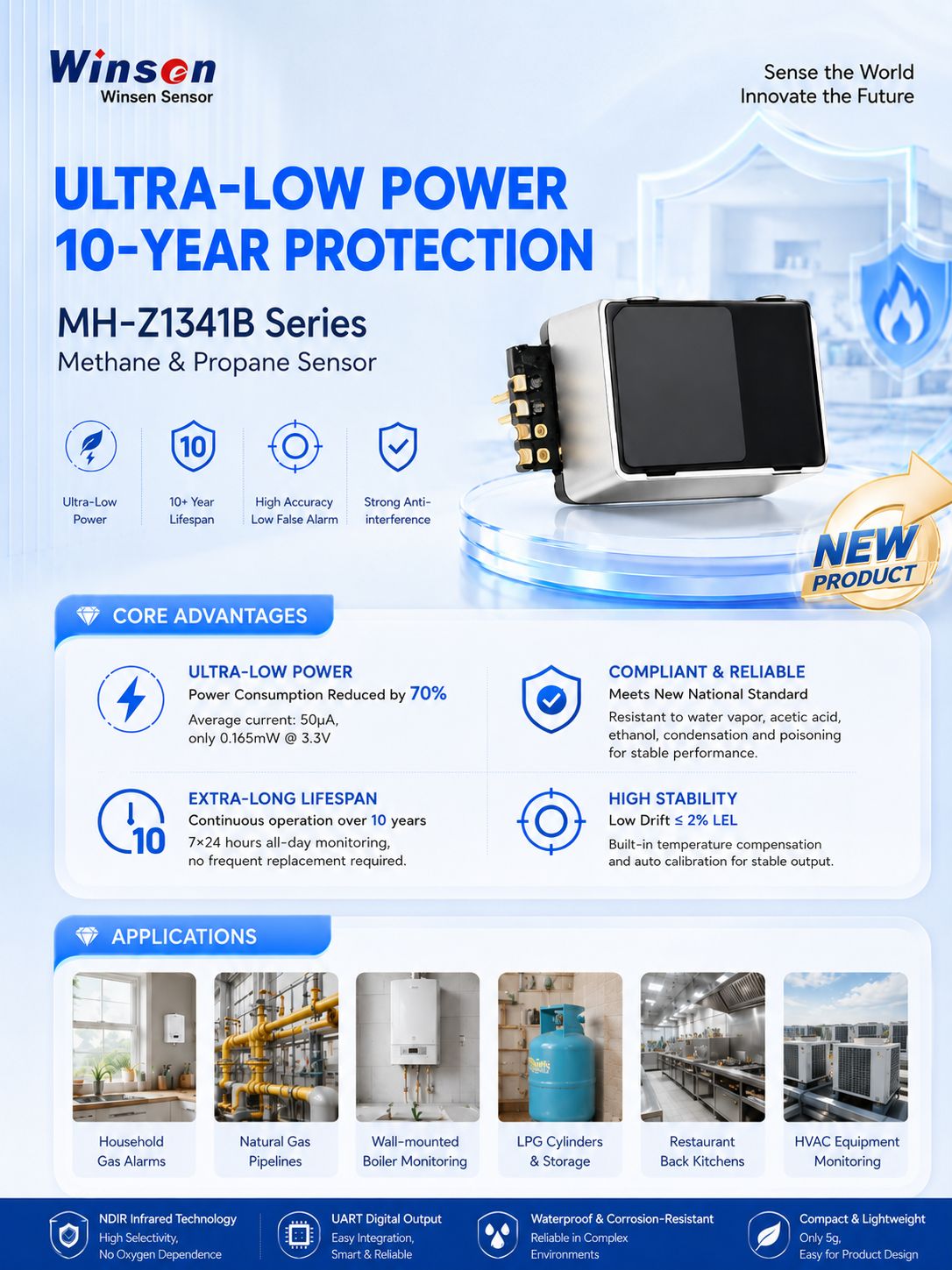
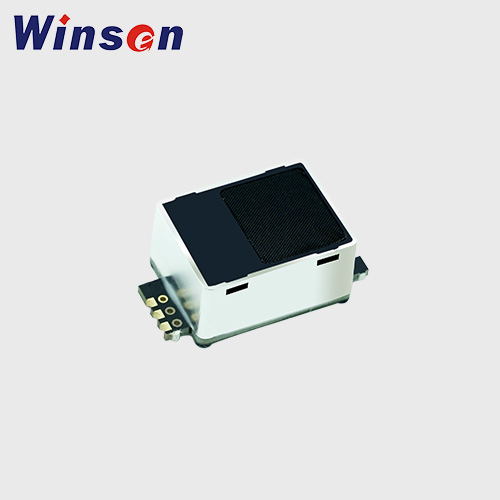
To support this upgrade, we have launched the MH-Z1341B series low-power NDIR combustible gas sensor. Designed for residential and light-commercial gas leakage detection, this compact infrared sensor can detect combustible gases such as methane and propane, providing a new solution for the next generation of household gas alarms.
1. From Industrial Gas Detection to Household Kitchens: Why NDIR Technology Matters
Combustible gas alarms have traditionally used several sensing technologies, including catalytic combustion, semiconductor, and infrared detection. Among them, NDIR infrared gas sensing is becoming increasingly important for higher-end household gas alarm designs.
NDIR technology detects gas concentration by measuring how gas molecules absorb infrared light at specific wavelengths. Methane and propane have characteristic infrared absorption features, allowing the sensor to identify target gas concentration through an optical path rather than a chemical reaction.
For household environments, this brings several important advantages.
Better selectivity for real gas leakage
Kitchen environments are complex. Water vapor, alcohol vapor, cooking fumes, vinegar-like vapors, and cleaning agents may all appear during daily use.
An NDIR sensor is based on infrared absorption and has strong selectivity for target combustible gases. This helps reduce the risk of false alarms caused by many common household interference sources.
No oxygen dependence
Unlike some combustion-based detection methods, NDIR detection does not depend on oxygen concentration. This makes the sensing principle more stable across different installation environments. Our MH-Z1341B product page highlights good selectivity, no oxygen dependence, long lifespan, built-in temperature compensation, and digital output as key advantages.
No chemical consumption, longer service life
NDIR detection is a physical optical method. It does not consume electrolyte, catalyst, or sensitive chemical material during normal operation. This gives it a natural advantage in long-life household gas alarms, especially products expected to work continuously for many years.
In the past, NDIR sensors were used more often in industrial or high-end commercial equipment because of cost and integration barriers. With the maturity of domestic infrared sensing technology and optical path design, NDIR combustible gas sensors are now moving into household gas safety products.
The MH-Z1341B series was developed for this trend: small enough to install, low enough in power consumption, and stable enough for long-term household use.
2. MH-Z1341B Series: A New Low-Power NDIR Solution
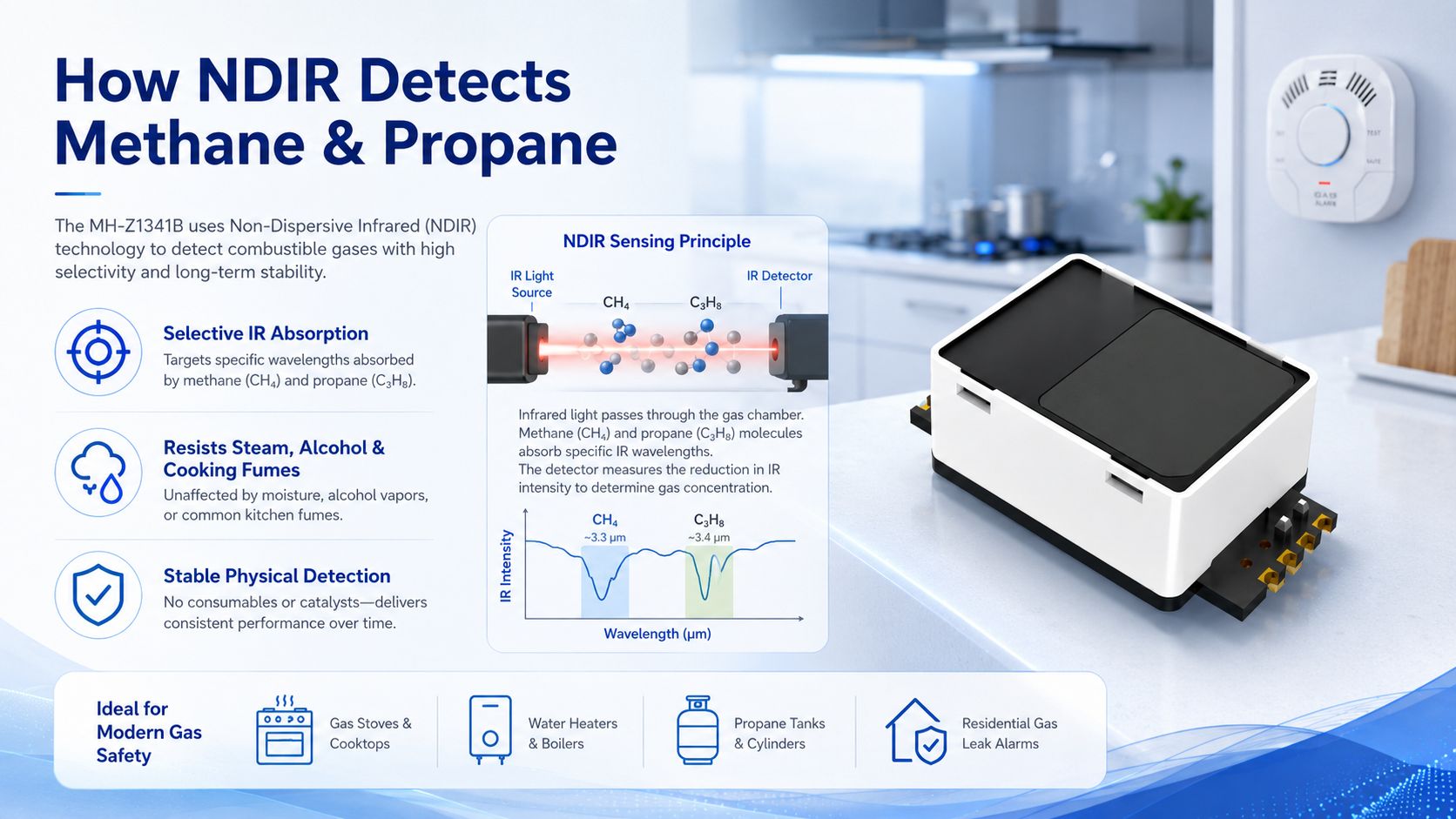
The MH-Z1341B combustible gas sensor combines mature infrared absorption gas detection technology with precision optical path design and refined circuit design. It is a compact, high-performance NDIR sensor platform for combustible gas detection.
It is especially suitable for:
- household combustible gas alarms
- natural gas alarm devices
- LPG / propane leakage alarms
- smart kitchen safety systems
- small commercial gas detection devices
- HVAC equipment gas safety monitoring
The sensor provides UART digital output, which makes integration easier for alarm manufacturers and smart home device developers.
3. Four Core Advantages for Household Gas Alarm Manufacturers
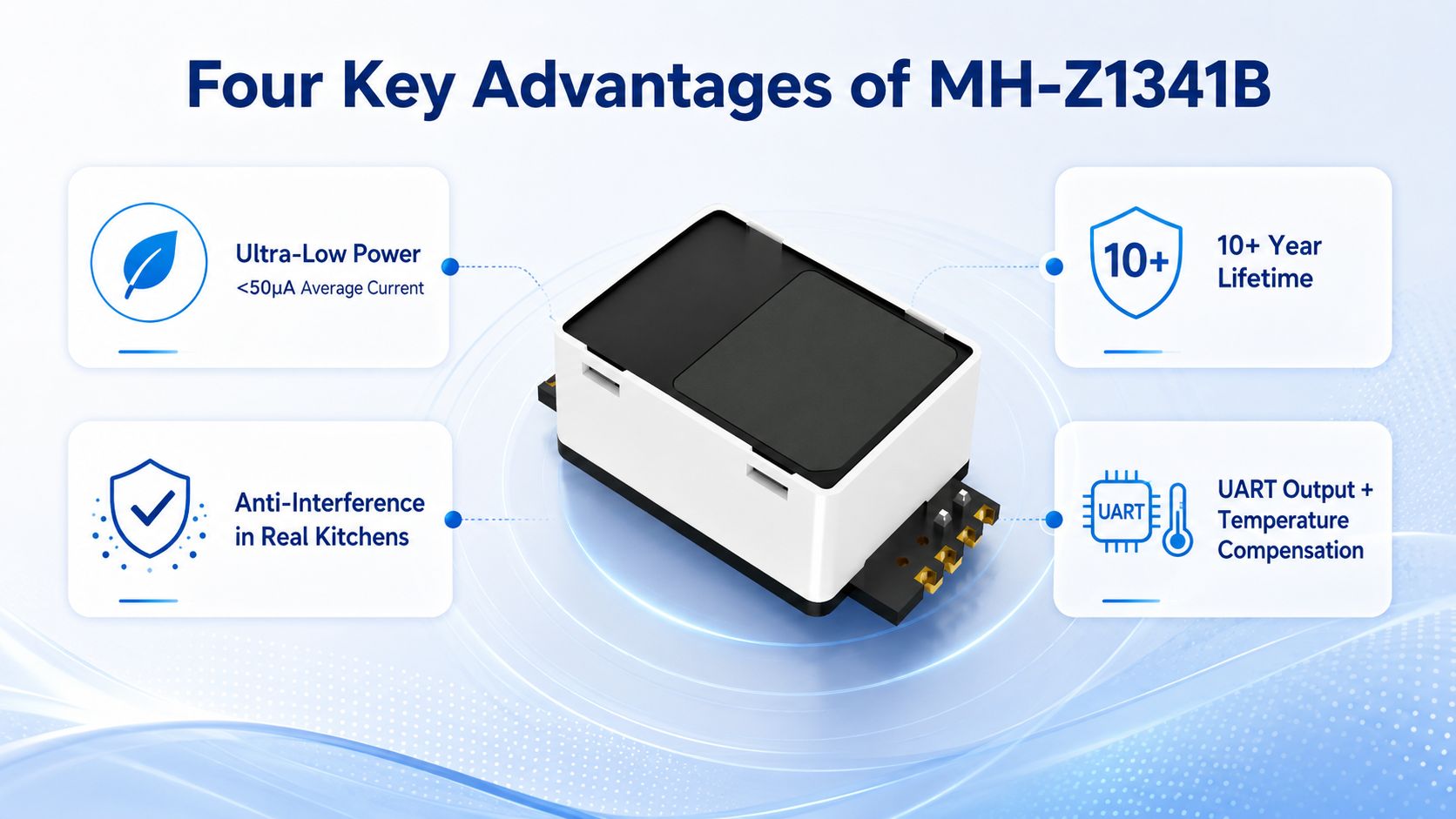
Advantage 1: Ultra-low power consumption
For household gas alarms, low power consumption is critical. Many products are designed for long-term operation, battery backup, smart home integration, or compact power architectures.
The MH-Z1341B sensor achieves an average current of <50μA at 3.3V power supply in clean air, with peak current of 40mA at 5V power supply.
This means:
- lower system standby power
- easier battery-backup design
- reduced heat generation
- better suitability for compact household alarm devices
- longer product service potential
In a 3.3V system, the average power consumption can be as low as approximately 0.165mW under clean-air low-concentration conditions, making it highly suitable for low-power alarm designs.
Advantage 2: More than 10 years of expected service life
Household gas alarms are safety devices that must remain reliable over time. Frequent sensor replacement increases maintenance cost and reduces user trust.
The MH-Z1341B uses NDIR infrared physical detection. Because it does not rely on chemical reaction consumption, it has a strong advantage in long-term stability.
The product specification lists an anticipated life of more than 10 years.
For gas alarm manufacturers, this helps support:
- long-life household alarm products
- reduced maintenance frequency
- stronger product reliability positioning
- better lifecycle value for end users
Advantage 3: Strong stability with temperature compensation
Kitchen and household environments are not constant. Temperature and humidity may change significantly between winter and summer, day and night, cooking and non-cooking periods.
The MH-Z1341B integrates temperature compensation and provides excellent linear output.
The sensor supports operation across -10°C to 60°C and 0–95% RH non-condensing conditions.
For alarm devices, this helps maintain more stable output in real use and supports more consistent alarm logic under changing environmental conditions.
Advantage 4: Strong anti-interference performance for real kitchens
False alarms are one of the biggest pain points in household gas alarm products.
A kitchen alarm must not only detect methane or propane; it must also resist interference from substances commonly found in the home environment.
MH-Z1341B is designed with:
- anti-moisture interference
- anti-poisoning characteristics
- resistance to acetic acid and ethanol interference
- waterproof and corrosion-resistant electroplated air chamber
These characteristics are listed in the product features and manual, supporting better reliability in household gas detection applications.
This is especially valuable for kitchen environments where steam, vinegar, alcohol, cleaning agents, and cooking emissions may frequently appear.
4. Product Specifications at a Glance
| Item | MH-Z1341B Reference Specification |
|---|---|
| Detection principle | NDIR infrared absorption |
| Target gas | Combustible gas |
| Typical gas configuration | Methane / propane series options |
| Power supply | DC 3.3–5.5V |
| Average current | <50μA @ 3.3V in clean air |
| Peak current | 40mA @ 5V |
| Output signal | UART, TTL 3.0V level |
| Range | 0–100% LEL optional |
| Preheating time | 180s |
| Response time | T90 <30s |
| Working temperature | -10°C to 60°C |
| Working humidity | 0–95% RH, non-condensing |
| Storage temperature | -20°C to 60°C |
| Weight | 5g |
| Expected lifetime | >10 years |
The product page lists the MH-Z1341B detection range as 0–100% LEL optional, response time as T90 <30s, UART output, low power consumption and excellent stability. The attached manual also confirms the same core electrical and environmental parameters.
5. Why MH-Z1341B Fits the Upgrade of Household Gas Alarms
For methane / natural gas alarms
Methane is the main component of natural gas. In residential kitchens, a methane alarm must operate continuously and respond quickly when leakage occurs from pipelines, valves, cookers, or connectors.
MH-Z1341B provides NDIR-based methane detection with UART digital output, allowing alarm manufacturers to build smart gas alarms with stable digital signal processing and easier system integration.
For propane / LPG alarms
Liquefied petroleum gas is still widely used in gas cylinders, especially in apartments, rural homes, restaurants, food stalls, and temporary cooking locations.
Propane leakage may accumulate in low areas because propane is heavier than air. A stable LPG alarm must detect leakage reliably while reducing false alarms in complex kitchen environments.
The low-power NDIR design of MH-Z1341B gives gas alarm manufacturers a strong option for LPG / propane safety products.
For smart home gas safety systems
With smart home and IoT integration, household gas alarms are no longer isolated devices. They may connect with:
- mobile app alerts
- gas shutoff valves
- kitchen ventilation systems
- smart home gateways
- property management platforms
UART output makes MH-Z1341B easier to integrate into connected gas alarm designs.
6. Preparing for the New GB 15322.2-2026 Standard Window
China’s new mandatory national standard GB 15322.2-2026, Combustible gas detectors—Part 2: Household combustible gas detectors, has been released and is listed as “soon to be implemented” by the National Public Service Platform for Standards Information. The official platform shows a publication date of 2026-01-28 and an implementation date of 2027-08-01.
For gas alarm manufacturers, this transition period is a key opportunity to upgrade product technology in advance.
The future competition in household gas alarms will focus not only on whether the device can alarm, but also on:
- lower false alarm rate
- stronger environmental adaptability
- longer service life
- lower power consumption
- better anti-interference performance
- more reliable long-term output
- easier smart system integration
The MH-Z1341B series is developed to support this direction, helping manufacturers prepare for stricter performance expectations and higher-quality household gas safety products.
7. Typical Application Scenarios
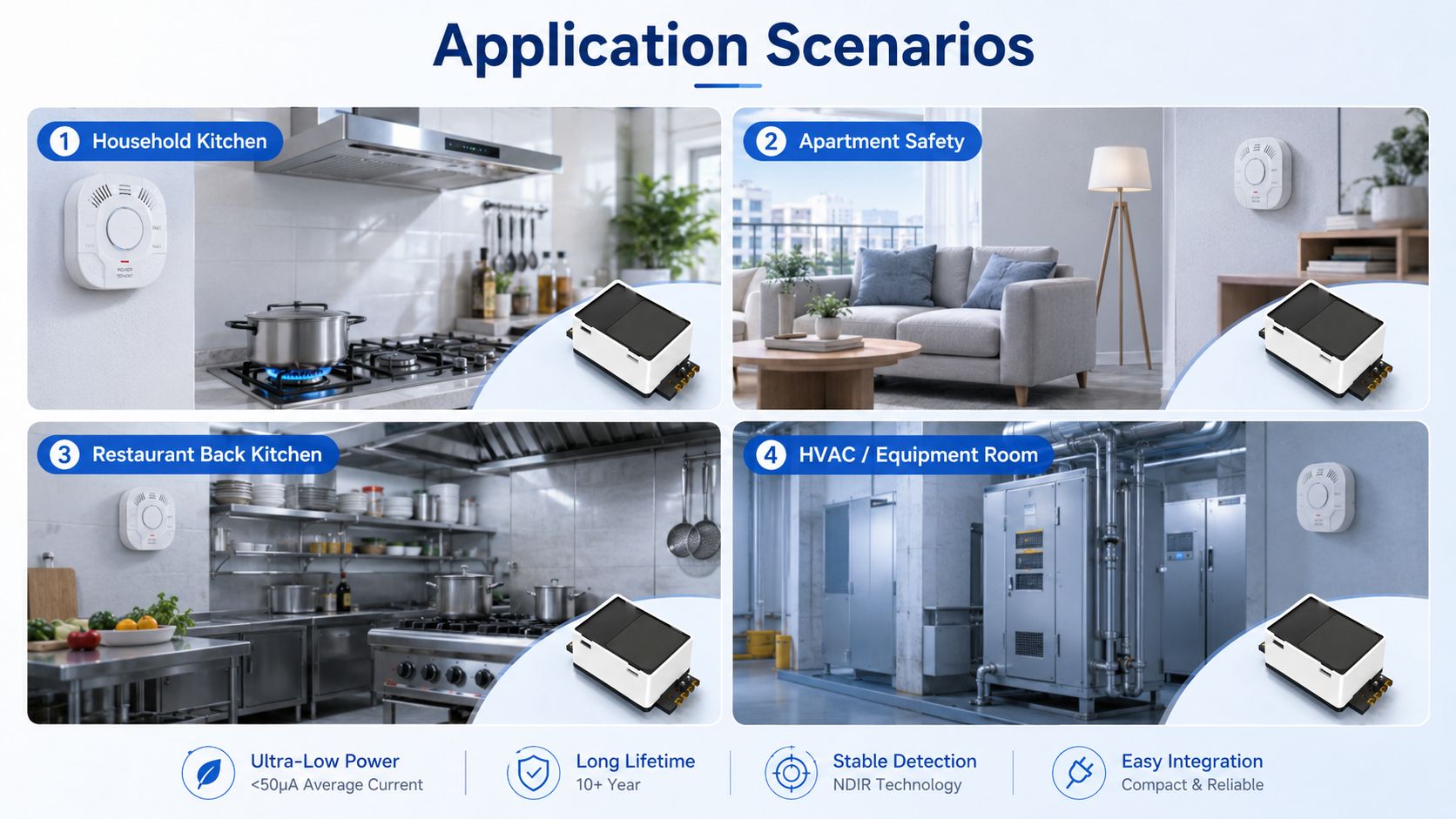
Household kitchens
Gas leakage from valves, hoses, stove connectors, or pipelines can create serious risks. MH-Z1341B can be used as the core sensing component in household gas alarms for continuous methane or LPG monitoring.
Apartments and rental housing
In multi-family residential buildings, gas leakage detection is essential for protecting both individual households and shared spaces. Low power consumption and long life make MH-Z1341B suitable for high-volume residential alarm deployment.
Restaurant back kitchens
Commercial kitchens often use LPG cylinders or pipeline natural gas. A stable anti-interference sensor helps reduce false alarms while maintaining real leak detection capability.
HVAC and equipment rooms
The product page also lists HVAC equipment as an application field. In equipment areas where combustible gas leakage may occur, MH-Z1341B provides a compact NDIR sensing option.
8. Design Value for Alarm Manufacturers
For manufacturers developing new household combustible gas alarms, MH-Z1341B provides value in four key dimensions:
| Manufacturer Need | MH-Z1341B Value |
|---|---|
| Lower power design | <50μA average current in clean air |
| Long product lifecycle | >10 years expected lifetime |
| Fewer false alarms | NDIR selectivity + anti-moisture / ethanol / acetic acid interference |
| Easy MCU integration | UART digital output |
| Compact alarm design | Small size, 5g weight |
| Stable real-world operation | Temperature compensation + excellent linear output |
| New standard preparation | Supports performance upgrade during GB 15322.2-2026 transition window |
9. NDIR vs Traditional Sensing Methods in Household Gas Alarms
| Item | NDIR Infrared Sensor | Traditional Chemical / Catalytic / Semiconductor Routes |
|---|---|---|
| Detection principle | Optical infrared absorption | Chemical reaction / catalytic combustion / material conductivity change |
| Oxygen dependence | No oxygen dependence | Some principles may be affected by oxygen level |
| Long-term consumption | No chemical consumption | Sensitive material or catalyst may degrade |
| Poisoning resistance | Stronger anti-poisoning potential | Some technologies may be affected by poisoning gases |
| Kitchen interference | Strong resistance to many common interferences | More likely to be affected by humidity, alcohol, vapor, fumes |
| Power consumption | MH-Z1341B supports ultra-low average current | Varies by technology; some require continuous heating |
| Service life | >10 years expected | Depends on sensing principle and environment |
Conclusion: A New Core for Safer, Smarter Household Gas Alarms
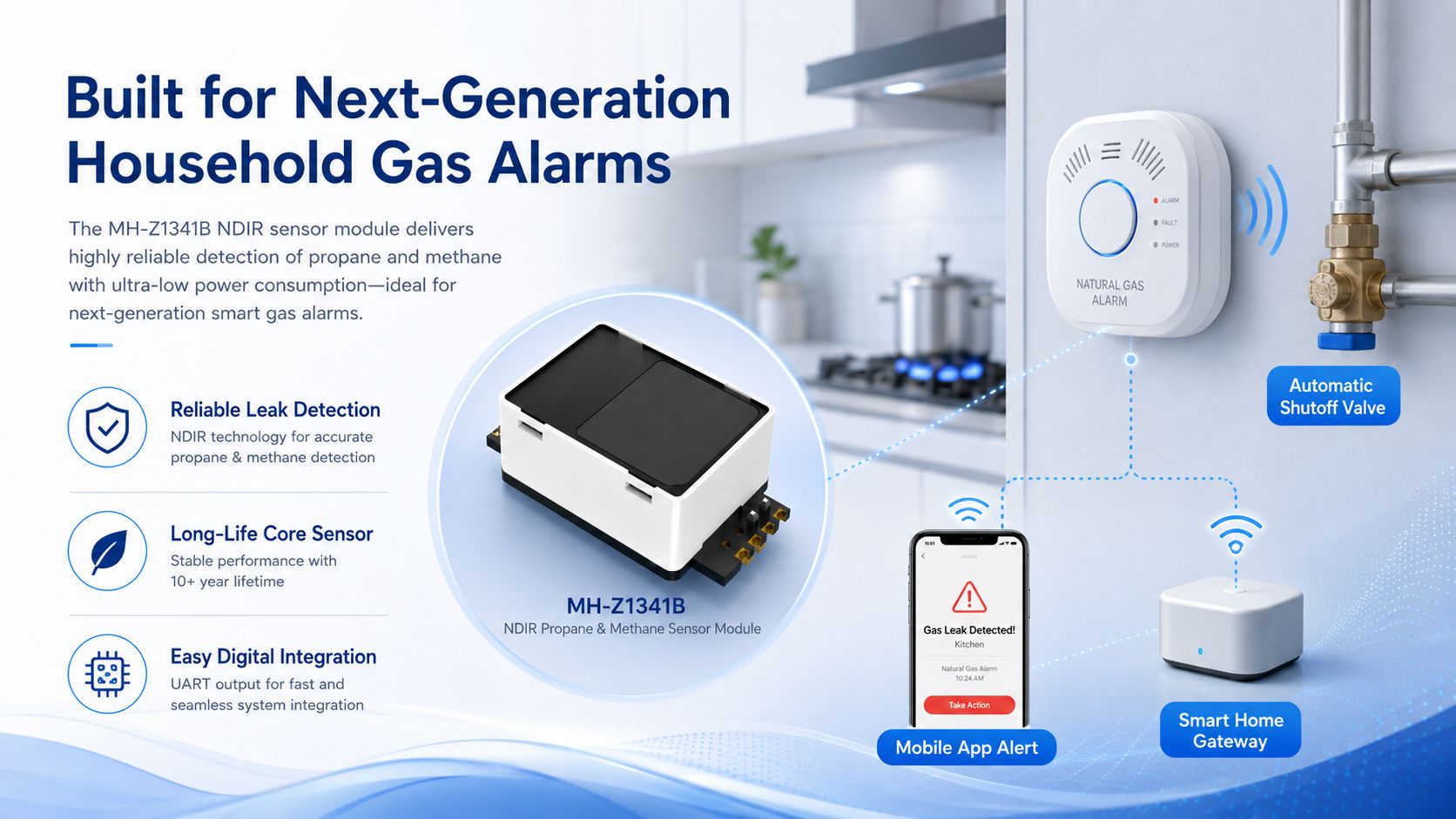
From household gas pipelines and LPG cylinders to restaurant kitchens and smart home safety systems, gas leakage detection is entering a new stage. Users expect gas alarms to be more stable, more durable, less prone to false alarms, and easier to integrate with intelligent safety systems.
The MH-Z1341B low-power NDIR propane and methane sensor is designed for this upgrade.
With ultra-low power consumption, more than 10 years of expected lifetime, NDIR physical detection, UART digital output, temperature compensation, anti-moisture performance, and resistance to ethanol and acetic acid interference, it provides a reliable sensing core for the next generation of household combustible gas alarms.
As the industry prepares for the new GB 15322.2-2026 implementation window, we welcome partners to contact us for samples, technical documents, and application support.
Together, we can bring safer, smarter, and more reliable household gas alarm products into millions of homes.