Formaldehyde Is Not Always Visible: Why Continuous Indoor Air Monitoring Matters
Formaldehyde is commonly associated with newly renovated homes, composite wood furniture and building materials.
In reality, potential emission sources can be much broader.
Adhesives, coatings, textiles, packaging materials, furniture and various manufactured products may all contribute to indoor volatile organic compound emissions under certain conditions.
Recent public discussion around formaldehyde associated with insulated food-delivery bags has once again drawn attention to an important indoor air quality issue:
pollutant sources are not always visible or obvious.
For homes, offices, schools and other occupied spaces, this makes reliable air monitoring increasingly important.
Rather than relying only on a one-time test, continuous sensing can provide a clearer picture of how formaldehyde concentrations change with temperature, humidity, ventilation and indoor activities.
Formaldehyde Sources Can Be Closer Than Expected
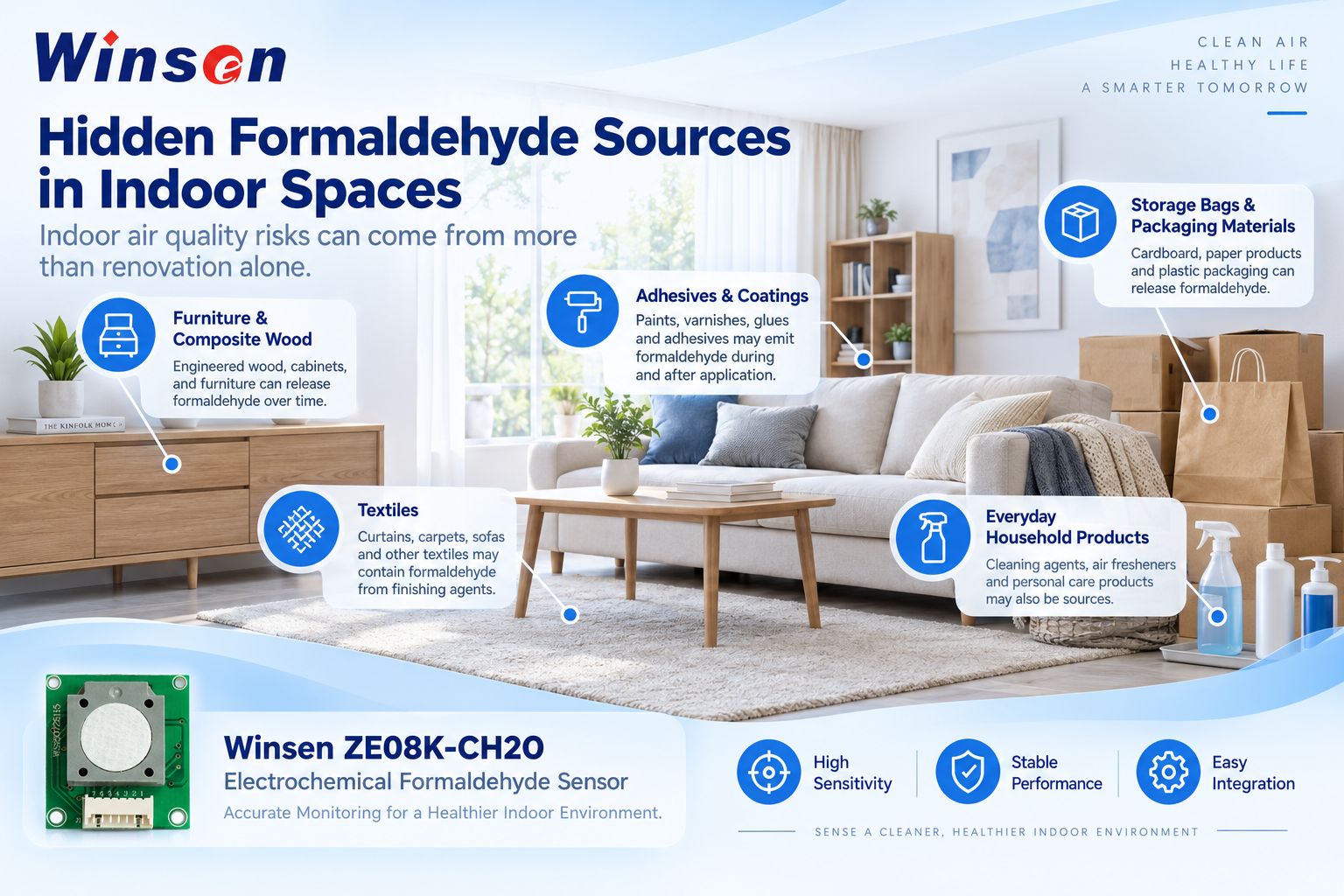
For many years, formaldehyde pollution has been closely linked to renovation and furniture.
Common potential sources include:
- engineered wood and composite panels;
- furniture;
- adhesives and bonding materials;
- coatings and paints;
- textiles;
- packaging materials;
- some household and consumer products.
The important point is not that every product in these categories necessarily releases unsafe levels of formaldehyde.
Rather, indoor air quality can be influenced by a combination of materials, environmental conditions and ventilation.
A room containing many emission sources may behave differently from a room containing only one.
Similarly, a material that produces relatively low emissions in a well-ventilated environment may contribute more to indoor concentration when stored in a closed space.
This makes formaldehyde monitoring a dynamic problem rather than a simple yes-or-no question.
Why Smell Is Not a Reliable Formaldehyde Detector
Human smell should not be treated as a formaldehyde measurement method.
Odor sensitivity varies significantly between people, and indoor environments usually contain mixtures of many VOCs rather than formaldehyde alone.
Some individuals may notice an irritating odor earlier than others. Some may not notice it clearly at all.
For this reason, indoor air quality should be evaluated with measurement rather than subjective smell.
A sensor provides something the human nose cannot:
a repeatable concentration-related signal that can be recorded, analyzed and used by an electronic control system.
This is particularly valuable in environments where people remain for long periods, such as:
- homes;
- schools;
- offices;
- hotels;
- hospitals;
- laboratories;
- vehicles.
Formaldehyde Concentration Changes Over Time
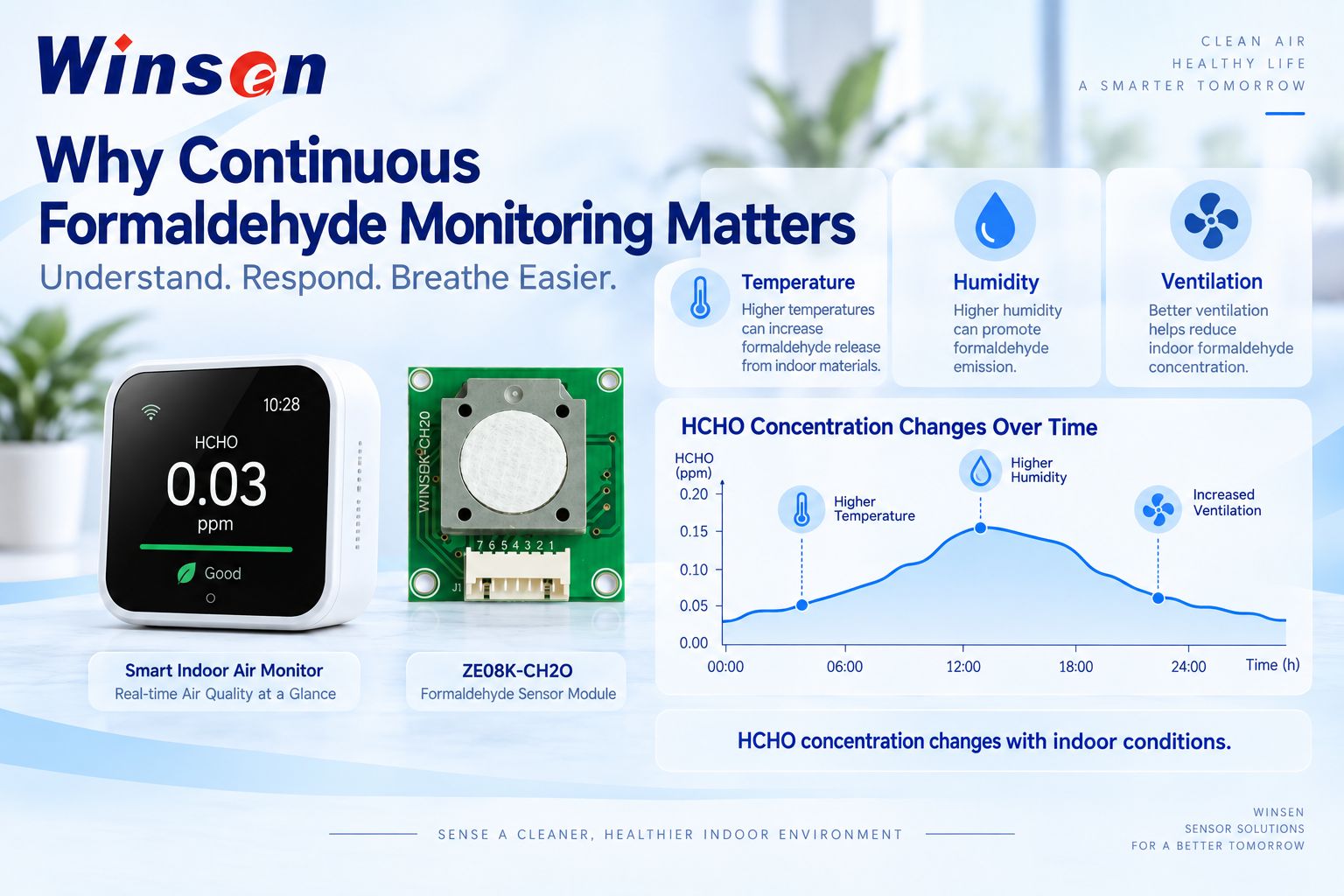
Indoor formaldehyde concentration is not necessarily constant.
Several environmental factors can influence emissions and accumulation.
Temperature
Higher temperatures can increase emissions from some formaldehyde-containing materials.
This is one reason indoor pollutant levels may change between seasons or during periods of hot weather.
Humidity
Humidity can also influence material emission characteristics.
In warm and humid environments, monitoring becomes particularly relevant when potential formaldehyde-emitting materials are present.
Ventilation
Ventilation determines how quickly pollutants are diluted and removed from a room.
Opening windows or operating a fresh-air system can increase air exchange.
Closed rooms, on the other hand, may allow pollutants to accumulate.
Source Loading
Furniture, adhesives, coatings and stored products all contribute differently to the overall indoor environment.
As the number of potential sources changes, indoor pollutant concentrations may also change.
This is why a measurement taken at one moment cannot always describe the long-term indoor air condition.
From One-Time Testing to Continuous Air Quality Monitoring
Traditional indoor air testing often provides a snapshot.
Modern sensing systems can provide something different:
continuous environmental data.
Formaldehyde sensors can now be integrated into devices such as:
- portable air quality monitors;
- air purifiers;
- fresh-air ventilation systems;
- HVAC equipment;
- smart home devices;
- building environmental monitoring systems.
Instead of measuring the room once, the equipment can monitor how the environment changes throughout the day.
This enables a more intelligent control model:
Sensing → Data Analysis → Ventilation / Purification → Indoor Air Management
For OEM manufacturers, the sensor becomes the core component that transforms an invisible chemical change into usable data.
Electrochemical Technology for Formaldehyde Detection
Electrochemical sensing is one of the established technical routes for low-concentration formaldehyde monitoring.
When formaldehyde reaches the sensing element, an electrochemical reaction generates an electrical signal related to the target gas concentration.
The signal can then be processed by the sensor module and transmitted to the host device.
For indoor air quality applications, a practical formaldehyde sensor must consider more than sensitivity alone.
Important factors include:
- low-concentration measurement capability;
- selectivity;
- resolution;
- response time;
- temperature influence;
- cross-interference;
- long-term stability;
- power consumption;
- module size;
- output interface;
- ease of integration.
These requirements are especially important for consumer and smart-home devices expected to remain in operation continuously.
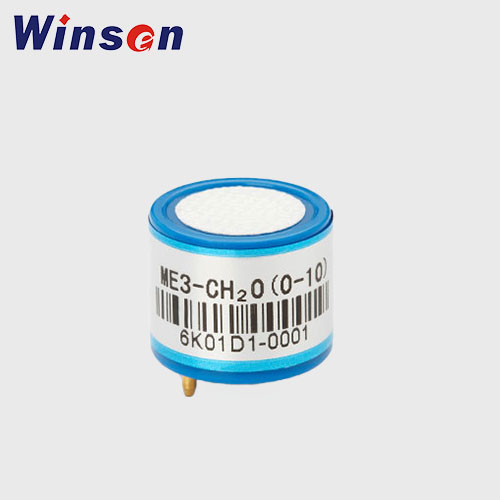
ZE08K-CH2O Electrochemical Formaldehyde Sensor
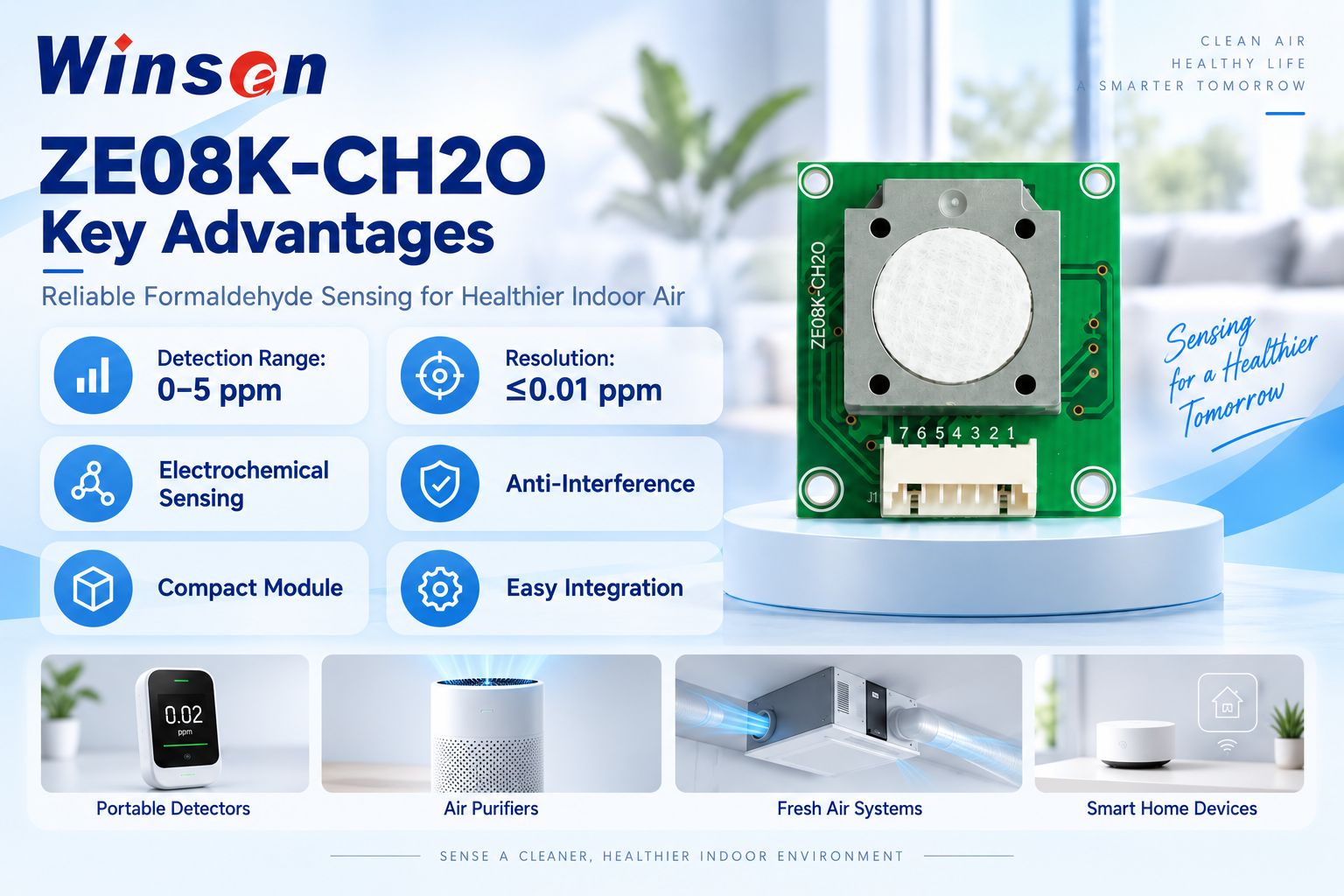
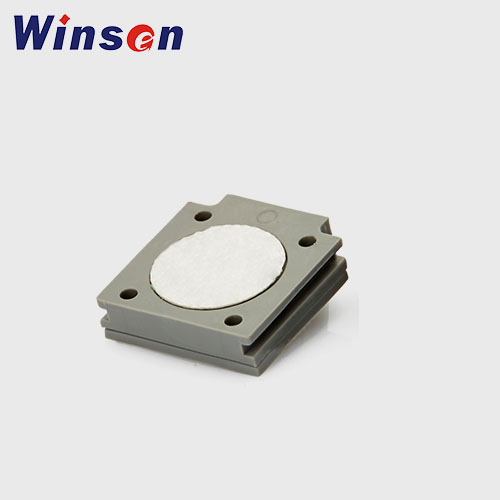
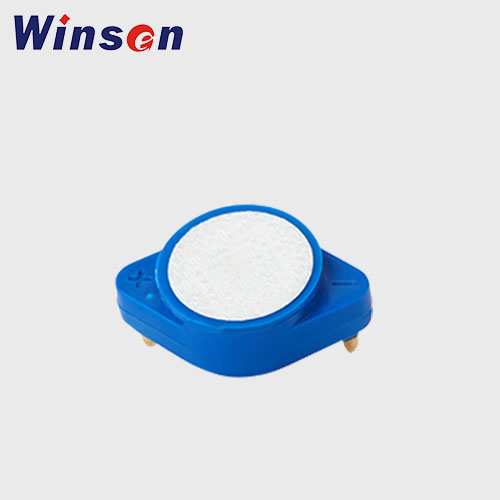
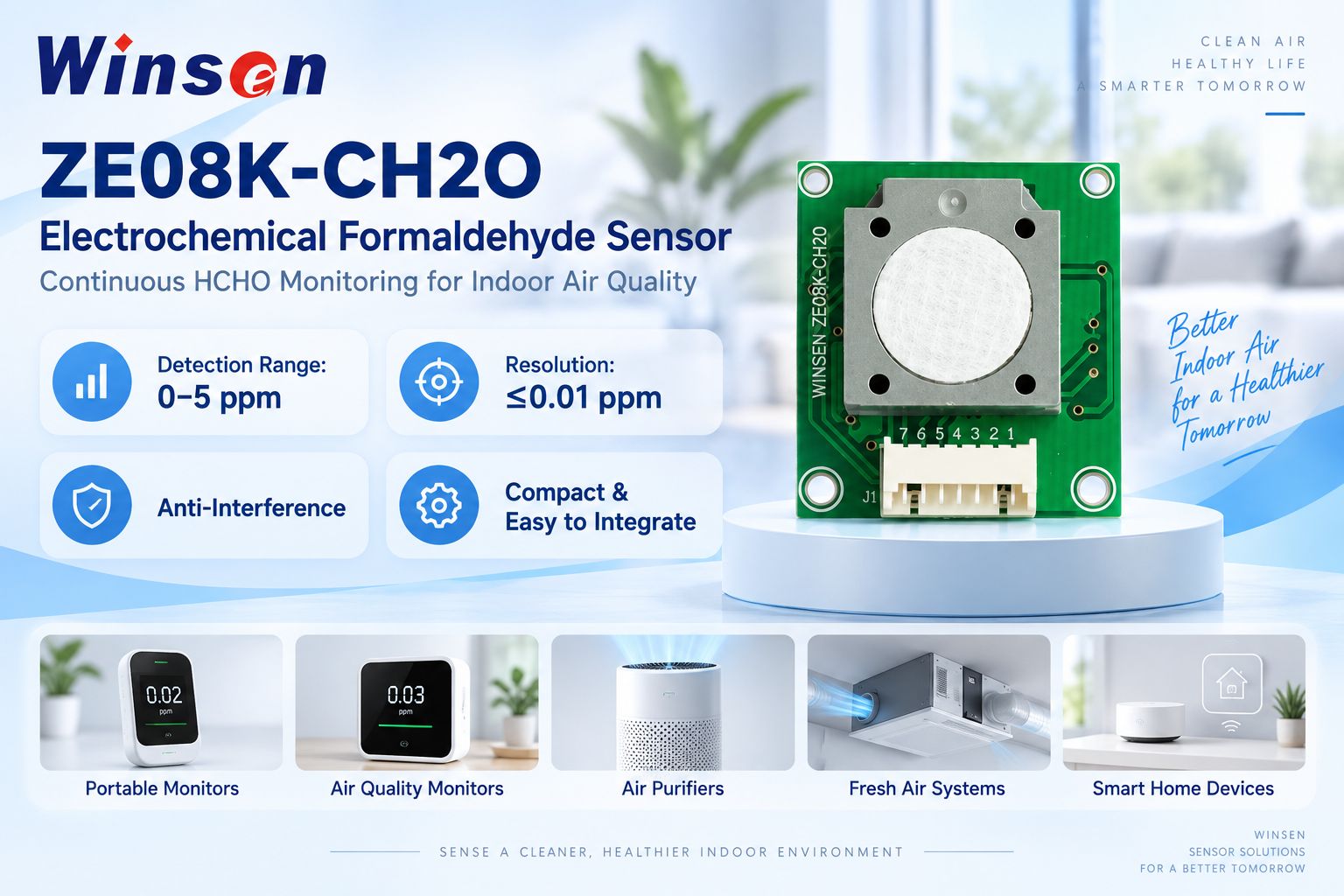
The Winsen ZE08K-CH2O Electrochemical Formaldehyde Sensor is designed for HCHO monitoring in indoor air quality equipment.
The module combines an electrochemical sensing element with signal processing and temperature compensation to provide a compact sensing solution for OEM integration.
Its published detection range is 0–5 ppm, with a resolution of ≤0.01 ppm, making it suitable for indoor formaldehyde monitoring applications.
High Sensitivity for Low-Concentration Monitoring
Indoor air quality applications require sensors capable of detecting relatively small concentration changes.
ZE08K-CH2O is designed to provide stable formaldehyde concentration information for environmental monitoring devices.
Anti-Interference Optimization
Real indoor air contains many gases besides formaldehyde.
Potential interferents can include:
- alcohol;
- acetone;
- benzene-related VOCs;
- cleaning product vapors;
- other organic volatile compounds.
The ZE08K-CH2O incorporates anti-interference optimization to help improve the reliability of formaldehyde measurement in complex indoor environments.
Compact Design for OEM Integration
The module is suitable for integration into compact electronic products.
This makes it useful for manufacturers developing:
- portable monitors;
- air quality terminals;
- air purifiers;
- smart appliances;
- HVAC systems.
Multiple Signal Outputs
The module supports multiple output methods for integration with different host control architectures.
This allows manufacturers to incorporate formaldehyde data into displays, control logic, alarms or connected monitoring platforms.
Typical Applications of ZE08K-CH2O
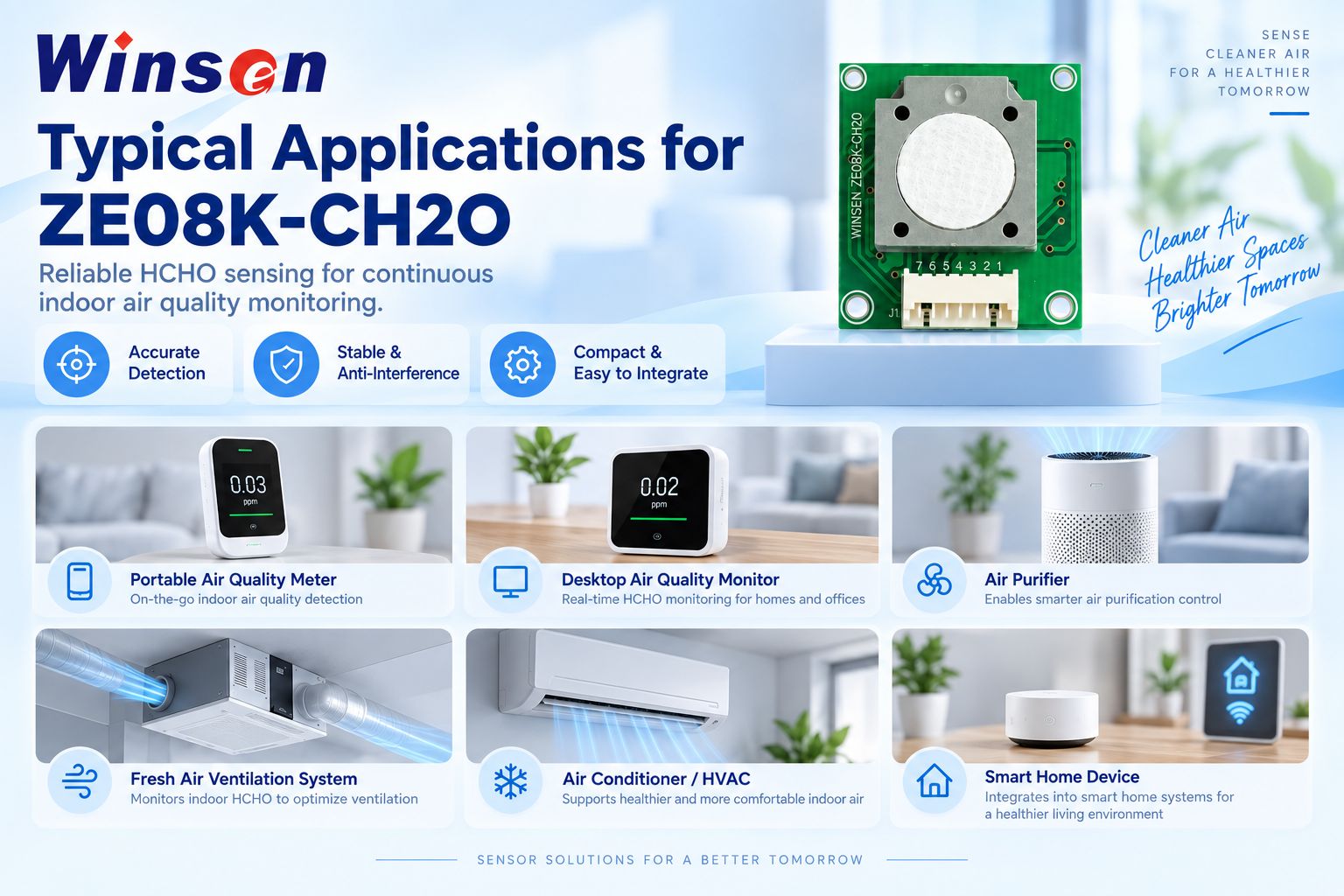
The ZE08K-CH2O can support a broad range of indoor air quality applications.
Portable Air Quality Monitors
Portable devices can be used to monitor formaldehyde conditions in:
- homes;
- offices;
- newly furnished rooms;
- rental properties;
- vehicles;
- public indoor spaces.
Air Quality Monitoring Equipment
Dedicated indoor air monitors can combine formaldehyde with other environmental parameters such as:
- CO2;
- VOCs;
- PM2.5;
- temperature;
- humidity.
This creates a more complete indoor air quality picture.
Air Purifiers
Formaldehyde sensing can provide an additional environmental input for intelligent purification systems.
Instead of operating only at fixed fan speeds, future systems can use pollutant information as part of their control strategy.
Fresh-Air Ventilation Systems
Ventilation systems can use indoor sensor data to support demand-based air exchange.
When pollutant conditions change, the controller can adjust ventilation according to the overall system design.
Air Conditioners and HVAC Equipment
Modern HVAC systems are increasingly integrating environmental sensors beyond temperature alone.
Formaldehyde sensing can become part of a broader IAQ sensing architecture together with CO2, VOC, PM and humidity sensors.
Smart Home Systems
Connected formaldehyde sensors can provide continuous environmental information to smart home platforms.
This allows users or automation systems to track changes and coordinate ventilation or purification equipment.
Formaldehyde Is Only One Part of Indoor Air Quality
Modern indoor air quality monitoring is becoming increasingly multi-dimensional.
A complete IAQ device may monitor several parameters at the same time:
HCHO + CO2 + VOC + PM2.5 + Temperature + Humidity
Each parameter provides a different part of the environmental picture.
Formaldehyde sensors help identify one important pollutant.
CO2 sensors can provide information related to ventilation and occupancy.
Particulate sensors monitor airborne particles.
Temperature and humidity sensors provide environmental context.
VOC sensors can indicate broader volatile organic compound changes.
Combining multiple sensing dimensions gives equipment manufacturers more useful data for intelligent indoor environmental control.
From Detection to Indoor Air Management
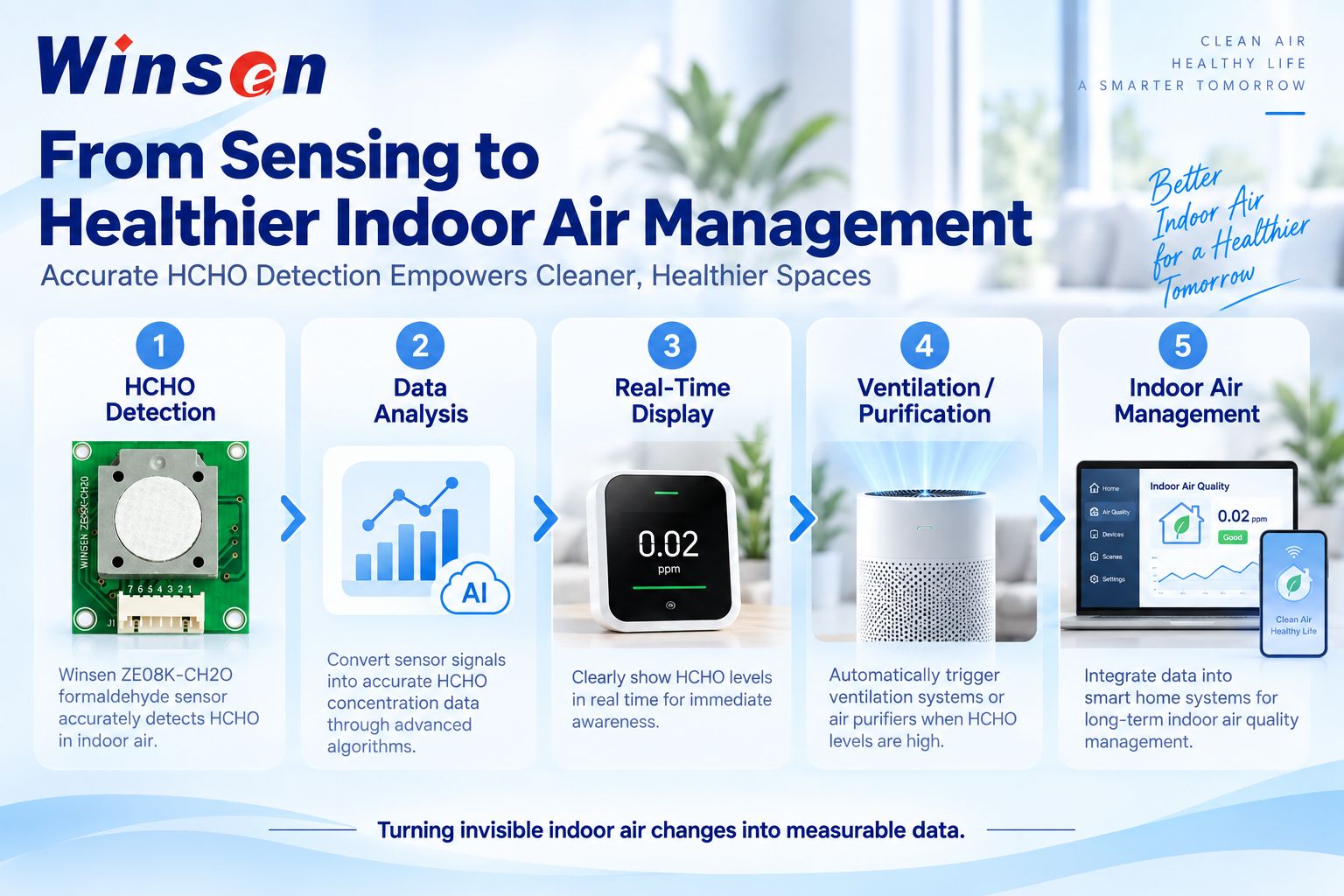
The role of indoor air sensors is changing.
In the past, many products were designed simply to display a concentration value.
Today, sensors are increasingly connected to other parts of the system.
A modern indoor air management architecture may look like:
Sensor → Controller → Analysis → Ventilation / Purification → Environmental Adjustment
For example, a smart ventilation system may combine formaldehyde, CO2 and humidity data before adjusting airflow.
An air purifier may combine PM, VOC and HCHO data to determine its operating strategy.
A building management platform may record long-term trends and use environmental information to support maintenance or ventilation planning.
The sensor therefore becomes more than a measuring component.
It becomes part of a complete environmental control system.
Why OEMs Should Consider Continuous Formaldehyde Monitoring
For equipment manufacturers, continuous monitoring offers several advantages over one-time testing.
It allows devices to:
- track concentration changes over time;
- identify unusual environmental trends;
- support intelligent control strategies;
- provide users with visible indoor air data;
- integrate with ventilation and purification systems;
- support connected smart-home and building platforms.
As indoor air quality becomes an increasingly important product feature, reliable sensing can help manufacturers differentiate their devices beyond basic temperature or particle monitoring.
Invisible Pollutants Need Reliable Sensing
The public discussion around formaldehyde in everyday products may change with the news cycle.
The underlying indoor air quality challenge will remain.
Formaldehyde can originate from many materials and products, and its indoor concentration can change with temperature, humidity, ventilation and material loading.
It cannot be evaluated reliably with sight or smell alone.
It needs to be measured.
As air quality monitors, purifiers, HVAC systems and smart home devices become more connected and intelligent, formaldehyde sensing will increasingly become part of a broader environmental sensing ecosystem.
For OEM manufacturers, the goal is not simply to display another number.
It is to turn invisible environmental changes into data that can be:
measured, analyzed, controlled and managed.
The ZE08K-CH2O Electrochemical Formaldehyde Sensor provides a compact sensing option for formaldehyde monitoring in indoor air quality equipment, HVAC systems, purifiers, smart homes and other connected environmental devices.
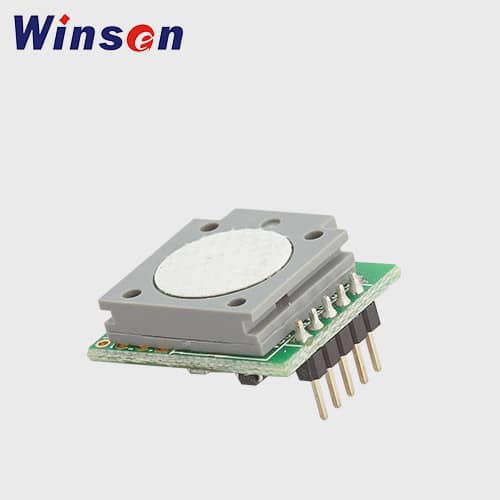
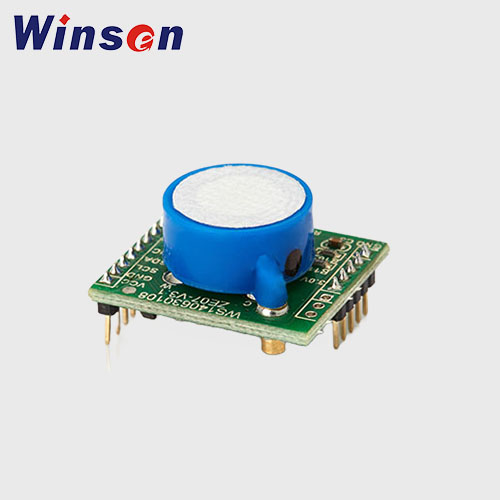
Electrochemical HCHO Formaldehyde Sensor Module ZE08B-CH2O
- CH2O, HCHO, Formaldehyde
- 0~1.6ppm
- Read More
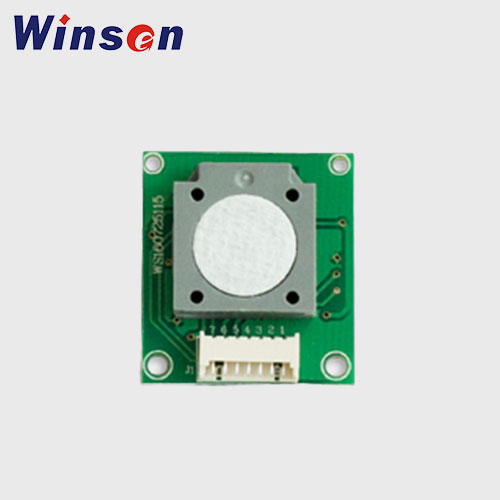
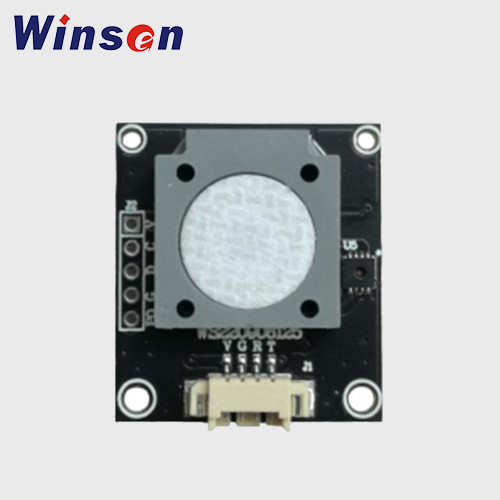
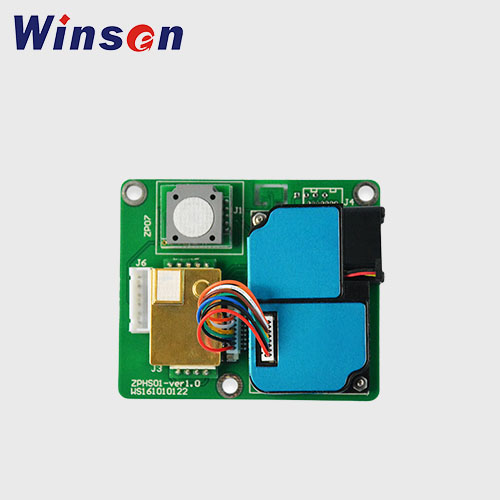
ZPHS01 Multi-in-One Sensor Module (HCHO version)
- CO2, PM2.5, CH2O, VOC, Temperature, Humidity
- CO2: 0-5000ppm; PM2.5: 0-1000μg/m³; CH2O: 0-1.6ppm; VOC: 4 level; Temperature: 0-65℃ (Accuracy±0.5℃); Humidity: 0-100%RH (Accuracy±3%)
- Read More