Stable Pressure, Stable Liquid Cooling: Pressure Monitoring Solution for Data Center CDU Systems
The rapid development of artificial intelligence, high-performance computing and large-scale GPU clusters is driving continuous growth in data center power density.
As computing systems become more powerful, traditional air cooling faces increasing challenges in heat dissipation efficiency and space utilization. Liquid cooling is becoming an important thermal management approach for next-generation data centers because it provides higher heat transfer efficiency and better support for high-density computing environments.
However, a liquid cooling system requires continuous monitoring of key operating parameters to maintain stable operation. Among these parameters, pressure, temperature and flow are three essential indicators that reflect coolant circulation conditions.
Pressure monitoring provides valuable information about:
- Pump operating conditions
- Supply and return coolant pressure balance
- Filter resistance changes
- Heat exchanger pressure drop
- External pipeline operating status
For data center liquid cooling systems, pressure measurement is not only a monitoring requirement but also an important data source for system control, operation analysis and preventive maintenance.
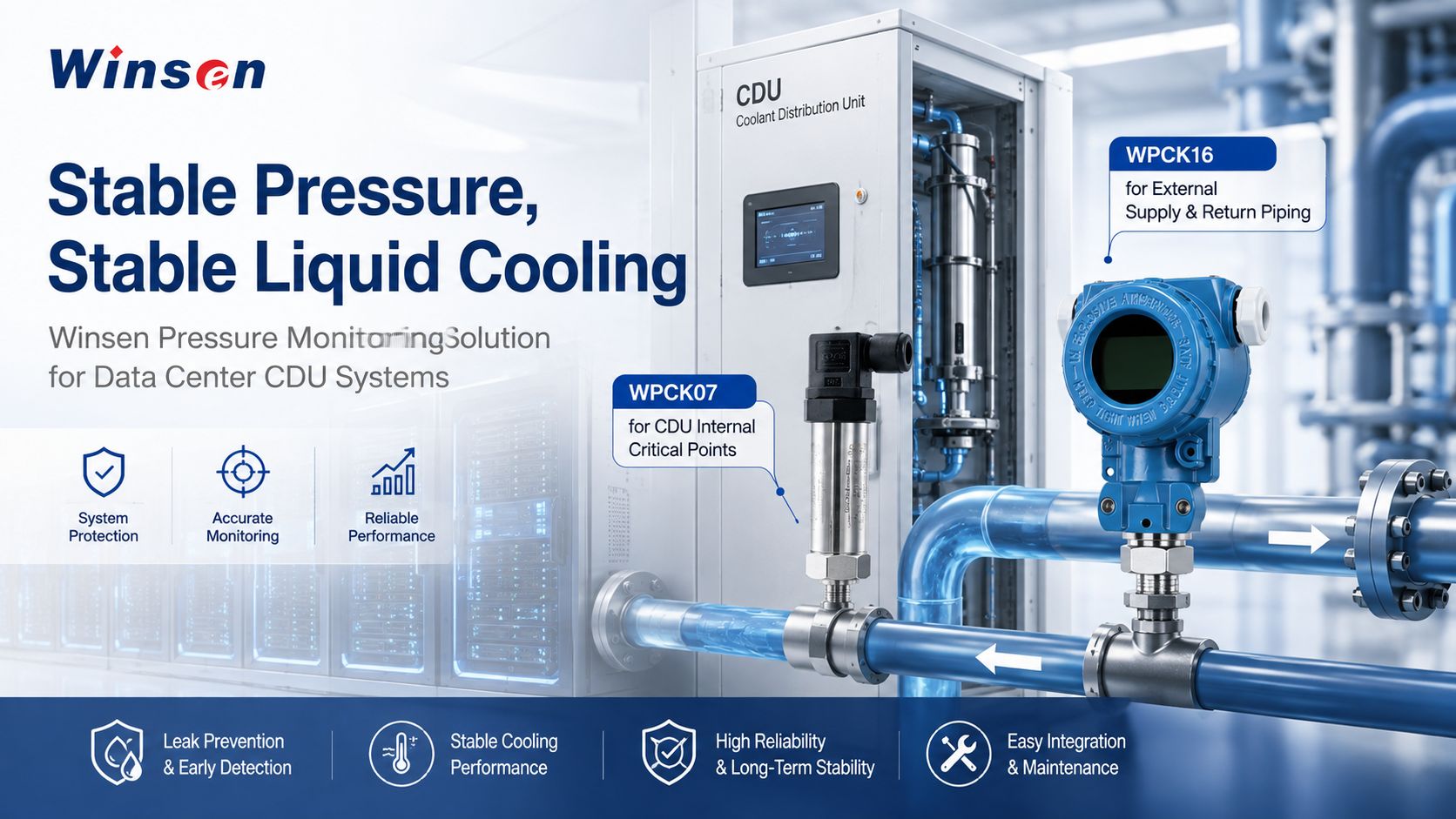
Winsen provides a pressure monitoring solution designed for different liquid cooling application levels:
- WPCK07 pressure sensor: Designed for critical pressure measurement points inside CDU systems.
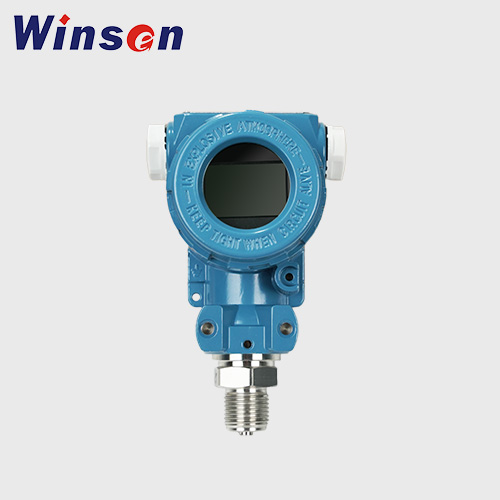
- WPCK16 pressure transmitter: Designed for external facility-side supply and return piping where field inspection and system monitoring are required.
Why Does a Liquid Cooling System Need Pressure Monitoring?
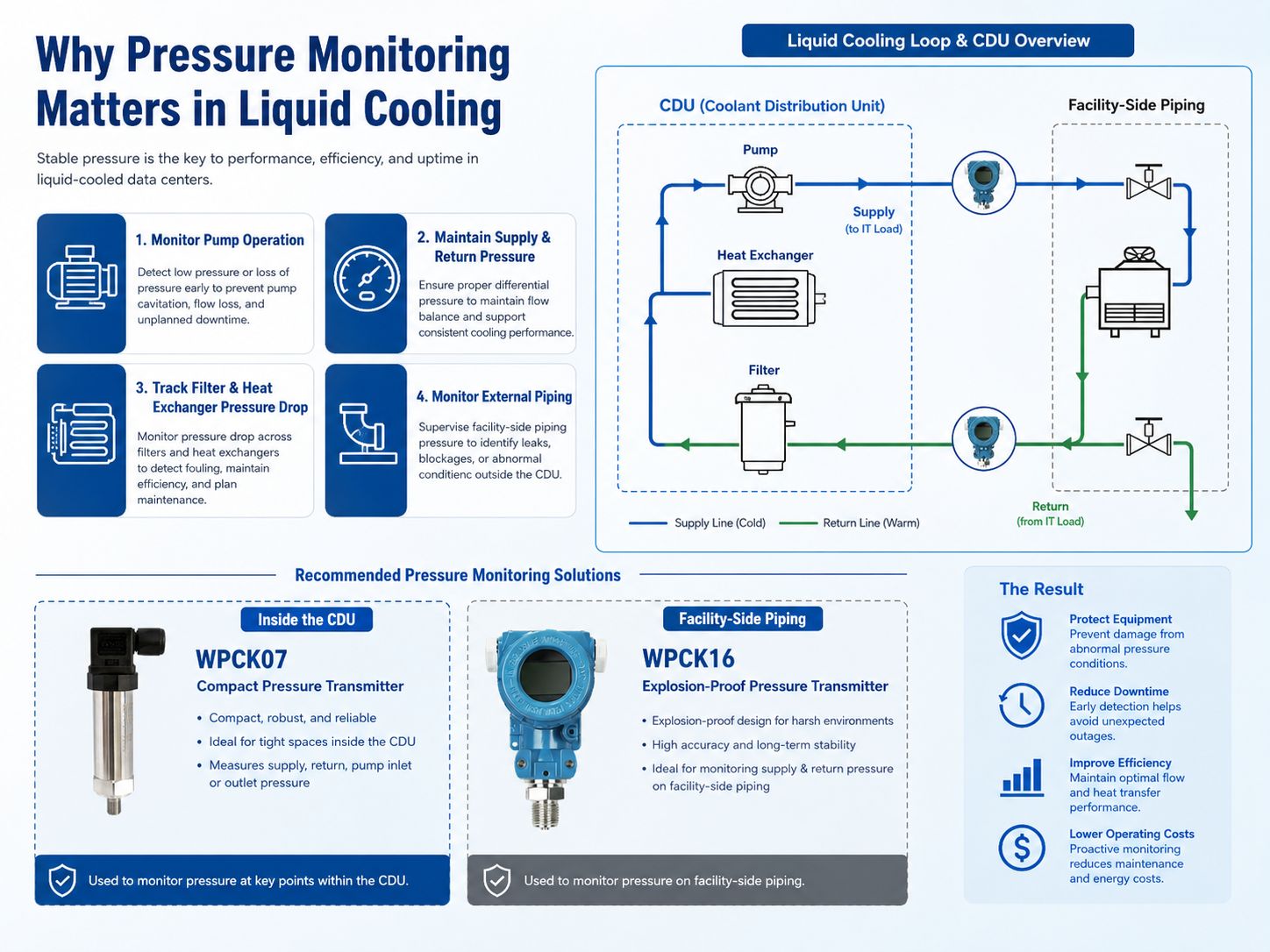
Pressure monitoring helps data center operators and system developers understand the hydraulic condition of a liquid cooling system.
In a CDU-based cooling architecture, pressure data can support the evaluation of:
- Pump performance
- Coolant circulation status
- Supply and return pressure difference
- Component pressure loss
- Pipeline condition
By combining pressure information with temperature and flow measurements, the cooling system can obtain a more complete picture of its operating condition.
CDU: A Key Component in Data Center Liquid Cooling Systems
A Coolant Distribution Unit (CDU) is a key connection point between computing equipment and facility cooling infrastructure.
In direct liquid cooling systems, the CDU manages coolant circulation between the server cooling loop and the facility cooling loop through heat exchange and pump circulation.
A typical CDU may include:
- Circulation pumps
- Heat exchangers
- Filters
- Valves
- Pressure control components
- Supply and return manifolds
- Pressure sensors
- Temperature sensors
- Flow sensors
- Control systems
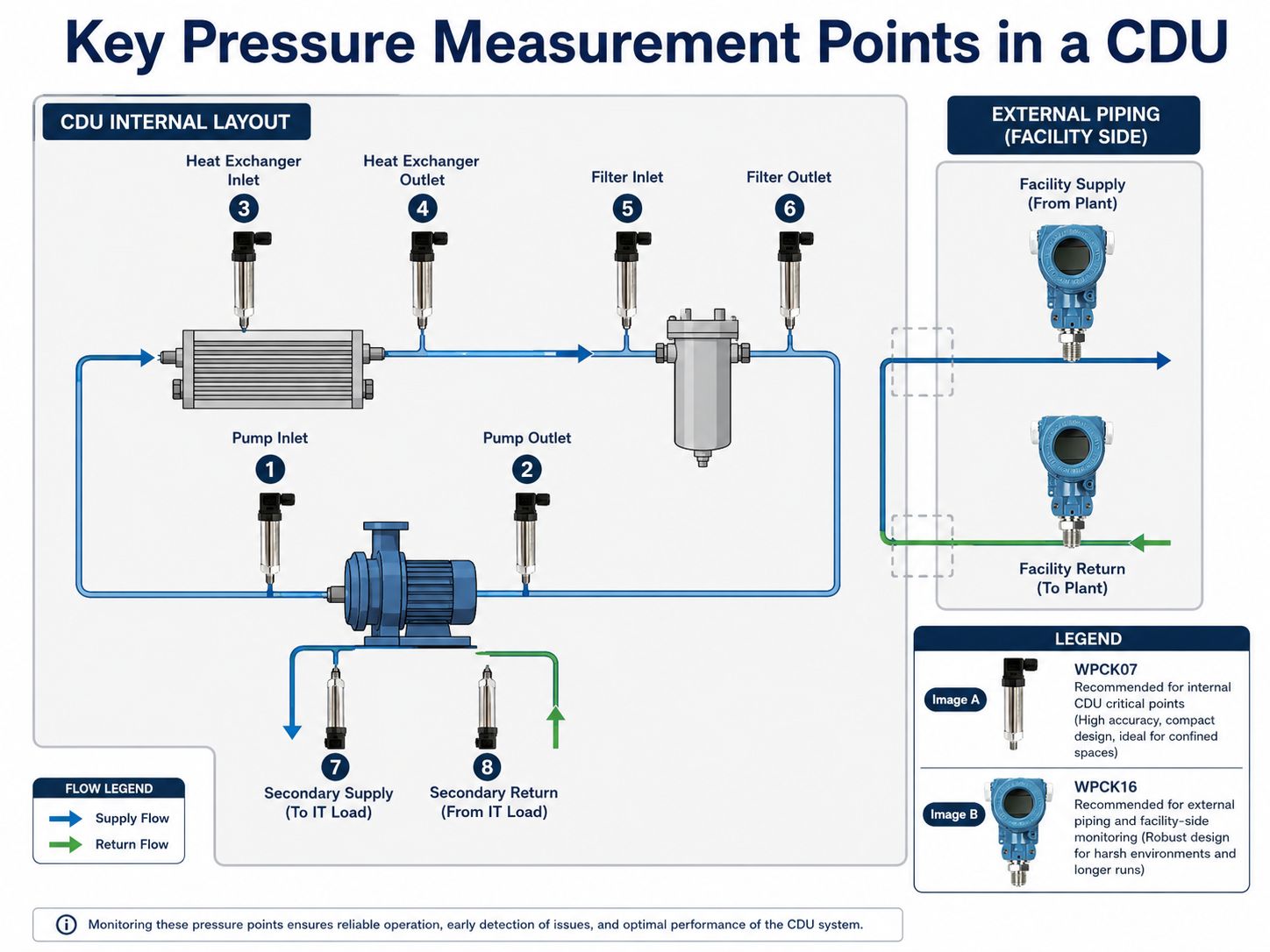
Inside the CDU, pressure sensors are installed at important hydraulic points to monitor changes in the coolant circuit.
Typical measurement locations include:
- Pump inlet and outlet
- Heat exchanger inlet and outlet
- Filter inlet and outlet
- Secondary-side supply and return pipelines
For modular data centers and liquid cooling containers, the CDU may also connect to external facility-side cooling pipelines. These external pipelines require additional pressure monitoring points for commissioning, inspection and system operation management.
Key Applications of Pressure Monitoring in Liquid Cooling Systems
Monitoring Pump Operation
The circulation pump provides the driving force for coolant movement.
Pressure measurement before and after the pump can provide information related to:
- Pump operating status
- Pressure difference changes
- Hydraulic performance
- System operation trends
During pump startup, shutdown or valve adjustment, temporary pressure fluctuations may occur. Pressure sensors used in these environments should consider long-term stability and adaptability to dynamic operating conditions.
Monitoring Supply and Return Pressure Balance
Liquid-cooled servers and cold plates require appropriate coolant circulation conditions.
Monitoring supply and return pressure helps evaluate:
- Hydraulic balance
- Coolant distribution
- Pump adjustment performance
- Abnormal pressure changes
When pressure data is analyzed together with temperature and flow information, system developers can better understand cooling performance and operating trends.
Monitoring Filter and Heat Exchanger Conditions
Pressure differences across components provide useful information about hydraulic resistance.
For example:
A filter may experience increasing flow resistance as contaminants accumulate. Monitoring pressure before and after the filter can provide data for maintenance planning.
Similarly, pressure changes across a heat exchanger can help evaluate variations in hydraulic conditions.
Pressure monitoring therefore supports condition analysis without requiring the system to rely only on fixed maintenance intervals.
Monitoring External Supply and Return Pipelines
In modular data centers and liquid cooling containers, the CDU is often connected to external cooling infrastructure through longer supply and return pipelines.
External pressure monitoring can support:
- Pipeline condition evaluation
- Commissioning adjustment
- Routine inspection
- Pressure trend analysis
Typical monitoring locations include:
- Facility supply pipeline
- Facility return pipeline
- CDU primary-side connections
- External cooling equipment connections
Challenges for Liquid Cooling Pressure Sensors
Data center liquid cooling systems often operate continuously and contain pumps, valves, heat exchangers and compact piping structures.
Pressure sensors used in these environments need to consider several engineering requirements.
Long-Term Measurement Stability
Pressure data may be used for:
- System monitoring
- Control adjustment
- Trend analysis
- Maintenance decisions
Long-term measurement stability is important for reliable operation analysis.
Pressure Fluctuation Adaptability
Pump operation and valve actions may create temporary pressure changes.
Pressure sensors should be suitable for applications where dynamic hydraulic conditions exist.
Coolant Compatibility
Liquid cooling systems may use different cooling media, including:
- Water
- Deionized water
- Water-glycol mixtures
- Application-specific coolants
Sensor material selection should be evaluated according to the actual coolant composition and operating environment.
Compact Integration
CDU systems contain multiple components within limited space.
Pressure sensors installed inside the CDU should support compact integration and flexible installation requirements.
System Communication Compatibility
Liquid cooling systems may connect with:
- PLC controllers
- Industrial monitoring systems
- Data center management platforms
- Embedded control units
Pressure sensors should support suitable electrical outputs and communication interfaces according to system requirements.
CDU Internal Pressure Monitoring: WPCK07 Pressure Sensor
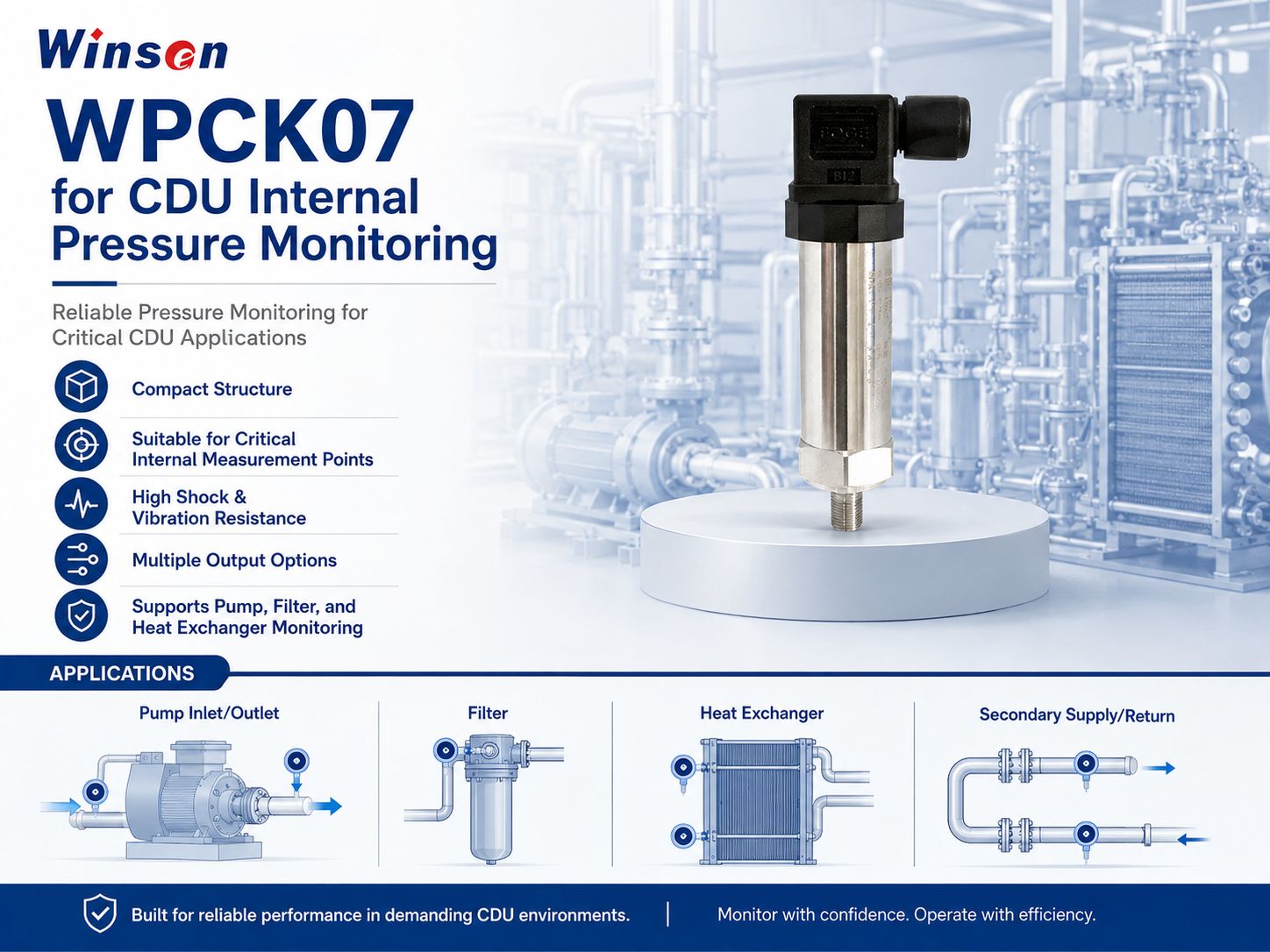
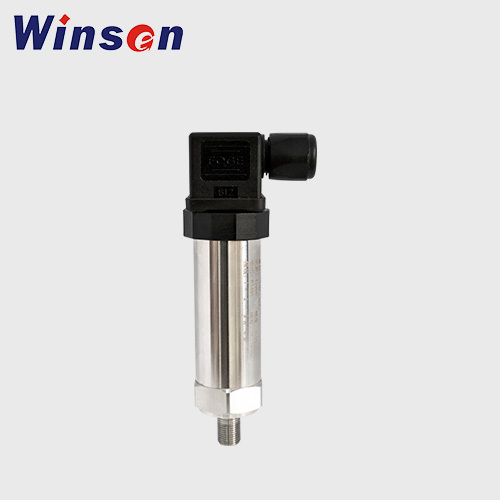
For critical pressure measurement points inside CDU systems, Winsen provides the WPCK07 Pressure Sensor.
WPCK07 is designed for equipment-level pressure monitoring applications where compact integration and stable measurement are required.
Typical application locations include:
- Pump inlet and outlet
- Heat exchanger inlet and outlet
- Filter inlet and outlet
- Secondary-side supply and return pipelines
Key characteristics include:
- Compact structure for equipment integration
- Stainless-steel pressure interface
- Multiple pressure range options
- Flexible electrical output configurations
- Support for digital communication options
- Suitable for long-term industrial monitoring applications
By installing WPCK07 at key CDU measurement points, system developers can obtain pressure data from important hydraulic components and combine it with temperature and flow information for further analysis.
External Facility-Side Pressure Monitoring: WPCK16 Pressure Transmitter
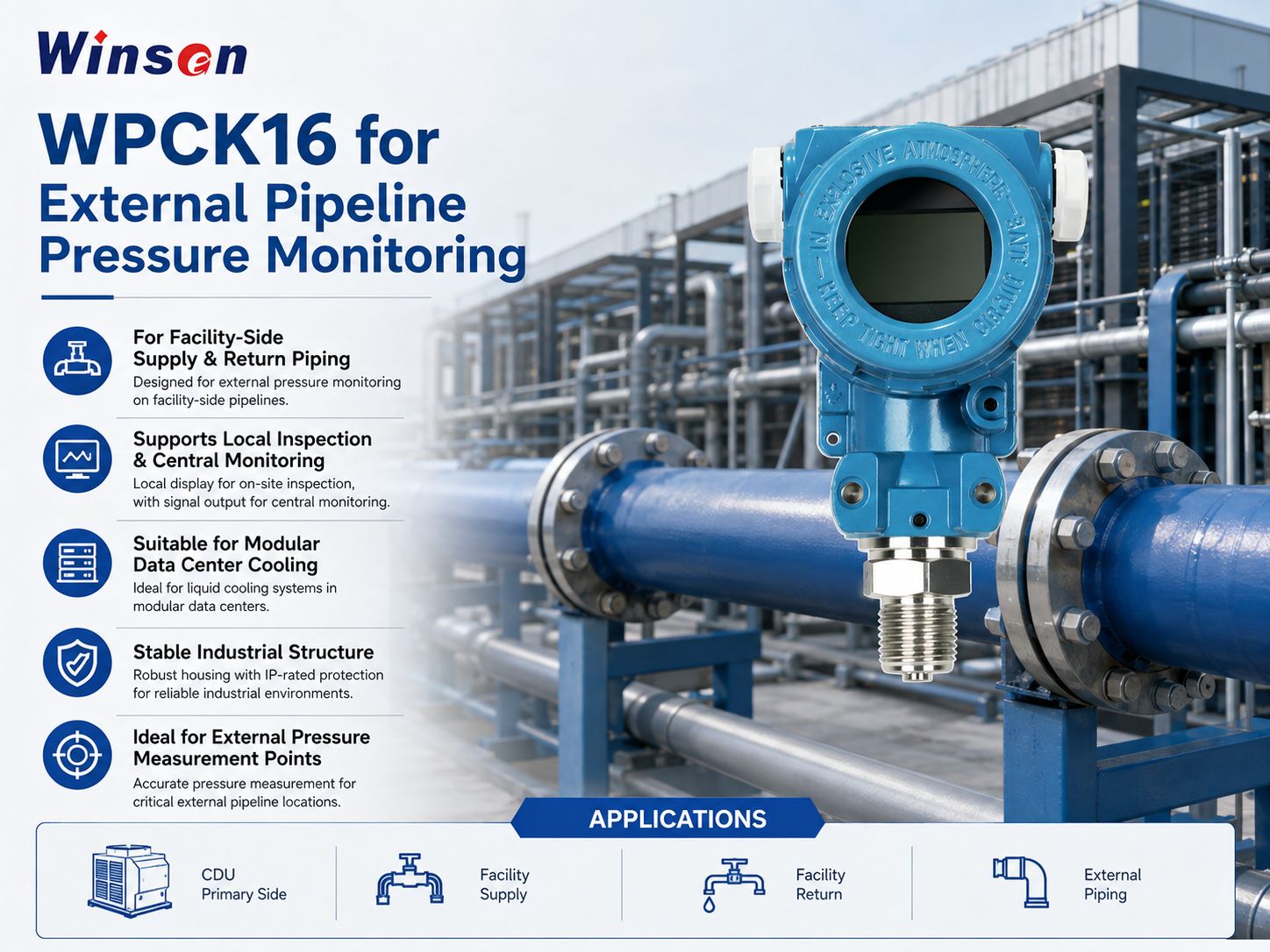
For external liquid cooling pipelines and facility-side monitoring points, Winsen provides the WPCK16 Pressure Transmitter.
WPCK16 is designed for applications where pressure monitoring requires both system integration and convenient field inspection.
Typical applications include:
- CDU primary-side pipelines
- Facility supply and return pipelines
- Modular liquid cooling container piping
- External cooling infrastructure connections
WPCK16 can support applications requiring:
- Local pressure checking
- Remote pressure monitoring
- Pressure trend recording
- Integration with control systems
This makes it suitable for external pipeline monitoring where operation teams need visibility into coolant pressure conditions during commissioning and maintenance.
Recommended Pressure Monitoring Architecture for Liquid Cooling Systems
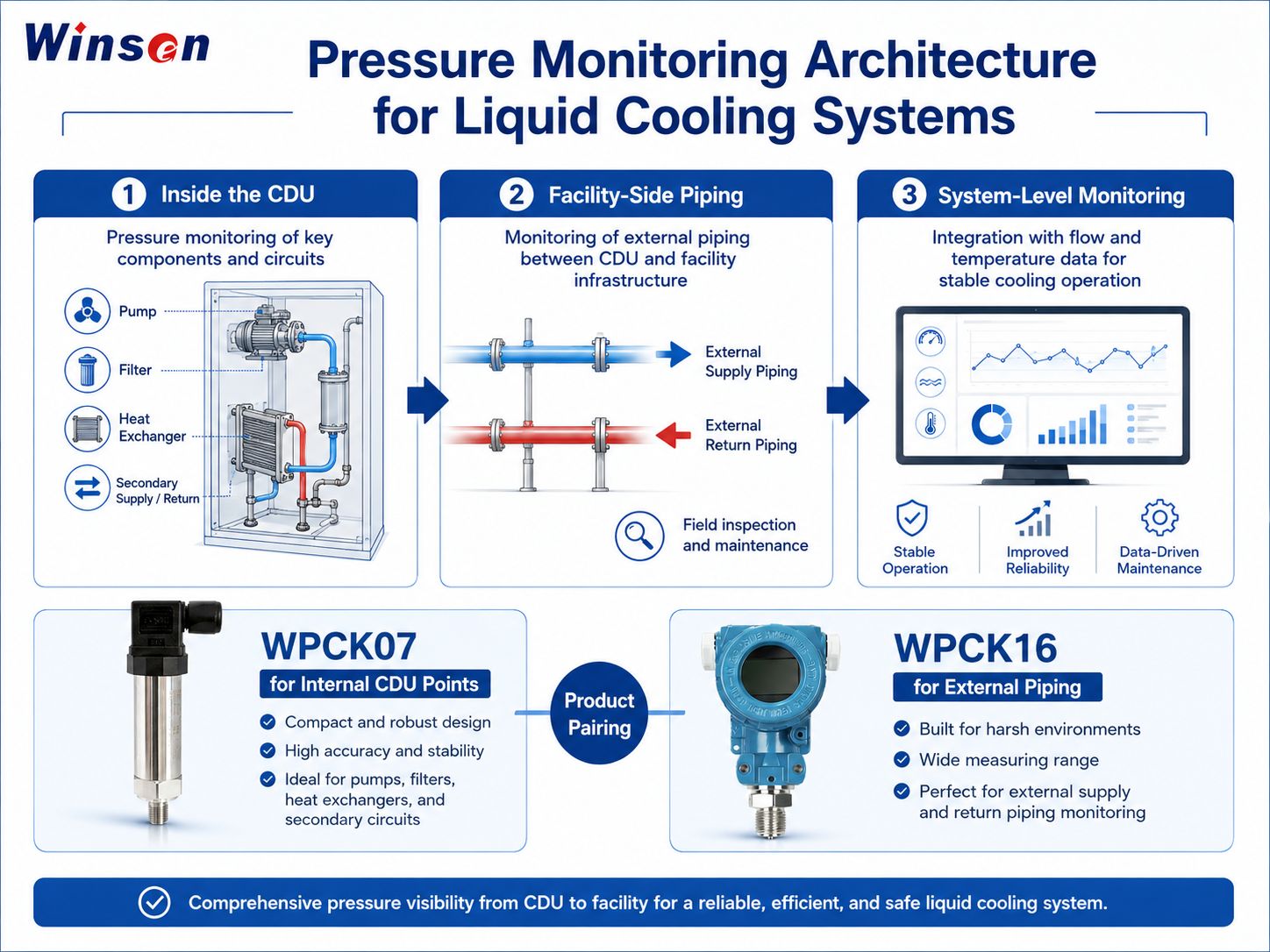
A complete liquid cooling pressure monitoring strategy should select sensors according to installation position and system requirements.
| Application Location | Monitoring Purpose | Recommended Product |
|---|---|---|
| Pump inlet and outlet | Monitor pump pressure conditions and pressure changes | WPCK07 |
| Heat exchanger inlet and outlet | Monitor hydraulic pressure changes | WPCK07 |
| Filter inlet and outlet | Monitor pressure difference trends | WPCK07 |
| CDU secondary supply and return | Monitor coolant circulation conditions | WPCK07 |
| Facility-side supply and return pipelines | Monitor external cooling pressure | WPCK16 |
| Modular liquid cooling container piping | Support field inspection and remote monitoring | WPCK16 |
The recommended architecture is:
Inside CDU → WPCK07
External Facility-Side Pipeline → WPCK16
This configuration allows pressure monitoring coverage from the internal CDU hydraulic circuit to the external cooling infrastructure.
Combining Pressure Monitoring with Temperature and Flow Data
Pressure is one of the important parameters in liquid cooling systems, but it provides greater value when combined with other operating information.
A complete monitoring system may include:
- Pressure
- Temperature
- Flow
- Humidity (where required)
For example:
When pressure changes together with reduced flow, the system can evaluate possible changes in hydraulic resistance.
When pressure remains stable but temperature increases, engineers can further investigate thermal load, heat transfer efficiency or cooling capacity.
Multi-parameter monitoring provides a more complete data foundation for liquid cooling system analysis.
Pressure Sensor Selection Considerations for CDU Applications
When selecting pressure sensors for CDU and liquid cooling projects, engineers should consider:
Pressure Range
The measurement range should match the expected operating pressure and possible transient conditions.
Coolant Medium
The cooling medium, additives and operating temperature should be considered during material selection.
Installation Interface
Mechanical connection requirements should match the CDU structure and pipeline design.
Output Signal
The sensor output should be compatible with the target control system, such as:
- Analog signals
- Digital communication
- RS485 interfaces
Installation Location
Internal CDU measurement points and external pipeline measurement points have different requirements.
Compact integration is important inside the CDU, while field accessibility may be more important for external piping.
Frequently Asked Questions
What is a CDU in a liquid cooling system?
A CDU (Coolant Distribution Unit) is a key component that manages coolant circulation between computing equipment and facility cooling infrastructure through pumps, heat exchangers and control components.
Why are pressure sensors needed in data center liquid cooling systems?
Pressure sensors provide information about coolant circulation conditions, pump operation, pressure balance and component pressure changes, supporting system monitoring and maintenance analysis.
Where should pressure sensors be installed in a CDU?
Typical installation points include pump inlet and outlet, heat exchanger inlet and outlet, filter inlet and outlet, and supply and return pipelines.
What is the difference between WPCK07 and WPCK16?
WPCK07 is designed for internal CDU pressure monitoring where compact integration is required. WPCK16 is designed for external pipeline monitoring where field inspection and system integration are important.
Can pressure monitoring be combined with temperature and flow monitoring?
Yes. Pressure, temperature and flow data can be combined to provide a more complete understanding of liquid cooling system operating conditions.
Stable Pressure Supports Stable Liquid Cooling
As AI computing, high-performance servers and GPU clusters continue to increase data center power density, liquid cooling systems are becoming an important part of modern computing infrastructure.
The CDU plays a central role in managing coolant circulation between computing equipment and facility cooling systems. Accurate pressure monitoring provides valuable information about hydraulic conditions, system trends and maintenance requirements.
Winsen provides pressure monitoring solutions for different liquid cooling application levels:
WPCK07 for critical pressure measurement points inside CDU systems
WPCK16 for external facility-side supply and return pipeline monitoring
For CDU manufacturers, liquid cooling system developers and data center infrastructure providers, Winsen can support pressure sensor selection according to application requirements, including pressure range, coolant conditions, installation structure and communication needs.
Contact Winsen to discuss pressure monitoring solutions for your data center liquid cooling system development.