What Is an AI Nose? How AI-Powered Electronic Noses Give Machines a Sense of Smell
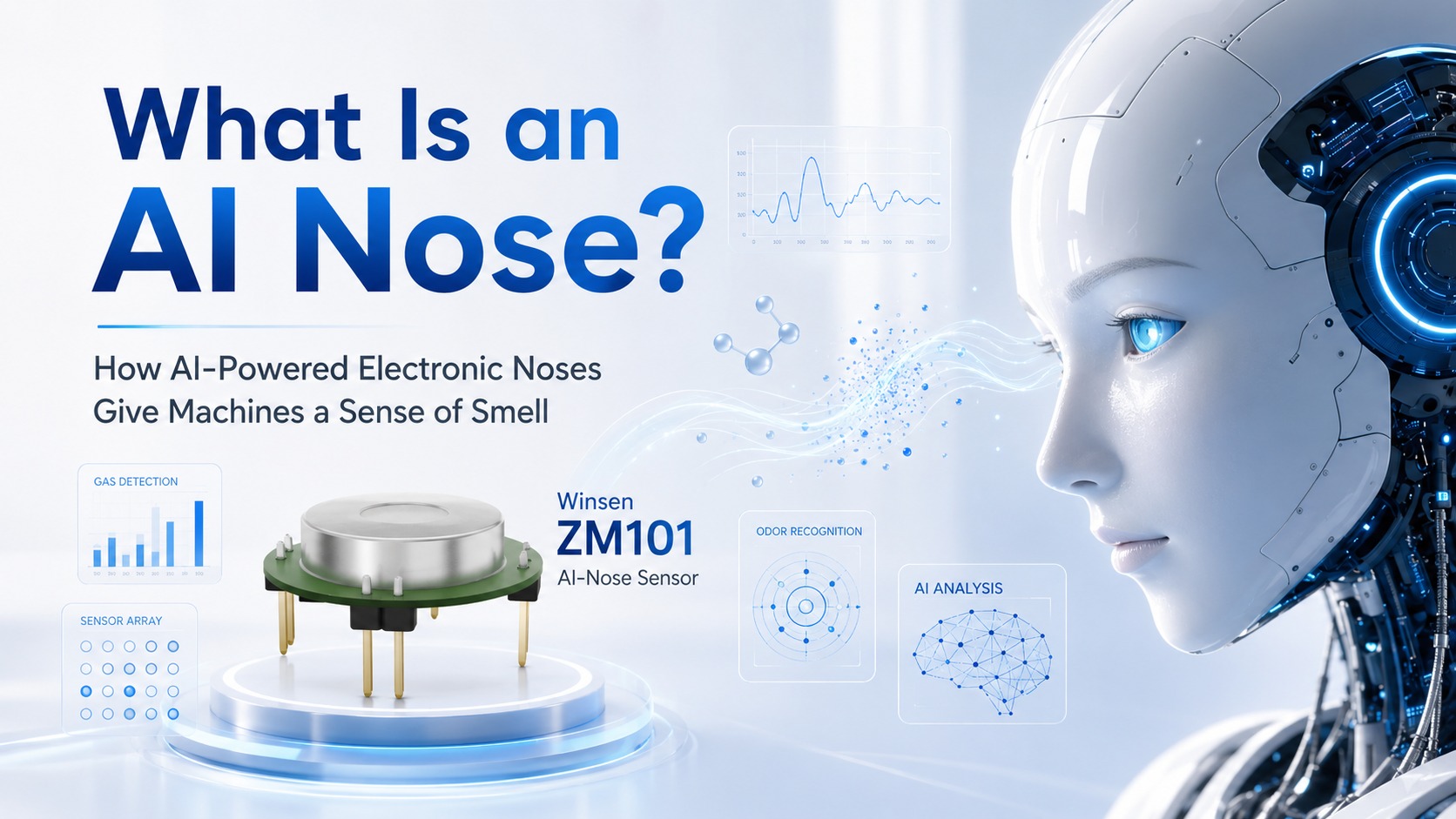
Artificial intelligence has enabled machines to see through cameras, listen through microphones, and understand their surroundings through LiDAR, radar, thermal imaging and other sensing technologies.
But many important changes in the physical world cannot be seen or heard.
A leaking gas pipe may look completely normal. Food can begin to spoil before visible changes appear. A battery or electrical component can release abnormal volatile compounds before smoke develops. Industrial processes can generate characteristic gas mixtures that are difficult to identify using a single gas concentration measurement.
This is where an AI Nose, also known as an AI-powered electronic nose or artificial olfactory sensing system, becomes valuable.
Instead of trying to mechanically reproduce the human nose, an AI Nose combines a multi-channel gas sensor array with signal processing and artificial intelligence algorithms.
The sensor array reacts to gases or odors, while AI analyzes the combined response pattern to determine what type of chemical environment the system is sensing.
In simple terms:
Gas or Odor → Sensor Array → Signal Processing → AI Model → Pattern Recognition
This changes gas sensing from simply asking:
“How much of a specific gas is present?”
to a more advanced question:
“What kind of gas, odor or chemical pattern is present?”
That difference is the foundation of machine olfaction.
What Is an AI Nose?
An AI Nose is an intelligent chemical sensing system designed to recognize gases, odors or characteristic gas mixtures using multiple sensing channels and pattern-recognition algorithms.
A typical system contains four core elements:
- Gas sensor array
- Signal acquisition and environmental compensation
- Feature extraction
- AI or machine-learning model
Unlike a conventional single-gas detector, an AI Nose does not necessarily depend on one sensor being perfectly selective to one specific gas.
Instead, several sensors respond differently to the same sample.
The combined response creates a multidimensional pattern—similar to a chemical fingerprint.
AI algorithms can then learn how these fingerprints differ.
For example, several odor sources may all contain VOCs, but the response intensity across different sensing channels can be significantly different.
A single signal may not clearly identify the sample. When several signals are analyzed together, however, the pattern becomes much more distinctive.
That is where artificial intelligence becomes useful.
How Does an AI Nose Work?
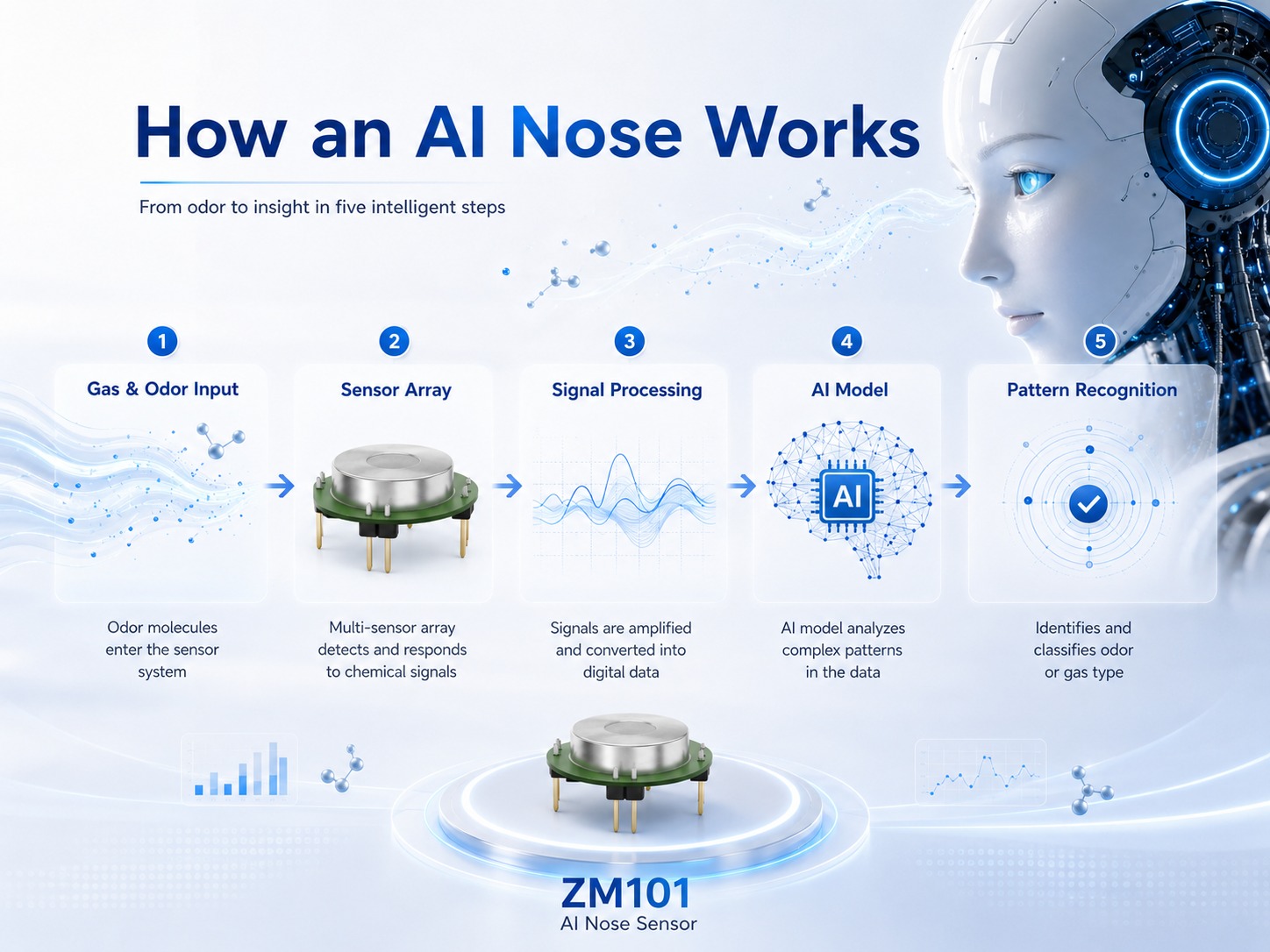
An AI Nose converts invisible chemical information into digital data that an AI model can analyze.
The overall process can be divided into five stages.
1. Gas and Odor Input
The process begins when a gas, vapor or odor reaches the sensing system.
The sample may contain:
- A single gas
- Multiple gases
- VOC mixtures
- Odor molecules
- Environmental interference
- Different humidity and temperature conditions
Real-world odors are rarely composed of only one chemical compound. They are usually complex mixtures.
2. Sensor Array Response
Instead of relying on one sensing element, an AI Nose uses several sensing channels simultaneously.
Each channel has different sensitivity characteristics.
When exposed to the same sample:
- One channel may respond strongly
- Another may respond moderately
- Another may respond only slightly
The relationship between these signals creates the first version of the odor fingerprint.
In a six-channel system, the response can conceptually be represented as:
R = [R₁, R₂, R₃, R₄, R₅, R₆]
Each value represents the response of one sensing channel.
The system can also analyze how those responses change over time.
3. Signal Processing
Raw sensor signals need to be processed before they are sent to an AI model.
Signal processing may include:
- Filtering
- Amplification
- Baseline correction
- Temperature compensation
- Humidity compensation
- Signal normalization
- Drift compensation
Environmental compensation is especially important because gas sensors can be influenced by changing temperature and humidity.
4. AI Model Analysis
The processed data is converted into features that make different gas patterns easier to distinguish.
Useful features may include:
- Response amplitude
- Response speed
- Recovery speed
- Signal slope
- Relative response between channels
- Area under the response curve
- Temporal characteristics
- Normalized sensor response
These features are then analyzed by machine-learning or deep-learning algorithms.
Depending on the application, suitable approaches may include:
- PCA
- Support vector machines
- Decision trees
- Random forests
- Neural networks
- Deep-learning models
- Time-series classification models
The objective is not simply to use the most complicated AI algorithm.
The objective is to build a model that can reliably distinguish the required gas or odor patterns under actual operating conditions.
5. Pattern Recognition
Once the system has been trained, the AI model can analyze new sensor data and compare it with previously learned patterns.
The final result may include:
- Odor classification
- Gas-pattern identification
- Abnormality detection
- Process-state recognition
- Quality classification
- Probability score
- Intelligent decision output
The result can then be transmitted to a robot, appliance, industrial controller, vehicle system or cloud platform.
AI Nose vs. Traditional Gas Sensors
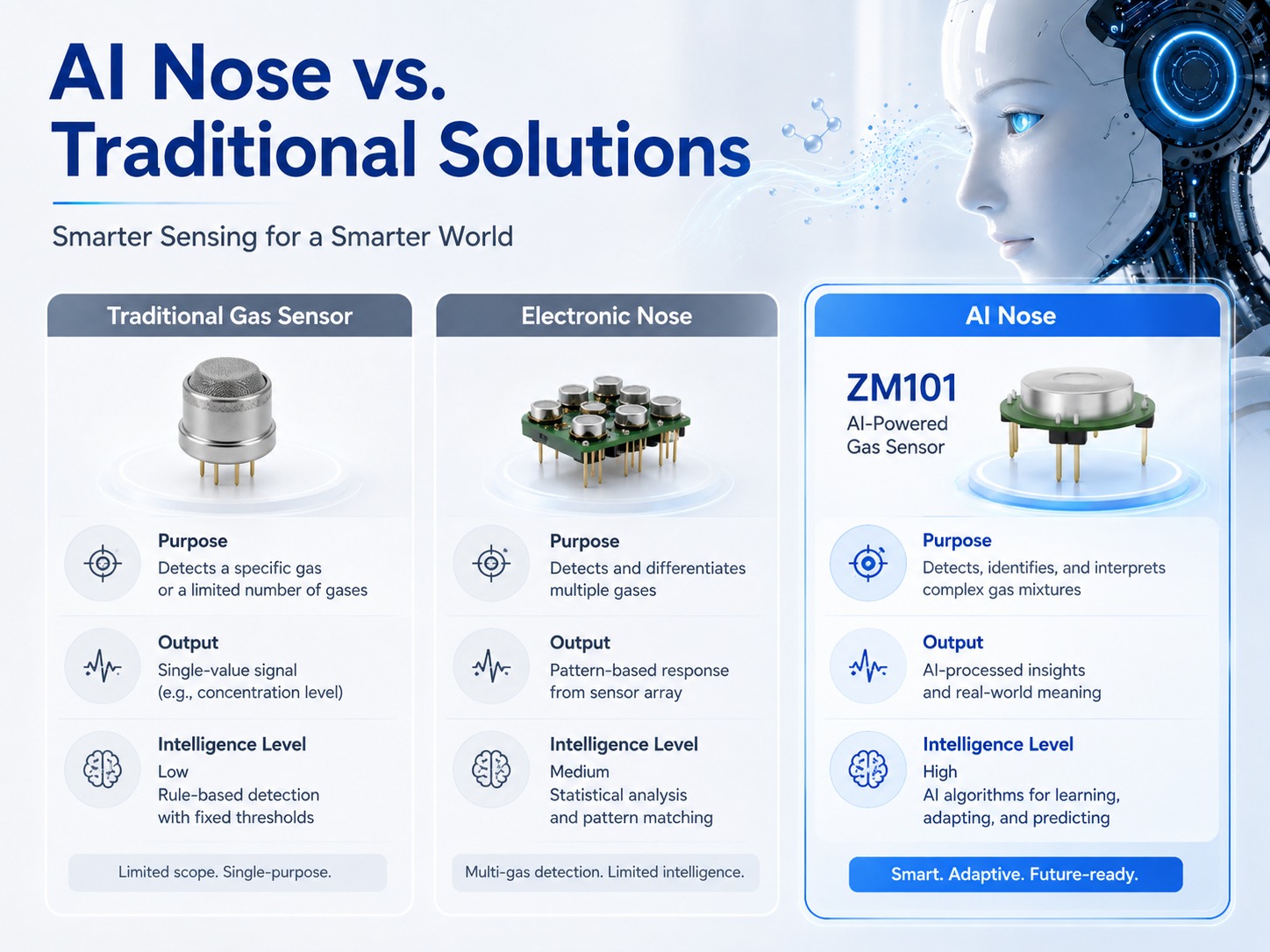
Traditional gas sensors and AI Nose systems solve different problems.
| Technology | Main Purpose | Typical Output | Intelligence Level |
|---|---|---|---|
| Single Gas Sensor | Detect or measure a specific target gas | Gas concentration | Fixed detection logic |
| Electronic Nose | Compare response patterns from multiple sensors | Pattern classification | Statistical pattern recognition |
| AI Nose | Learn complex sensor-array characteristics using AI | Classification, recognition and intelligent decision | Machine learning / AI analysis |
A conventional CO sensor, for example, may be designed to determine whether the carbon monoxide concentration is 20 ppm, 50 ppm or 100 ppm.
An AI Nose may instead analyze several sensor responses and determine whether the overall chemical pattern is more similar to:
- Normal air
- Solvent vapor
- Abnormal industrial emission
- Food spoilage
- Combustion-related gases
- A trained process state
- A specific odor category
Therefore, an AI Nose should not be considered a replacement for every conventional gas sensor.
Where a safety system requires an exact concentration threshold for a regulated target gas, a dedicated gas sensor remains essential.
AI Nose technology becomes especially valuable when the application requires:
- Pattern recognition
- Classification
- Chemical-environment identification
- Complex gas-mixture analysis
- Abnormal-state recognition
Why Does an AI Nose Need Multiple Sensors?
Human olfaction is fundamentally based on pattern recognition.
The human nose does not normally use one receptor for one specific odor.
Instead, multiple receptors respond at different intensities, creating a pattern that the brain interprets as a smell.
Electronic noses use a similar general concept.
Rather than creating one perfectly selective sensor for every possible odor, a sensor array provides multiple partially overlapping sensing dimensions.
This approach is particularly useful for complex mixtures such as:
- Food odors
- Industrial exhaust
- Refrigerant environments
- Combustion gases
- Chemical production emissions
- Indoor environmental odors
- Waste-treatment gases
The sensor array provides the multidimensional data.
AI provides the ability to interpret it.
Electronic Nose vs. AI Nose
The term electronic nose, or e-nose, has existed for decades.
A traditional electronic nose generally combines:
Sensor Array + Pattern Recognition
AI Nose technology can be viewed as the next stage of this concept.
Modern AI Nose systems benefit from:
- MEMS miniaturization
- Higher-dimensional sensor arrays
- Improved digital signal processing
- Machine learning
- Neural networks
- Edge AI processors
- Cloud-based model development
- Multi-sensor fusion
The important improvement is not simply adding the word “AI.”
The real change is that sensor-array data can now be processed by more powerful learning algorithms and integrated into intelligent systems capable of making decisions.
MEMS Technology Makes AI Nose Systems Easier to Integrate
One of the historical challenges of electronic nose systems has been size.
Traditional odor-recognition instruments can require:
- Multiple independent sensors
- Complex sampling chambers
- Large circuit boards
- External processing equipment
MEMS gas sensing technology significantly reduces these integration barriers.
MEMS sensors can provide:
- Compact size
- Low power consumption
- Fast thermal response
- Multiple sensing elements in a compact structure
- Suitability for mass production
- Easier integration into embedded equipment
This makes electronic olfaction increasingly practical for robots, appliances, vehicles and other intelligent terminals.
Winsen ZM101-A AI Nose Sensor
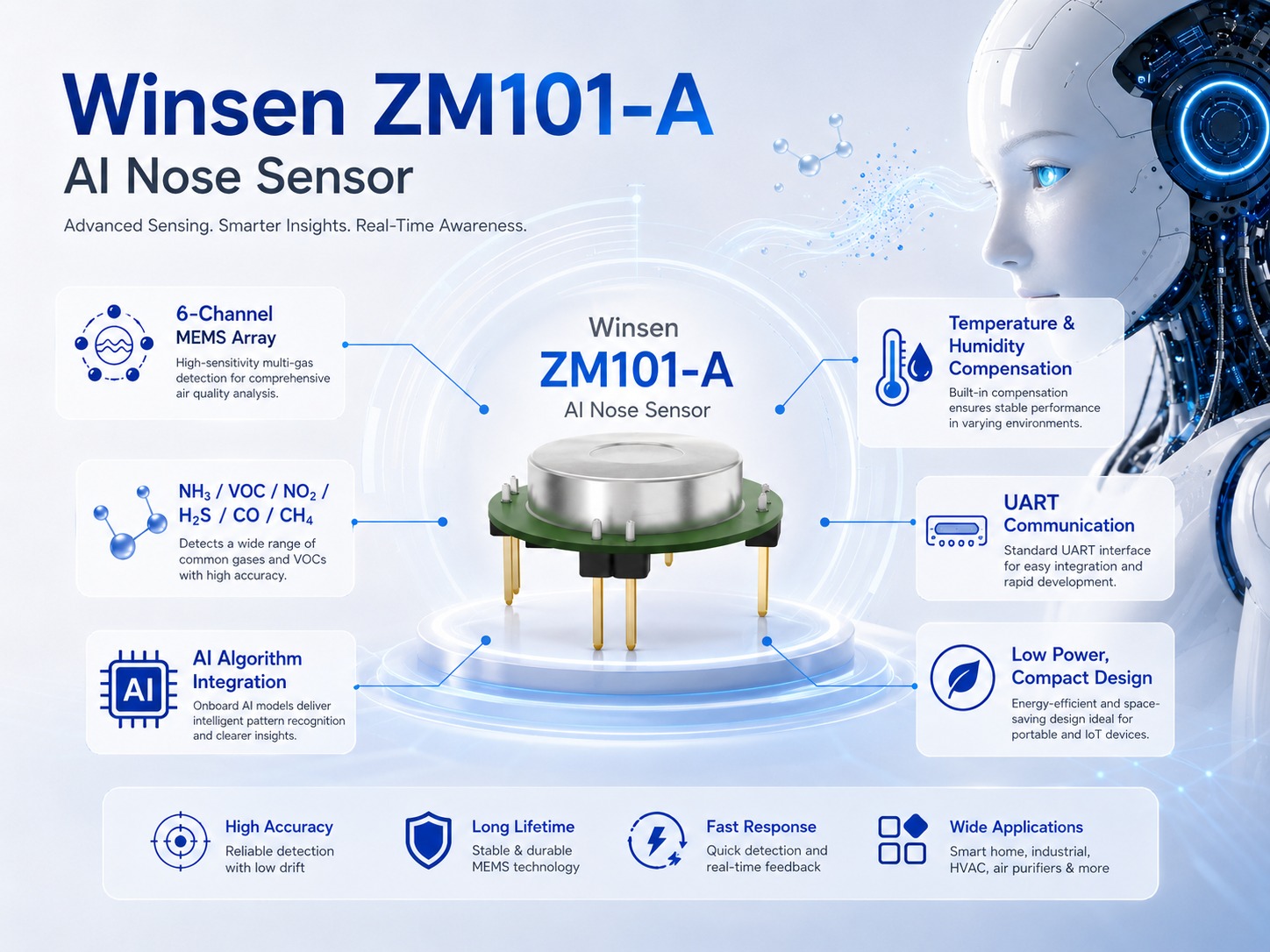
Winsen has developed the ZM101-A AI-Nose Sensor as a multi-channel intelligent sensing platform based on MEMS gas sensing technology.
ZM101-A integrates up to six MEMS sensing channels, providing multidimensional gas-response information that can be used for AI-based odor and chemical-pattern recognition.
Available sensing dimensions include:
- NH₃
- VOC
- NO₂
- H₂S
- CO
- CH₄
The important point is that these channels are not intended only to provide six independent concentration values.
Their combined response creates a richer sensing pattern that can be used for machine-learning and AI recognition.
Key Features of ZM101-A
- Up to six MEMS sensing channels
- Compact sensor-array design
- Fast response and recovery
- Temperature and humidity compensation
- Signal filtering and processing
- AI model integration capability
- UART communication
- Low power consumption
- Suitable for embedded intelligent devices
- Flexible application development
ZM101-A Technical Parameters
| Parameter | Specification |
|---|---|
| Product Model | ZM101-A |
| Product Type | MEMS Gas Sensor Array |
| Sensing Channels | Up to 6 |
| NH₃ Range | 1–100 ppm |
| VOC Range | 1–10 ppm |
| NO₂ Range | 0.1–10 ppm |
| H₂S Range | 0.5–10 ppm |
| CO Range | 5–200 ppm |
| CH₄ Range | 100–6000 ppm |
| Supply Voltage | DC 3.3 V |
| Operating Current | ≤150 mA |
| Power Consumption | ≤400 mW |
| Communication | UART |
| Warm-up Time | ≤120 s |
| Operating Temperature | -40°C to 85°C |
| Operating Humidity | 5%RH–95%RH, non-condensing |
For real AI Nose projects, the sensing-channel configuration and model should be selected according to the customer's actual target gases, odors and application environment.
An AI Nose Does Not Automatically Recognize Every Smell
This is an important engineering distinction.
An AI Nose is not a universal smell detector that can identify every possible odor immediately after it is powered on.
AI recognition depends on training data.
If a customer wants a system to recognize four different operating conditions, representative samples from those four conditions normally need to be collected.
For example, an industrial robot application might define:
- Normal environment
- Solvent leakage
- Combustible gas abnormality
- Process exhaust abnormality
The sensor array repeatedly samples these environments.
The resulting sensor-response data is then labeled and used to train the AI model.
The complete development process is therefore:
Sensor Hardware + Application Samples + Dataset + Algorithm + Validation
If the target odor changes, the training dataset may also need to change.
This application-oriented development approach is more reliable than assuming one universal model can recognize every odor.
AI Nose Applications
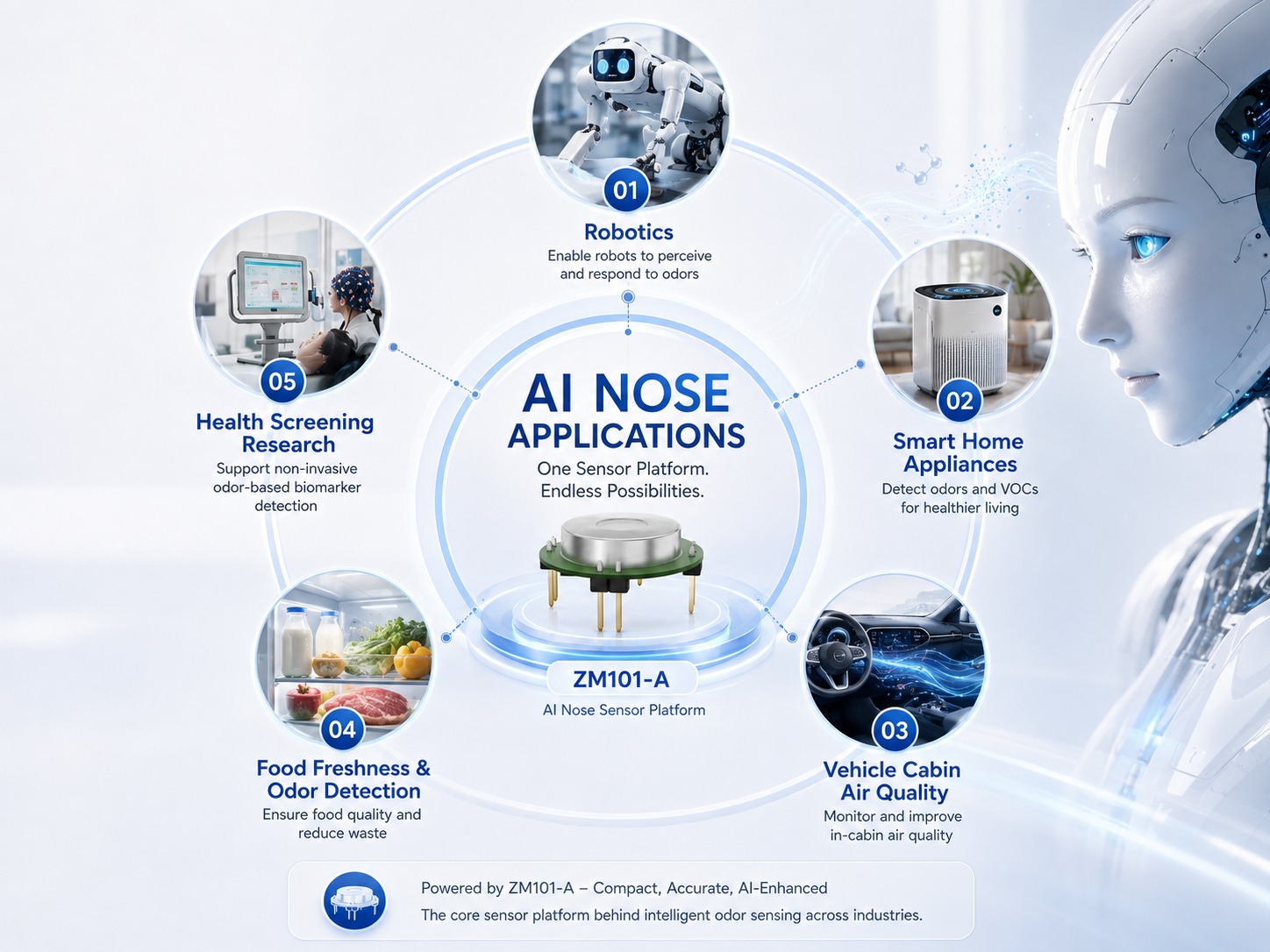
AI Nose technology can be applied wherever machines need to understand chemical or odor information.
Robotics
Robots can use AI Nose technology to sense chemical environments that cannot be understood through vision alone.
Potential tasks include:
- Gas-leak inspection
- VOC abnormality detection
- Industrial environmental monitoring
- Odor-source localization
- Hazardous area inspection
- Process exhaust monitoring
Smart Home Appliances
Electronic olfaction can be integrated into:
- Air purifiers
- Refrigerators
- Range hoods
- Air conditioners
- Smart kitchen appliances
Potential functions include:
- Abnormal odor detection
- Food freshness recognition
- Intelligent ventilation
- Cooking-state monitoring
- Adaptive air purification
Vehicle Cabin Air Quality
Future intelligent vehicles may combine gas sensors and AI Nose systems to recognize:
- Cabin odor changes
- VOC accumulation
- Outside-air pollution
- Abnormal chemical events
- Air circulation requirements
This can provide another sensing dimension for intelligent cabin control.
Food Freshness and Odor Detection
Food releases different volatile compounds as:
- Ripening occurs
- Oxidation develops
- Microbial spoilage progresses
- Storage conditions change
AI Nose technology can potentially classify these changing odor patterns.
Possible applications include:
- Refrigerator freshness monitoring
- Food storage
- Cold-chain inspection
- Quality sorting
- Food processing
Health Screening Research
Human breath and biological samples contain complex volatile compounds.
Electronic noses are being investigated for research applications involving:
- Breath-pattern analysis
- Odor biomarkers
- Patient monitoring research
- Non-invasive screening research
These applications require appropriate clinical research and regulatory validation before being used for diagnostic purposes.
AI Nose for Robotics and Embodied Intelligence
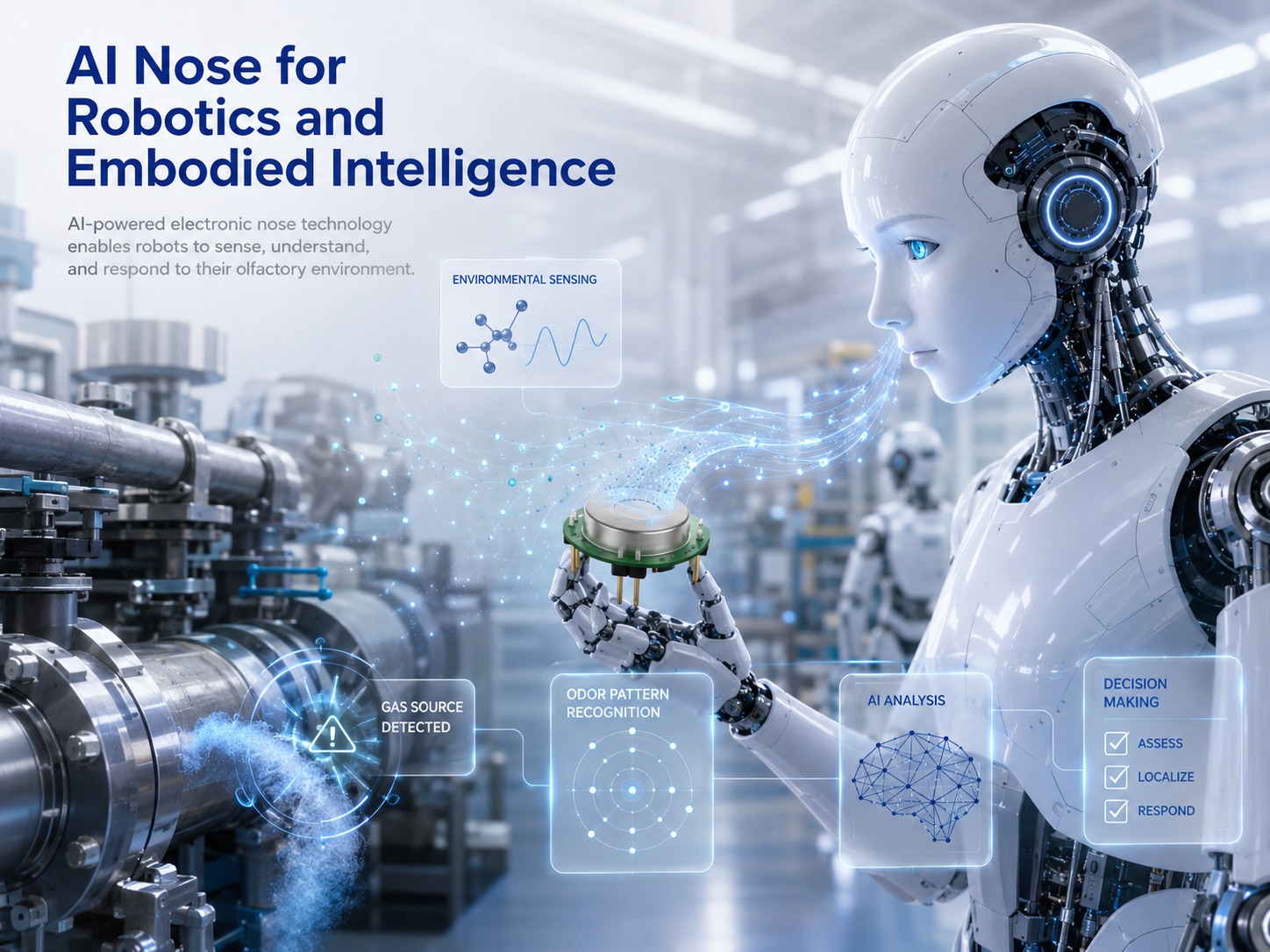
Robotics is one of the most promising directions for AI Nose technology.
Modern robots already use multiple sensing technologies:
- Cameras
- LiDAR
- Microphones
- Force sensors
- Inertial sensors
- Thermal imaging
- Position sensors
These systems enable robots to understand:
- Shape
- Distance
- Sound
- Movement
- Temperature
- Physical contact
But none of these directly tells the robot what chemical substances or odor patterns exist in the surrounding air.
An AI Nose introduces another perception dimension:
chemical perception.
This can be especially valuable for industrial and service robots.
Industrial Inspection Robots
An inspection robot may move through:
- Factories
- Chemical plants
- Energy facilities
- Warehouses
- Pipeline systems
- Confined spaces
The robot can continuously collect gas-array signals while moving.
A possible workflow is:
- The robot patrols an industrial facility.
- The AI Nose continuously monitors the surrounding chemical environment.
- An abnormal odor pattern is detected.
- The robot records its current position.
- The AI system evaluates the sensor pattern.
- The robot approaches or resamples the area.
- The system sends an alarm with location information.
The system can therefore move beyond:
“An abnormal gas was detected.”
toward:
“An abnormal chemical pattern was detected near this specific piece of equipment.”
That information is much more useful for predictive maintenance and industrial safety.
AI Nose at World Robot Conference 2026
The development of AI Nose technology also reflects a broader evolution in robotics.
At World Robot Conference 2026, Winsen demonstrated AI Nose technology as part of its intelligent sensing portfolio for robots and embodied intelligence.
The application concept is simple:
Vision enables robots to see.
Microphones enable robots to hear.
Force sensors enable robots to touch.
AI Nose technology enables robots to gain another important sensory capability:
the ability to perceive chemical information in the air.
You can learn more about this application in:
AI Nose for Robot Sensing at World Robot Conference 2026
As robots move from controlled laboratories into factories, energy facilities, warehouses, homes and public environments, chemical sensing may become increasingly important.
From Gas Detection to Intelligent Environmental Perception
The value of AI Nose technology becomes even greater when it is combined with other sensors.
A robot or intelligent device may integrate:
- AI Nose
- Dedicated CO₂ sensor
- Oxygen sensor
- Combustible gas sensor
- Electrochemical toxic gas sensor
- Temperature and humidity sensor
- Particulate matter sensor
- Smoke sensor
- Flame sensor
- Camera
- LiDAR
- Thermal imaging
AI can then evaluate several environmental dimensions at the same time.
For example:
Abnormal VOC Pattern + Temperature Increase + Equipment Location
may provide much more useful information than any one signal alone.
This is an important direction for multimodal environmental perception.
Industrial Applications of AI Nose Technology
Industrial Safety
AI Nose systems can help recognize characteristic gas patterns associated with:
- Chemical leakage
- Process abnormalities
- Equipment overheating
- Unusual emissions
- Mixed-gas events
Dedicated safety sensors should still be used where regulations require alarms at specific gas concentrations.
AI Nose adds an intelligent pattern-recognition layer.
Environmental Monitoring
Traditional monitoring often focuses on individual pollutant concentrations.
AI Nose systems can add pattern-recognition capability for:
- Industrial exhaust
- Waste-treatment odors
- Abnormal emissions
- Odor-source identification
- Environmental inspection
Smart Appliances
Future appliances may not simply detect that VOC concentration has increased.
They may attempt to identify what kind of odor event is occurring and respond differently.
For example:
- Cooking odor → increase ventilation
- Spoilage odor → send freshness warning
- Abnormal chemical odor → issue safety alert
That is a more intelligent form of environmental control.
How to Develop an AI Nose Application
A successful AI Nose project should start with the application rather than with the AI algorithm.
Step 1: Define the Recognition Target
Determine exactly what the system needs to distinguish.
For example:
- Normal vs. abnormal
- Three gas-mixture states
- Five food odors
- Several production conditions
- Multiple leakage types
The target should be measurable and clearly defined.
Step 2: Select the Sensor Channels
Different target gases require different sensing dimensions.
The sensor combination should provide enough response differences between the target categories.
ZM101-A offers multiple MEMS gas sensing channels that can support application-specific configurations.
Step 3: Design the Sampling Structure
Sensor performance depends strongly on how gases reach the sensing elements.
The mechanical design should consider:
- Air inlet
- Sampling distance
- Airflow
- Chamber volume
- Contamination
- Response time
- Sensor position
A strong AI model cannot completely compensate for inconsistent gas sampling.
Step 4: Collect Representative Training Data
The dataset should represent realistic operating conditions.
Training samples should consider variations in:
- Gas concentration
- Temperature
- Humidity
- Background air
- Sample age
- Production batch
- Airflow
- Environmental interference
The more representative the training dataset is, the more useful the final model will be.
Step 5: Train and Validate the AI Model
Training data and validation data should be separated.
Evaluation should consider:
- Classification accuracy
- False positive rate
- False negative rate
- Repeatability
- Environmental robustness
- Long-term drift
Step 6: Deploy the Model
The final AI model can be deployed on:
- MCU
- Edge AI processor
- Industrial controller
- Robot computer
- Gateway
- Cloud platform
The appropriate architecture depends on response time, power consumption and computing requirements.
Important Challenges in AI Nose Development
Sensor Drift
Gas sensor responses can gradually change during long-term operation.
Long-life applications may require:
- Baseline compensation
- Periodic calibration
- Algorithm adjustment
- Model retraining
Temperature and Humidity
Environmental conditions can affect sensor responses.
Temperature and humidity compensation therefore plays an important role in improving system stability.
Cross-Sensitivity
Cross-sensitivity is not always negative in an electronic nose.
Partially overlapping responses are actually useful for creating chemical fingerprints.
However, environmental interferents still need to be included during model training and validation.
Sampling Consistency
The same odor source can produce different sensor signals if:
- Airflow changes
- Sampling distance changes
- Concentration changes
- Source position changes
Mechanical design and sampling strategy are therefore part of the AI Nose system—not simply packaging details.
Training Data Quality
AI performance ultimately depends on data quality.
Large amounts of poorly labeled data are not necessarily better than a carefully designed dataset collected under representative conditions.
Frequently Asked Questions
What is an AI Nose?
An AI Nose is a chemical perception system that combines a multi-channel gas sensor array with machine-learning or AI algorithms to recognize characteristic gases, odors and chemical patterns.
Is an AI Nose the same as an electronic nose?
They are closely related. An AI Nose can be considered a modern electronic nose that uses machine-learning or deep-learning algorithms for more advanced pattern recognition and intelligent analysis.
Can an AI Nose recognize every odor?
No.
An AI Nose usually needs training data from the target gases or odors that it is expected to recognize.
Its recognition capability depends on:
- Sensor configuration
- Sample quality
- Dataset quality
- Algorithm design
- Environmental conditions
Why does an AI Nose use multiple sensors?
Different sensors respond differently to the same chemical mixture.
Combining several sensing channels creates a multidimensional chemical fingerprint that contains more information than one sensor signal alone.
What can Winsen ZM101-A sense?
ZM101-A provides sensing dimensions including:
- NH₃
- VOC
- NO₂
- H₂S
- CO
- CH₄
It supports up to six MEMS sensing channels for multi-dimensional gas and odor pattern analysis.
Can ZM101-A be integrated with AI algorithms?
Yes.
The ZM101-A platform can provide multi-channel sensing data for applications involving feature extraction, model training and pattern recognition.
Can an AI Nose be used in robots?
Yes.
AI Nose technology can provide robots with chemical and olfactory perception for applications such as:
- Industrial inspection
- Environmental monitoring
- Odor recognition
- Gas-source investigation
- Smart service robotics
Does an AI Nose replace a gas detector?
Not necessarily.
When an application requires a certified alarm at a specific concentration of CO, H₂S, combustible gas or another target gas, a dedicated gas sensor or gas detector should still be used.
AI Nose technology can complement these systems by providing pattern recognition and environmental classification.
Giving Machines Another Way to Understand the World
Artificial intelligence has already transformed the way machines process images, language and sound.
Chemical perception represents another important frontier.
An AI Nose combines:
MEMS Sensor Arrays + Signal Processing + Environmental Compensation + Artificial Intelligence
to convert invisible gases and odors into digital patterns that machines can understand.
For robotics, industrial monitoring, smart appliances, vehicles, food applications and intelligent environmental systems, this provides an additional layer of perception that cameras and microphones cannot offer.
The Winsen ZM101-A AI-Nose Sensor provides a compact multi-channel MEMS sensing platform designed for AI-based gas and odor recognition applications.
As intelligent machines increasingly enter complex real-world environments, the ability to understand not only what they can see and hear, but also what is present in the surrounding air, may become an increasingly important part of machine perception.
Winsen provides gas sensors, MEMS sensor arrays and application-oriented technical support for AI Nose, robotics and intelligent environmental sensing projects. For OEM projects, sensing channels, mechanical structures and AI models can be evaluated according to the actual application requirements.