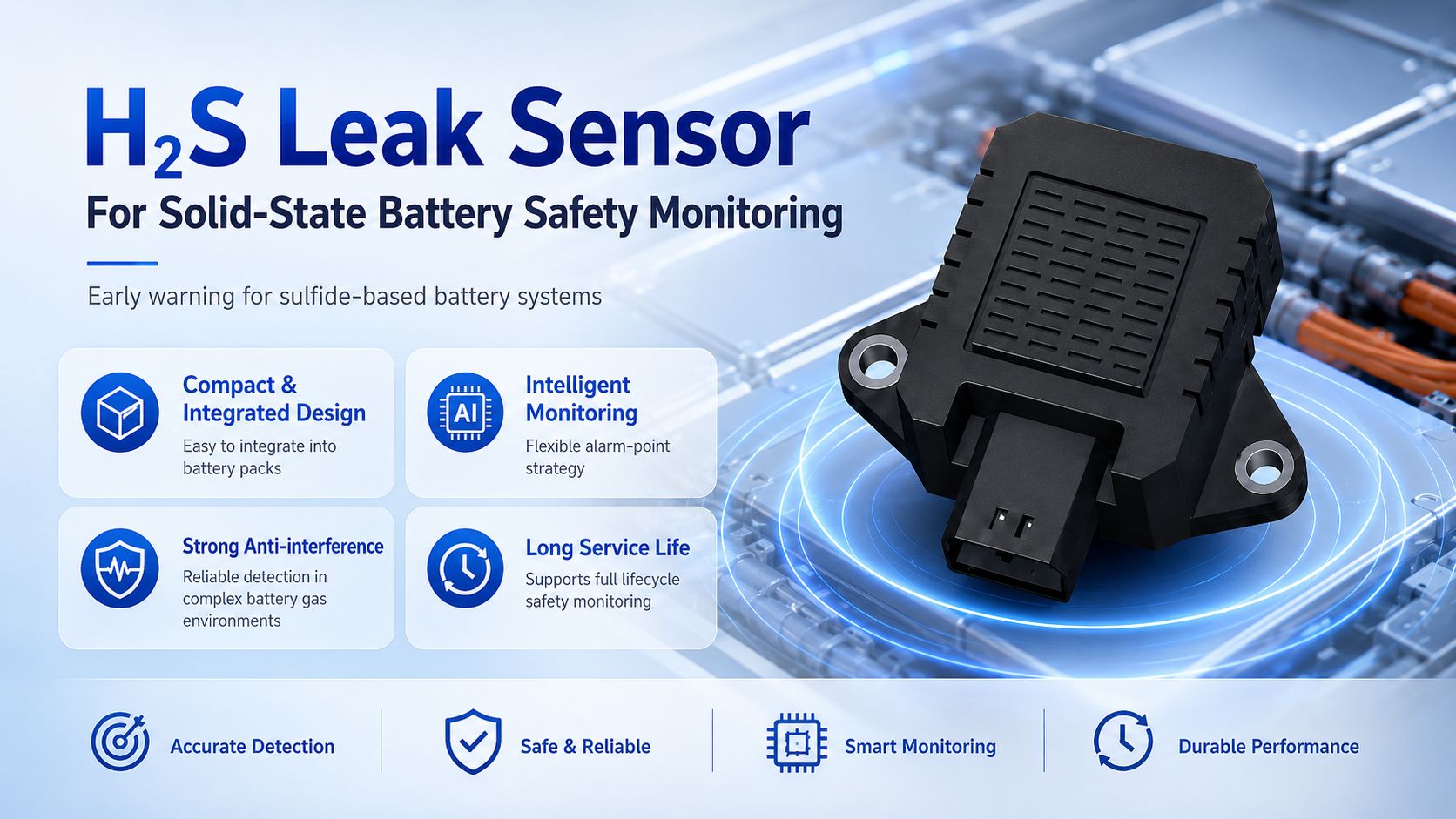
Solid-State Battery Development Accelerates: Why H₂S Sensing Matters for Sulfide-Based Systems
Solid-state batteries are moving from laboratory research toward engineering validation, pilot production and future commercial deployment.
As battery manufacturers, automotive companies and materials suppliers continue investing in this technology, the industry is also building clearer terminology, classification methods, testing procedures and production requirements.
China has launched a recommended national standard project titled Solid-State Battery for Electric Vehicle—Part 1: Terms and Classification. The official national standards platform currently lists a proposed implementation date of January 1, 2028. This standardization effort reflects a broader industry need to establish clearer technical boundaries for liquid, hybrid solid-liquid and all-solid-state battery technologies.
However, replacing a liquid electrolyte with a solid material does not eliminate every safety risk.
For batteries using sulfide solid electrolytes, moisture sensitivity and potential hydrogen sulfide generation create new monitoring requirements throughout material preparation, cell development, manufacturing, testing and system integration.
Reliable H₂S sensing can provide an additional layer of early warning for these emerging battery technologies.
Why Sulfide Solid Electrolytes Are Attracting Attention
Solid-state batteries can use different electrolyte systems, including:
- polymer electrolytes;
- oxide electrolytes;
- sulfide electrolytes;
- halide and composite electrolyte systems.
Among these routes, sulfide solid electrolytes are considered promising because of their high ionic conductivity, mechanical softness and relatively good contact with electrode materials. These properties can help reduce interface resistance and support high-performance all-solid-state battery designs.
Their potential advantages include:
- high room-temperature ionic conductivity;
- good mechanical formability;
- close contact with electrode materials;
- suitability for high-energy-density battery architectures;
- potential compatibility with scalable powder-processing methods.
These characteristics make sulfide electrolytes important candidates for next-generation electric vehicles, energy-storage systems, robotics, aviation equipment and high-performance consumer electronics.
At the same time, sulfide materials introduce a specific environmental challenge: sensitivity to moisture.
How Moisture Can Produce Hydrogen Sulfide
Many sulfide solid electrolytes can react with water molecules present in ambient air.
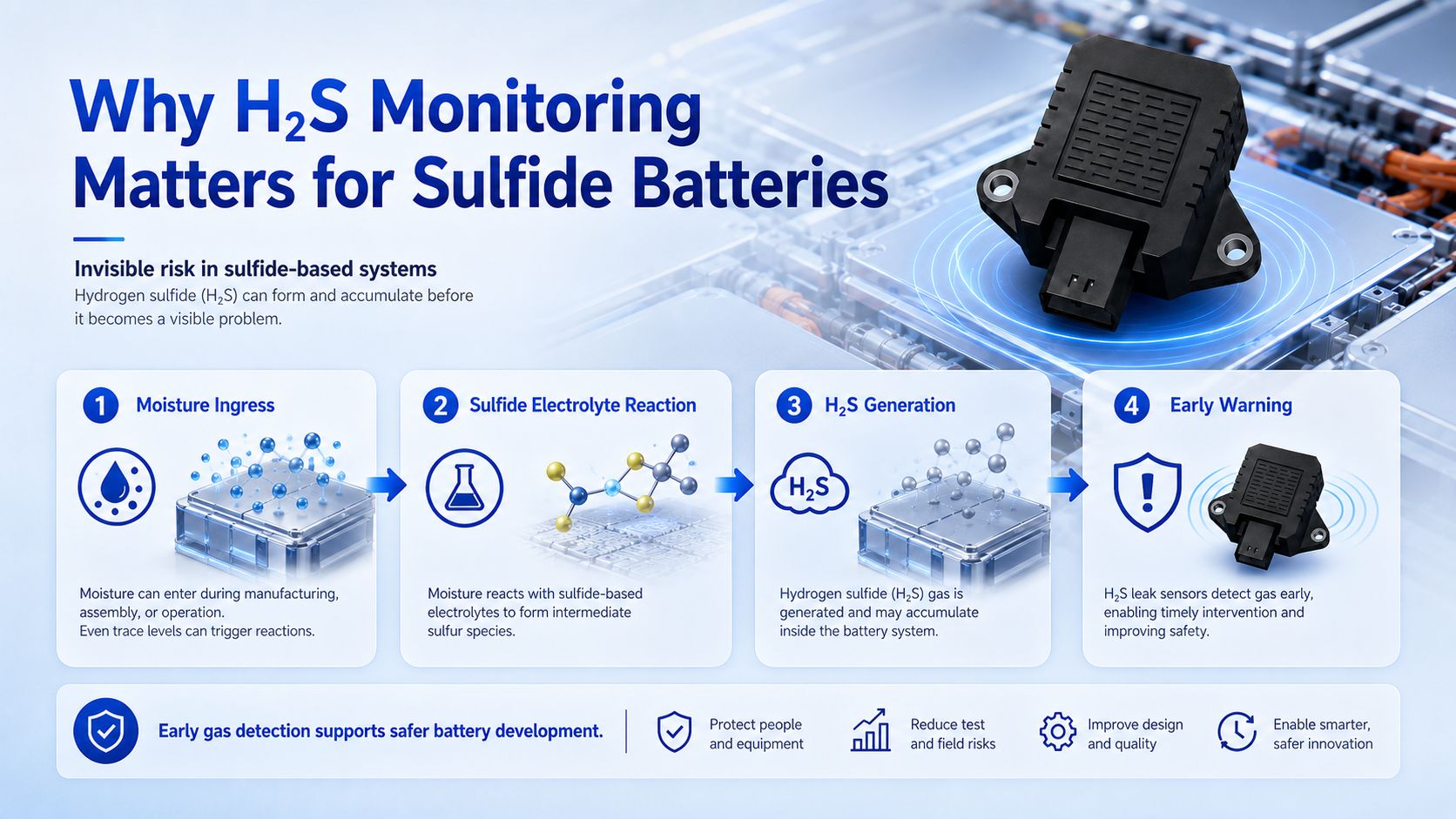
When moisture reaches the electrolyte, hydrolysis reactions may degrade the material and release hydrogen sulfide gas. Studies of sulfide systems such as lithium argyrodites and LGPS-type electrolytes have documented H₂S generation when these materials are exposed to moisture.
The simplified risk chain can be described as:
Moisture ingress → electrolyte degradation → H₂S generation → material-performance and personnel-safety risk
Possible moisture entry points include:
- raw-material handling;
- powder transfer;
- dry-room abnormalities;
- glove-box leakage;
- sealing defects;
- damaged test cells;
- module or pack enclosure failure;
- improper storage and transportation;
- maintenance operations.
H₂S generation may indicate that the electrolyte has been exposed to conditions that could also affect battery performance, interface stability and production quality.
For this reason, H₂S monitoring can provide value beyond conventional toxic-gas protection. It may also act as an indirect process and material-condition indicator.
Why H₂S Requires Instrument-Based Monitoring
Hydrogen sulfide is a toxic and highly flammable gas. Exposure can affect the eyes, respiratory system and nervous system, while high concentrations may rapidly create life-threatening conditions.
Although H₂S is commonly associated with a rotten-egg odor at lower concentrations, odor should never be treated as a reliable safety method.
Human perception may be influenced by:
- competing industrial odors;
- ventilation and airflow;
- personal sensitivity;
- protective equipment;
- rapid concentration changes;
- prolonged exposure.
Automated sensor monitoring is therefore necessary in areas where sulfide materials are handled, processed, tested or stored.
A suitable monitoring system should detect concentration changes early enough to support:
- local alarms;
- ventilation activation;
- equipment interlocks;
- process suspension;
- personnel evacuation;
- remote notifications;
- traceable event records.
Where H₂S Sensors Can Be Used in the Solid-State Battery Process
Raw-Material Preparation
Sulfide powders may be mixed, milled, weighed or transferred before cell manufacturing.
Sensors installed near material-handling equipment can help identify abnormal moisture exposure, powder leakage or H₂S generation before the gas spreads through the production area.
Typical monitoring locations include:
- powder preparation rooms;
- feeding and mixing equipment;
- transfer stations;
- storage cabinets;
- local exhaust systems;
- waste-material containers.
Dry Rooms and Glove Boxes
Humidity control is essential when processing moisture-sensitive sulfide materials.
A humidity sensor identifies changes in water-vapor conditions, while an H₂S sensor provides a second dimension of information by detecting whether sulfide degradation has already begun.
Combining these parameters can create a more complete warning strategy:
| Monitoring Parameter | Information Provided |
|---|---|
| Relative humidity | Indicates moisture-control conditions |
| H₂S concentration | Indicates possible sulfide reaction or material leakage |
| Temperature | Supports environmental compensation and process analysis |
| Differential pressure | Helps verify containment and airflow direction |
Pilot Production Lines
During pilot production, equipment structures and manufacturing processes are still being optimized.
H₂S sensors can be deployed around:
- coating and pressing equipment;
- cell assembly stations;
- powder-recovery systems;
- vacuum equipment;
- sealing processes;
- exhaust pipelines;
- equipment maintenance zones.
Because pilot lines frequently change configuration, compact sensor modules with digital output can simplify temporary or distributed monitoring.
Cell Testing and Validation Chambers
Abuse testing, environmental testing and long-term cycling may expose cells to pressure, temperature or mechanical conditions beyond normal use.
H₂S monitoring can complement temperature, pressure, smoke and other gas measurements during:
- high-temperature testing;
- humidity exposure;
- mechanical damage testing;
- overcharge or short-circuit evaluation;
- enclosure and sealing validation;
- accelerated aging tests.
A rise in H₂S does not by itself identify the complete failure mechanism, but it can provide valuable evidence that sulfide materials have contacted moisture or undergone abnormal degradation.
Battery Modules and Packs
Future sulfide-based battery modules may require gas monitoring at selected locations, particularly where safety analysis identifies possible leakage or moisture-ingress paths.
Possible sensor positions include:
- module air channels;
- pack ventilation outlets;
- service compartments;
- pressure-relief pathways;
- battery-management enclosures.
The final installation point must consider gas diffusion, airflow, enclosure volume and response-time requirements.
Storage and Transportation
Damaged packaging, seal failure or poor environmental control can create risks before materials or cells reach the production line.
H₂S sensors can support monitoring in:
- raw-material warehouses;
- intermediate-product storage;
- transport containers;
- battery sample cabinets;
- returned-product isolation areas.
Why Electrochemical H₂S Detection Fits This Application
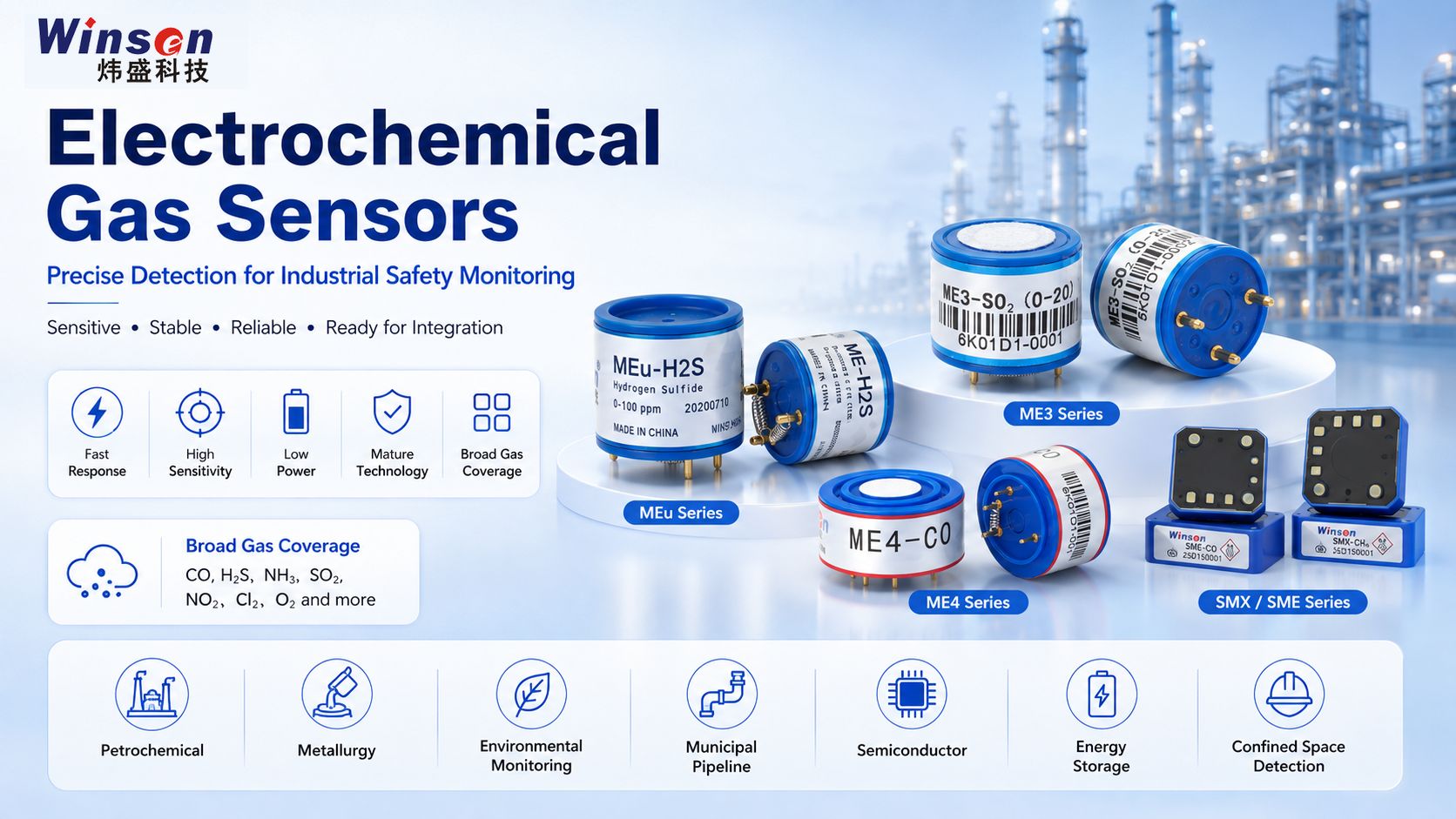
Electrochemical sensors are well suited to low-concentration toxic-gas monitoring.
When H₂S diffuses into the sensor, it reacts at the working electrode and produces a current related to the gas concentration. The module amplifies and processes this signal before delivering usable concentration data to the host system.
Key application advantages include:
- sensitivity at low ppm levels;
- low power consumption;
- compact size;
- relatively simple electrical integration;
- continuous monitoring capability;
- digital output for intelligent control;
- suitability for distributed sensor networks.
For battery R&D and manufacturing environments, these characteristics support both fixed and portable monitoring equipment.
Building a Multi-Parameter Battery Safety System

H₂S sensing should not be treated as the only safety indicator.
Solid-state battery monitoring may combine:
- H₂S concentration;
- humidity;
- temperature;
- pressure;
- hydrogen or carbon monoxide;
- smoke and particulate signals;
- insulation and electrical data.
A multi-parameter strategy reduces dependence on a single signal and gives the control system more context for determining whether an abnormal condition is developing.
For example:
- Humidity rises inside a controlled enclosure.
- H₂S concentration begins to increase.
- The control system verifies airflow and pressure conditions.
- Local ventilation is activated.
- Material processing is stopped.
- Personnel receive an alarm.
- Event data is stored for process analysis.
This approach helps move battery safety management from simple alarm generation toward intelligent condition assessment.
Sensor Selection and Integration Considerations
Detection Range
The required range depends on whether the objective is early micro-leak detection, occupational safety monitoring or high-concentration fault analysis.
A lower range can provide better resolution for early warning, while abuse-testing applications may require a broader range or multiple sensors.
Response Time
The sensor and sampling structure should respond quickly enough for the intended protective action.
The complete response time includes:
- gas generation;
- gas diffusion;
- airflow transport;
- sensor response;
- control-system processing.
Sensor Placement
H₂S is slightly heavier than air, but real gas distribution depends strongly on temperature, ventilation, enclosure geometry and the gas-release point.
Placement should be based on application testing or gas-dispersion analysis rather than a universal mounting height.
Environmental Compensation
Battery production environments may experience controlled but changing temperature and humidity.
Temperature and humidity compensation helps reduce environmental influence on the sensor signal, but the complete device should still be validated across the expected operating range.
Cross-Interference
Other gases or vapors used in battery manufacturing may affect electrochemical sensor output.
Equipment developers should evaluate expected process chemicals and perform interference testing under realistic conditions.
Maintenance and Functional Diagnostics
A safety-monitoring system should include:
- sensor fault identification;
- scheduled verification;
- calibration strategy;
- alarm testing;
- communication-failure detection;
- maintenance records.
Value for Solid-State Battery Manufacturers
| Customer Requirement | H₂S Sensing Value |
|---|---|
| Moisture-related process warning | Detects gas associated with sulfide degradation |
| Personnel protection | Provides instrument-based toxic-gas monitoring |
| Pilot-line safety | Supports distributed monitoring around changing equipment |
| Cell-test analysis | Adds gas data to temperature, pressure and electrical records |
| Quality control | Helps identify abnormal material handling or sealing conditions |
| Automated safety response | UART and analog output support alarms and interlocks |
| Compact equipment design | Small modules fit test chambers and monitoring terminals |
| Traceability | Concentration data supports event and trend analysis |
Frequently Asked Questions
Do all solid-state batteries release H₂S?
No. H₂S risk is mainly associated with sulfide-based solid electrolytes and conditions in which those materials contact moisture or undergo relevant degradation reactions.
Oxide, polymer and other electrolyte routes have different material properties and safety considerations.
Does H₂S detection prove that a battery has failed?
Not by itself.
An H₂S signal indicates possible sulfide-material exposure, leakage or degradation. It should be evaluated together with humidity, temperature, pressure, electrical and other gas data.
Where should an H₂S sensor be installed?
Potential locations include material-handling equipment, dry rooms, glove boxes, test chambers, exhaust ducts, module ventilation paths and storage areas.
The final location should be determined through gas-diffusion analysis and application testing.
Conclusion: Earlier Gas Detection Supports Safer Solid-State Battery Development
Solid-state battery technology is advancing, but successful commercialization requires more than higher energy density and improved electrochemical performance.
For sulfide-based systems, moisture sensitivity and potential H₂S generation must be considered throughout material processing, cell development, production, testing, storage and future system integration.
H₂S sensors make this invisible risk measurable.
By integrating electrochemical sensing, intelligent processing and standardized output, our H₂S sensor solutions can help battery manufacturers detect abnormal conditions earlier, improve process visibility and build more complete multi-parameter safety systems.