Beyond Renovation Materials: Why Formaldehyde Monitoring Matters in Modern Homes
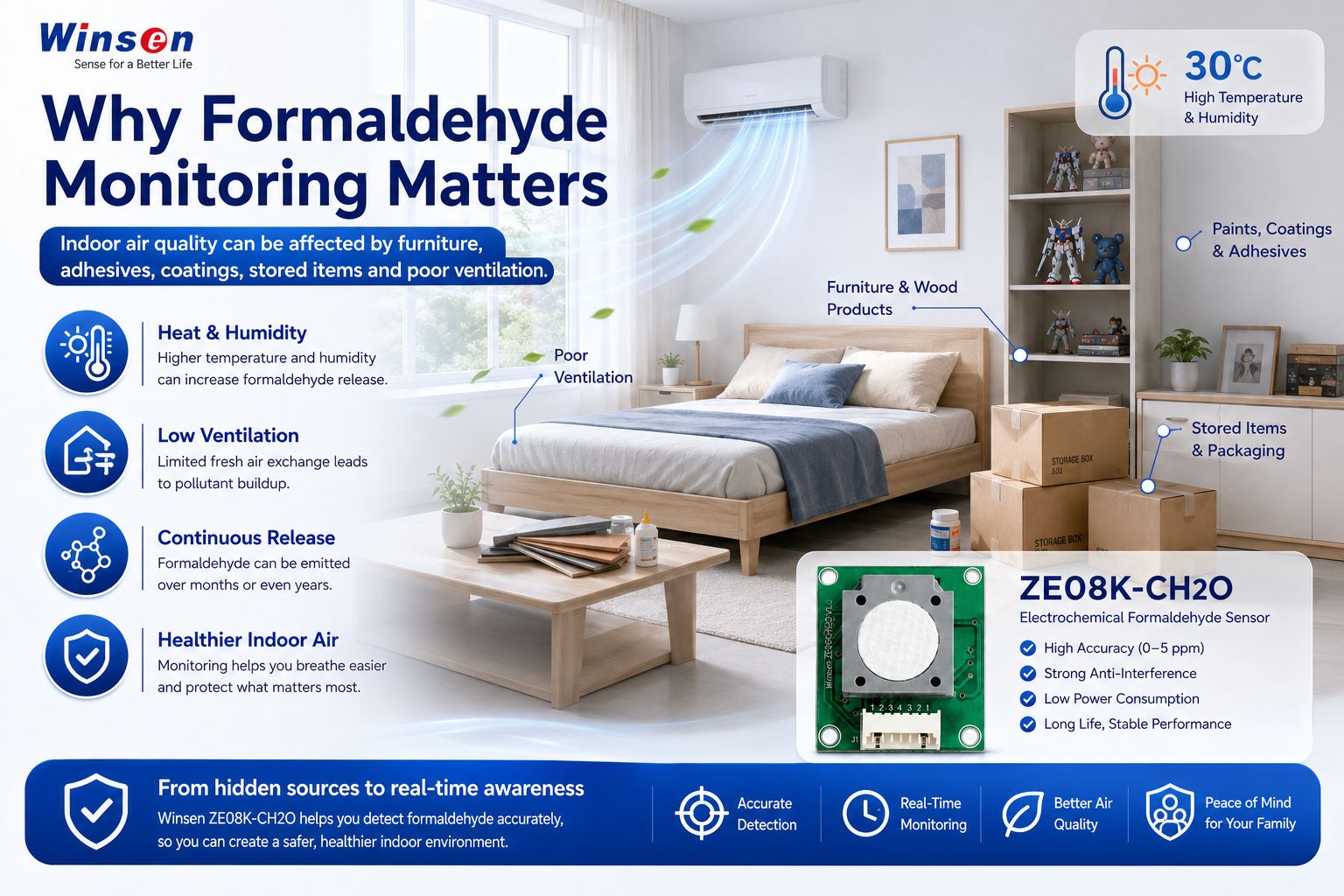
Formaldehyde is often associated with newly renovated homes, engineered wood furniture and building materials. However, modern indoor environments are becoming more complex.
Bedrooms, home offices and hobby rooms may now contain large collections of decorative items, model figures, printed products, craft materials, display cabinets, storage boxes and packaged consumer goods. Individually, these products may seem insignificant. When many materials are stored together in a small, poorly ventilated room, however, the combined effect on indoor air quality deserves greater attention.
This does not mean that every collectible, toy or craft product releases formaldehyde. The more relevant issue is that a densely furnished room may contain multiple potential sources, including composite-wood shelving, adhesives, coatings, printed paper, fabrics, packaging and other materials that release volatile compounds over time. The US Environmental Protection Agency identifies composite wood, building materials, glues, paints, coatings, fabrics and paper products among the possible indoor sources of formaldehyde.
As homes become more airtight and people spend more time indoors, indoor air-quality management needs to move beyond one-time testing toward continuous, data-based monitoring.
Formaldehyde Sources Extend Beyond Recent Renovation
Renovation remains one of the most familiar formaldehyde-related concerns, but it is not the only possible source.
Formaldehyde-containing resins are widely used in composite wood products such as particleboard, plywood and medium-density fiberboard. Formaldehyde or formaldehyde-releasing substances may also be associated with:
- furniture and storage cabinets;
- glues and adhesives;
- paints, coatings, lacquers and finishes;
- pressed fabrics and textile treatments;
- insulation and construction materials;
- printed paper and packaging products;
- some household and personal-care products;
- smoke and unvented fuel-burning appliances.
Indoor exposure mainly occurs when formaldehyde released from materials accumulates in the air and is inhaled.
For rooms used to store collections or hobby products, the concern may therefore come from the entire environment rather than one individual object. Display furniture, wall finishes, storage materials, adhesives, packaging and limited air exchange can all influence the final indoor concentration.
Why Summer Heat Can Increase Indoor Formaldehyde Levels
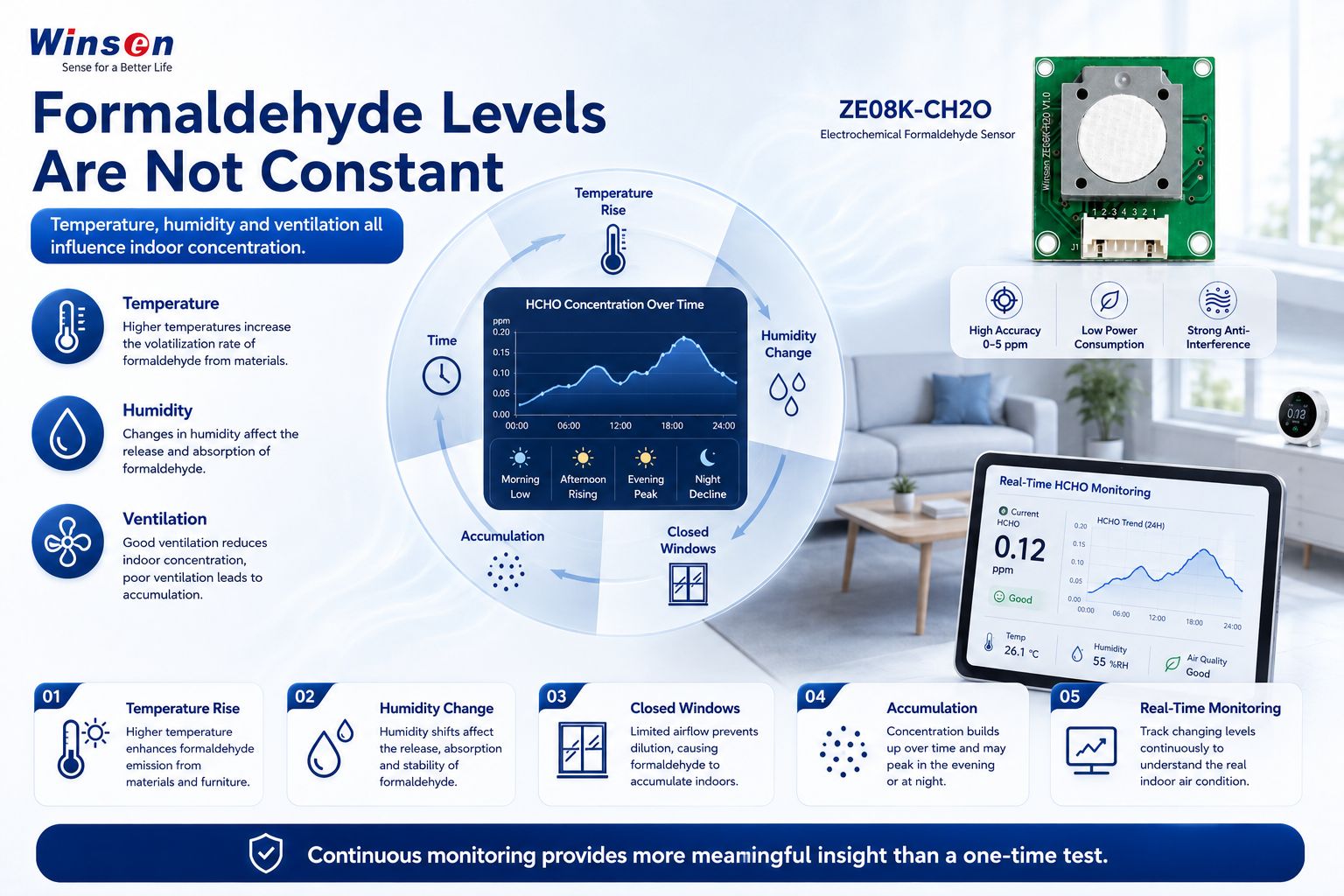
Formaldehyde concentration is not fixed.
It changes according to:
- the number and type of emission sources;
- material age and condition;
- indoor temperature;
- relative humidity;
- room volume;
- air-exchange rate;
- ventilation habits.
Health Canada states that higher temperature and humidity can increase formaldehyde levels through off-gassing from some products, while fresh outdoor air can lower indoor concentrations through dilution.
This is particularly relevant during hot weather. Indoor materials become warmer, humidity may rise, and air conditioners are often used with doors and windows closed for extended periods. Although the air-conditioning system circulates indoor air, recirculation alone does not necessarily introduce enough fresh outdoor air to dilute gaseous pollutants.
The result can be a combination of accelerated emissions and reduced air exchange.
This explains why a room that appeared acceptable during cooler weather may produce different readings during summer, after prolonged closure or following changes in occupancy and ventilation.
A Single Test Cannot Represent Long-Term Indoor Conditions
A professional one-time test is useful for assessing conditions at a particular moment, but formaldehyde concentration can vary throughout the day and across seasons.
A reading obtained after several hours of ventilation may differ considerably from one measured:
- early in the morning;
- after the room has remained closed overnight;
- during hot and humid weather;
- after installing new furniture;
- after adding large quantities of stored products;
- while heating or air-conditioning equipment is operating.
For reference, the World Health Organization recommends an indoor formaldehyde guideline value of 0.1 mg/m³ as a 30-minute average. This value should be treated as an indoor air-quality reference rather than as a simple dividing line between completely safe and dangerous conditions.
For homes, schools, offices and other continuously occupied spaces, trend data is often more informative than a single isolated result. Continuous monitoring can help users understand when concentrations rise, how ventilation affects the readings and whether intervention is producing a sustained improvement.
From Passive Testing to Active Indoor Air-Quality Management
Modern air-quality devices increasingly integrate formaldehyde monitoring with ventilation, purification and smart-home control.
A typical intelligent management process may include:
- A formaldehyde sensor continuously measures the indoor concentration.
- The device records changes over time.
- The controller compares the reading with the configured threshold.
- If the concentration rises, the system activates ventilation, fresh-air equipment or an appropriate purification function.
- The device continues monitoring to confirm whether the concentration is decreasing.
- Historical data is used to identify recurring patterns and potential sources.
This creates a closed-loop system:
Sensing → Analysis → Ventilation or purification → Verification
Ventilation remains one of the most important ways to reduce indoor gaseous contaminants. Effective ventilation replaces polluted indoor air with outdoor air rather than merely recirculating the same air.
A formaldehyde sensor does not remove pollution itself. Its value is to make an invisible and continuously changing pollutant measurable, helping the complete system determine when action is needed.
How Electrochemical Formaldehyde Detection Works
An electrochemical formaldehyde sensor detects the target gas through a controlled electrochemical reaction.
When formaldehyde diffuses into the sensor, it reacts at the sensing electrode and generates a small electrical current. Within the designed measurement range, the signal corresponds to the gas concentration.
The supporting circuit then amplifies, compensates and processes the signal before providing concentration data to the main controller.
For indoor air-quality equipment, electrochemical technology offers several useful characteristics:
- high sensitivity at low concentrations;
- compact structure;
- relatively low power consumption;
- linear concentration output;
- suitability for continuous monitoring;
- integration into portable and fixed equipment.
The performance of the finished device also depends on calibration, temperature compensation, airflow design, interference management and the control algorithm.
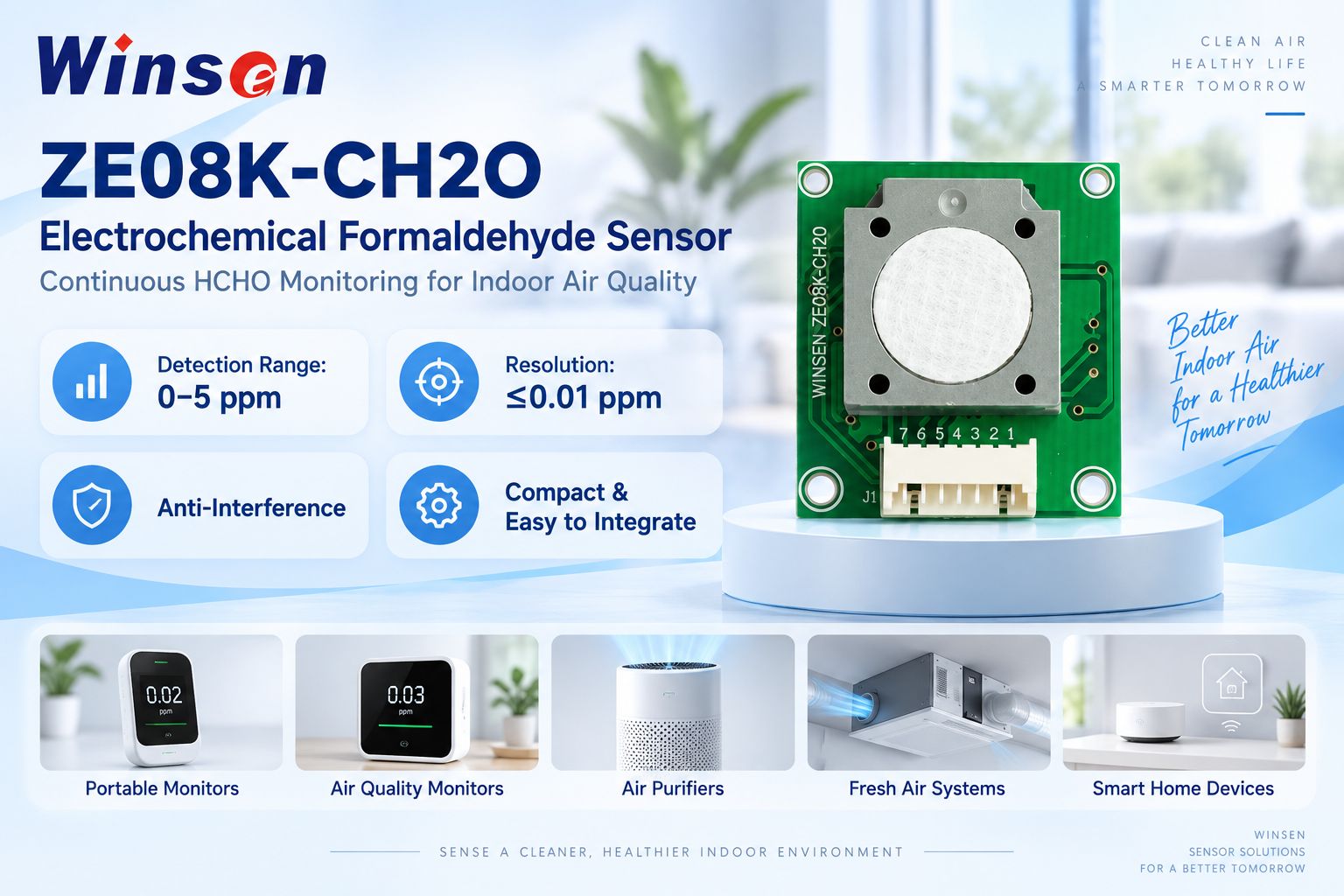
Winsen ZE08K-CH2O Electrochemical Formaldehyde Sensor
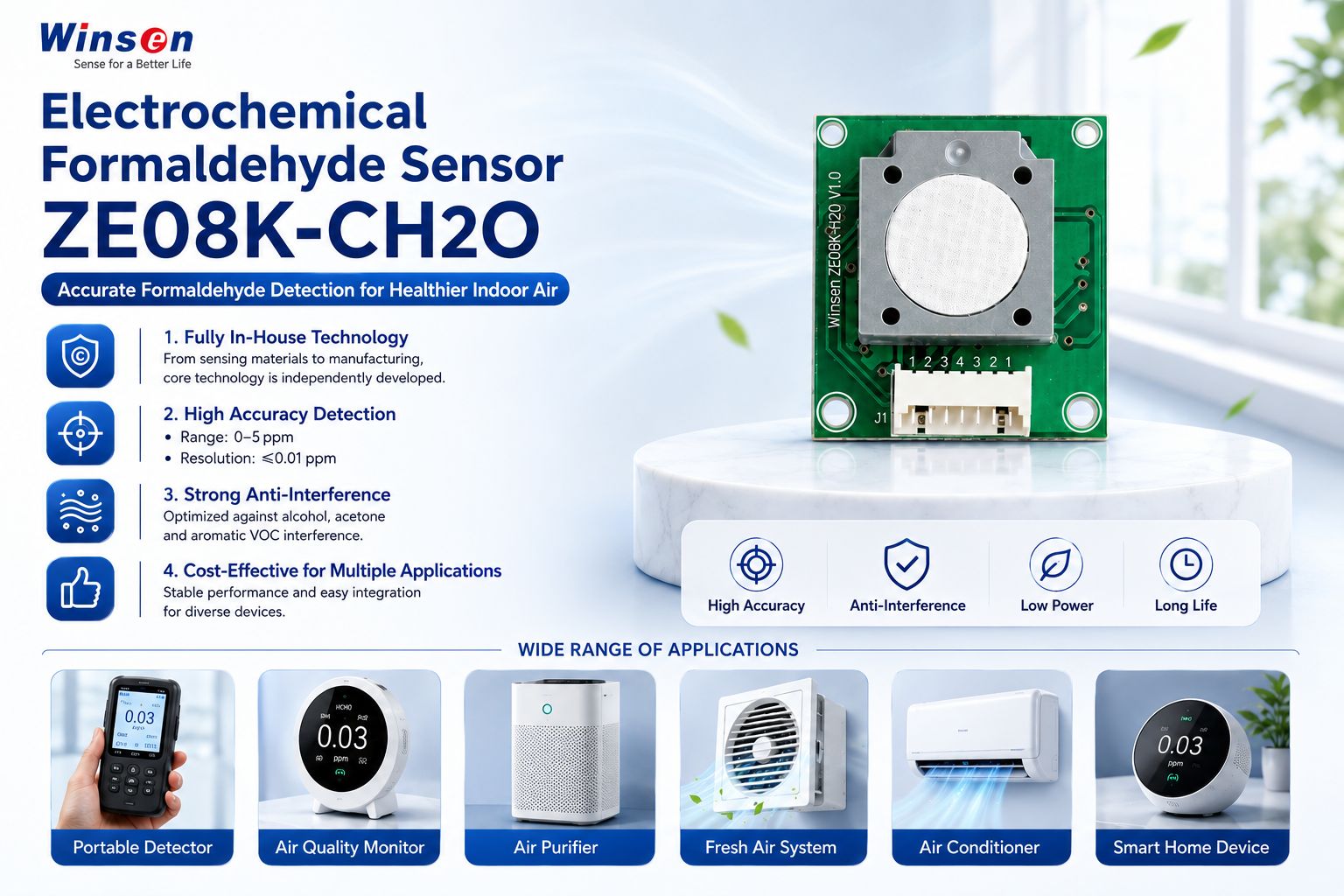
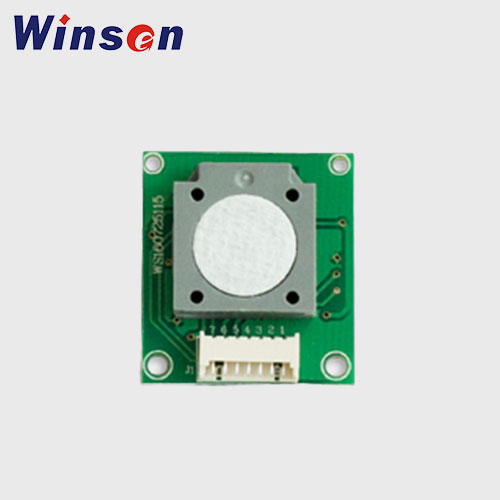
To support continuous indoor formaldehyde monitoring, we developed the ZE08K-CH2O electrochemical formaldehyde detection module.
The module combines our electrochemical sensing technology with signal-processing circuitry and an integrated temperature sensor. Temperature compensation helps reduce the influence of environmental changes on the measurement output.
ZE08K-CH2O provides digital and analog signals, allowing equipment manufacturers to integrate it into different control platforms.
Key Specifications
| Parameter | ZE08K-CH2O |
|---|---|
| Target gas | Formaldehyde, CH₂O/HCHO |
| Detection principle | Electrochemical |
| Detection range | 0–5 ppm |
| Resolution | ≤0.01 ppm |
| Response time | ≤60 seconds |
| Recovery time | ≤60 seconds |
| Supply voltage | 3.7–5.5 V |
| Output | UART, analog voltage and PWM |
| Operating temperature | −20°C to 50°C |
| Operating humidity | 15–90% RH, non-condensing |
| Expected service life | Five years under specified clean-air conditions |
These specifications are based on our current product information and operating conditions. Final performance in an end device depends on enclosure design, airflow, calibration, interference gases and the actual operating environment.
High Sensitivity and Fine Resolution
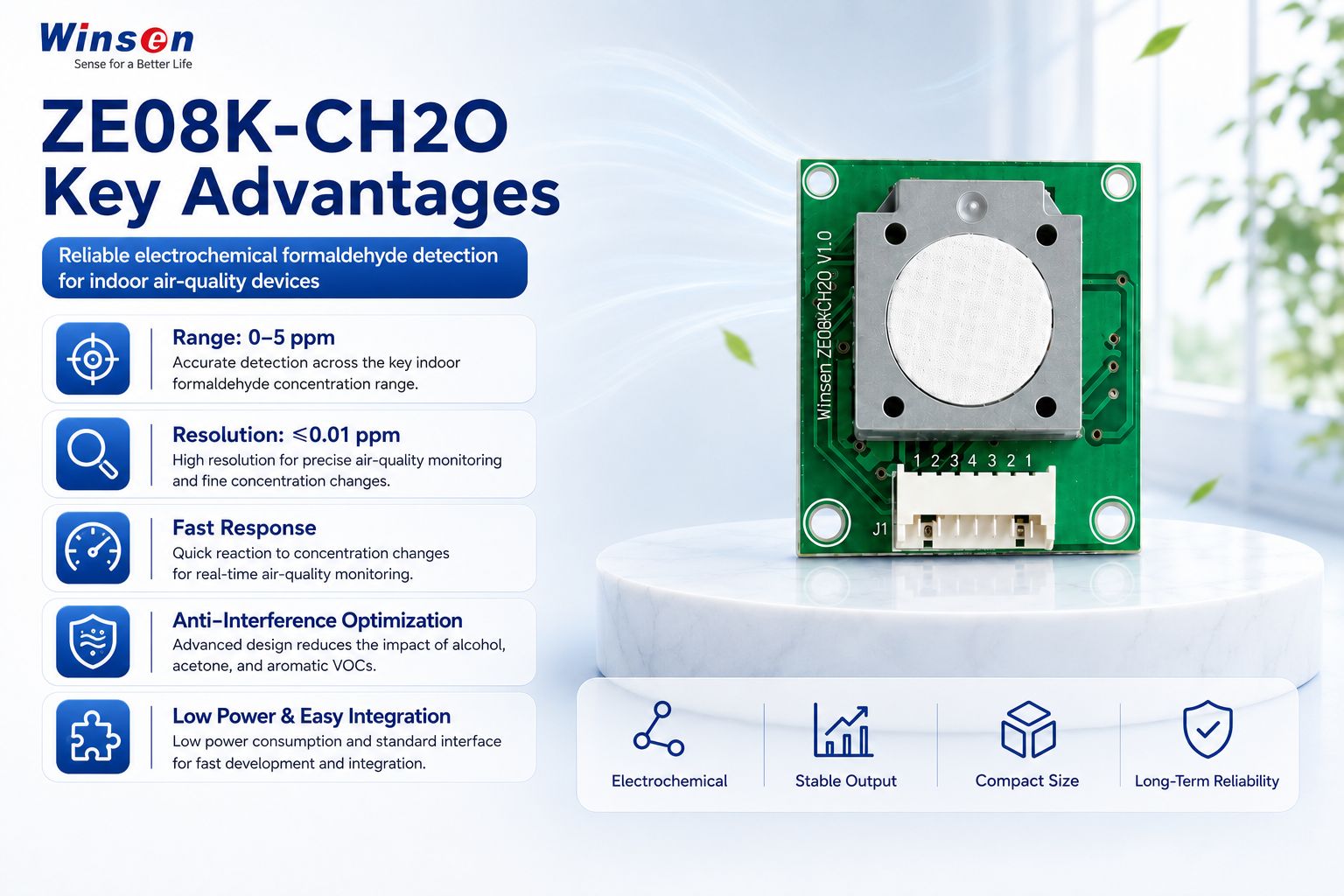
Indoor formaldehyde monitoring requires the ability to recognize relatively small concentration changes.
With a measurement range of 0–5 ppm and resolution of no more than 0.01 ppm, ZE08K-CH2O can provide the detailed concentration data needed by indoor air-quality monitors, smart appliances and ventilation-control systems.
Integrated Temperature Compensation
Environmental temperature affects both material emissions and sensor behavior.
ZE08K-CH2O integrates a temperature sensor to support compensation, helping the module maintain more stable output under changing indoor conditions.
Multiple Output Options
The module supports:
- UART digital output;
- analog voltage output;
- PWM output.
This allows customers to connect the sensor to microcontrollers, display systems, smart-home gateways and appliance control boards using the interface that best matches the product architecture.
Compact, Low-Power Integration
The miniaturized module is suitable for space-limited equipment and battery-powered instruments.
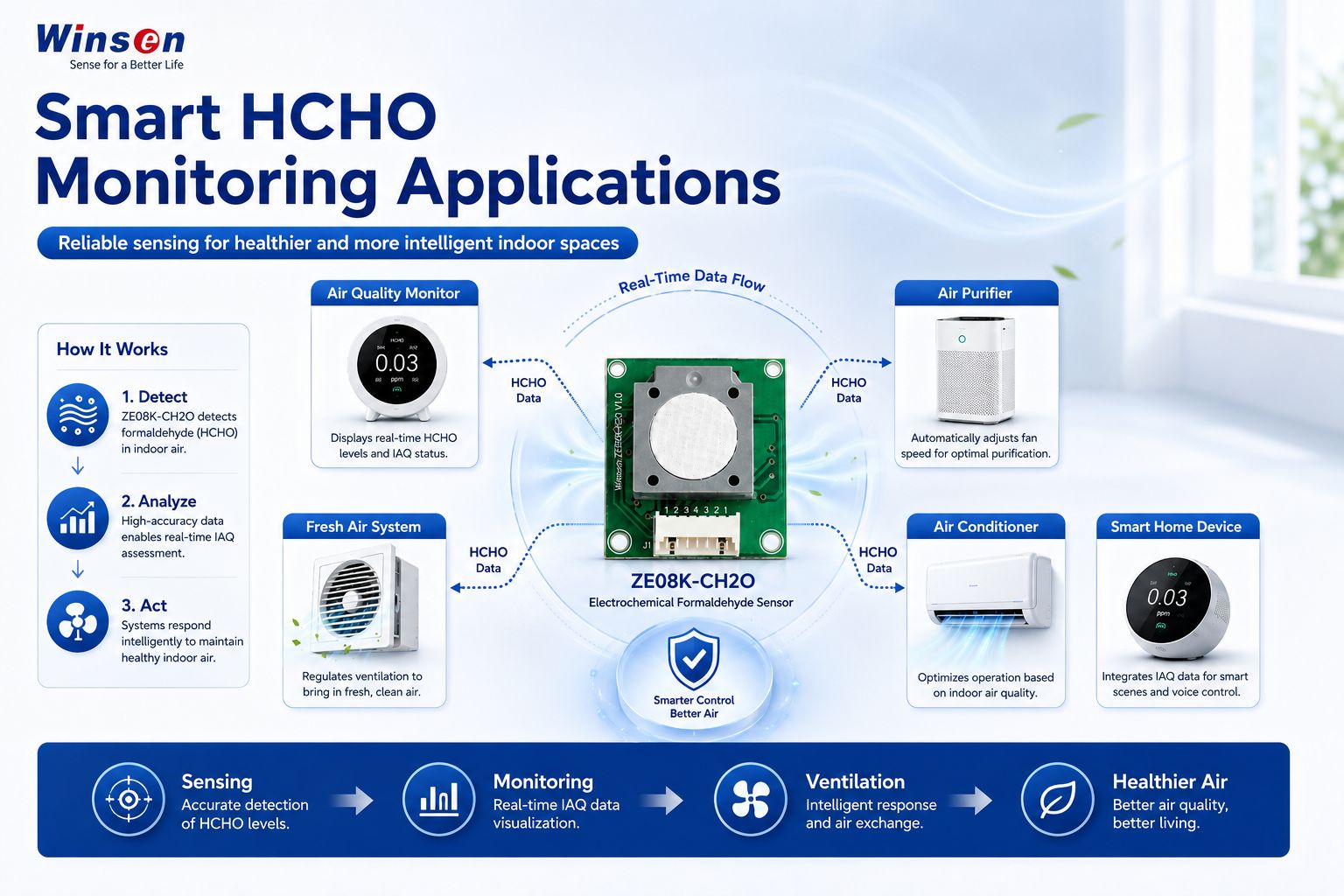
Typical applications include:
- portable formaldehyde detectors;
- indoor air-quality monitors;
- air purifiers;
- fresh-air and ventilation systems;
- air conditioners;
- smart-home environmental terminals.
Typical Application Scenarios
Indoor Air-Quality Monitors
A dedicated air-quality monitor can display real-time formaldehyde concentration and record historical trends.
When combined with temperature, humidity, CO₂, particulate-matter and VOC sensors, the device can provide a more complete understanding of the indoor environment.
Fresh-Air and Ventilation Systems
Formaldehyde data can be used as one of the inputs for demand-controlled ventilation.
When the concentration rises, the system can increase outdoor-air exchange. Once the reading falls, ventilation output can be adjusted to balance indoor air quality and energy consumption.
Air Purifiers
A formaldehyde sensor can help the purifier:
- display current concentration;
- activate an appropriate operating mode;
- adjust fan speed;
- evaluate treatment progress;
- notify users when ventilation is also required.
The actual removal capability depends on whether the purifier includes media or technology designed for gaseous formaldehyde. A conventional particle filter alone is not intended to remove all gaseous VOCs effectively.
Smart-Home Systems
Connected sensors can send formaldehyde data to a smart-home platform and coordinate:
- fresh-air units;
- exhaust fans;
- air purifiers;
- windows or ventilation actuators;
- mobile alerts;
- historical air-quality reports.
Portable Inspection Equipment
Portable detectors can be used to compare conditions across:
- bedrooms;
- nurseries;
- offices;
- classrooms;
- storage rooms;
- recently furnished areas;
- collection or hobby rooms.
Portable readings are particularly useful for identifying concentration differences between locations and under different ventilation conditions.
Integration Considerations for Equipment Manufacturers
Sensor Placement
The module should be positioned where representative room air can reach it.
Avoid installation:
- directly beside an air outlet;
- immediately next to a known emission source;
- inside a completely sealed enclosure;
- near strong heat sources;
- where condensation can contact the module.
Airflow Design
Excessive airflow can destabilize readings, while insufficient airflow can slow response.
The enclosure should allow controlled diffusion of indoor air without exposing the sensor to strong direct convection.
Cross-Interference
Electrochemical gas sensors may respond to certain non-target gases.
The ZE08K-CH2O manual includes cross-response data for substances such as ethanol, carbon monoxide, hydrogen sulfide, benzene-related compounds and acetic acid. Product designers should evaluate likely interference sources in the intended environment and apply appropriate structural design, filtering or algorithms.
This is especially important in kitchens, workshops or rooms where alcohol-based cleaners, fragrances and solvents may be used.
Calibration and Product Validation
The complete device should be validated under realistic conditions, including:
- different temperatures and humidity levels;
- expected interfering gases;
- enclosure airflow;
- long-term baseline stability;
- ventilation and purifier operating modes;
- intended alarm thresholds.
Sensor data should support, rather than replace, professional indoor air-quality assessment where serious contamination is suspected.
Why Continuous Formaldehyde Monitoring Adds Product Value
| Equipment Requirement | Sensor Value |
|---|---|
| Detect changing indoor conditions | Continuous concentration measurement |
| Support intelligent ventilation | Real-time data for fresh-air control |
| Improve purifier interaction | Feedback before and after treatment |
| Provide visible air-quality information | Digital display and historical trends |
| Enable smart-home automation | UART output for connected controllers |
| Support compact products | Miniaturized, low-power module |
| Reduce environmental measurement drift | Integrated temperature compensation |
| Improve user confidence | Measurable and traceable air-quality data |
Frequently Asked Questions
Are collectible figures and hobby products always a formaldehyde source?
No. It is inaccurate to assume that every collectible or decorative product releases formaldehyde.
The possible indoor-air concern may instead involve a combination of materials, including coatings, adhesives, packaging, textiles and composite-wood display furniture. Actual emissions depend on the product materials, manufacturing process, quantity, temperature and ventilation conditions.
Why can formaldehyde readings rise during hot weather?
Higher temperature and humidity can increase off-gassing from certain products. At the same time, closed windows and limited fresh-air exchange can allow indoor concentrations to accumulate.
Is one formaldehyde test enough?
A one-time test reflects conditions during that measurement period. Because concentration can change with weather, ventilation and room use, continuous monitoring provides more information about trends and recurring exposure conditions.
Can an air purifier remove formaldehyde?
Only when it includes treatment designed for gaseous pollutants. Particle filters are primarily designed for airborne particles and may not effectively remove gaseous contaminants on their own. Source control and ventilation remain important.
What products can use ZE08K-CH2O?
The module is suitable for portable detectors, indoor air-quality monitors, air purifiers, fresh-air systems, air conditioners and smart-home environmental devices.
Does ZE08K-CH2O support digital output?
Yes. It supports UART digital output as well as analog voltage and PWM outputs.
Conclusion: Make Changing Indoor Air Quality Visible
Formaldehyde risk is no longer a concern limited to newly renovated buildings.
Modern indoor spaces contain increasingly diverse materials, furnishings, consumer products and storage systems. Combined with high temperature, humidity and limited ventilation, these factors can cause indoor formaldehyde concentration to change over time.
This is why indoor air-quality management must evolve from one-time testing to continuous sensing and active control.
Our ZE08K-CH2O electrochemical formaldehyde sensor provides a compact, sensitive and easy-to-integrate sensing core for air-quality monitors, ventilation systems, air purifiers and smart-home devices.
By making formaldehyde concentration visible, equipment manufacturers can help users understand their indoor environment, respond to changing conditions and build healthier, more intelligent living spaces.