TDLAS vs Semiconductor Methane Sensors: How Hybrid Sensing Improves Home Gas Safety
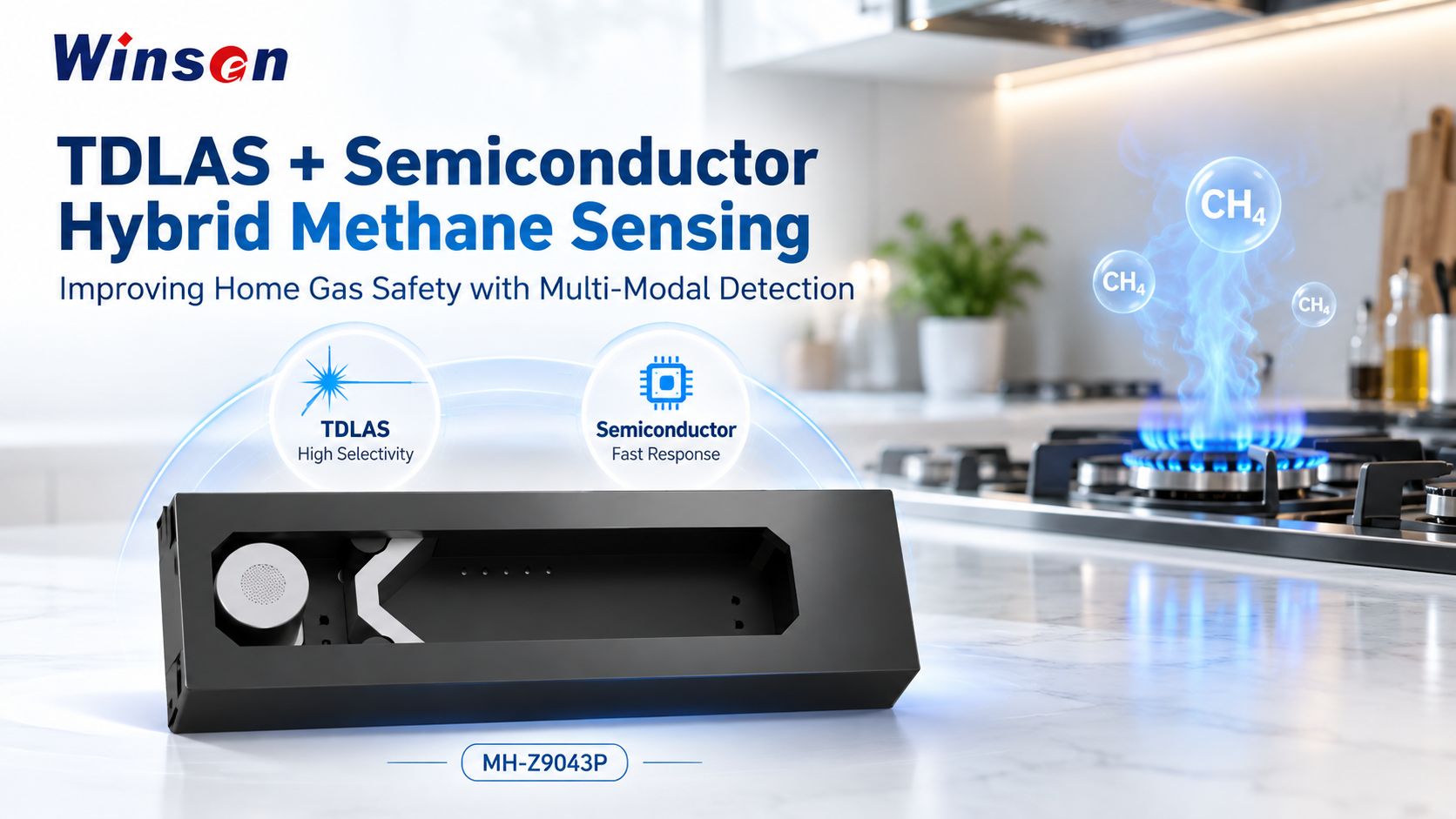
For residential gas alarm manufacturers, detecting methane is only part of the engineering challenge. A gas alarm must also distinguish a real leak from background interference, remain dependable through years of continuous operation, and respond appropriately when its sensing components behave abnormally.
These requirements have renewed interest in two established detection approaches: tunable diode laser absorption spectroscopy (TDLAS) and metal oxide semiconductor (MOS) gas sensing. TDLAS offers highly selective optical measurement of methane, while semiconductor sensors provide a separate gas-response mechanism backed by extensive practical application experience.
Neither technology is immune to every failure mode. That is why combining their signals—with environmental compensation, diagnostics, and a carefully designed alarm strategy—can provide a more informative basis for household methane detection.
This article explains how each technology works, what can affect its reliability, and how hybrid sensing can help OEMs design safer residential gas alarms.
How Does TDLAS Laser Methane Detection Work?
TDLAS measures gas concentration by observing how target molecules absorb laser light at specific wavelengths. Methane (CH4) has well-defined absorption features in the near-infrared region. For example, approximately 1653.7 nm is a widely studied methane absorption wavelength used in TDLAS research. The exact operating wavelength and scanning method depend on the laser and sensor design; this example should not be treated as an unpublished specification of a particular Winsen model.
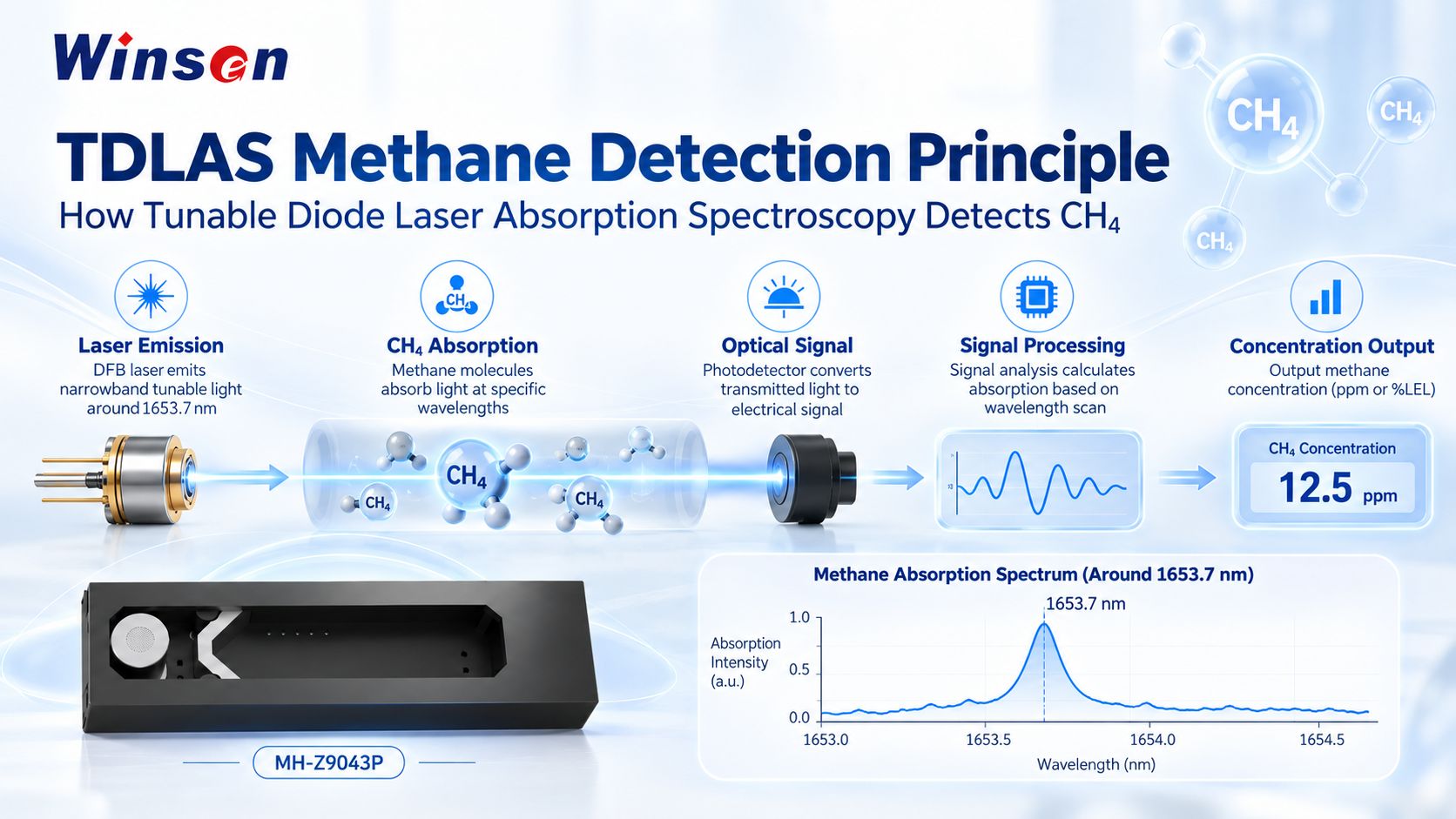
A typical laser methane sensing system performs four tasks:
- Laser emission: A tunable semiconductor laser is driven across a wavelength range that includes a target methane absorption feature.
- Gas absorption: Methane molecules within the optical path absorb some of the transmitted light at characteristic wavelengths.
- Optical detection: A photodetector measures the resulting light signal.
- Signal processing: Electronics and algorithms analyze the absorption feature and estimate methane concentration.
In simplified form, the Beer–Lambert relationship connects absorption to gas concentration and effective optical path length. A longer optical path can strengthen a measurable absorption signal, provided the optical design and signal-to-noise ratio are properly controlled.
The main attraction of TDLAS is gas selectivity. Instead of relying on a broadly reactive sensing material, it looks for methane's characteristic spectral absorption. This can reduce cross-sensitivity to many non-target gases encountered in kitchens and domestic environments. It does not, however, eliminate every possible influence from pressure, temperature, optics, electronics, or interfering absorption features.
For a broader introduction, see Winsen's guide to tunable diode laser absorption spectroscopy.
What Can Affect the Long-Term Reliability of Laser Methane Sensors?
High selectivity is valuable, but an optical measurement system must remain stable enough to find and interpret the target absorption line correctly. In a TDLAS instrument, the laser source, optical path, detector, temperature control, and processing electronics all contribute to the final result.
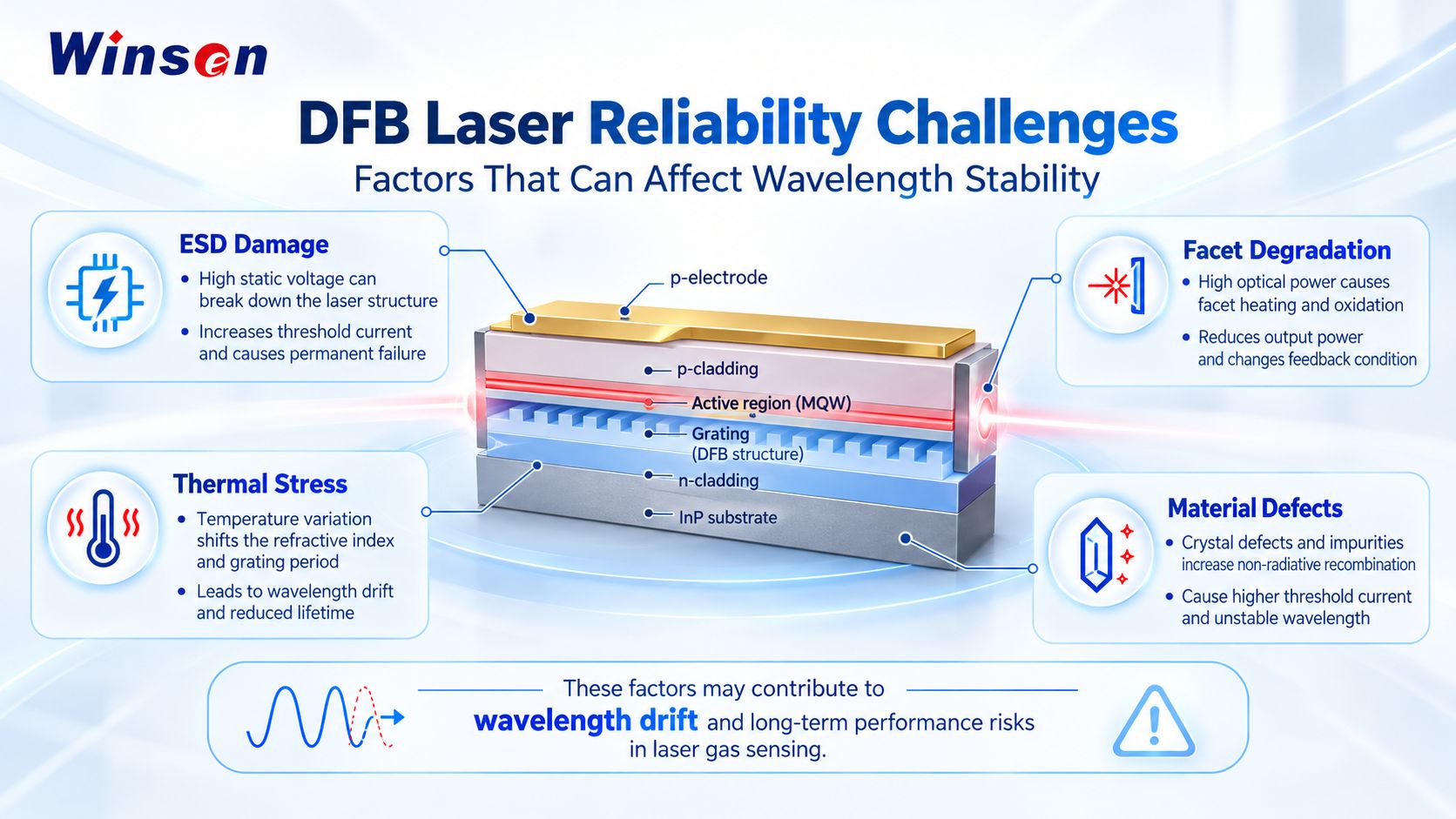
Laser wavelength shift and temperature control
The wavelength emitted by a distributed feedback (DFB) laser depends on its operating conditions, particularly injection current and temperature. This tunability makes spectroscopy possible, but the instrument must control or track the wavelength closely enough to locate the methane absorption feature.
If wavelength tuning moves outside the expected scanning region, a valid gas absorption signal can become weaker or be interpreted incorrectly. Temperature regulation, scan monitoring, reference features, and diagnostic routines are therefore important design considerations.
Electrostatic discharge and semiconductor damage
Laser diodes are semiconductor devices and can be vulnerable to electrostatic discharge (ESD). Severe electrical stress may damage a device or alter its electrical and optical characteristics. Depending on the damage mechanism, symptoms may include reduced output power, changed operating current, degraded stability, or wavelength shifts.
Importantly, ESD exposure does not always produce the same outcome, and a wavelength shift should not automatically be assumed whenever a laser has suffered electrical stress. Appropriate ESD protection and device-level validation remain essential.
Optical facet aging and packaging stress
Laser facet degradation, changes in optical feedback, contamination, and repeated thermal cycling can also affect the stability of a laser-based sensing system. Mechanical or thermal movement in the package may influence optical alignment even when the laser itself continues to operate.
The engineering lesson is straightforward: an accurate methane sensor needs both a selective detection principle and mechanisms to recognize abnormal operating conditions. Long-term reliability is a system property, not simply a characteristic of the light source.
How Do Semiconductor Methane Sensors Work?
Metal oxide semiconductor gas sensors detect changes in the electrical characteristics of a heated sensing material when it interacts with the surrounding atmosphere. Surface reactions involving oxygen species and reducing gases, including methane, can alter charge-carrier concentrations and therefore the sensor's electrical resistance.
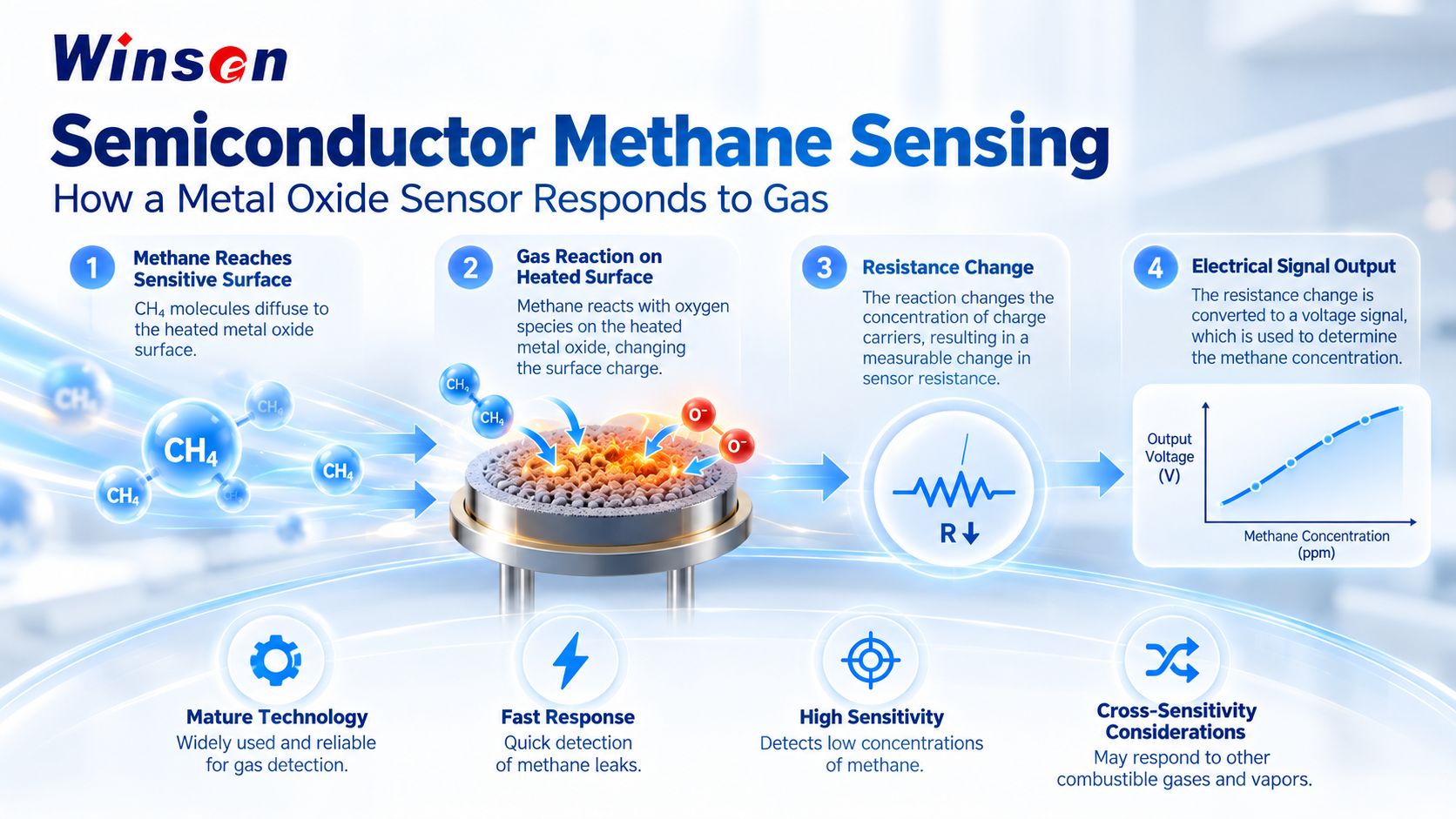
In practical devices, the electrical response is measured and interpreted using a calibration and processing strategy. Sensitive material composition, heater control, filtering structures, and algorithms all affect the sensor's gas response.
Semiconductor sensors are widely used because they can offer attractive sensitivity, compact form factors, and established manufacturing processes. They can also provide a physically different measurement channel from TDLAS, which is especially useful for cross-checking unusual readings.
The limitation is selectivity. A MOS element may respond to more than one combustible gas or volatile compound. Humidity, temperature, poisoning substances, and material aging can change its baseline or sensitivity. Therefore, a semiconductor signal should not automatically be interpreted as definitive proof of methane without considering the sensor's calibration and intended operating environment.
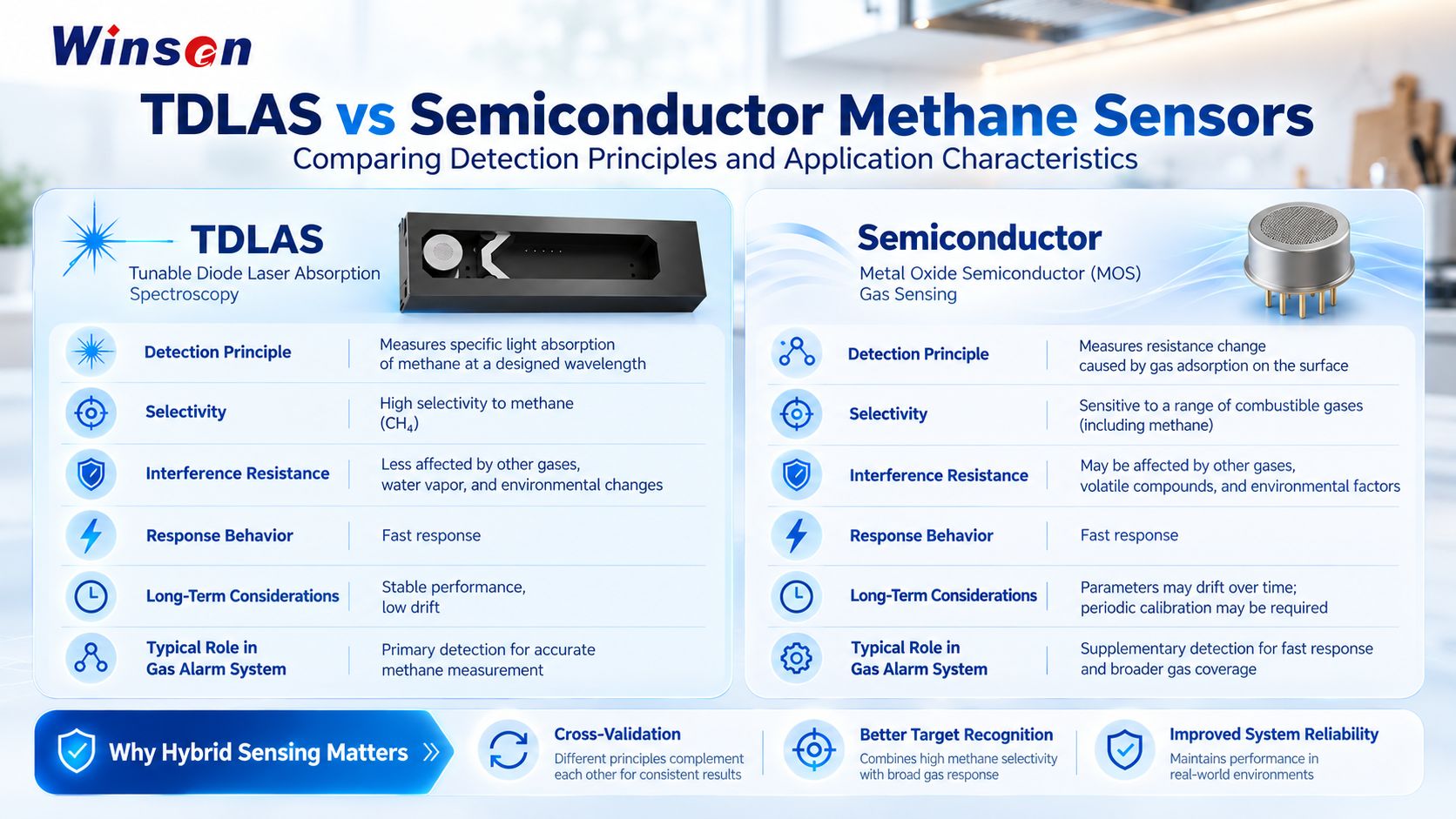
TDLAS vs Semiconductor Methane Sensors: Key Differences
| Engineering consideration | TDLAS laser sensing | MOS semiconductor sensing |
|---|---|---|
| Measurement principle | Optical absorption at selected methane wavelengths | Change in sensing-material electrical resistance |
| Methane selectivity | Typically high when the wavelength and optical analysis are correctly designed | Depends on material formulation, filters, temperature and algorithms |
| Response to other vapors | Often lower cross-sensitivity to many non-target gases; not immune to all interference | May respond to other combustible gases or VOCs |
| Environmental influences | Laser tuning, optics, temperature, pressure and optical signal quality | Temperature, humidity, surface chemistry and aging |
| Long-term risks | Optical or electronic degradation, wavelength/control issues | Baseline drift, sensitivity changes and possible poisoning |
| Integration considerations | Laser drive, photodetection, optical structure and control algorithms | Heater drive, resistance readout, compensation and calibration |
| Role in a hybrid design | Selective methane measurement | Independent supplementary response and diagnostic evidence |
There is no universal winner for every application. Performance depends on the actual sensor design, its calibration, ambient conditions, and complete alarm-system architecture. A well-engineered hybrid approach is intended to combine complementary information rather than to claim that either technology has no weaknesses.
How Does Hybrid Laser + Semiconductor Methane Sensing Work?
Hybrid sensing brings together two signals generated by different physical principles. In a representative architecture, the laser channel serves as the primary source of selective methane information, while the semiconductor channel supplies additional evidence about gas-related changes in the surrounding environment. Temperature and humidity data can provide further context for compensation and diagnostics.
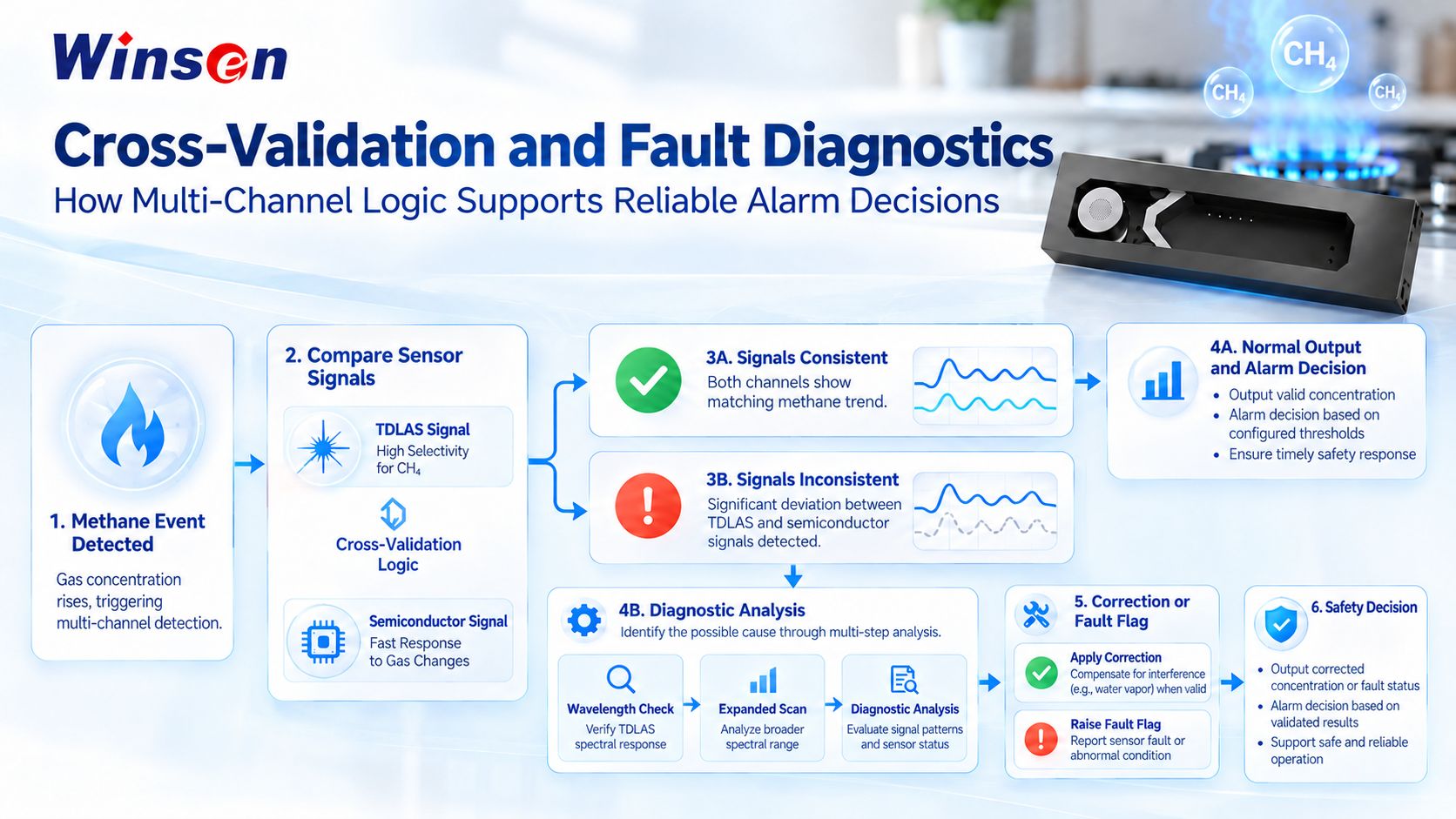
The resulting system can compare more than two isolated concentration readings. It can examine signal magnitude, trend, timing, channel health and environmental conditions.
When the two channels agree
If the laser and semiconductor channels both indicate a change consistent with methane exposure, their agreement can increase confidence in the event assessment. The controller must still apply its verified thresholds, timing rules, and alarm requirements.
When the semiconductor responds but the laser does not
A mismatch calls for investigation, not an immediate conclusion that either channel is wrong. Possibilities include a non-target interfering vapor affecting the semiconductor sensor, an optical or wavelength-control problem, a difference in response times, or other abnormal operating conditions.
One possible diagnostic strategy is to check the optical signal, verify the laser's scanning state, and—where supported by the design—expand the wavelength search or adjust operating conditions before evaluating the response again. If a valid methane absorption feature is recovered, the system may use the verified information to correct its measurement path. If it is not recovered, the controller should follow its defined fault and safety strategy.
When the laser responds but the semiconductor does not
A selective laser response should not automatically be rejected because the second channel is quiet. Different response thresholds, time constants, contamination states, or sensor faults may explain the disagreement. The safety logic must be evaluated against the requirements of the finished gas alarm.
The purpose of cross-validation is not to suppress alarms indiscriminately. It is to improve event interpretation while preserving a safe response to credible hazards and sensor faults.
Cross-Validation, Fault Detection and Alarm Decisions
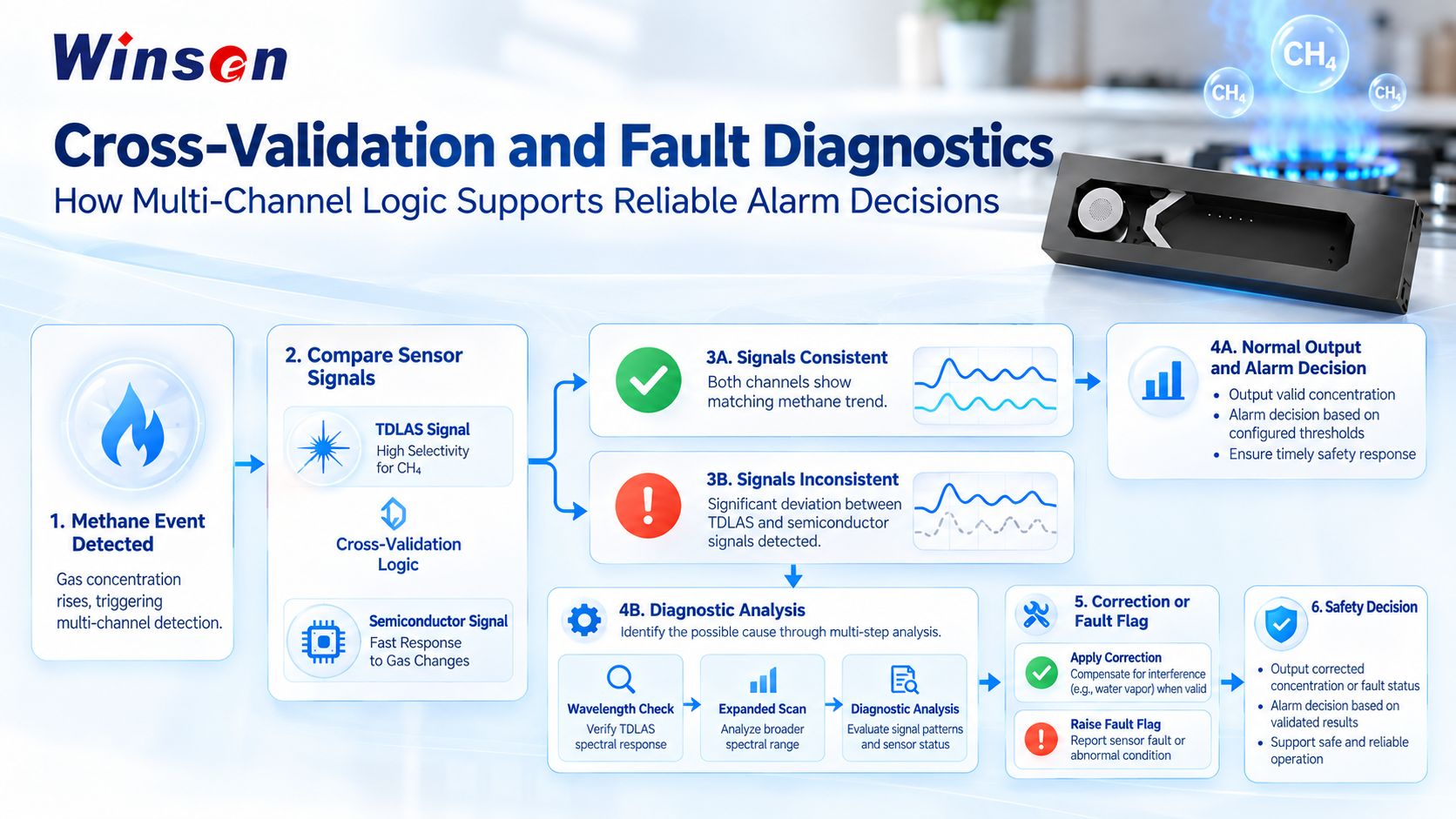
A practical hybrid methane sensing architecture should distinguish at least three conditions:
- Valid gas detection: One or more verified signal paths indicate methane at a level requiring action under the approved alarm logic.
- Possible interference or signal mismatch: The sensor channels disagree and additional checks are required.
- Sensor or system fault: Self-diagnostics detect a condition that prevents the sensor from providing trustworthy measurement information.
These states should not all produce the same response. For example, the system may display a fault condition, transmit a diagnostic code, or activate a defined protective response according to its design. The precise implementation must be validated by the alarm manufacturer and must never delay a required alarm beyond applicable safety limits.
For OEM engineers, this means that fusion algorithms need a testable fault-response specification, not just a claim of reduced false alarms. Useful tests include stuck sensor outputs, interrupted optical signals, simulated heater failures, supply-voltage disturbances, and disagreement between channels during gas exposure.
Winsen MH-Z9043P: A Compact Methane Sensing Solution for OEMs
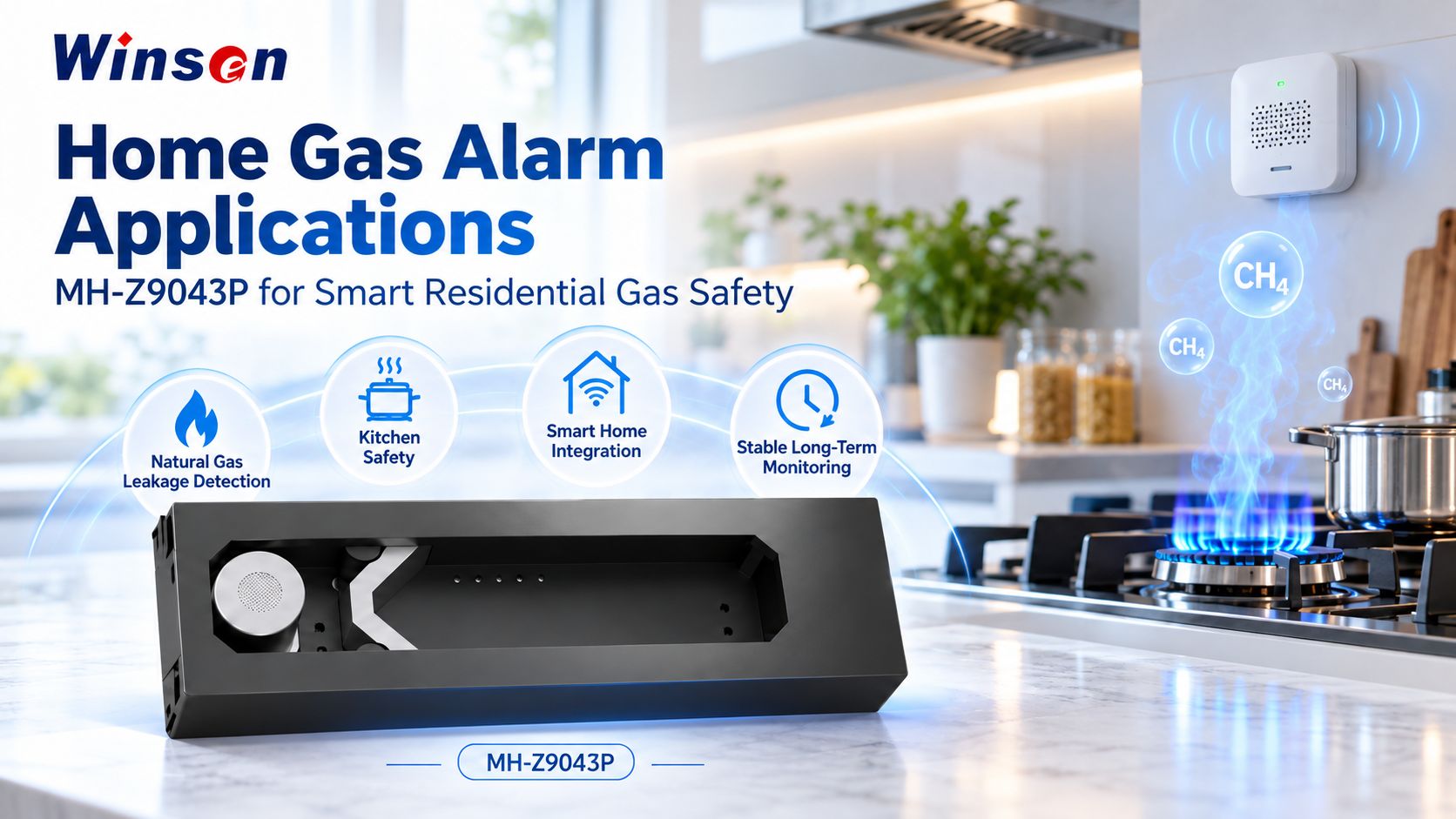
Winsen's MH-Z9043P TDLAS Laser Methane Sensor is designed primarily for household methane leakage detection. Its published product page identifies TDLAS as the detection principle and describes an internal reflective optical path, temperature-control and compensation algorithms, and a dual safety mechanism.
Our separate MH-Z9043P multi-modal sensing overview also discusses the use of laser, semiconductor, and environmental sensing information together. OEM customers should confirm the exact internal channel configuration and diagnostic interfaces for the product revision being evaluated rather than assuming that every described fusion function is exposed to the host controller.
Published MH-Z9043P specifications
| Parameter | Specification |
|---|---|
| Product model | MH-Z9043P |
| Target gas | Methane (CH4) |
| Detection principle | TDLAS |
| Power supply voltage | DC (4.5–5.5) V |
| Operating current | <300 mA (@5V supply) |
| Interface level | 3.0V |
| Output signal | UART serial port (TTL level 3.0V) |
| Warm-up time | 15s |
| Response time | T90 < 15s |
| Operating temperature | -13°C to 58°C (manufacturer's stated range; see product notes) |
| Operating humidity | 0–95% RH (non-condensing) |
| Dimensions | 66 mm × 19 mm × 19.9 mm |
| Weight | <30 g |
| Service life | >10 years |
Specifications may change; confirm the latest datasheet, installation conditions, and test requirements before design approval.
The reflective optical structure helps fit the measurement path into a compact module, while UART output supports integration with the host microcontroller. For product developers, the key benefit is the ability to evaluate a defined methane sensing component within the broader alarm architecture, rather than designing an optical measurement system from the ground up.
Methane detection is not the same as LPG detection
An important point for international OEMs: MH-Z9043P is specified for methane (CH4), which is commonly the principal component of natural gas. LPG applications commonly involve propane and/or butane and require sensors validated for those target gases. Do not substitute a methane-only sensor into an LPG alarm design without checking gas compatibility and the complete application requirements.
OEM Checklist: What Should Be Validated Before Product Launch?
Selecting a sensing module is the first step. Gas alarm manufacturers should also validate the finished product under realistic environmental and electrical conditions.
- Target gas and alarm thresholds: Confirm methane specificity, intended concentration units, alarm setpoints, and the required response time at the finished-device level.
- Interference testing: Evaluate relevant vapors and background gases, including alcohol-related and cooking-related interferents, at appropriate concentrations.
- Environmental cycling: Test temperature, humidity, condensation avoidance, and recovery after extreme but specified storage or operating conditions.
- Long-term stability: Establish aging and drift test methods, along with production quality controls and field-maintenance expectations.
- Fault injection: Test missing signals, laser-control abnormalities, power interruption, communication loss, and other diagnostic failure cases.
- Alarm behavior: Verify that signal mismatches, diagnostic routines, and fault handling cannot create unacceptable alarm delays or unsafe suppression.
- Mechanical integration: Check gas access, orientation, enclosure design, installation location, and electromagnetic compatibility.
- Market requirements: Validate the complete detector against standards and certification requirements relevant to the intended country or region. Component specifications do not by themselves establish certification of the finished alarm.
For manufacturers considering hybrid detection, these tests help determine whether the second sensing channel adds useful diagnostic coverage under real field conditions—not merely whether two sensors can produce signals in the laboratory.
Frequently Asked Questions
Is TDLAS more accurate than a semiconductor methane sensor?
TDLAS generally offers stronger methane selectivity because it measures a characteristic optical absorption feature. Overall accuracy, however, depends on the complete sensor implementation, calibration, operating conditions, and fault management. It is not correct to assume that any TDLAS device always outperforms any semiconductor device in every measurement metric.
Why is 1653.7 nm often used for methane detection?
Methane has a useful near-infrared absorption feature around 1653.7 nm, and this wavelength has been used in published DFB-laser TDLAS methane systems. It is an example from the literature, not a claim about the precise internal wavelength of MH-Z9043P.
Can laser wavelength drift cause missed methane detections?
An uncontrolled wavelength or scan error can weaken or distort a methane absorption measurement. Whether that results in a fault, an incorrect reading, or a missed alarm depends on the sensor's monitoring functions and the finished system's safety logic. That is why wavelength control and diagnostics matter.
Does adding a semiconductor sensor eliminate false alarms?
No. A supplementary channel can provide useful information for cross-validation, but the semiconductor sensor has its own cross-sensitivities and failure mechanisms. Reduced false alarms must be demonstrated through controlled tests without compromising necessary gas-leak alarms.
Can MH-Z9043P be integrated into a connected home gas alarm?
The published model provides UART serial output and is intended for home methane leakage detection. Integration into connected products is possible at the system-design level, subject to interface, power, enclosure, and compliance requirements. Refer to the official product information and request the latest integration documentation.
Does a hybrid methane sensing module make the final alarm automatically compliant?
No. The finished alarm's detection performance, fault behavior, environmental resistance, electrical safety, and other applicable requirements must be evaluated independently for its target market.
Conclusion: Better Gas Safety Starts with Better Fault Awareness
Methane sensing technology is moving beyond the question of whether a sensor can respond to gas. For modern residential alarms, equally important questions are whether the detector can distinguish interference from a real leak, recognize abnormal component behavior, and maintain a dependable safety response over time.
TDLAS and MOS semiconductor sensing approach methane detection from different physical principles. Their complementary information can be valuable when combined with thoughtful signal processing, environmental compensation, and fault-aware alarm design.
At Winsen, we continue developing sensing solutions that help OEM manufacturers balance gas selectivity, practical reliability, compact integration, and long-term operation. If you are designing a next-generation natural gas alarm, explore the MH-Z9043P methane sensor and contact our technical team to discuss sample evaluation, interface requirements, and system validation.
Technical reading: Winsen TDLAS technology guide · Research on 1653.7 nm TDLAS methane detection · Review of metal-oxide semiconductor methane sensors