Ultrasonic Oxygen Sensors for Oxygen Concentrators: Measuring Oxygen Concentration and Flow
Oxygen concentrators are widely used in home healthcare and medical environments to provide supplemental oxygen. As these devices become more compact, intelligent, and application-specific, accurate monitoring of oxygen concentration and gas flow has become increasingly important for equipment manufacturers.
Oxygen concentration indicates the proportion of oxygen in the delivered gas, while flow rate describes the volume of gas delivered over time. Monitoring both parameters helps oxygen concentrators maintain reliable operating conditions and provides essential data for equipment monitoring and control.
Ultrasonic sensing technology offers an integrated approach to these measurements. Winsen's US1001 and US1010 ultrasonic oxygen sensors are designed to measure oxygen concentration and flow simultaneously, supporting the development of household and medical oxygen concentrators.
Why Do Oxygen Concentrators Need Both Oxygen Concentration and Flow Monitoring?
Oxygen concentration and flow rate are two important parameters in oxygen concentrator operation. Although they describe different aspects of gas delivery, monitoring them together provides equipment manufacturers with more comprehensive information about system performance.
1. Oxygen Concentration Monitoring
Oxygen concentration represents the proportion of oxygen in the output gas mixture. Monitoring this parameter helps the equipment control system evaluate oxygen production performance and identify changes in the gas output.
For household and medical oxygen concentrators, continuous oxygen concentration measurement can provide feedback for system monitoring and help maintain consistent operating conditions.
2. Oxygen Flow Rate Monitoring
Flow rate measures the volume of oxygen-containing gas delivered through the output pathway per unit of time. It is an important parameter for understanding gas delivery conditions and supporting flow control within the equipment.
Accurate flow measurement helps manufacturers develop equipment monitoring functions and optimize system operation.
3. Why Measure Both Parameters Simultaneously?
Measuring oxygen concentration alone does not provide complete information about gas delivery. Similarly, flow measurement alone cannot indicate the oxygen content of the output gas.
By acquiring both parameters through one sensing module, equipment manufacturers can simplify system integration while obtaining complementary data for monitoring and control.
- Oxygen concentration: Provides information about the oxygen content of the output gas.
- Flow rate: Provides information about the volume of gas being delivered.
- Combined monitoring: Supports more comprehensive equipment performance evaluation and control strategies.
How Do Ultrasonic Oxygen Sensors Measure Oxygen Concentration and Flow?
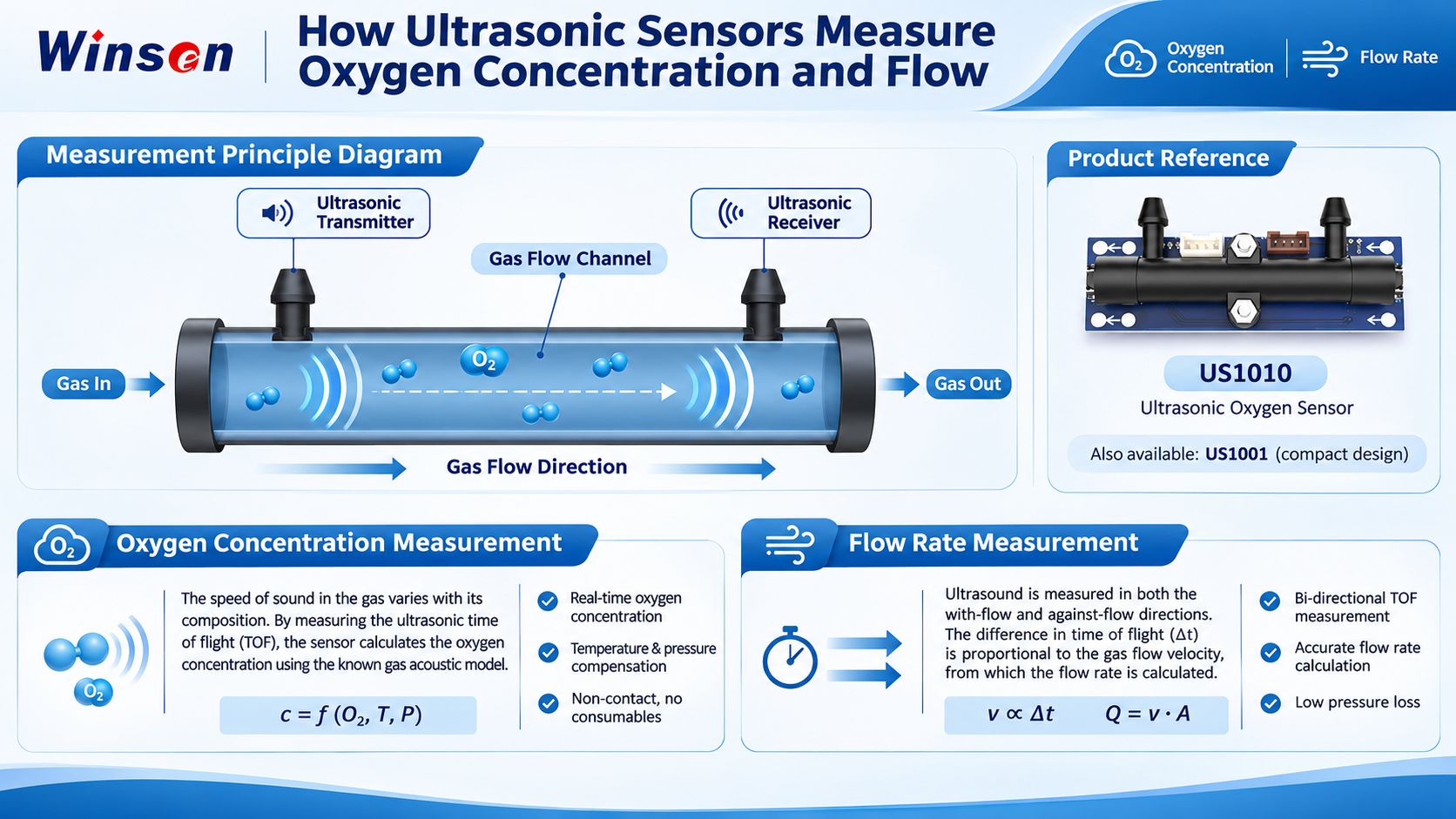
Ultrasonic oxygen sensors use the propagation characteristics of sound waves in gas to determine oxygen concentration and flow velocity.
The propagation time of ultrasonic waves in a binary gas mixture changes with gas composition and flow conditions. By measuring these changes and applying temperature compensation, the sensor can calculate oxygen concentration and flow simultaneously.
1. Oxygen Concentration Measurement
The speed of sound in a gas mixture is influenced by its composition. When the oxygen proportion changes, the acoustic properties of the gas also change.
The ultrasonic sensor measures the propagation time of ultrasonic signals through the gas pathway. By analyzing the measured signal and applying the appropriate calculation model and temperature compensation, the module determines oxygen concentration.
2. Flow Rate Measurement
Gas flow affects the propagation time of ultrasonic waves traveling in the direction of flow and against the direction of flow.
By measuring the difference between these propagation times, the sensor can calculate gas flow velocity and determine the corresponding flow rate.
3. Integrated Dual-Parameter Measurement
The ultrasonic measurement principle allows oxygen concentration and flow information to be obtained through the same sensing system.
This integrated approach offers several advantages for oxygen concentrator manufacturers:
- Simultaneous oxygen concentration and flow measurement.
- Fast measurement response for real-time monitoring.
- No reliance on electrochemical consumable sensing elements for the ultrasonic measurement process.
- Compact module integration for oxygen equipment design.
- Temperature compensation to support measurement accuracy.
Winsen US1001 and US1010 Ultrasonic Oxygen Sensors
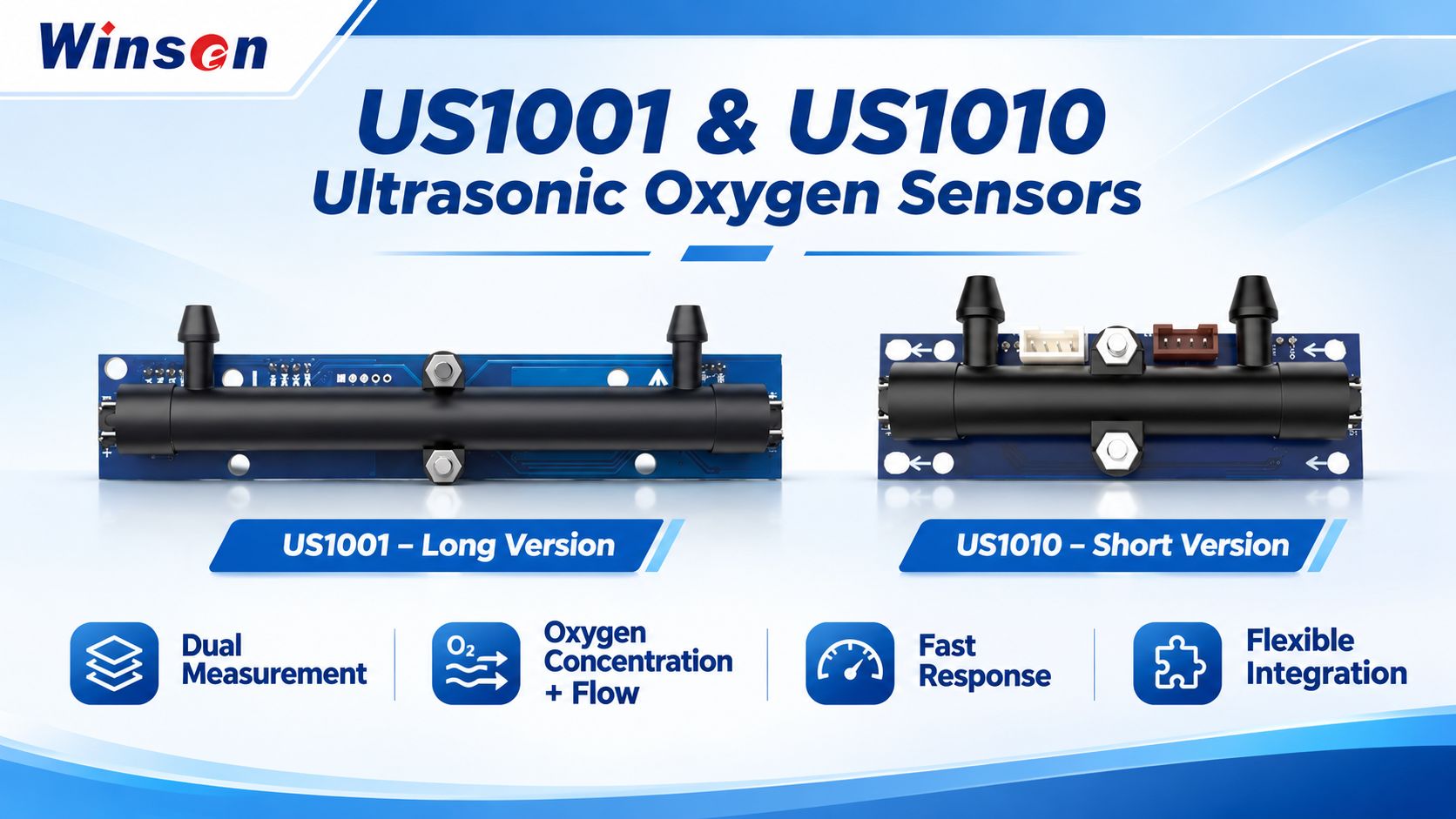
Winsen provides two ultrasonic oxygen sensor models for oxygen concentration and flow monitoring: US1001 and US1010.
Both models are designed for oxygen concentrators and related equipment. Their different mechanical dimensions provide equipment manufacturers with flexibility when designing internal gas pathways and installation structures.
US1001 Ultrasonic Oxygen Sensor – Long Version
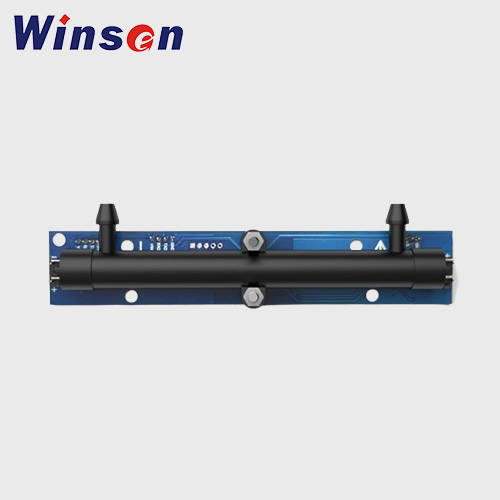
The Winsen US1001 ultrasonic oxygen sensor features a long-form structure and is designed for oxygen concentration and flow measurement in oxygen concentrators and related equipment.
- Simultaneous oxygen concentration and flow measurement.
- Ultrasonic detection principle.
- Real-time measurement response.
- High measurement accuracy and stability.
- Designed for household and medical oxygen concentrators.
US1010 Ultrasonic Oxygen Sensor – Short Version
The Winsen US1010 ultrasonic oxygen sensor features a shorter mechanical structure, providing another integration option for oxygen concentrators with different internal space requirements.
- Simultaneous oxygen concentration and flow measurement.
- Compact mechanical structure.
- Ultrasonic detection principle.
- Fast response and stable measurement performance.
- Designed for household and medical oxygen concentrators.
US1001 vs. US1010: Key Specifications
The following table compares the main technical parameters of the two ultrasonic oxygen sensor models.
| Parameter | US1001 | US1010 |
|---|---|---|
| Detection Principle | Ultrasonic | Ultrasonic |
| Target Gas | Oxygen (O₂) | Oxygen (O₂) |
| Oxygen Measurement Accuracy | ±1.5% FS (5–45°C) | ±1.5% FS (5–45°C) |
| Oxygen Resolution | 0.1% | 0.1% |
| Flow Measurement Range | 0–10 L/min | 0–10 L/min |
| Flow Measurement Accuracy | ±0.2 L/min (5–45°C) | ±0.2 L/min (5–45°C) |
| Flow Resolution | 0.1 L/min | 0.1 L/min |
| Response Time | ≤1.5 s (T90) | ≤1.5 s (T90) |
| Operating Voltage | 4.5–13.2 V | 4.5–13.2 V |
| Average Current | ≤30 mA | ≤30 mA |
| Output Signal | UART (3.3 V) | UART (3.3 V) |
| Dimensions (L × W × H) | 120 × 30 × 30 mm | 78.2 × 30 × 20 mm |
| Weight | 25 g | 20 g |
| Operating Temperature | 0–55°C | 0–55°C |
| Operating Humidity | 0–95% RH (non-condensing) | 0–95% RH (non-condensing) |
| Expected Service Life | ≥5 years | ≥5 years |
Which model should you choose?
US1001 is suitable for equipment designs that can accommodate its longer mechanical structure. US1010 provides a shorter installation option for systems with more limited internal space.
The final selection should consider the available installation space, gas pathway design, electrical interface, and overall equipment requirements.
How to Integrate an Ultrasonic Oxygen Sensor into an Oxygen Concentrator
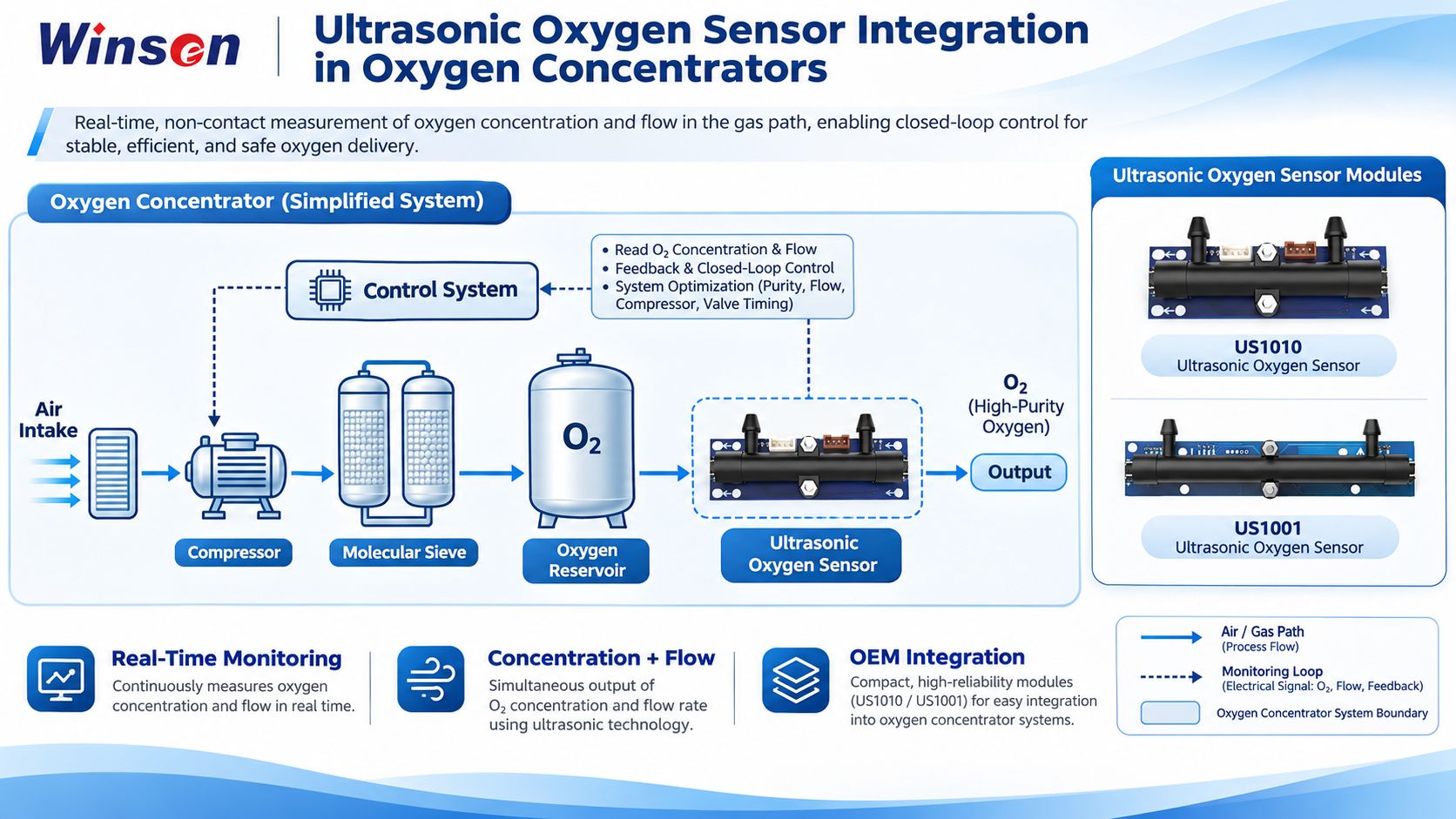
Sensor integration is an important part of oxygen concentrator development. In addition to selecting the appropriate sensor model, equipment manufacturers need to consider the gas pathway, electrical connections, communication protocol, and control system requirements.
1. Gas Pathway Integration
The sensor should be installed in an appropriate position within the oxygen delivery pathway. The gas connection, installation direction, sealing structure, and operating conditions should be evaluated during equipment development.
2. Electrical Connection
Both US1001 and US1010 support an operating voltage of 4.5–13.2 V and provide a UART (3.3 V) output interface.
OEM engineers should verify the power supply, signal connections, grounding, and electrical compatibility with the main control board.
3. Data Acquisition and System Control
The sensor provides oxygen concentration and flow data to the equipment controller. The controller can use these measurements as inputs for monitoring functions, operating logic, and equipment performance evaluation.
The integration process generally involves:
- Establishing the gas pathway and mechanical installation.
- Connecting the sensor to the power supply and main control board.
- Configuring UART communication and data acquisition.
- Verifying oxygen concentration and flow measurements.
- Integrating the measurement data into the equipment monitoring and control strategy.
- Conducting system-level testing under representative operating conditions.
Applications of Ultrasonic Oxygen Sensors
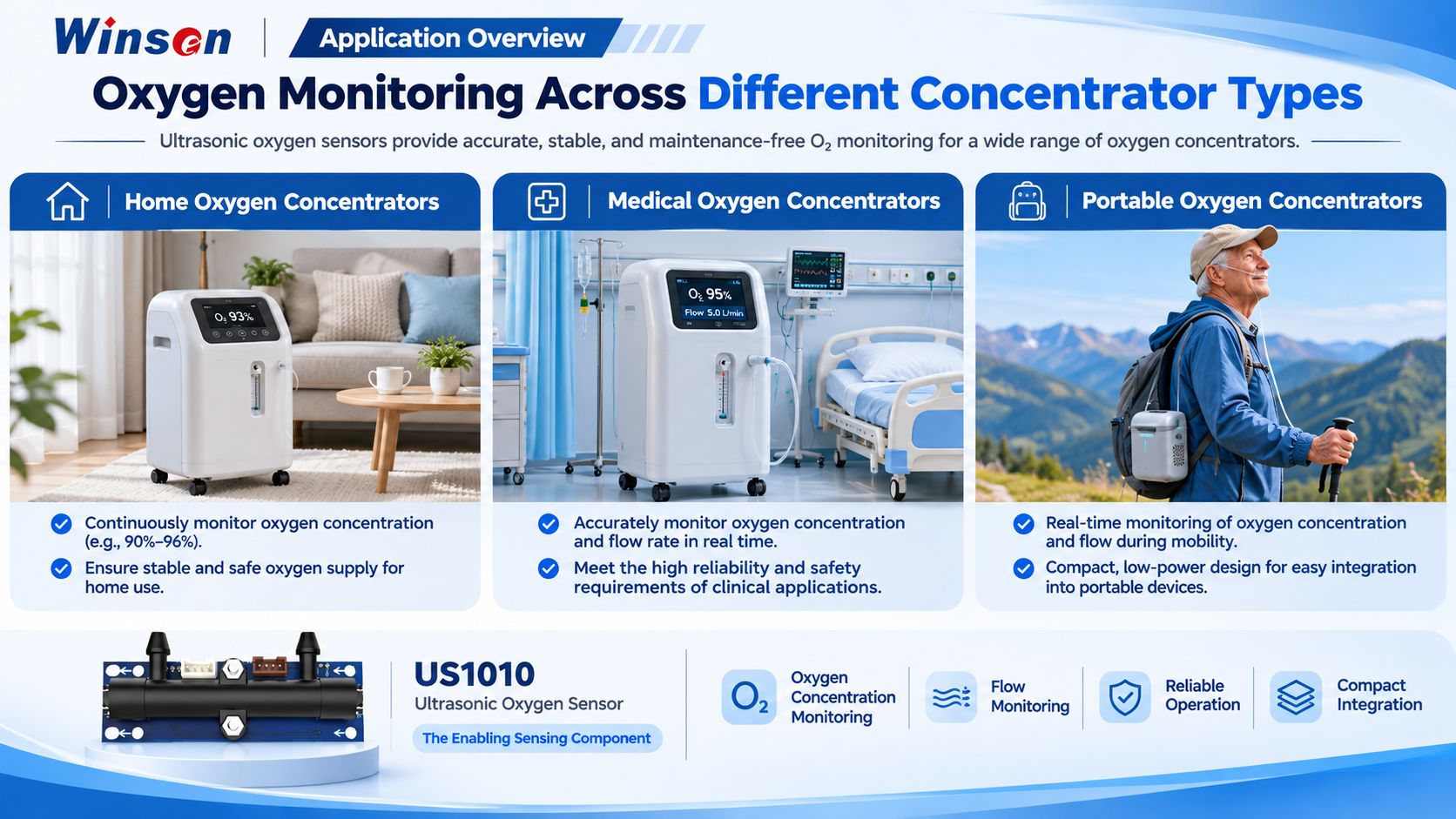
With integrated oxygen concentration and flow measurement, ultrasonic oxygen sensors can support a variety of oxygen equipment applications.
Household Oxygen Concentrators
Home oxygen concentrators require reliable oxygen output monitoring during extended operation. Ultrasonic oxygen sensors provide concentration and flow data that can support equipment monitoring and control.
Medical Oxygen Concentrators
Medical oxygen concentrator manufacturers can integrate ultrasonic sensing modules into their equipment to monitor oxygen concentration and gas flow. The sensor data can support equipment performance monitoring and system-level safety design.
Portable Oxygen Equipment
Compact oxygen equipment places additional requirements on sensor dimensions and integration flexibility. The shorter mechanical structure of US1010 provides an alternative for equipment designs with limited installation space.
Other Oxygen Monitoring Equipment
Ultrasonic oxygen sensors can also be considered for oxygen chambers, oxygen therapy equipment, and other systems requiring oxygen concentration and flow measurement, subject to application-specific evaluation.
How to Select the Right Oxygen Sensor for Your Equipment
When selecting an oxygen sensor for an oxygen concentrator, OEM manufacturers should evaluate several factors:
- Measurement requirements: Confirm the required oxygen concentration and flow measurement ranges.
- Accuracy and response: Evaluate whether the measurement accuracy and response time meet the equipment design requirements.
- Installation dimensions: Compare US1001 and US1010 according to available mechanical space.
- Electrical compatibility: Check the operating voltage, current consumption, and UART communication interface.
- Operating environment: Evaluate temperature, humidity, condensation, and gas pathway conditions.
- System verification: Conduct integration testing to verify measurement performance under actual equipment operating conditions.
Sensor selection should be based on the complete equipment design rather than a single technical parameter. For medical applications, the equipment manufacturer remains responsible for system-level validation, applicable regulatory compliance, and safety functions.
Frequently Asked Questions About Ultrasonic Oxygen Sensors
1. What does an ultrasonic oxygen sensor measure?
An ultrasonic oxygen sensor measures oxygen concentration and gas flow. It analyzes ultrasonic wave propagation characteristics in the gas and uses temperature compensation to calculate the corresponding measurement results.
2. Can one ultrasonic sensor measure both oxygen concentration and flow?
Yes. Winsen US1001 and US1010 ultrasonic oxygen sensors are designed to measure oxygen concentration and flow simultaneously through an integrated ultrasonic sensing approach.
3. What is the difference between US1001 and US1010?
The main difference is their mechanical structure. US1001 is the long version, with dimensions of 120 × 30 × 30 mm, while US1010 is the short version, with standard dimensions of 78.2 × 30 × 20 mm. Both support oxygen concentration and flow measurement.
4. What is the response time of US1001 and US1010?
Both models have a standard response time of ≤1.5 seconds (T90). Customized response configurations can be discussed according to specific application requirements.
5. Where are US1001 and US1010 commonly used?
Typical applications include household oxygen generators, medical oxygen concentrators, and related oxygen monitoring equipment.
6. What communication interface do these sensors use?
Both US1001 and US1010 provide a UART output signal with a 3.3 V logic level, supporting integration with compatible equipment control systems.
Winsen: Ultrasonic Oxygen Sensing Solutions for OEM Manufacturers
As oxygen equipment continues to evolve toward intelligent monitoring, compact design, and improved system integration, reliable oxygen sensing technology plays an important role in equipment development.
Winsen's US1001 and US1010 ultrasonic oxygen sensors combine oxygen concentration and flow measurement in integrated modules, providing two mechanical configurations for different equipment designs.
Whether you are developing household oxygen concentrators, medical oxygen equipment, or portable oxygen devices, Winsen provides ultrasonic oxygen sensing products and technical support for OEM integration.
Looking for an ultrasonic oxygen sensor for your oxygen concentrator? Contact Winsen to discuss your measurement requirements, installation dimensions, and OEM integration needs.