LPG Safety: Where to Install Gas Leak Detectors and How to Choose the Right Sensor

Liquefied petroleum gas (LPG) is widely used for cooking, heating, commercial food service, building energy systems and industrial applications. It is convenient and energy-dense, but a leak can create a combustible atmosphere if gas accumulates before being detected.
An effective LPG safety strategy therefore goes beyond simply installing a gas alarm.
It should consider:
where LPG may leak, where the gas will travel, where it may accumulate, whether the detector is positioned in that path, and what the system should do after a leak is detected.
A practical LPG safety system can be understood as:
Safe Gas Installation + Ventilation + Leak Detection + Alarm / Shutoff + Inspection and Maintenance
Gas detectors provide an additional layer of protection. They do not replace proper gas piping, ventilation, maintenance or safe operating procedures.
Why Does LPG Need Special Attention?
LPG commonly contains propane, butane or a mixture of the two.
One of the most important characteristics for gas detector placement is that LPG vapor is heavier than air. If it escapes into an enclosed or poorly ventilated space, it can move downward and accumulate in low areas such as pits, drains, basements and other low points. The UK Health and Safety Executive specifically notes this behavior and the associated fire, explosion and suffocation hazards. (健康与安全执行局)
This is different from methane.
Methane is lighter than air and tends to move upward, while propane and LPG generally settle toward lower areas.
That difference directly affects detector placement.
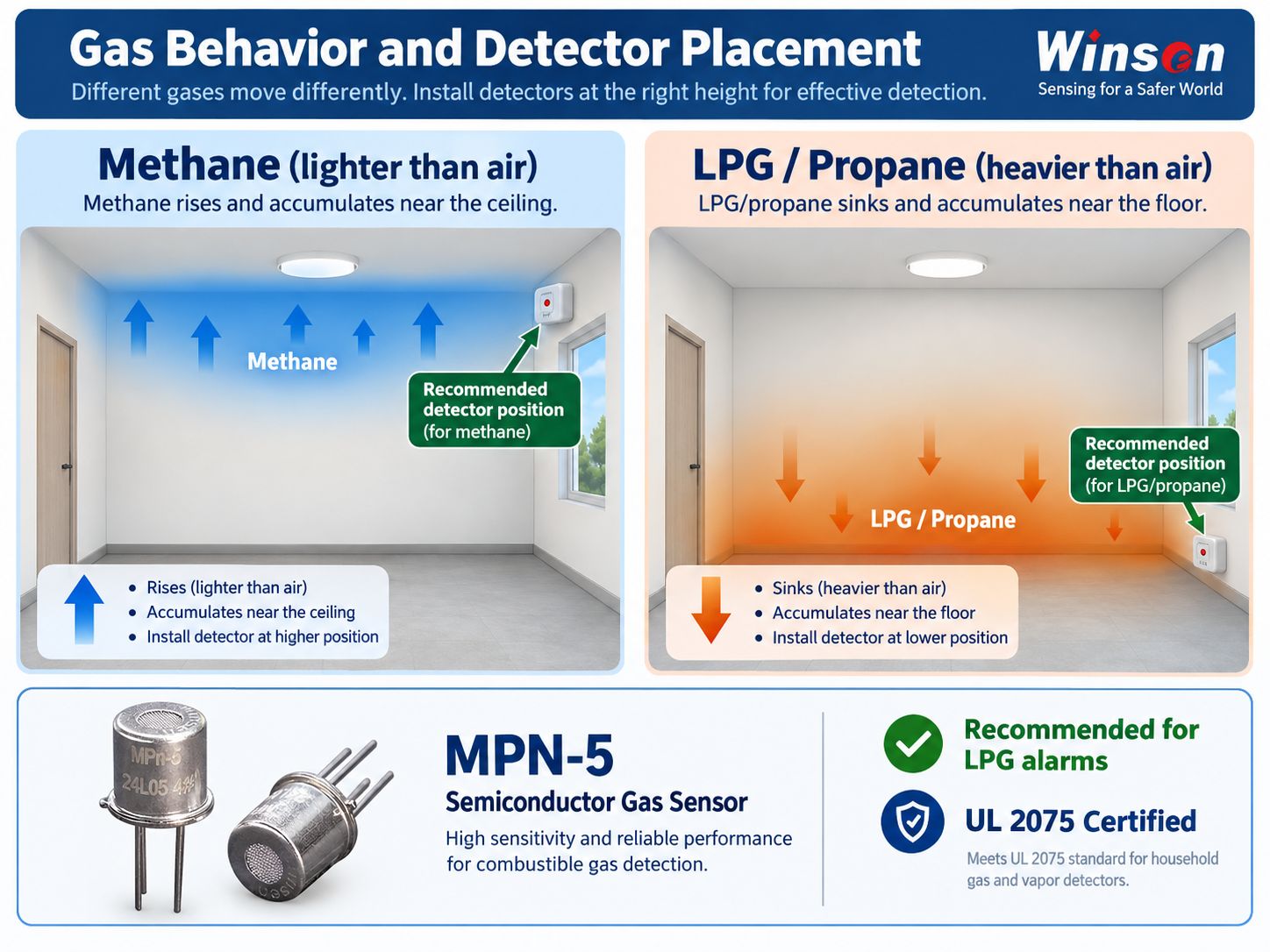
The practical principle is simple:
The detector should be installed where the target gas is realistically expected to reach the sensing element.
For LPG, that often means paying more attention to lower areas than would be typical for methane detection.
However, there is no universal mounting height that applies to every detector and every country. Exact installation requirements should follow the detector manufacturer's instructions, applicable standards and local regulations.
A Recent Japan Case Reinforces the Importance of Detector Placement
A useful real-world example came from Japan in September 2026.
On September 11, 2026, Okayama Prefecture published a notice relaying a request from Japan's Ministry of Economy, Trade and Industry. The request urged LP gas suppliers serving buildings used by large numbers of people to voluntarily and promptly install gas leak alarms or similar equipment in locations where leaked gas could accumulate, while also reviewing their safety-management arrangements. (冈山县官方网页)
The important point is not simply that more alarms may be installed.
The more important engineering principle is:
Gas detection needs to be located around realistic accumulation zones rather than placed arbitrarily in a building.
This principle is relevant far beyond Japan and applies to residential, commercial and industrial LPG safety systems.
Where Should an LPG Gas Detector Be Installed?
Detector placement should start with the actual gas installation.
A practical site assessment should answer four questions:
-
Where can LPG leak?
-
Where will the gas move after release?
-
Where can it accumulate?
-
Will the detector receive enough gas quickly enough to respond?
General guidance for fixed flammable gas detectors also emphasizes locating sensors at or near points where gas release is possible and considering the way gas moves through the monitored area. (健康与安全执行局)

1. Monitor Likely LPG Leak Sources
The first step is to identify mechanical connections and gas-handling components that could become leakage points.
Typical locations include:
-
cylinder or tank connections;
-
regulators;
-
valves;
-
flexible hoses;
-
threaded pipe joints;
-
flanges;
-
appliance connections;
-
gas manifolds.
These points do not automatically require one detector each.
Instead, they should be used to understand where a leak could start and how gas would move from that location.
2. Pay Attention to Low-Level Accumulation Areas
Because LPG is heavier than air, low areas deserve particular attention.
Possible accumulation zones include:
-
floor depressions;
-
pits;
-
trenches;
-
basements;
-
drains;
-
enclosed corners;
-
low spaces behind equipment.
A detector positioned far above these areas may receive less gas or may respond later than a detector located within the actual gas path.
For this reason, LPG detector design should consider both leak source and accumulation zone.
3. Consider Regulators, Valves and Pipe Connections
Regulators and valves are important parts of LPG systems because they contain seals, connections and moving components.
A typical LPG supply path may look like:
Cylinder / Tank → Regulator → Valve → Hose → Pipe → Appliance
Each interface is a potential inspection point.
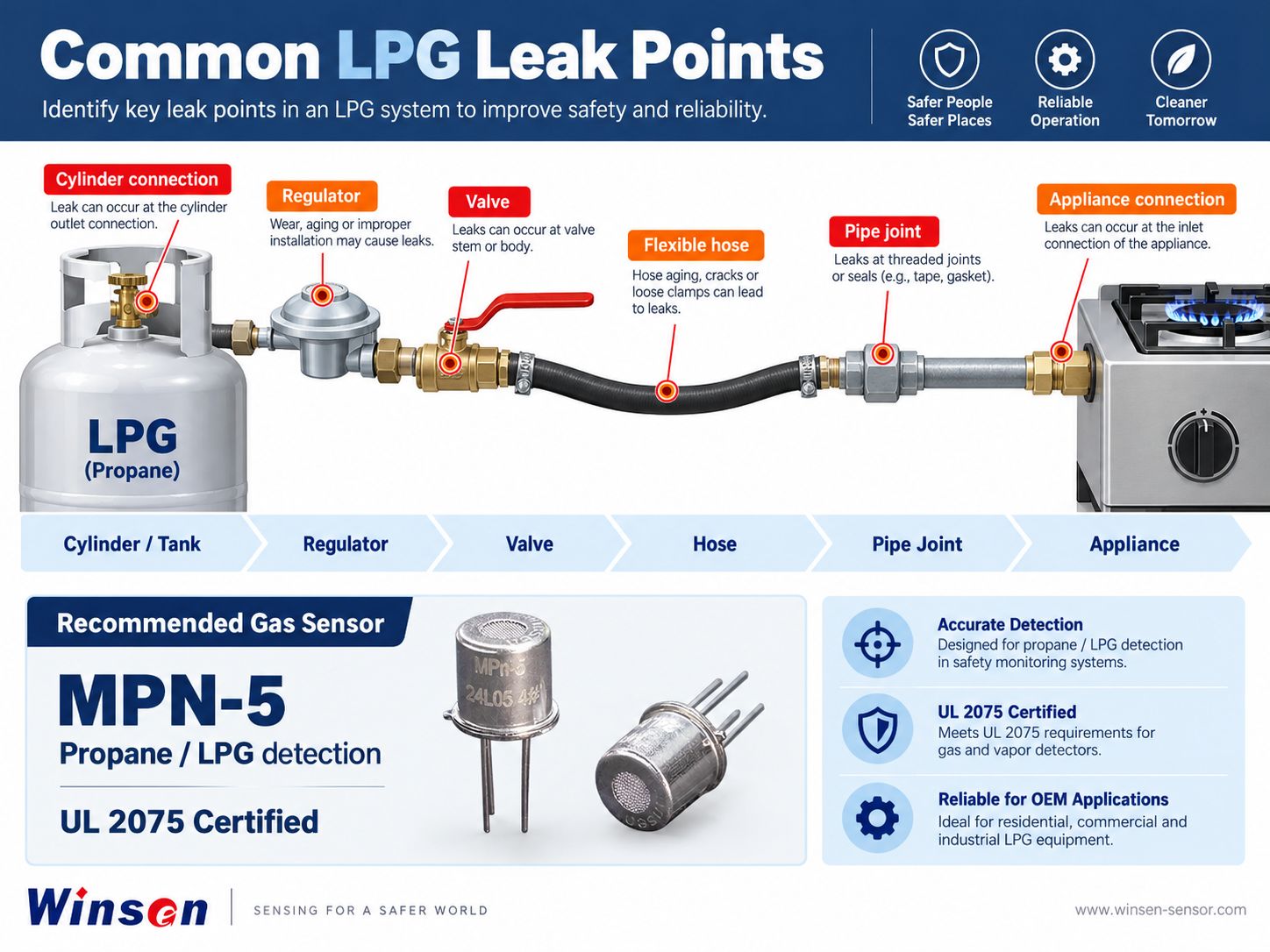
Leak detection planning should therefore consider the entire gas path instead of focusing only on the final appliance.
4. Consider Ventilation and Airflow
Gas density alone does not determine the final gas path.
Air movement can significantly influence where leaking LPG travels.
Important factors include:
-
exhaust fans;
-
supply-air vents;
-
open doors;
-
open windows;
-
kitchen ventilation hoods;
-
local airflow around machinery.
Strong airflow may dilute gas or carry it away from a detector.
Therefore, installation should not rely only on the rule that LPG moves downward.
A better design considers:
Gas Density + Leak Location + Airflow + Room Geometry
5. Monitor Unoccupied or Infrequently Visited Areas
Continuous gas detection can be particularly valuable in spaces that are not always occupied.
Examples include:
-
LPG cylinder rooms;
-
equipment rooms;
-
utility rooms;
-
storage areas;
-
back-of-house commercial spaces;
-
gas distribution rooms.
A leak in an occupied kitchen may eventually be noticed by personnel.
A slow leak inside an enclosed utility space may continue much longer without anyone noticing it.
This is one reason fixed gas detection is valuable in enclosed or partially enclosed areas where combustible gases can accumulate. (健康与安全执行局)
Common LPG Detector Installation Mistakes
Choosing a suitable LPG sensor is only part of the job.
Incorrect installation can reduce the effectiveness of the entire detector.
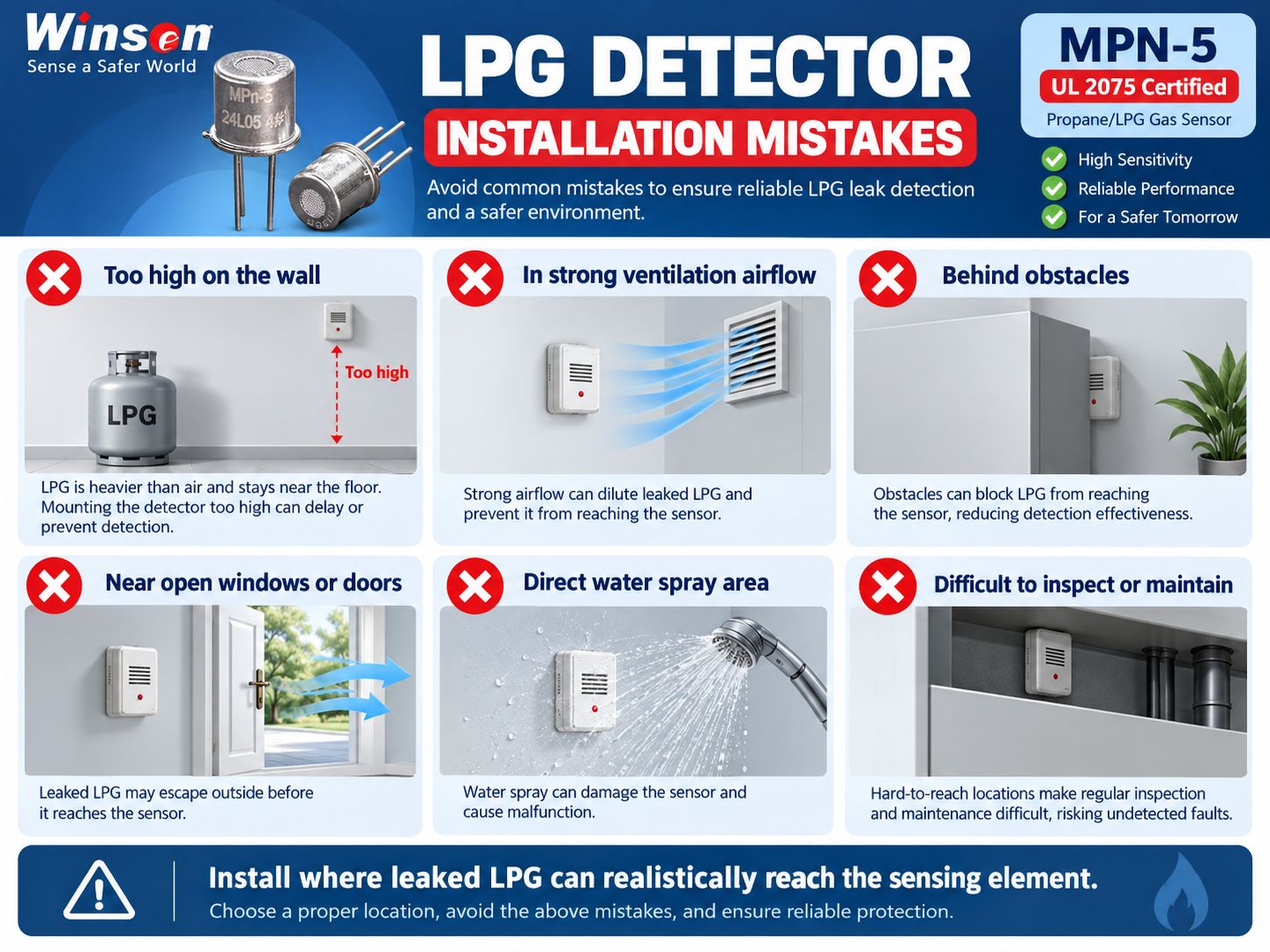
Installing the Detector Too High
For LPG applications, placing the detector too far above the likely accumulation zone can delay the sensing response.
Exact height should always follow the completed detector's installation instructions and applicable regulations.
Installing Directly in Strong Ventilation Airflow
A detector located directly beside a fresh-air outlet, fan or strong ventilation path may experience gas dilution.
The installation point should represent the expected gas accumulation area rather than the cleanest airflow in the room.
Hiding the Detector Behind Equipment
Cabinets, appliances and other structures can block gas movement.
The sensing inlet needs access to the surrounding atmosphere.
Installing Beside an Open Window or Door
Strong natural airflow may carry leaking gas away from the detector before the gas reaches the sensing element.
Installing Where Water Can Directly Reach the Detector
Direct water spray, condensation or contamination can affect detector reliability depending on the enclosure design.
Installing Where Maintenance Is Difficult
Gas detectors need inspection, testing and sometimes calibration or sensor replacement.
A location that is almost impossible to access may create maintenance problems later.
A useful rule is:
Install the detector where leaked LPG can realistically reach the sensing element and where the device can still be inspected and maintained.
How Many LPG Detectors Are Needed?
There is no universal rule such as "one detector per room."
The required number depends on the actual risk layout.
Important factors include:
-
room size;
-
number of gas appliances;
-
number of potential leak sources;
-
partitions;
-
ventilation;
-
low-level spaces;
-
storage areas;
-
gas distribution layout;
-
detector coverage;
-
local regulations.
For example, one detector in a commercial kitchen may not provide meaningful coverage for a separate LPG cylinder room or a remote regulator area.
Large facilities may therefore require multiple sensing points.
The objective is not to maximize detector quantity.
The objective is to provide appropriate coverage of realistic gas release and accumulation locations.
What Should Happen After LPG Is Detected?
A gas sensor is only the first component in a complete safety chain.
A typical LPG gas leak alarm architecture can include:
LPG Leak → Sensor / Detector → Alarm → Gas Shutoff / Ventilation → Monitoring System
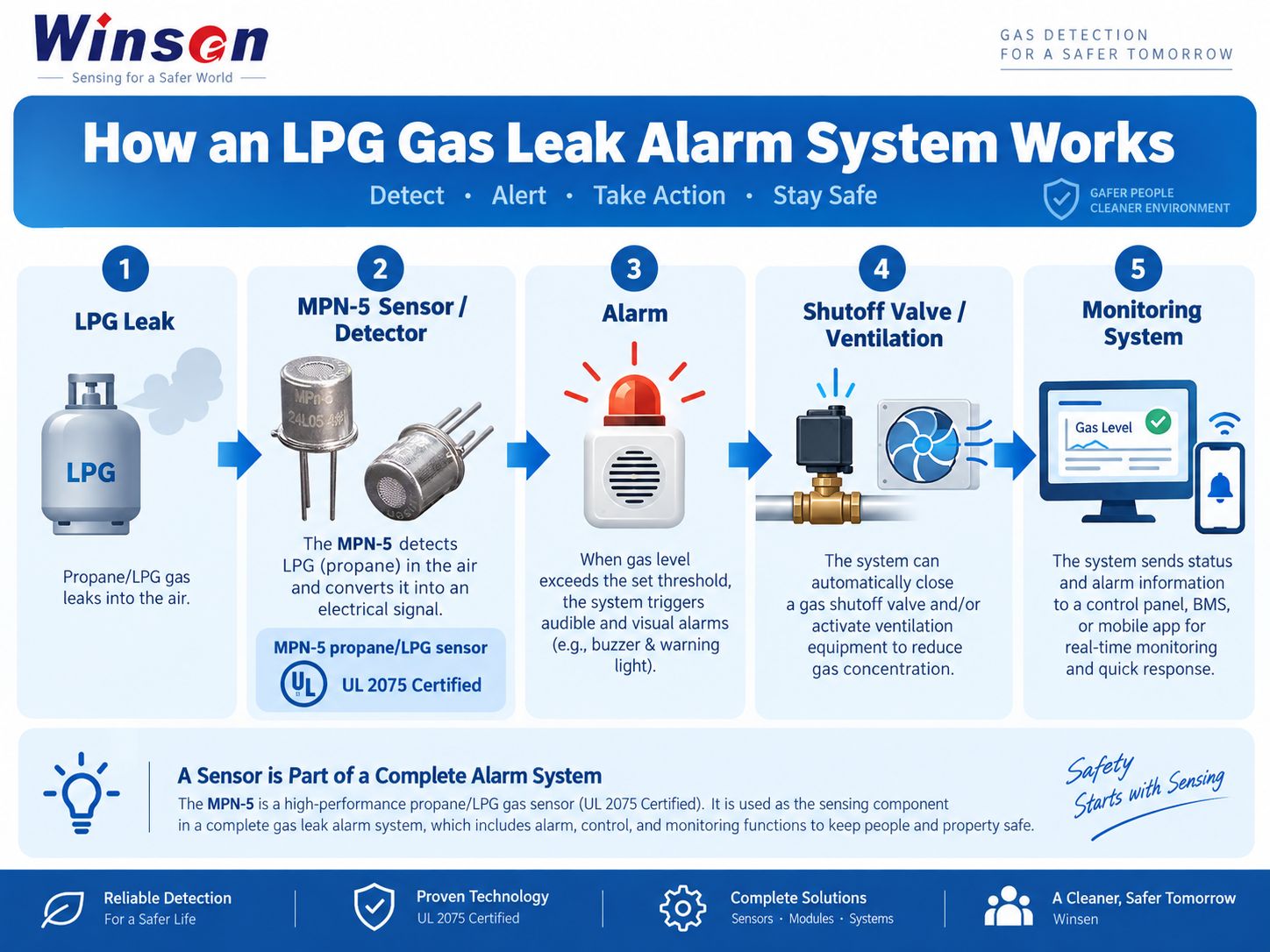
When the gas concentration reaches the configured alarm condition, the completed detector or control system may activate:
-
audible alarm;
-
visual warning;
-
gas shutoff valve;
-
ventilation system;
-
control panel;
-
BMS;
-
remote monitoring platform.
HSE guidance similarly notes that fixed gas detector systems can trigger alarms when a specified concentration is exceeded, while emphasizing that detectors are not a substitute for safe working practices and maintenance. (健康与安全执行局)
The final alarm threshold and response logic should be defined according to the completed detector design, applicable standards and the specific application.
Gas Sensor vs. Gas Detector: They Are Not the Same Product
This distinction is particularly important for OEMs.
A gas sensor is the sensing element.
A complete gas detector or gas leak alarm may include:
-
sensing element;
-
sensor drive circuit;
-
signal conditioning;
-
calibration;
-
microcontroller;
-
alarm algorithm;
-
buzzer;
-
visual indicator;
-
relay;
-
valve output;
-
fault monitoring;
-
power supply;
-
enclosure;
-
communication interface.
Therefore:
A certified or high-performance sensor does not automatically mean the completed gas alarm is certified.
The complete detector must be designed, tested and approved according to the requirements of the intended market.
MPn-5: Winsen Propane Sensor for LPG Safety Applications
For propane and LPG gas alarm applications, Winsen recommends the MPn-5 Semiconductor Propane Sensor.

MPn-5 is designed specifically for propane (C3H8) and liquefied gas detection.
It uses a metal oxide semiconductor sensing structure manufactured with a multi-layer thick-film process. The heating electrode, measuring electrode and gas-sensitive layer are integrated on an Al2O3 ceramic substrate and protected by a metal-cap package.
According to the current Winsen product specification, MPn-5 provides:
| Parameter | MPn-5 |
|---|---|
| Target Gas | Propane / Liquefied Gas |
| Chemical Formula | C3H8 |
| Detection Principle | Semiconductor |
| Detection Range | 0–5250 ppm |
| Heater Voltage | 5 V ± 0.1 V AC or DC |
| Heater Consumption | 305 ± 25 mW |
| Package | Metal Cap |
| Service Life | Up to 10 years |
| Certification | UL 2075 |
The sensor has achieved UL 2075 certification and is designed for OEM gas alarm manufacturers developing residential, commercial and industrial propane detection products. Winsen also specifies improved resistance to common household interferents, including alcohol, cooking vapors and humidity changes. (Winsen Sensor)
Why Is Interference Resistance Important in LPG Alarms?
Real-world gas alarms do not operate in laboratory air.
A detector installed in a kitchen or commercial environment may encounter:
-
alcohol vapor;
-
cooking fumes;
-
cleaning products;
-
changing humidity;
-
temperature changes;
-
other volatile compounds.
If a sensing element responds too strongly to common environmental interferents, the final detector may require more complex filtering and alarm logic.
For this reason, sensor development should consider not only target-gas sensitivity but also long-term stability and response to interfering gases.
MPn-5 was developed with these OEM integration requirements in mind. (Winsen Sensor)
Why UL 2075 Matters for OEM Development
UL 2075 is an important certification milestone for MPn-5 because it provides additional third-party validation for propane sensing applications.
For OEM manufacturers, however, the distinction between sensor certification and finished-product certification remains important.
MPn-5 itself has achieved UL 2075 certification. (Winsen Sensor)
The complete LPG detector still includes:
-
electronics;
-
firmware;
-
enclosure;
-
alarm logic;
-
power supply;
-
indicators;
-
outputs;
-
final system design.
The final detector therefore needs to be evaluated according to its own target-market requirements.
Where Can MPn-5 Be Used?
MPn-5 is suitable for OEM applications such as:
-
residential propane gas alarms;
-
LPG leak alarms;
-
commercial gas leak detectors;
-
commercial kitchen safety products;
-
combustible gas detectors;
-
fixed propane leak monitoring equipment;
-
integrated fire and gas safety products.
The sensor's compact metal-cap package is suitable for integration into dedicated alarm PCBs and compact detector housings.
LPG Safety in Commercial Kitchens
Commercial kitchens are a particularly important LPG detection scenario.
They combine:
-
gas appliances;
-
valves;
-
regulators;
-
multiple connections;
-
high equipment density;
-
strong ventilation;
-
frequent operation.
A detector should therefore not simply be placed wherever there is space on the wall.
The system designer needs to consider the appliance layout, pipe routing, low-level gas movement and ventilation.
The image below shows the typical relationship between LPG leak sources, low-level accumulation and detector positioning.
For commercial facilities, the objective is to detect a leak early enough for the alarm and response system to take action according to the site's safety design.
LPG Safety in Schools, Hospitals and Public Buildings
Public buildings introduce additional operational considerations because many occupants may not be familiar with LPG equipment or emergency procedures.
Relevant locations may include:
-
school kitchens;
-
hospital kitchens;
-
cafeteria areas;
-
boiler or utility rooms;
-
LPG storage areas;
-
gas equipment rooms;
-
service spaces.
The September 2026 Japanese safety action provides a useful reminder that buildings used by large numbers of people require particular attention to locations where leaking gas can accumulate. (冈山县官方网页)
Again, the key principle is not simply "install more detectors."
It is:
identify the leak source, understand gas movement, and place detection where LPG can actually reach it.
LPG Detector Maintenance Is Part of Safety
A gas detector is not a device that should be installed and then forgotten.
The maintenance program for a completed LPG alarm may include:
-
visual inspection;
-
detector function testing;
-
alarm testing;
-
calibration when required;
-
checking the gas inlet;
-
checking relay outputs;
-
verifying shutoff linkage;
-
checking communication;
-
replacing sensors according to product-life requirements.
Industrial flammable gas detection guidance also emphasizes that detector systems require appropriate use and maintenance throughout their service life. (健康与安全执行局)
The exact maintenance interval should follow the finished detector manufacturer's instructions and applicable regulations.
Frequently Asked Questions About LPG Gas Detectors
Is LPG heavier than air?
Yes. LPG vapor is heavier than air and can settle in low areas such as basements, drains and floor-level spaces. (健康与安全执行局)
Should an LPG detector be installed near the floor?
LPG detectors are generally positioned lower than methane detectors because LPG tends to settle. However, the exact mounting height depends on the completed detector, local regulations, room layout and the manufacturer's installation instructions.
Where are the most common LPG leak points?
Common potential leak points include cylinder or tank connections, regulators, valves, flexible hoses, pipe joints and appliance connections.
Can I install an LPG detector next to a ventilation fan?
Strong airflow may dilute or redirect leaking gas, so the detector should not automatically be placed directly in a strong ventilation stream. Detector positioning should consider actual airflow and likely gas accumulation.
How many LPG detectors does a commercial kitchen need?
There is no universal number. The required quantity depends on room layout, gas appliances, pipe connections, ventilation and possible accumulation zones.
Is a propane sensor the same as a complete LPG alarm?
No. The sensor is the sensing component. The completed alarm also requires electronics, calibration, alarm logic, power supply, enclosure and other functions.
What gas does MPn-5 detect?
MPn-5 is designed for propane (C3H8) and liquefied gas detection, with a specified detection range of 0–5250 ppm. (Winsen Sensor)
Is Winsen MPn-5 UL 2075 certified?
Yes. MPn-5 has achieved UL 2075 certification. (Winsen Sensor)
How long is the MPn-5 service life?
Winsen specifies a service life of up to 10 years under the stated operating and test conditions. (Winsen Sensor)
LPG Safety Starts with Understanding Where the Gas Will Go
A reliable LPG gas detection system is not created simply by choosing a sensitive sensor.
The complete design needs to consider:
Where can LPG leak?
Where will it travel?
Where can it accumulate?
Will the detector be exposed to that gas?
What will the system do when a leak is detected?
Because LPG is heavier than air, low-level gas accumulation, pipe connections, valves, regulators, enclosed spaces and airflow all need to be considered when determining detector placement.
Recent safety actions in Japan reinforce the same engineering principle: gas alarms are most useful when they are installed in locations where leaked gas may realistically accumulate. (冈山县官方网页)
For OEMs developing propane and LPG gas alarms, Winsen's MPn-5 Semiconductor Propane Sensor provides a dedicated C3H8 sensing option with a 0–5250 ppm detection range, up to 10-year service life and UL 2075 certification. (Winsen Sensor)
Learn more about MPn-5 Semiconductor Propane Sensor
For LPG alarm manufacturers, fire-safety equipment companies and gas detector OEMs, Winsen can support sensor evaluation, sample testing and product integration for residential, commercial and industrial propane detection projects.