Non-Contact Dry-Burning Protection Sensor: A New Safety Upgrade for Gas Stoves
Kitchen safety has always been an important direction for gas stove innovation.
As consumers pay more attention to cooking safety, dry-burning protection is moving from a high-end feature to a mainstream requirement. For gas stove manufacturers, the key question is no longer whether dry-burning protection is needed, but how to achieve it in a way that is accurate, reliable, user-friendly, and easy to integrate.
Traditional contact-based solutions often face challenges such as complex cookware adaptation, limited service life, mechanical wear, and higher maintenance cost. With diverse cookware shapes, materials, and cooking habits, balancing detection accuracy with long-term reliability has become a major technical challenge.
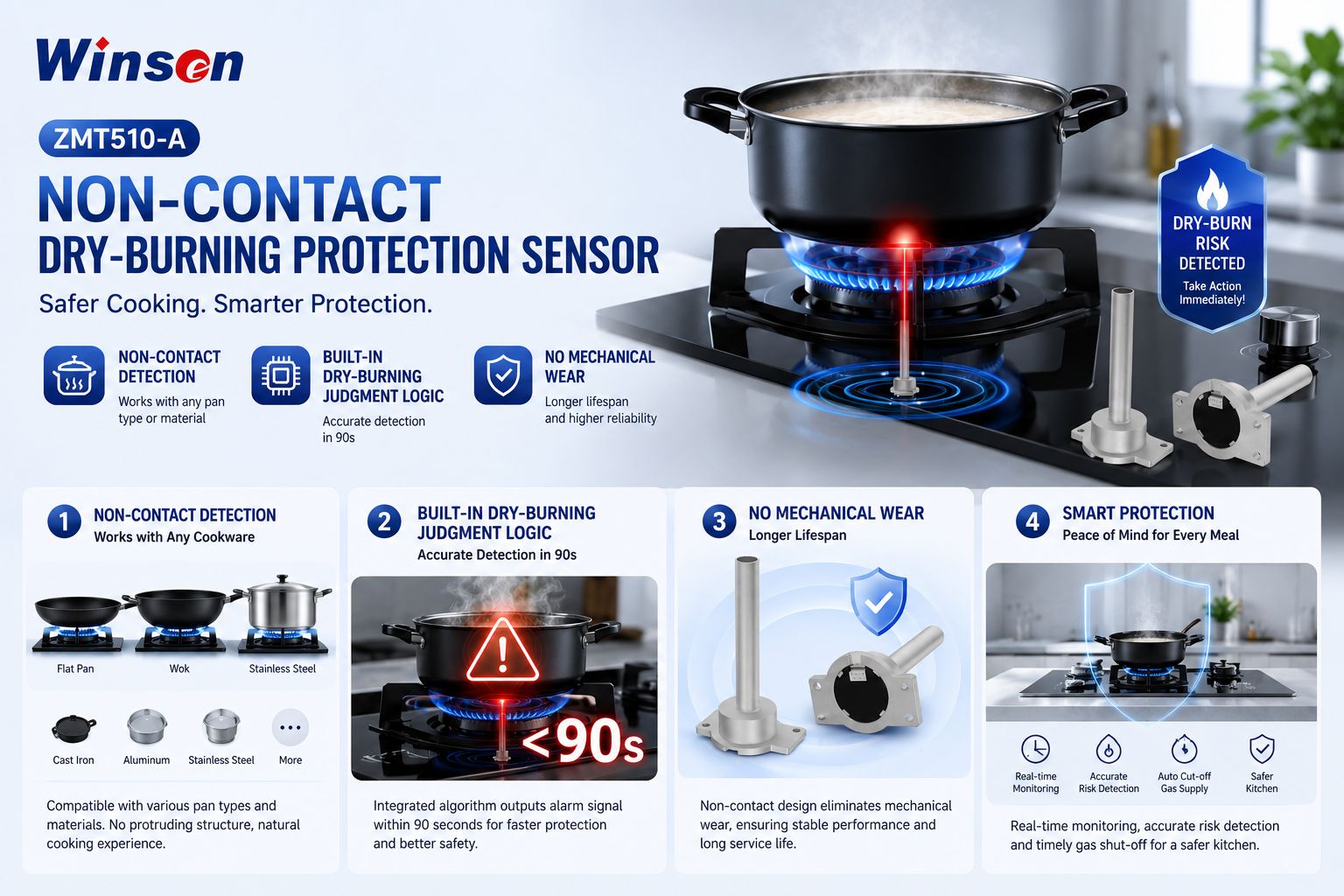
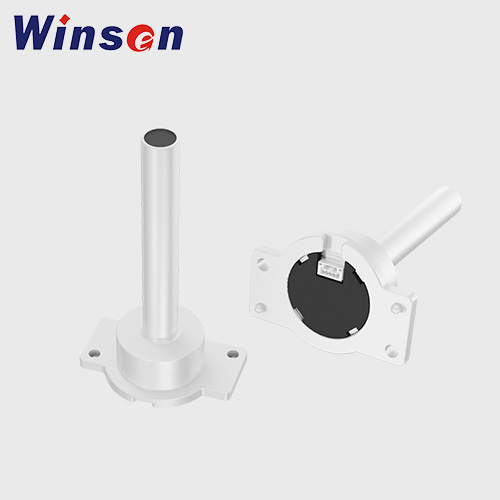
To support the next generation of safer gas stoves, we introduce the ZMT510-A non-contact dry-burning protection sensor, designed to provide a more reliable sensing solution for gas cooktop safety protection.
Why Gas Stoves Need Better Dry-Burning Protection
Dry-burning can occur when cookware is heated without enough liquid, oil, or food inside. In daily cooking, this may happen when users forget to turn off the stove, leave cookware unattended, or continue heating after water has evaporated.
Potential risks include:
- cookware damage
- food burning or smoke generation
- fire hazards
- safety concerns for elderly users and busy households
- negative user experience and product complaints
For gas stove manufacturers, dry-burning protection is not only a safety function. It is also a product differentiation feature that improves consumer trust and supports the development of smarter kitchen appliances.
1. Non-Contact Detection: Compatible with More Cookware Types
For gas stove manufacturers, cookware diversity is one of the biggest challenges.
In the real market, users may use:
- flat-bottom pans
- round-bottom woks
- cast iron pans
- stainless steel cookware
- aluminum pots
- thick-bottom cookware
- thin-bottom cookware
- cookware with uneven bottom surfaces
Traditional contact-based detection solutions often need to physically touch the pot bottom. This means the detection effect can be affected by cookware shape, bottom flatness, material, placement position, and contact quality.
The ZMT510-A adopts non-contact detection technology. It does not need direct physical contact with the cookware. Instead, it detects the thermal radiation signal emitted by the pot body.
This means the detection does not depend on:
- cookware thermal conductivity
- bottom flatness
- contact pressure
- mechanical lifting structure
- pot material consistency
As a result, ZMT510-A can adapt to different cookware types and materials more flexibly, giving gas stove manufacturers greater freedom in product design.
Better User Experience in Daily Cooking

Because ZMT510-A uses non-contact detection, it does not require a protruding mechanical contact structure above the burner area.
For users, the cooking experience remains close to that of a traditional gas stove:
- cookware placement feels natural
- pan tossing is not affected
- sliding or adjusting cookware remains convenient
- switching pots is easier
- daily operation is not interrupted by mechanical sensing parts
This is especially valuable for markets where wok cooking, high-heat stir-frying, and frequent cookware movement are common.
For manufacturers, better cookware compatibility also reduces the risk of after-sales issues caused by different user cookware habits.
2. Built-In Dry-Burning Judgment Logic for More Reliable Detection
In many contact-based solutions, the sensor only outputs raw temperature data. The gas stove manufacturer must develop the dry-burning judgment algorithm independently.
This creates several challenges:
- longer development cycle
- more testing workload
- difficult adaptation to different cooking scenarios
- higher risk of false alarms
- higher risk of missed alarms
- inconsistent user experience across product models
The ZMT510-A integrates the dry-burning judgment logic inside the sensor. Instead of only providing raw sensing data, it can directly output a dry-burning judgment result.
When a dry-burning risk is detected, the sensor can output an alarm signal within 90 seconds, providing the main control system with timely information for protection response.
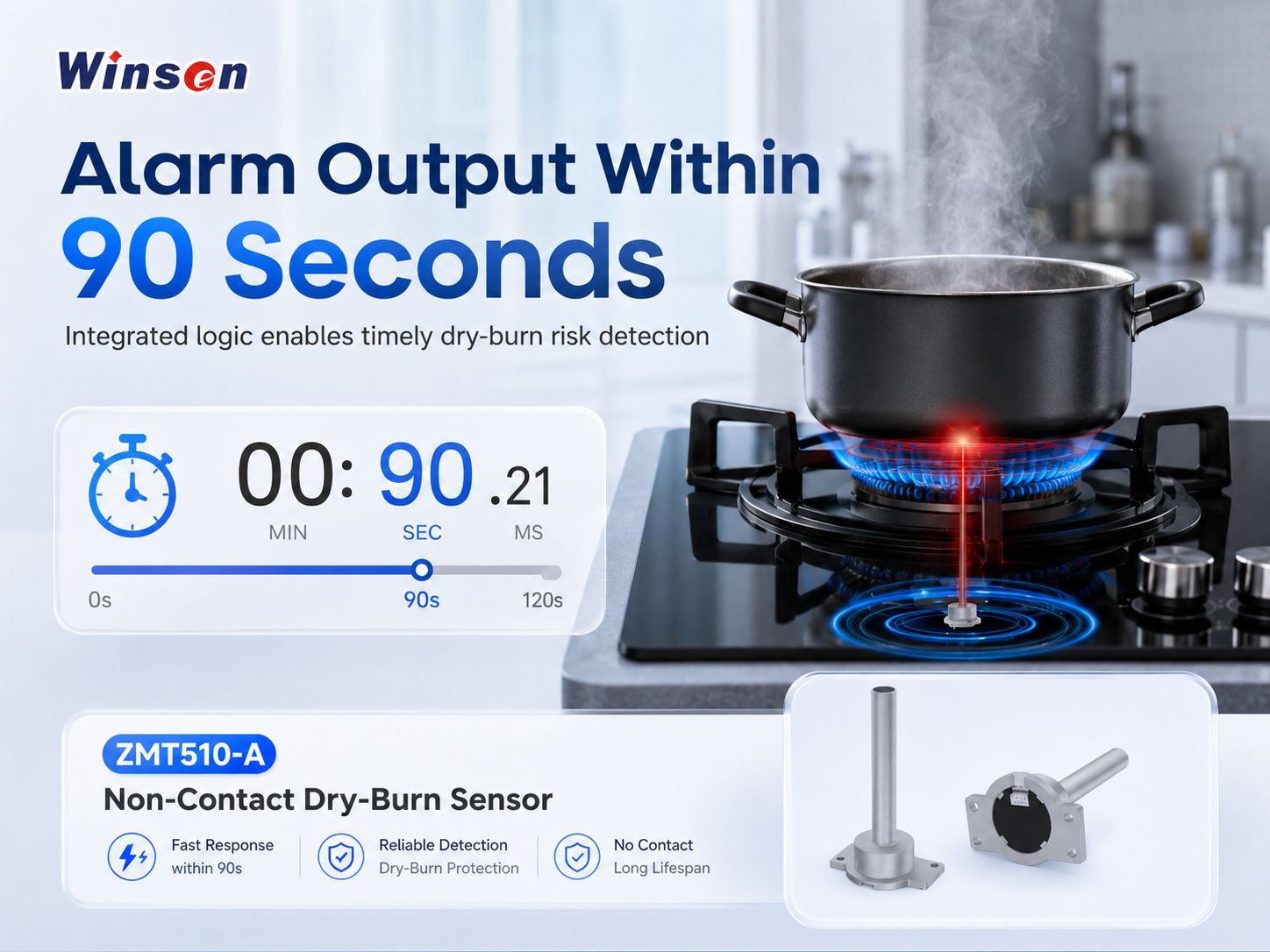
This helps the gas stove quickly take protective action, such as:
- triggering an alarm
- reducing heating power
- shutting off the gas valve
- reminding the user through the control panel
- activating smart home safety linkage
For manufacturers, this built-in logic helps reduce algorithm development difficulty and improve the consistency of the final product.
Reducing False Alarms and Missed Alarms
A dry-burning sensor must be accurate, but it must also be practical.
If the alarm is too sensitive, users may experience frequent false alarms during normal cooking.
If the alarm is too slow or inaccurate, the safety function may fail when it is truly needed.
By integrating mature judgment logic into the sensor, ZMT510-A helps provide a more stable foundation for dry-burning identification, improving both safety and user experience.
3. No Mechanical Wear for Longer Service Life
The kitchen environment is harsh for sensors.
Gas stove components are exposed to:
- high temperature
- oil fumes
- steam
- frequent heating cycles
- repeated cookware movement
- long-term daily use
Traditional mechanical contact structures may gradually wear, age, deform, or become contaminated by oil and residue. Over time, this can affect detection accuracy and product reliability.
Because ZMT510-A uses a non-contact sensing principle, it does not rely on mechanical contact with the cookware. This means there is no mechanical contact wear during normal operation.
The advantages are clear:
- longer service life
- more stable long-term performance
- lower maintenance risk
- reduced mechanical failure points
- improved reliability for high-frequency use
For gas stove manufacturers, this helps improve product durability and reduce after-sales maintenance pressure.
4. Easier Integration for Gas Stove Manufacturers
A good sensor solution should not only perform well. It should also be easy to implement in real products.
ZMT510-A is designed for gas stove safety applications and can support manufacturers in building dry-burning protection functions more efficiently.
Its integration value includes:
- no complex cookware contact structure
- reduced mechanical design difficulty
- built-in dry-burning judgment output
- easier control system linkage
- better compatibility with different cookware
- suitable for smart gas stove upgrades
For OEM and ODM gas stove projects, this can shorten development cycles and make product safety upgrades easier to commercialize.
5. Application Value for Smart Gas Stove Design
With ZMT510-A, gas stove manufacturers can build products that are safer, smarter, and more competitive.
| Manufacturer Need | ZMT510-A Value |
|---|---|
| Dry-burning protection | Detects abnormal heating risk and outputs alarm signal |
| Cookware compatibility | Non-contact detection supports different pot shapes and materials |
| Better user experience | No protruding contact structure, normal cooking operation |
| Long service life | No mechanical wear caused by pot contact |
| Easier development | Built-in dry-burning judgment logic reduces algorithm workload |
| Lower after-sales risk | More stable long-term operation in kitchen environments |
| Product upgrade | Supports smart safety features for modern gas stoves |
Typical Application Scenarios
ZMT510-A is suitable for:
- household gas stoves
- built-in gas cooktops
- smart gas stoves
- safety-enhanced kitchen appliances
- dry-burning protection systems
- OEM/ODM gas stove control platforms
- elderly-friendly kitchen safety products
- high-end cooktop safety upgrade projects
Why Non-Contact Dry-Burning Protection Is the Next Direction
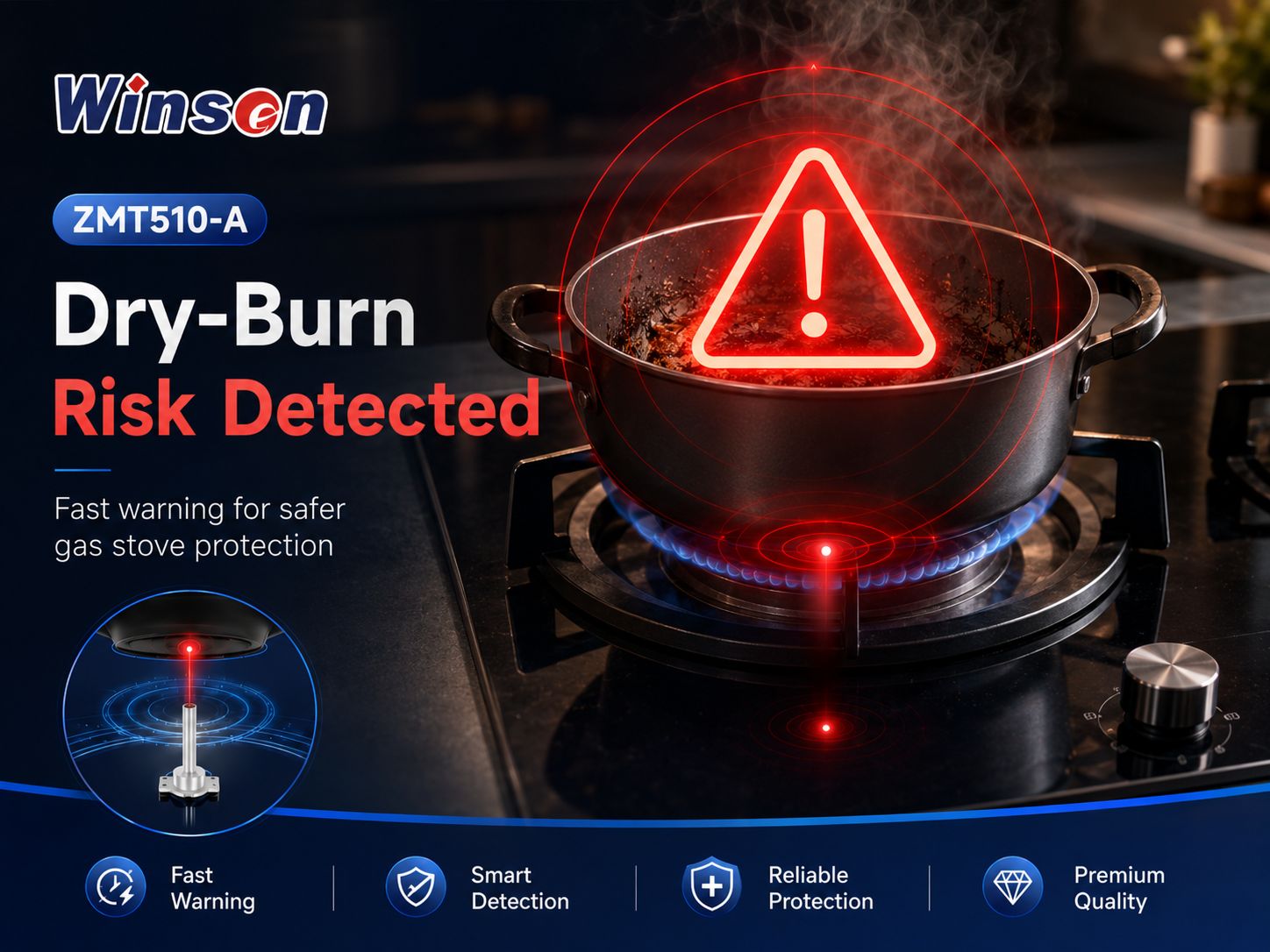
The competition in gas stove products is shifting from basic heating performance to safety, intelligence, and user experience.
A mature dry-burning protection system can help manufacturers:
- improve product safety level
- enhance consumer confidence
- reduce accident risk
- build differentiated product features
- meet the market demand for smarter kitchen appliances
Compared with traditional contact-based solutions, non-contact dry-burning detection provides a more flexible and durable path for product upgrade.
It solves key pain points in cookware compatibility, mechanical wear, and system integration, while maintaining a natural cooking experience for users.
FAQ
What is a dry-burning protection sensor?
A dry-burning protection sensor detects abnormal heating conditions when cookware is heated without enough liquid or food inside. It helps the gas stove identify potential dry-burning risk and trigger protective action.
Why is non-contact detection better for gas stoves?
Non-contact detection does not require direct physical contact with the pot. This improves compatibility with different cookware shapes and materials while avoiding mechanical wear.
Can ZMT510-A work with different cookware types?
Yes. Because it detects thermal radiation rather than relying on direct contact, it can adapt to flat-bottom pans, round-bottom woks, stainless steel cookware, cast iron cookware, aluminum pots, and other common cookware types.
Does ZMT510-A output raw temperature only?
No. ZMT510-A integrates dry-burning judgment logic inside the sensor and can directly output a dry-burning alarm signal when risk is detected.
How fast can the sensor respond to dry-burning risk?
When dry-burning risk is detected, the sensor can output an alarm signal within 90 seconds, providing timely information for the gas stove control system.
Why does non-contact sensing improve sensor lifetime?
Because there is no mechanical contact with cookware, the sensor avoids wear, deformation, and contact-related aging, supporting longer-term stable operation.
Conclusion: A More Reliable Path to Smart Gas Stove Safety
Dry-burning protection is becoming an important direction for gas stove safety upgrades.
For manufacturers, the ideal solution must be accurate, reliable, compatible with different cookware, easy to integrate, and stable over long-term use.
The ZMT510-A non-contact dry-burning protection sensor is developed for this need. With non-contact thermal radiation detection, built-in dry-burning judgment logic, no mechanical wear, and strong application compatibility, it provides a new-generation safety sensing solution for smart gas stoves.
If your company is evaluating dry-burning protection solutions or facing challenges with existing contact-based designs, we welcome you to contact us for samples and application testing.