Electrochemical Gas Sensors: A Proven Choice for Industrial Gas Detection
In modern industrial production, gas monitoring is an essential part of safety management.
From petrochemical plants and metallurgical workshops to pharmaceutical production, environmental monitoring, confined spaces and semiconductor manufacturing, many industrial processes involve toxic, harmful or hazardous gases. Accurate and reliable gas detection helps identify leakage risks, protect personnel safety and support continuous production.
Among different gas detection technologies, electrochemical gas sensors are one of the most mature and widely used solutions in the global gas detection market. They play an important role in detecting toxic gases such as carbon monoxide (CO), hydrogen sulfide (H₂S), nitrogen dioxide (NO₂), ammonia (NH₃), sulfur dioxide (SO₂), chlorine (Cl₂) and many other industrial gases.
For fixed gas detectors, portable gas detectors and industrial IoT monitoring systems, electrochemical sensors provide a proven sensing core for real-time safety monitoring.
Industrial Gas Detection Requires More Than Concentration Measurement
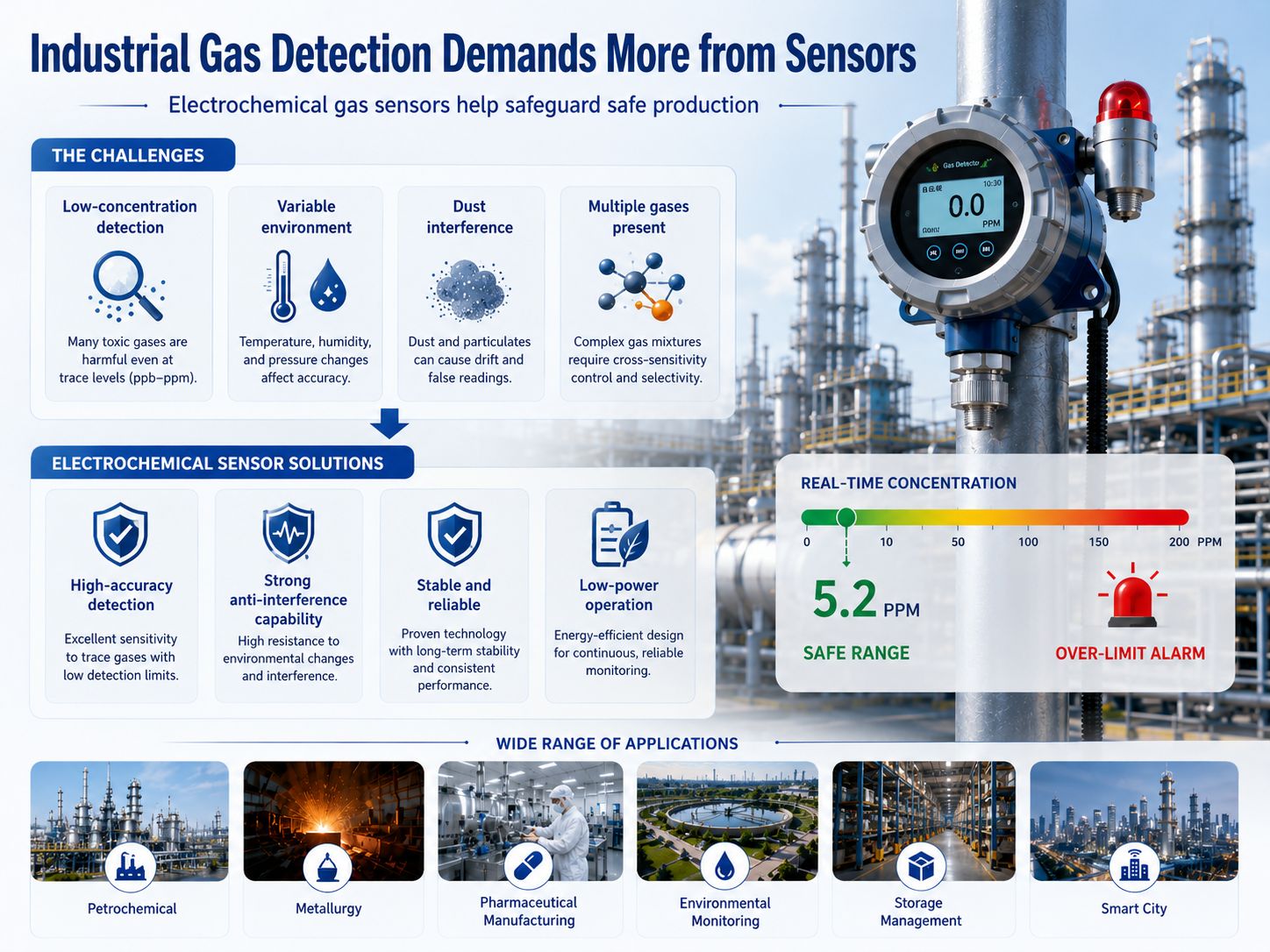
Industrial gas detection is not simply about reading a gas concentration value.
Many toxic gases have very low occupational exposure limits. This requires sensors to detect target gases accurately at ppm or even lower concentration levels. At the same time, industrial sites often include complex working conditions such as:
- temperature and humidity fluctuation
- dust and particulate interference
- multiple gases existing at the same time
- long-term continuous operation
- vibration and installation environment variation
- requirements for stable signal output
In these environments, sensors must provide reliable data continuously. A gas detector is only as trustworthy as its sensing element. If the sensor output drifts, responds slowly or is easily affected by interference, the whole safety monitoring system may lose reliability.
This is why electrochemical gas sensors continue to be widely adopted in industrial gas detection. After decades of application verification, they have become a mature and trusted technology route for toxic gas monitoring.
How Electrochemical Gas Sensors Work
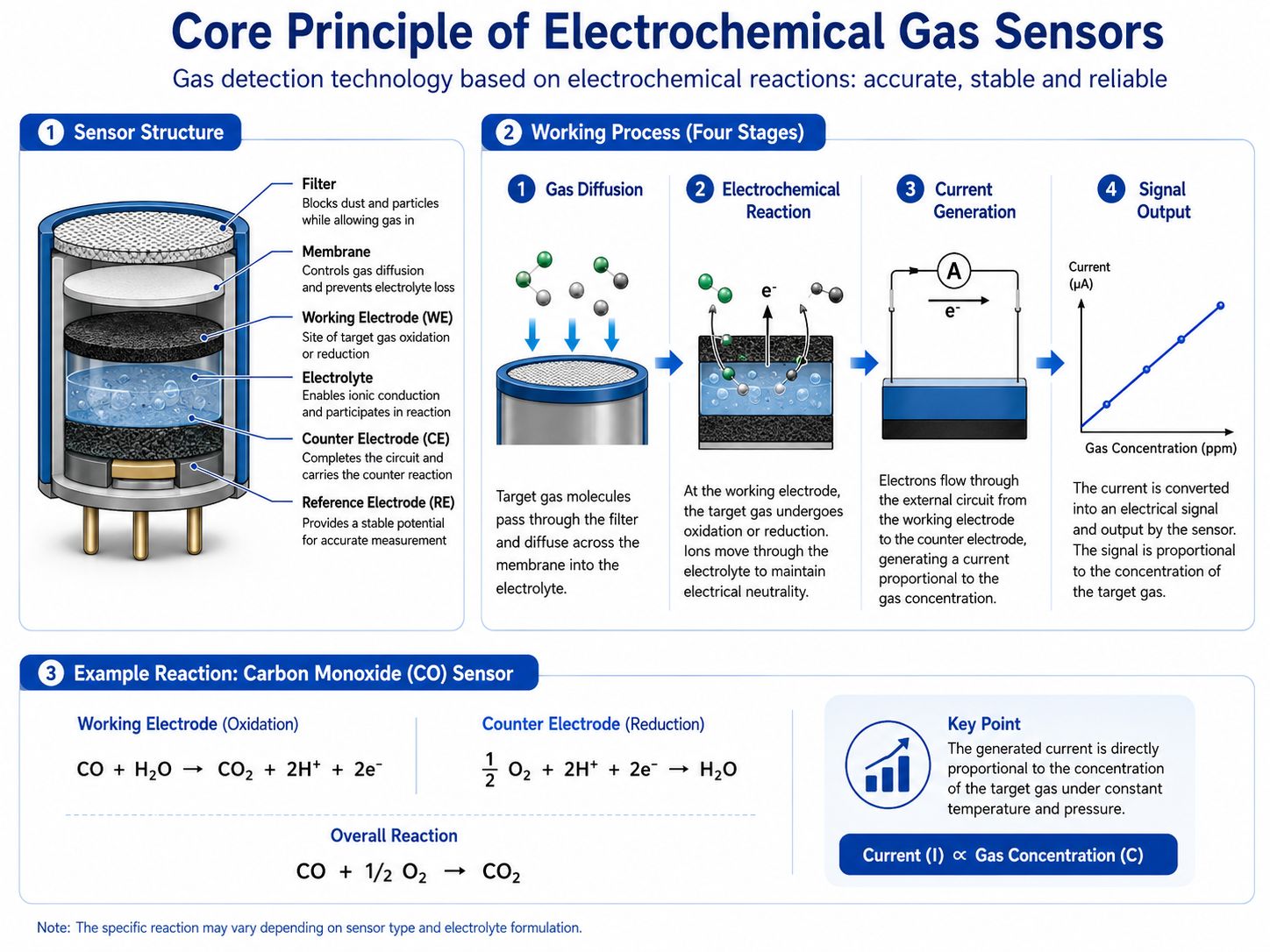
An electrochemical gas sensor works based on an electrochemical reaction between the target gas and electrodes inside the sensor.
When the target gas diffuses into the sensor, it reaches the working electrode through a gas diffusion barrier or membrane. At the working electrode, the gas undergoes an oxidation or reduction reaction. This reaction generates a small current signal.
The current is proportional to the concentration of the target gas under stable conditions. By measuring this current and processing the signal through the detector circuit, the system can calculate the gas concentration.
In simple terms:
Target gas enters the sensor → electrochemical reaction occurs → current is generated → gas concentration is calculated
This direct relationship between gas concentration and current output gives electrochemical gas sensors good linearity and makes them convenient for instrument design and calibration.
Why Electrochemical Sensors Are Widely Used
1. High Sensitivity for Toxic Gases
Electrochemical sensors are especially suitable for detecting many toxic gases at low concentrations. This makes them widely used in occupational safety, environmental protection and industrial process monitoring.
Typical target gases include:
- CO
- H₂S
- NO₂
- NH₃
- SO₂
- Cl₂
- O₃
- HCl
- HF
- PH₃
- H₂
- O₂
This wide gas coverage allows equipment manufacturers to build diversified gas detection products based on one mature technology platform.
2. Good Linearity and Easy Signal Processing
The output current of an electrochemical sensor has a good proportional relationship with gas concentration. This makes it easier for the detector circuit to process the signal and convert it into a readable concentration value.
For gas detector manufacturers, good linearity helps improve:
- calibration efficiency
- concentration calculation accuracy
- alarm threshold setting
- system consistency
- product development efficiency
3. Mature Technology and Proven Field Performance
Electrochemical gas sensing technology has been used in industrial gas detection for many years. Its material system, electrode structure, electrolyte formulation and manufacturing processes have become highly mature.
This long-term market verification gives electrochemical sensors strong application value in:
- fixed gas detection systems
- portable gas detectors
- confined space safety instruments
- industrial IoT monitoring terminals
- environmental monitoring devices
- multi-gas detection systems
For customers, a mature technology route means lower development risk and more predictable product performance.
4. Suitable for Continuous Safety Monitoring
Industrial safety systems require continuous monitoring, not occasional testing.
Electrochemical gas sensors are suitable for long-term gas concentration monitoring in many industrial environments. When integrated with alarms, controllers, cloud platforms or safety management systems, they can support:
- on-site alarm
- remote monitoring
- historical data recording
- trend analysis
- risk assessment
- preventive maintenance
This helps gas detection evolve from “leak detection” to “risk prevention”.
Winsen Electrochemical Gas Sensor Solutions
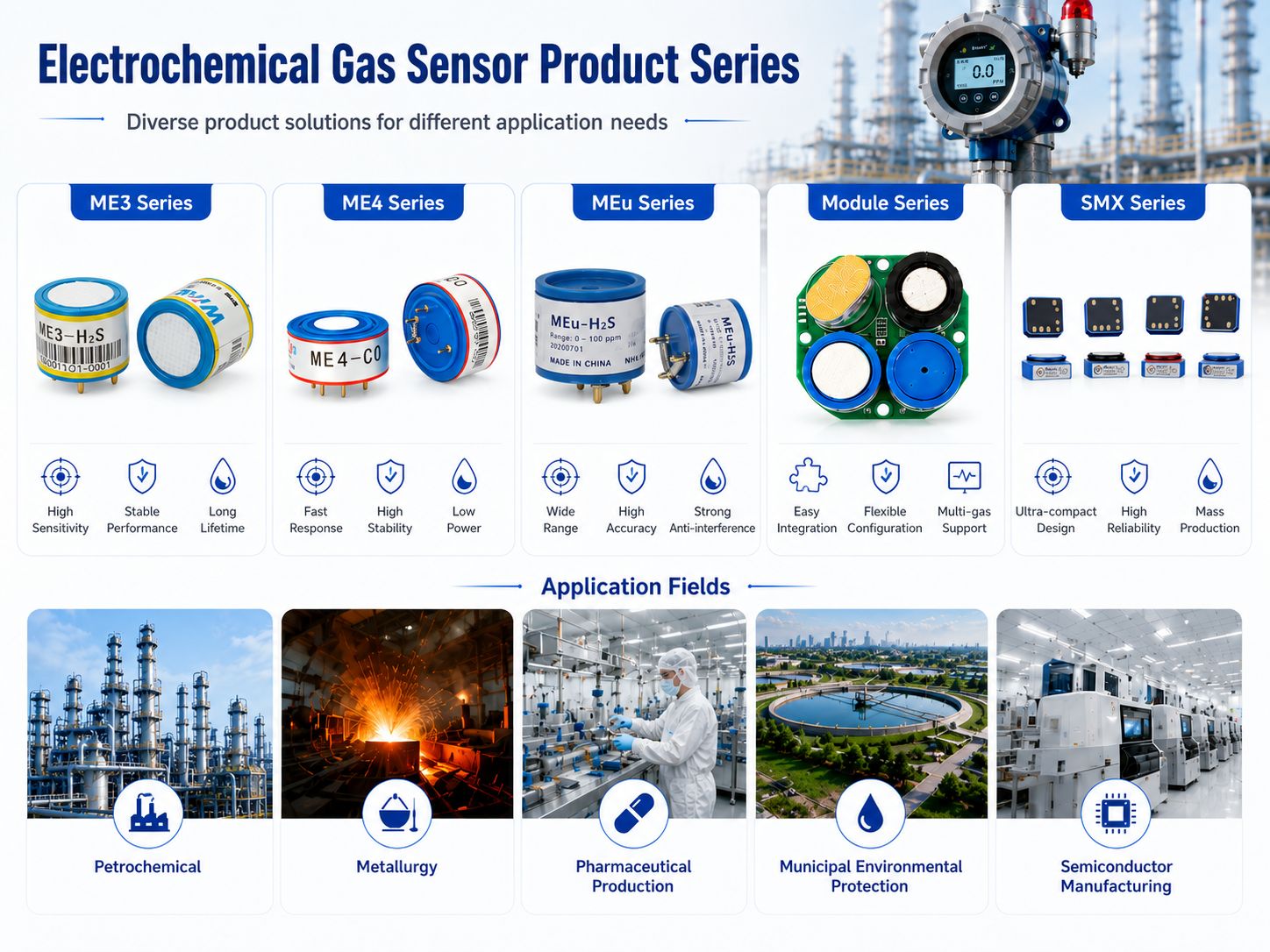
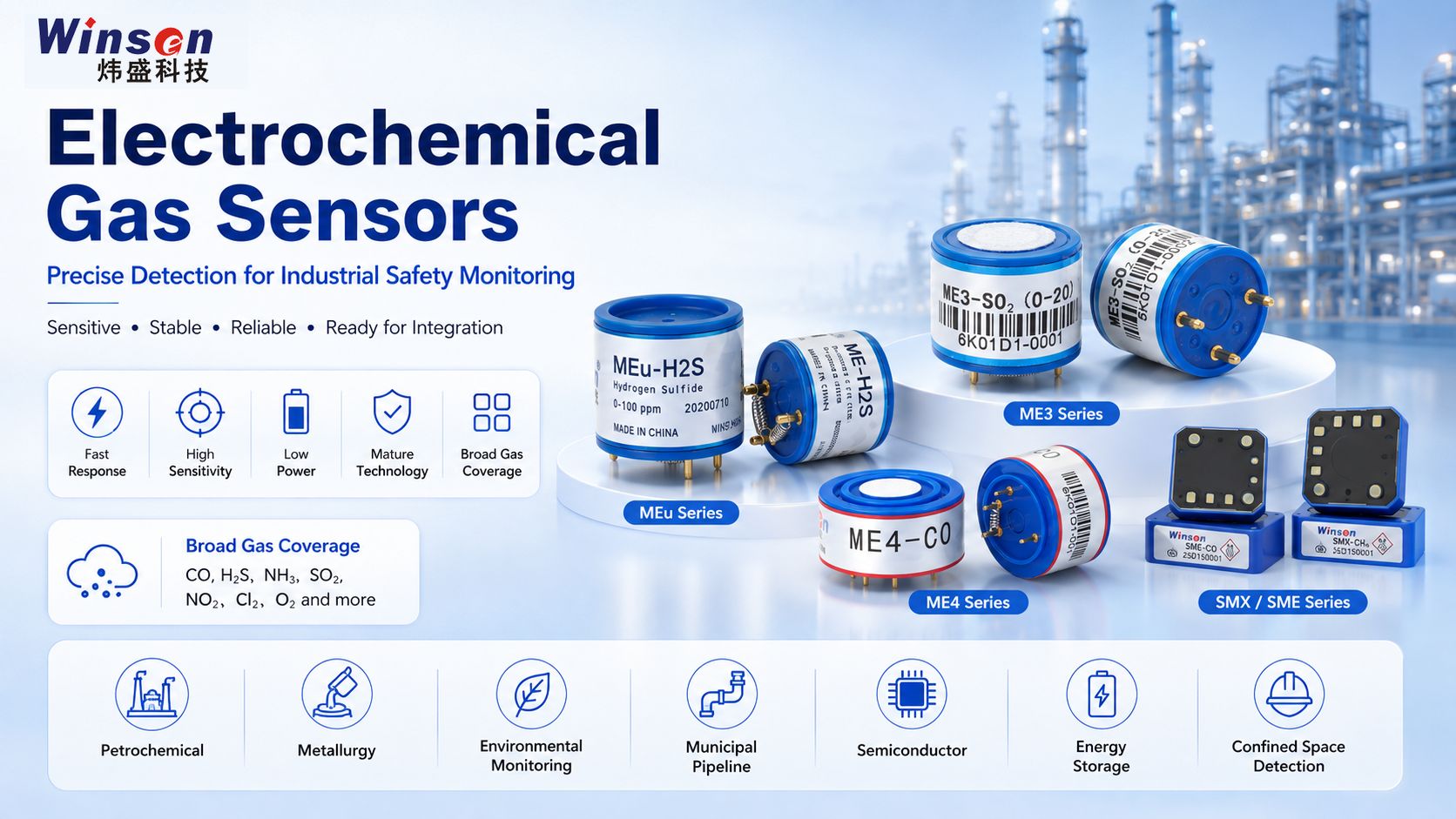
As a professional sensor solution provider, Winsen has developed a complete electrochemical gas sensor product portfolio for industrial gas detection applications.
Our electrochemical product lines include:
- ME3 Series electrochemical gas sensors
- ME4 Series electrochemical gas sensors
- MEu Series electrochemical gas sensors
- Electrochemical gas sensor modules
- SMX / SMX100 miniature intelligent gas sensor series
These products support different equipment structures, detection requirements and integration needs.
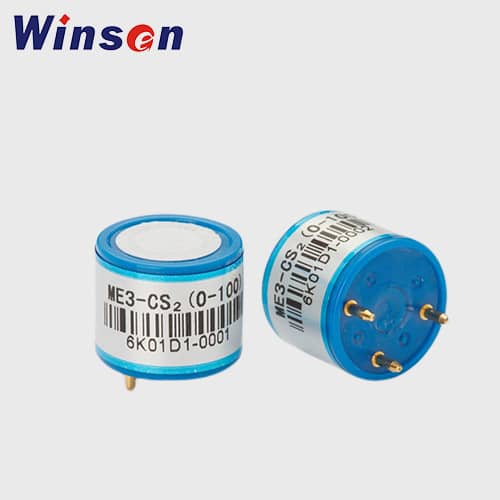
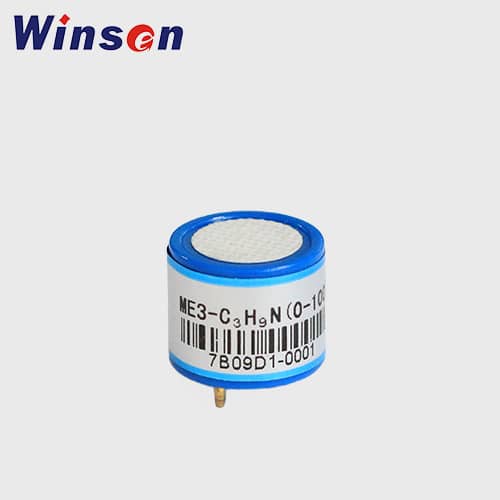
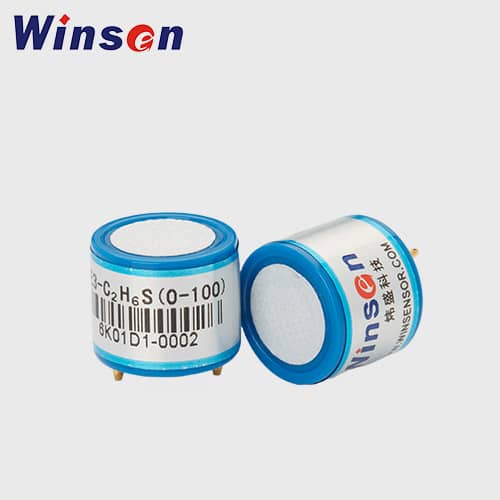
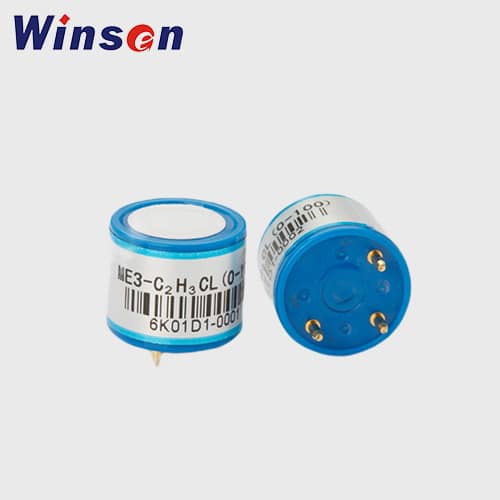
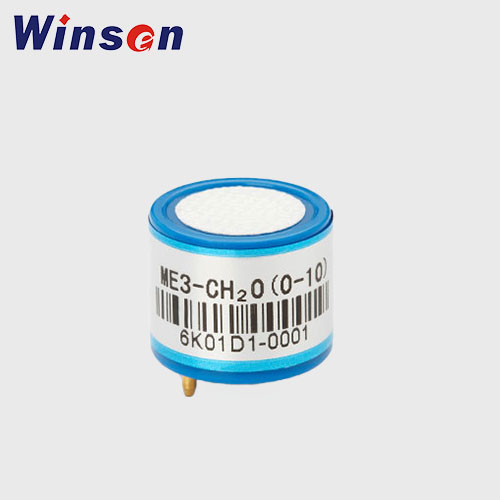
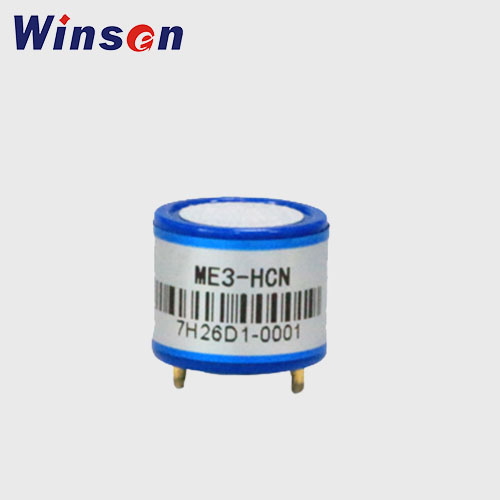
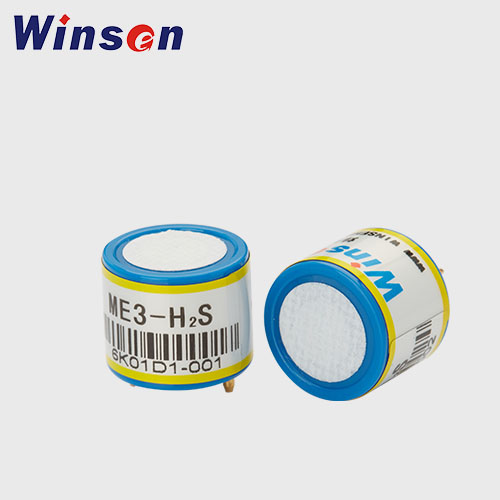
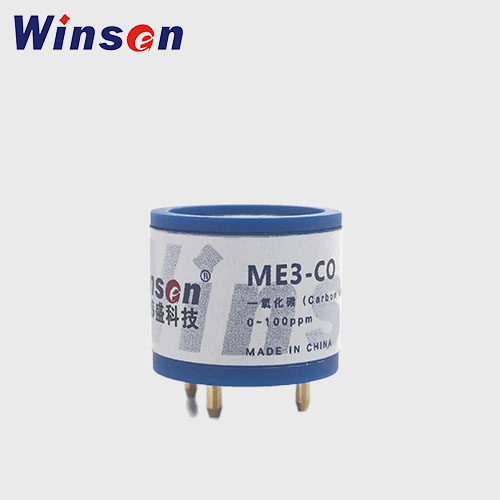
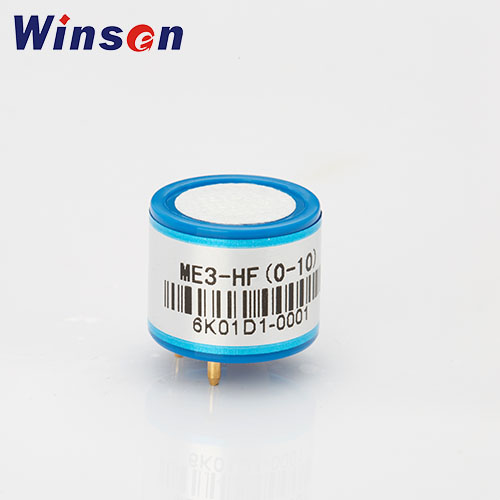
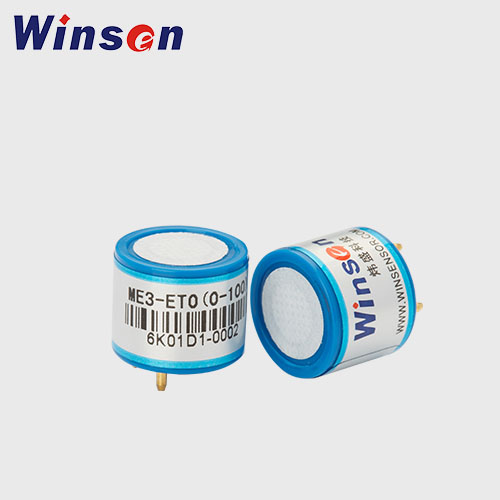
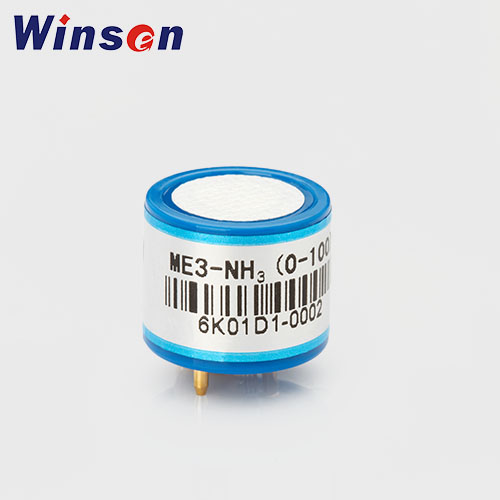
ME3 Series: Mature Industrial Gas Detection Core
The ME3 series is designed for industrial toxic gas detection applications requiring stable performance and reliable output.
It can be used in fixed gas detectors, portable gas detection instruments and industrial monitoring systems.
Typical features include:
- high sensitivity
- stable output
- mature structure
- suitable for multiple toxic gases
- long-term industrial application experience

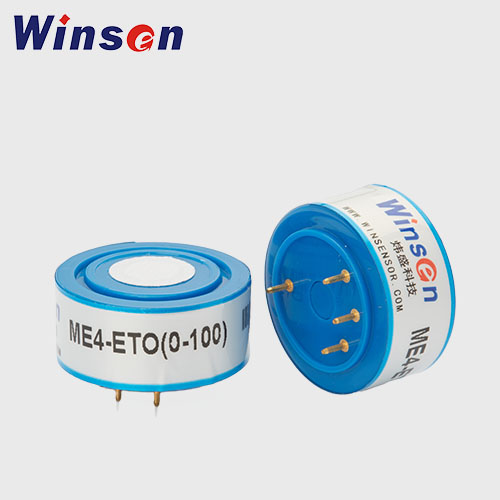
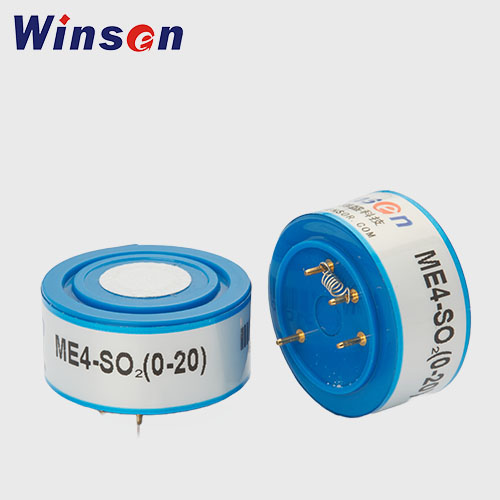
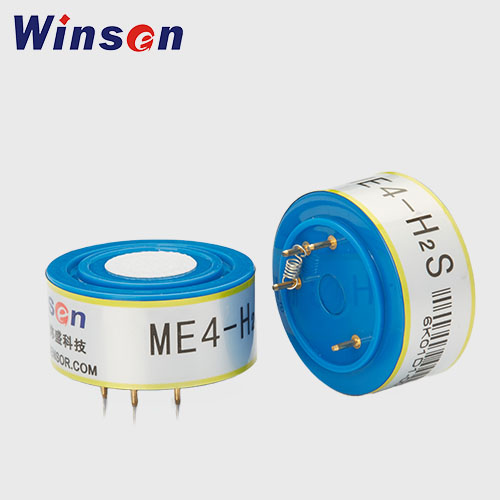
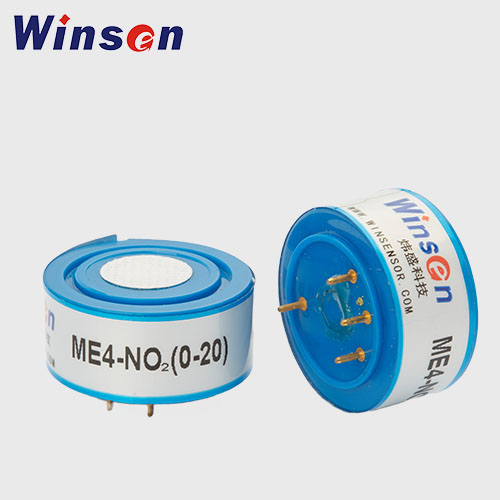
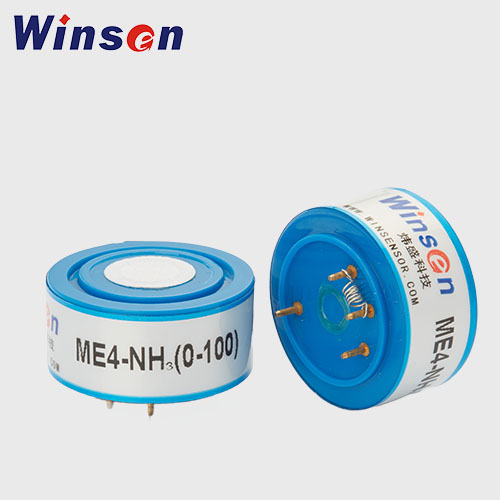
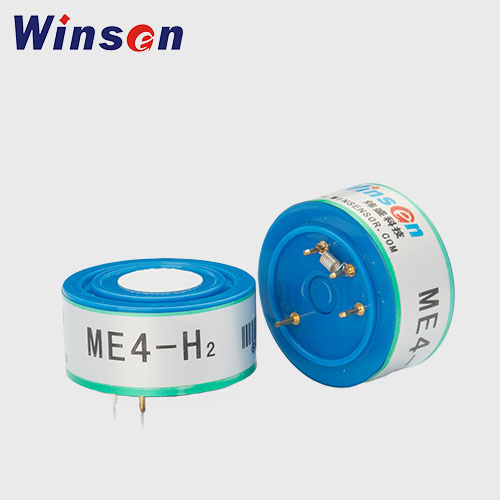
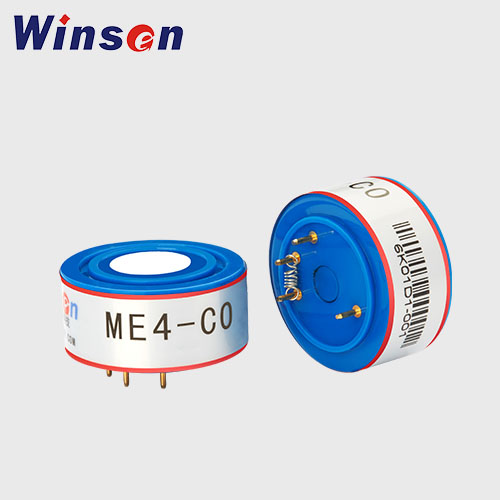
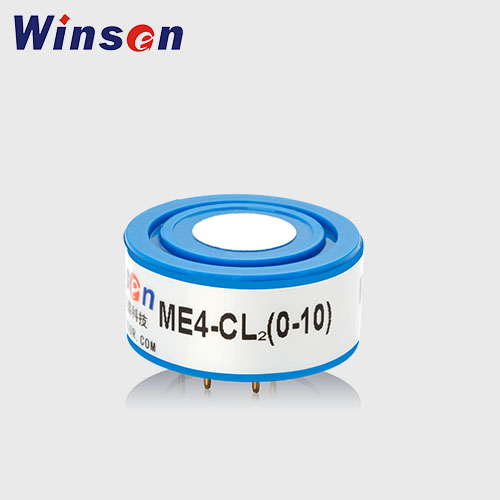
ME4 Series: Compact and Reliable Sensor Platform
The ME4 series provides a compact electrochemical sensing solution suitable for gas detection equipment with limited internal space.
It can be applied to both fixed and portable gas detection products, helping customers develop reliable gas detection instruments with flexible mechanical design.
Typical features include:
- compact size
- fast response
- good linearity
- stable performance
- suitable for various industrial gases
MEu Series: Upgraded Electrochemical Sensor Solution
The MEu series is designed to meet the growing demand for higher performance, better consistency and wider application adaptability.
It supports gas detection products that require improved stability and reliable long-term monitoring.
Typical features include:
- high accuracy
- wide detection range
- strong anti-interference capability
- stable long-term performance
- suitable for industrial safety applications
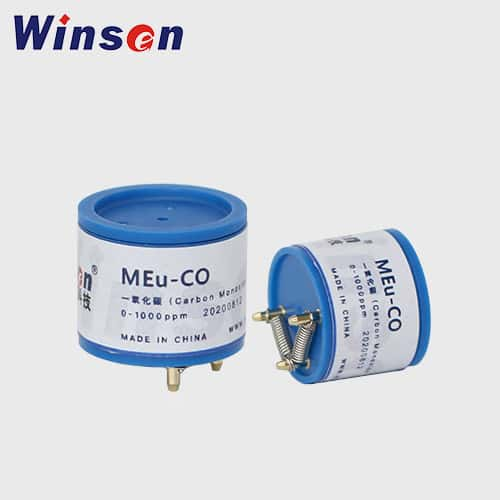
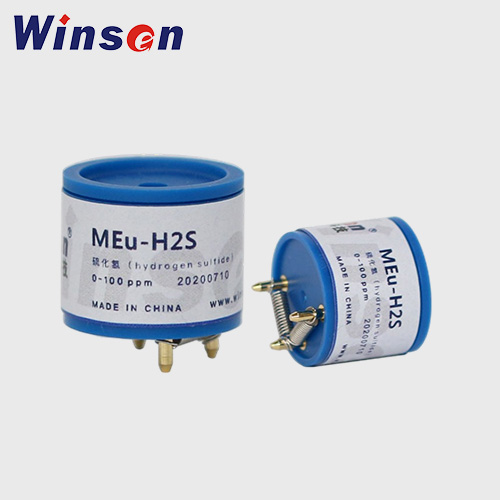
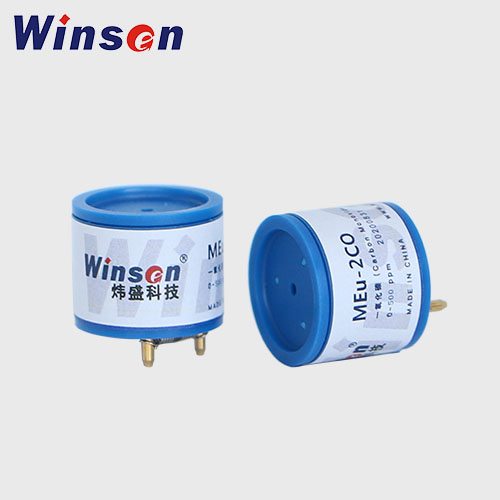
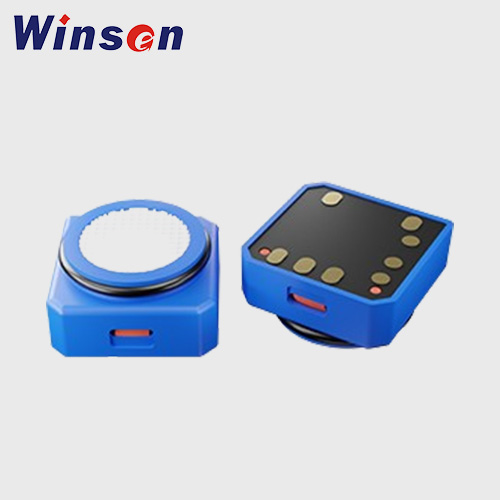
MEu-2CO Carbon Monoxide Sensor Over 7 years lifetime
- Carbon monoxide(CO)
- 0~500ppm,Max Range 1000ppm
- Read More
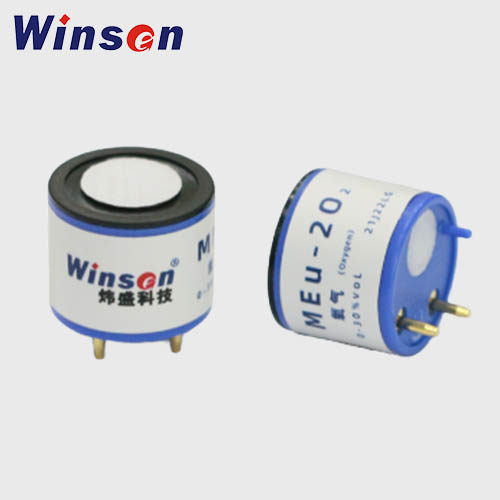
Electrochemical Gas Sensor Modules
For customers who need faster integration, Winsen also provides electrochemical gas sensor module solutions.
A gas sensor module integrates the sensor with signal processing circuits and compensation algorithms, helping equipment manufacturers reduce development workload.
Module solutions are suitable for:
- multi-gas detection equipment
- industrial IoT terminals
- environmental monitoring systems
- OEM gas detector platforms
- fast product development projects
Typical advantages include:
- easier integration
- standard output signal
- reduced circuit design difficulty
- flexible gas configuration
- shorter development cycle
SMX / SMX100 Series: Miniature Intelligent Gas Sensor Solutions
As terminal gas detection devices become smaller, lighter and smarter, the demand for miniaturized intelligent sensors continues to grow.
The SMX / SMX100 series is designed for compact gas detection equipment, portable devices, wearable safety terminals and intelligent industrial sensing applications.
Typical advantages include:
- ultra-compact design
- intelligent signal processing
- low-power operation
- easier installation
- suitable for portable and integrated devices
- support for intelligent gas detection product design
This series provides more design freedom for the next generation of lightweight gas detection equipment.
Typical Industrial Applications
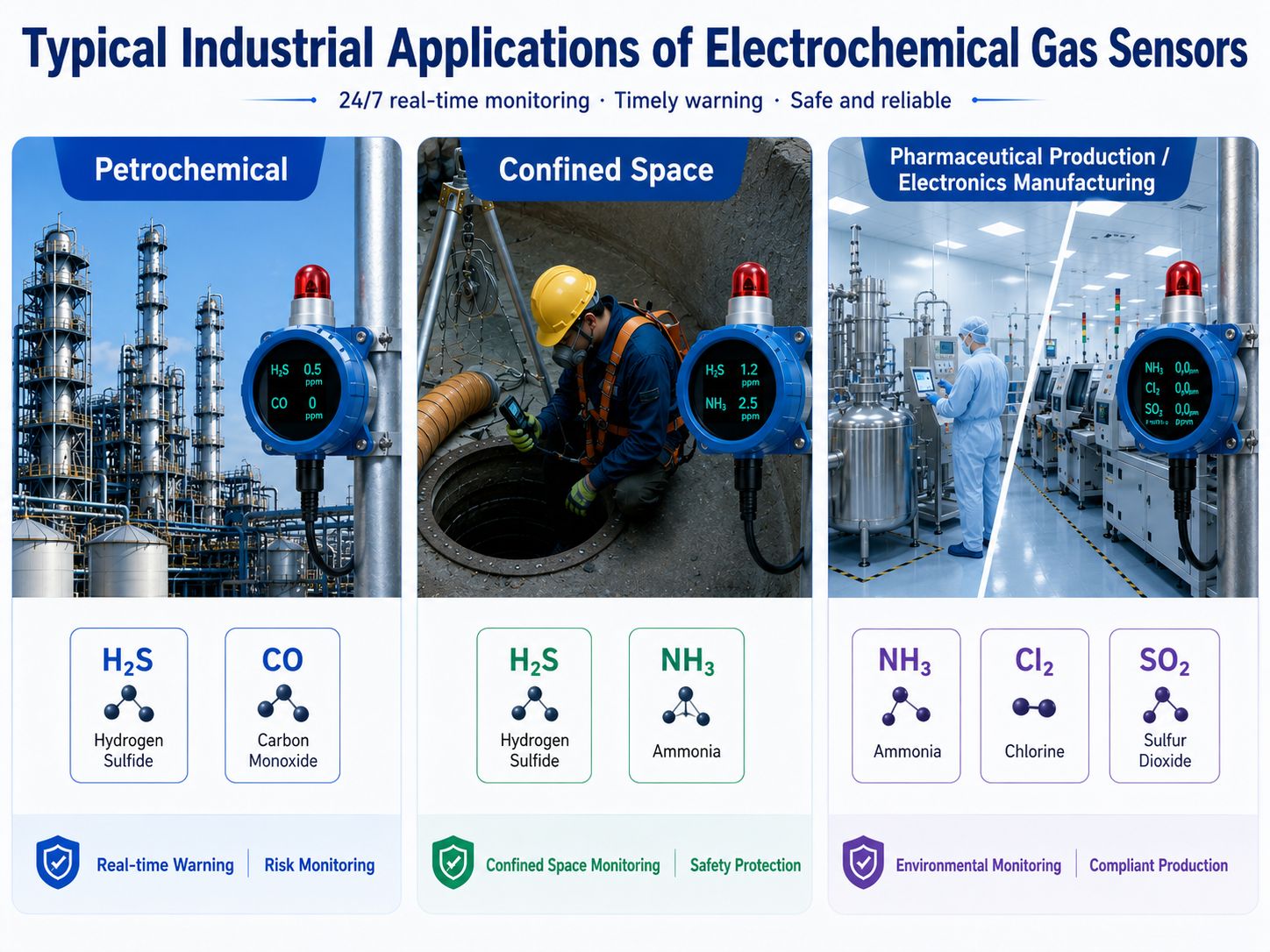
Petrochemical Industry
Petrochemical plants involve complex processes, pipelines, storage tanks and reaction units. Toxic and flammable gas leakage may occur at valves, flanges, pumps, compressors or storage areas.
Electrochemical sensors can be used to monitor gases such as:
- H₂S
- CO
- SO₂
- Cl₂
- NH₃
Application value:
- real-time warning
- leakage risk monitoring
- worker safety protection
- process safety management
Metallurgy and Smelting
Metallurgical sites often include high temperature, dust, combustion processes and complex gas emissions.
Electrochemical sensors can support the detection of gases such as:
- CO
- SO₂
- H₂S
- NO₂
Application value:
- toxic gas alarm
- workplace safety monitoring
- process gas risk control
- personnel protection
Confined Space Safety
Confined spaces such as tanks, tunnels, wells, pipelines, underground facilities and maintenance areas may contain hazardous gases or oxygen deficiency.
Common monitoring gases include:
- O₂
- H₂S
- CO
- NH₃
Application value:
- entry safety assessment
- portable detector integration
- real-time worker protection
- emergency response support
Pharmaceutical Production and Electronics Manufacturing
Pharmaceutical and electronics manufacturing environments may involve chemicals, cleaning agents, process gases and toxic gas risks.
Electrochemical sensors can detect gases such as:
- NH₃
- Cl₂
- SO₂
- O₃
- HCl
- HF
Application value:
- cleanroom environmental monitoring
- production safety
- compliance management
- equipment area gas monitoring
Environmental Monitoring
Electrochemical sensors are widely used in ambient air and industrial boundary monitoring systems. They can provide data for environmental assessment, emission monitoring and pollution control.
Typical gases include:
- NO₂
- SO₂
- O₃
- CO
- H₂S
- NH₃
Application value:
- air quality monitoring
- plant boundary monitoring
- environmental compliance
- smart city monitoring networks
From On-Site Alarm to Data-Driven Safety Management
With the development of industrial digitalization, gas detection is moving from single-point monitoring toward networked and system-based safety management.
Electrochemical sensors provide the basic gas concentration data. When this data is connected with controllers, cloud platforms and enterprise safety systems, it can support:
- remote monitoring
- alarm linkage
- data storage
- trend analysis
- abnormal pattern recognition
- predictive maintenance
- safety decision support
This means gas detection is no longer only about “finding a leak”. It is becoming part of a broader industrial risk prevention system.
Why Choose Winsen Electrochemical Gas Sensors
Complete product portfolio
We provide multiple electrochemical sensor series and module solutions to support different customer needs, from basic sensing elements to intelligent integrated modules.
Broad gas coverage
Our electrochemical sensing platform supports many toxic and hazardous gases used in industrial safety, environmental monitoring and commercial gas detection.
Stable manufacturing and consistency
Sensor consistency is critical for mass-produced gas detection equipment. Winsen uses strict production process control and automated manufacturing to improve product consistency and batch reliability.
Application-oriented support
Different industries require different gas types, ranges, response characteristics and mechanical structures. We provide application support to help customers select suitable products according to real working conditions.
Suitable for OEM integration
Our sensors and modules can be integrated into fixed detectors, portable instruments, multi-gas detectors and industrial IoT terminals, supporting OEM and ODM product development.
Product Selection Considerations
When selecting an electrochemical gas sensor, equipment manufacturers should consider:
- target gas type
- measurement range
- detection limit
- response time
- expected lifetime
- operating temperature and humidity
- cross-interference requirements
- installation structure
- output signal type
- calibration and maintenance strategy
- fixed or portable application
Choosing the right sensor is not only about matching the gas name. It must also match the real application environment and the detector system design.
Application Value for Gas Detection Equipment Manufacturers
| Customer Requirement | Winsen Sensor Value |
|---|---|
| Toxic gas detection | Supports CO, H₂S, NO₂, NH₃, SO₂, Cl₂ and more |
| Low concentration monitoring | High sensitivity for ppm-level detection |
| Stable industrial operation | Mature electrochemical technology with proven applications |
| Faster product development | Sensor modules reduce circuit and algorithm workload |
| Compact device design | ME4, MEu and SMX series support smaller products |
| System integration | Suitable for fixed, portable and IoT monitoring platforms |
| Reliable safety data | Supports alarm, control and safety management systems |
FAQ
What is an electrochemical gas sensor?
An electrochemical gas sensor detects gas concentration through an electrochemical reaction between the target gas and electrodes inside the sensor. The reaction generates a current proportional to the gas concentration.
What gases can electrochemical sensors detect?
Electrochemical sensors can detect many toxic and hazardous gases, including CO, H₂S, NO₂, NH₃, SO₂, Cl₂, O₃, HCl, HF, PH₃, H₂ and O₂.
Why are electrochemical sensors widely used in industrial gas detection?
They offer high sensitivity, good linearity, mature technology, stable performance and broad gas coverage, making them suitable for fixed detectors, portable instruments and industrial monitoring systems.
Are electrochemical gas sensors suitable for low concentration detection?
Yes. Electrochemical sensors are especially suitable for ppm-level detection of many toxic gases.
Can Winsen provide gas sensor modules?
Yes. We provide electrochemical gas sensor modules that integrate sensors, signal processing circuits and compensation algorithms to simplify customer integration.
Which industries use electrochemical gas sensors?
They are widely used in petrochemical, metallurgy, pharmaceutical production, electronics manufacturing, confined space safety, environmental monitoring, municipal safety and industrial IoT applications.
Conclusion: A Mature Sensing Technology for Industrial Safety
Industrial safety management is a long-term and systematic task. Accurate and reliable gas detection is an essential part of this system.
After decades of development and field verification, electrochemical gas sensors have become one of the most important technologies for industrial toxic gas detection. Their high sensitivity, good linearity, mature manufacturing process and broad application experience make them a proven choice for modern gas detection equipment.
As intelligent manufacturing, industrial IoT and digital safety management continue to develop, electrochemical gas sensors will play an even greater role in building safer, smarter and more reliable industrial environments.
Winsen will continue to provide professional electrochemical gas sensors and module solutions to support global customers in industrial gas detection, safety monitoring and environmental protection applications.