Turbidity Sensor for Smart Laundry and Dishwashing: Making Cleanliness Visible
As home appliances continue to move toward intelligence, energy efficiency, and user-centered automation, washing machines and dishwashers are no longer expected to run only on fixed programs.
Modern appliances need to understand the real cleaning process.
How dirty is the water?
Has the detergent removed the stains?
Is another rinse cycle still necessary?
Can the machine save water and energy without compromising cleaning results?
To answer these questions, appliances need a reliable sensing component that can “see” the cleanliness of water in real time.
That is where the turbidity sensor becomes essential.
Our ZW-TUR102 turbidity sensor is designed for smart laundry machines, dishwashers, and other intelligent cleaning equipment. By detecting changes in water turbidity, it helps appliances make smarter decisions during washing, rinsing, and cleaning cycles.
Why Smart Cleaning Needs a Turbidity Sensor
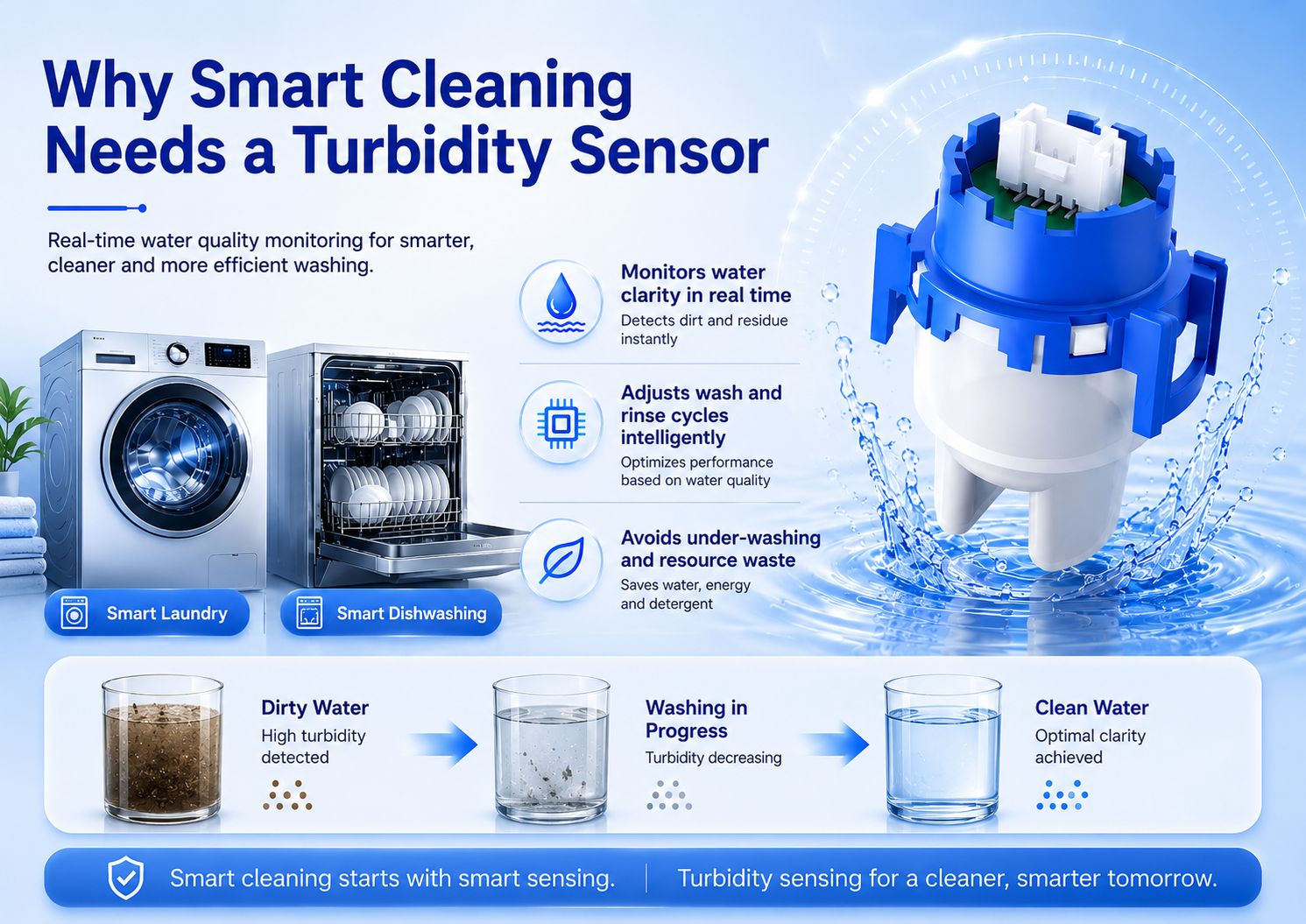
For washing machines and dishwashers, cleaning quality is not determined only by running time. It depends on the actual condition of the washing water.
Traditional machines usually operate with preset logic:
- fixed washing time
- fixed rinse cycles
- fixed water consumption
- fixed program duration
This approach is simple, but it cannot adapt to real cleaning conditions. A lightly soiled load may waste water and electricity, while a heavily soiled load may require additional washing or rinsing.
A turbidity sensor solves this problem by monitoring the clarity of water during the cleaning process.
When the water is highly turbid, it indicates that dirt, detergent residue, food particles, or fabric contaminants are still present. When turbidity decreases and stabilizes, the appliance can judge that the cleaning process is close to completion.
In this way, the appliance can move from fixed program control to intelligent decision control.
How a Turbidity Sensor Improves Appliance Intelligence
A turbidity sensor enables the appliance to respond to real water quality conditions instead of relying only on time.
1. Identifying soil level more accurately
At the beginning of a washing or dishwashing cycle, the sensor can detect the turbidity level of the water and help the system estimate how dirty the load is.
For example:
- low turbidity → light soil → shorter or gentler cycle
- moderate turbidity → normal soil → standard cycle
- high turbidity → heavy soil → stronger or longer cleaning cycle
This helps the appliance select a more suitable cleaning strategy automatically.
2. Optimizing wash and rinse cycles
During washing, the turbidity sensor continuously monitors water clarity. If the water remains turbid, the system can continue washing or rinsing. If the turbidity drops to a target level, the appliance can end the current stage automatically.
This helps avoid two common problems:
- under-washing, where clothes or dishes are not fully cleaned
- over-washing, where water, electricity, and detergent are wasted
For dishwashers, this is especially useful because food particles and grease residues vary greatly from one load to another. For washing machines, it helps adapt to different fabric types and soil levels.
3. Saving water and energy
Smart cleaning is not only about better washing performance. It is also about resource efficiency.
By detecting when the water has reached the required cleanliness level, a turbidity sensor helps reduce unnecessary wash time and rinse cycles.
This can support:
- more reasonable water usage
- lower energy consumption
- reduced detergent residue
- shorter program duration in light-load conditions
- more efficient operation across different cleaning scenarios
For appliance manufacturers, this creates a stronger selling point in the market of energy-saving smart home products.
4. Improving the user experience
Users care about cleaning results, but they also care about convenience.
With turbidity-based intelligent control, the appliance can automatically adjust the cleaning process without requiring users to manually judge soil level or select complex programs.
This improves the experience by helping appliances become:
- more automatic
- more accurate
- more efficient
- more reliable
- more aligned with real household needs
In short, the machine becomes smarter because it can sense what is actually happening inside the water.
ZW-TUR102 Turbidity Sensor: Designed for Smart Washing Applications
To achieve stable and reliable turbidity detection, the sensor must support wide-range detection, adapt to complex operating environments, and simplify integration for appliance manufacturers.
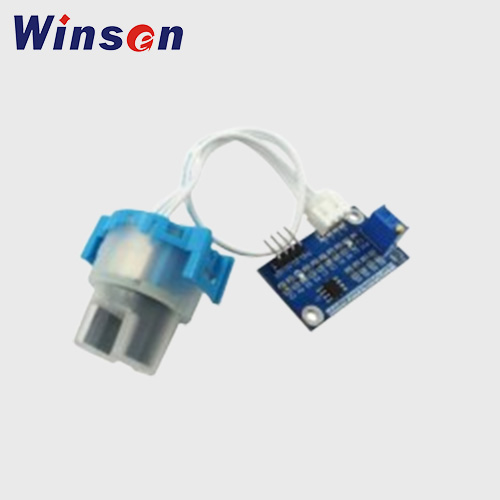
Our ZW-TUR102 turbidity sensor is developed for intelligent washing machines, dishwashers, and cleaning appliances. It provides stable turbidity monitoring for real-time water quality feedback.
Key Feature 1: Wide Measurement Range from 0 to 1000 NTU
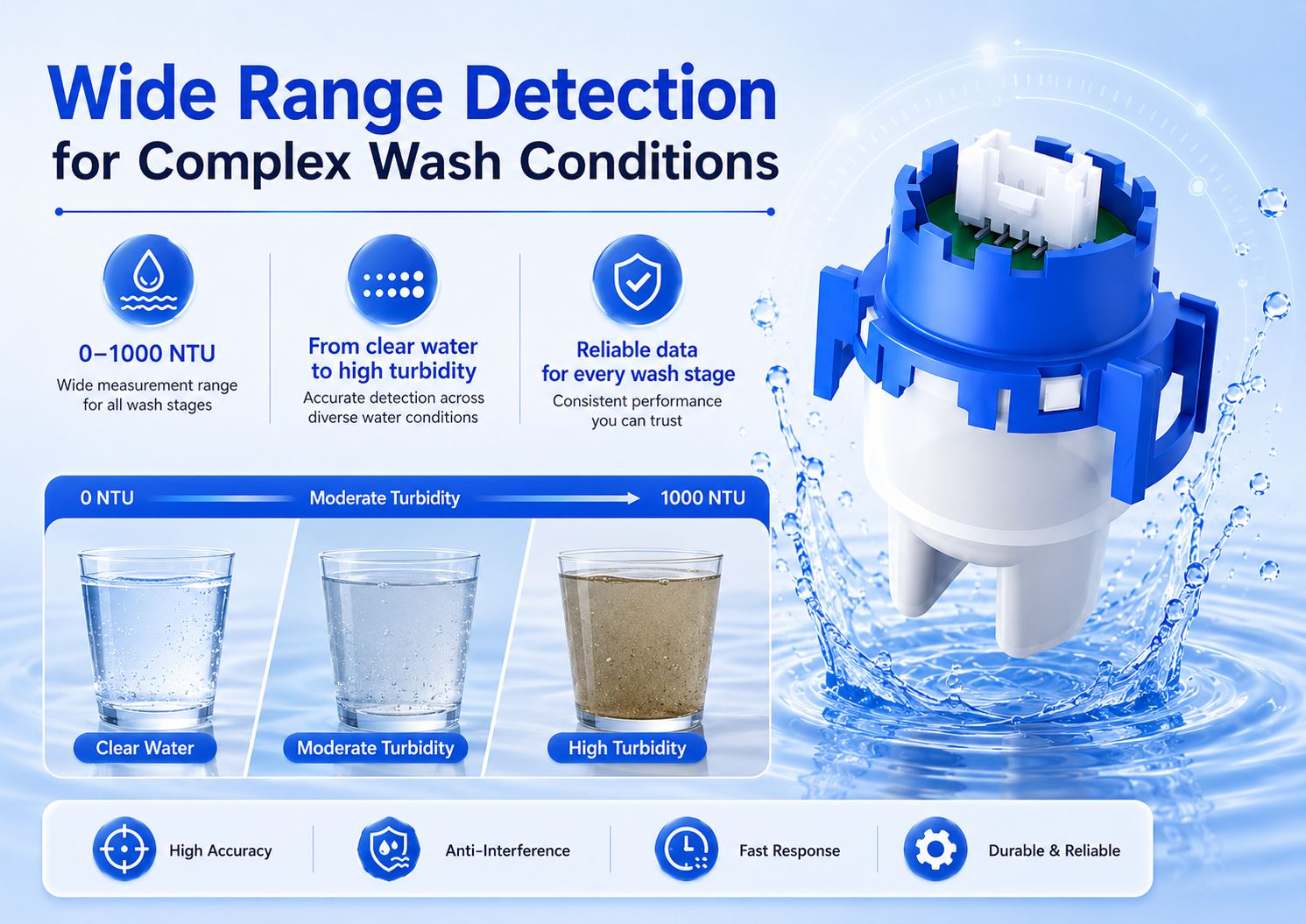
The sensor supports a turbidity measurement range of 0–1000 NTU, covering conditions from clean water to highly turbid liquid.
This range is suitable for different washing stages, including:
- clean water intake
- early washing with heavy soil release
- detergent and stain dispersion
- rinse water monitoring
- final water clarity judgment
Even under complex conditions such as high soil concentration, foam, and mixed residues, the sensor can provide useful water quality feedback for appliance control.
Key Feature 2: Built-in Temperature Sensor and Compensation Algorithm
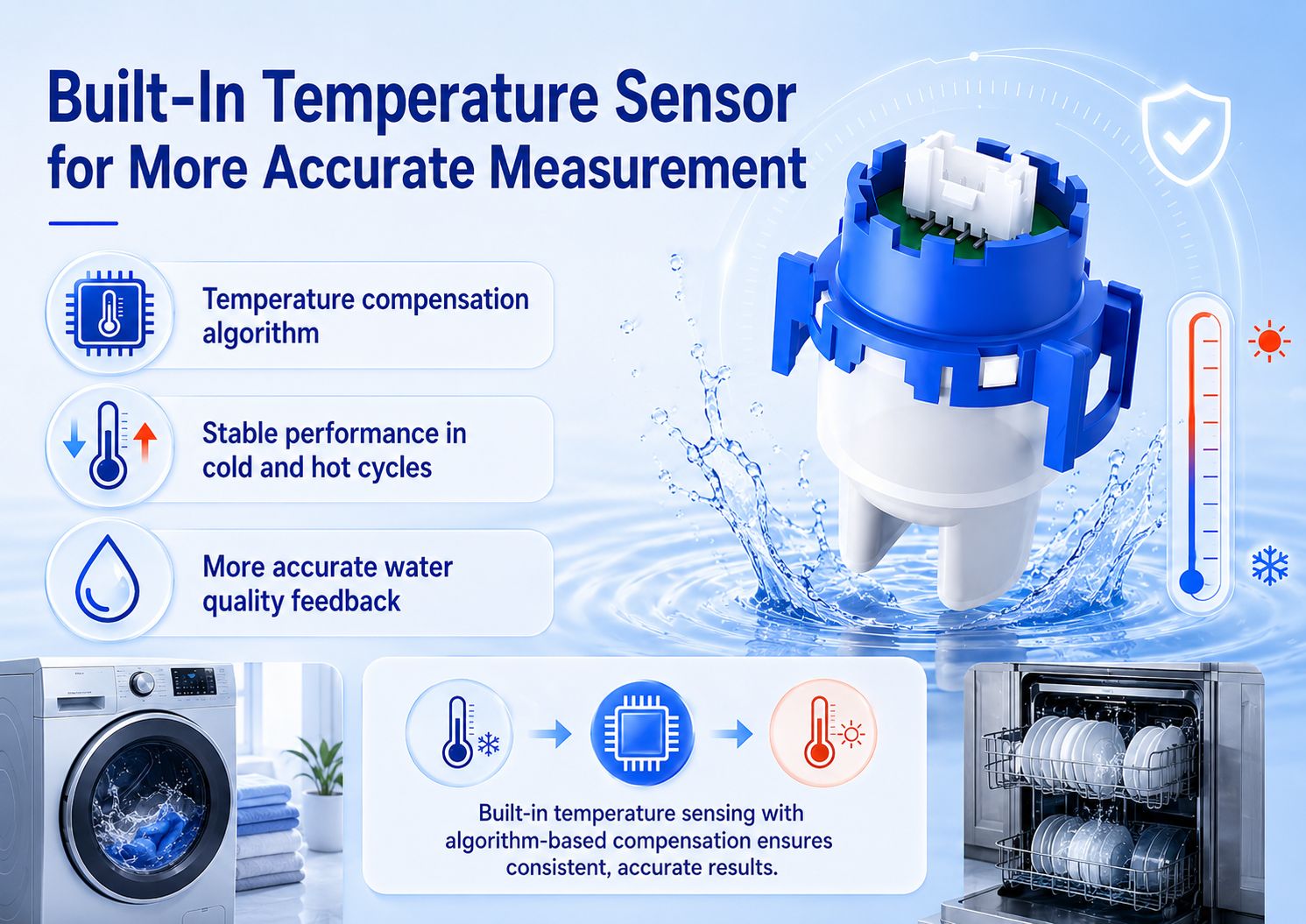
Water temperature changes significantly in real appliance operation.
A washing machine may use cold water, warm water, or high-temperature washing. A dishwasher may operate under high-temperature cleaning or disinfection cycles.
Temperature changes can affect turbidity measurement accuracy if not compensated.
The ZW-TUR102 includes a built-in temperature sensor and uses a temperature compensation algorithm to reduce the influence of temperature variation on detection results.
This helps ensure stable measurement in:
- cold-water washing
- warm-water washing
- high-temperature washing
- dishwasher hot-rinse cycles
- high-temperature sterilization scenarios
More accurate data feedback enables more reliable smart control.
Key Feature 3: Integrated Circuit Board Design for Easier System Integration
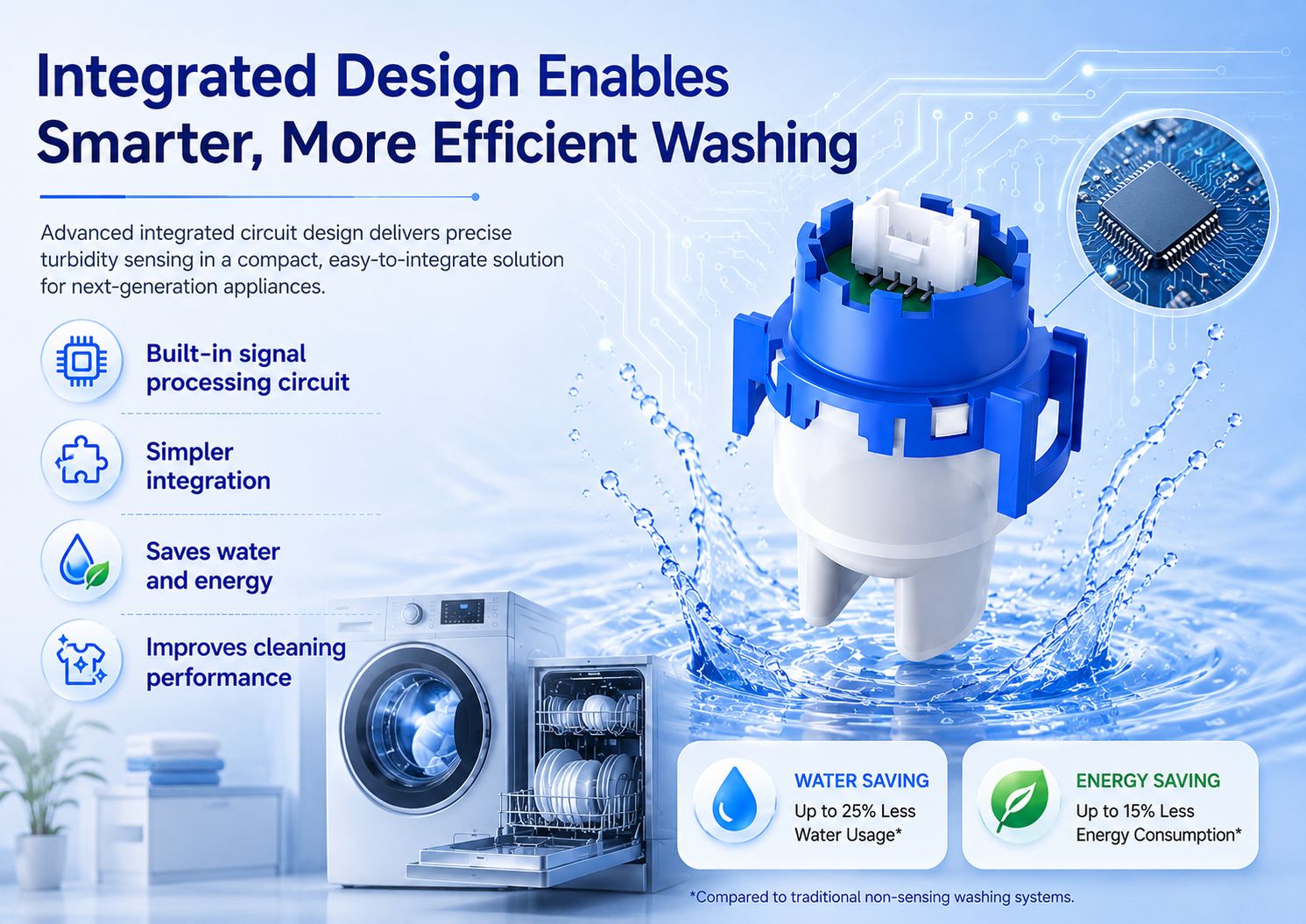
For appliance manufacturers, sensing performance is important, but integration efficiency is also critical.
The ZW-TUR102 adopts an integrated internal circuit board design. Signal processing is built into the sensor, so customers do not need to design additional external amplifier, filtering, or signal conditioning circuits.
This brings several practical benefits:
- easier integration into appliance control boards
- reduced development difficulty
- lower peripheral circuit cost
- improved signal consistency
- better anti-interference performance
- more convenient installation and production
For OEM appliance projects, this helps shorten the development cycle and improve product reliability.
Typical Applications
Smart washing machines
In washing machines, the turbidity sensor can monitor water clarity during the wash and rinse process. The system can then adjust cycle length, rinse times, and water usage based on actual soil removal status.
Application value:
- soil level recognition
- optimized wash duration
- smarter rinse control
- reduced detergent residue
- improved cleaning efficiency
- water and energy saving
Smart dishwashers
In dishwashers, food residue, grease, starch, and detergent foam can create different turbidity patterns.
By monitoring water clarity in real time, the appliance can determine whether dishes are still releasing dirt or whether the water has become clear enough to proceed to the next stage.
Application value:
- real-time food residue monitoring
- optimized wash and rinse process
- reduced water waste
- improved dish cleaning consistency
- better user experience
Other intelligent cleaning appliances
Beyond washing machines and dishwashers, turbidity sensing can also be used in other water-based cleaning and circulation systems where water clarity is a key control parameter.
Potential applications include:
- floor cleaning machines
- smart mopping systems
- appliance water circulation systems
- small cleaning equipment
- water quality feedback modules
From Fixed Programs to Intelligent Decisions
The biggest value of turbidity sensing is not simply measurement. It enables smarter control.
A basic washing machine follows a preset program.
A smarter washing machine senses the real cleaning state.
A basic dishwasher runs for a fixed time.
A smarter dishwasher adjusts its process according to water clarity.
This shift allows appliance manufacturers to develop products that are more efficient, more user-friendly, and more competitive in the smart home market.
Design Value for Appliance Manufacturers
| Manufacturer Need | ZW-TUR102 Value |
|---|---|
| Water clarity detection | Real-time turbidity monitoring |
| Wide application coverage | 0–1000 NTU range |
| Stable measurement | Built-in temperature sensor + compensation algorithm |
| Faster development | Integrated circuit board design |
| Lower system complexity | No additional complex signal conditioning required |
| Better appliance intelligence | Supports smart wash and rinse decisions |
| Energy-saving product design | Helps reduce unnecessary water and electricity use |
| Improved user experience | Cleaner results with smarter automatic control |
How ZW-TUR102 Helps Build Smarter Appliances
The ZW-TUR102 turbidity sensor can become a key part of the appliance control loop:
- The appliance starts washing or rinsing.
- The sensor monitors water turbidity in real time.
- The control system analyzes turbidity changes.
- The appliance adjusts wash time, rinse frequency, or water usage.
- The cycle ends when the water quality reaches the target condition.
This creates a closed-loop cleaning strategy based on actual water quality.
The result is a smarter appliance that can clean more effectively while reducing unnecessary resource consumption.
FAQ
What is a turbidity sensor?
A turbidity sensor detects how cloudy or unclear water is by measuring suspended particles, dirt, residue, or other impurities in the water.
Why do washing machines need turbidity sensors?
A turbidity sensor helps the washing machine detect how dirty the water is, allowing the system to adjust washing and rinsing based on the real cleaning condition.
How does a turbidity sensor help dishwashers?
It monitors food residue and water clarity during the washing process, helping the dishwasher decide whether to continue washing, continue rinsing, or end the cycle.
What is the measurement range of ZW-TUR102?
ZW-TUR102 supports a turbidity measurement range of 0–1000 NTU, covering clean water to highly turbid washing water.
Does ZW-TUR102 support temperature compensation?
Yes. The sensor includes a built-in temperature sensor and temperature compensation algorithm to improve measurement stability under different washing temperatures.
Is ZW-TUR102 easy to integrate?
Yes. It uses an integrated circuit board design with built-in signal processing, helping appliance manufacturers simplify system design and speed up development.
Conclusion: Make Cleanliness Visible
As smart appliances continue to evolve, washing machines and dishwashers need to become more adaptive, efficient, and intelligent.
The turbidity sensor gives appliances the ability to “see” water quality changes during the cleaning process. With real-time turbidity monitoring, machines can optimize washing and rinsing, improve cleaning results, reduce waste, and deliver a better user experience.
Our ZW-TUR102 turbidity sensor is designed for this new generation of smart washing and dishwashing appliances. With a 0–1000 NTU measurement range, built-in temperature compensation, integrated circuit board design, and stable water quality detection capability, it provides a reliable sensing core for intelligent appliance control.
For appliance manufacturers developing smarter, cleaner, and more efficient products, ZW-TUR102 helps turn water quality data into better cleaning decisions.