Automotive Sunlight and Rain-Light Sensors: A New Dimension of Intelligent Vehicle Perception
As vehicles become more intelligent, connected and user-centered, environmental perception is becoming increasingly important.
From automatic headlights to smart wipers, from adaptive cockpit displays to advanced driving assistance, sensors are becoming the “external nerves” that help vehicles understand the surrounding environment.
Among these sensing technologies, automotive sunlight sensors and rain-light sensors play an important role in vehicle comfort, safety and intelligent control.
To support the development of smarter vehicles, Winsen provides high-performance automotive-grade sunlight and rain-light sensing solutions, helping vehicles detect ambient light, rainfall and cabin environmental changes more accurately.
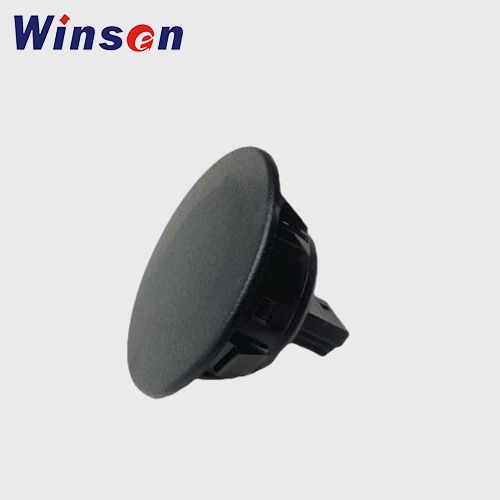
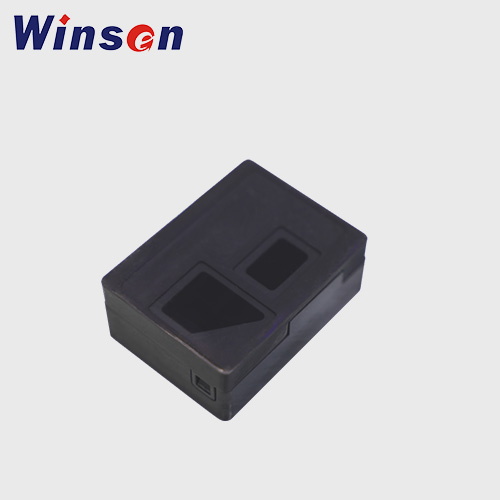
ZH101- Light and Rainfall Composite Sensor
- Water & Light
- Rainfall:7*7mm(Rainfall detection area)
Lighting directly above:1000~50000lx(Light intensity detection range)
Front light:1000~100000lx(Light intensity detection range)
Temperature:-40~85℃
Humidity:0~100%RH - Read More
Why Vehicles Need Smarter Light and Rain Sensing
Driving conditions change continuously.
A vehicle may move from bright sunlight into a tunnel, from a clear road into sudden rain, or from a dry environment into fogging risk. In these moments, the vehicle must respond quickly and correctly.
Traditional manual operation depends on driver attention. However, in real driving scenarios, drivers may forget to turn on headlights, delay wiper operation, or experience display glare under changing light conditions.
Automotive sunlight and rain-light sensors help solve these problems by enabling:
- automatic headlight control
- automatic wiper control
- adaptive display brightness adjustment
- fogging risk detection
- cockpit comfort optimization
- improved visibility and driving safety
For vehicle manufacturers, these sensors are no longer just comfort features. They are becoming important components of intelligent vehicle environment perception.
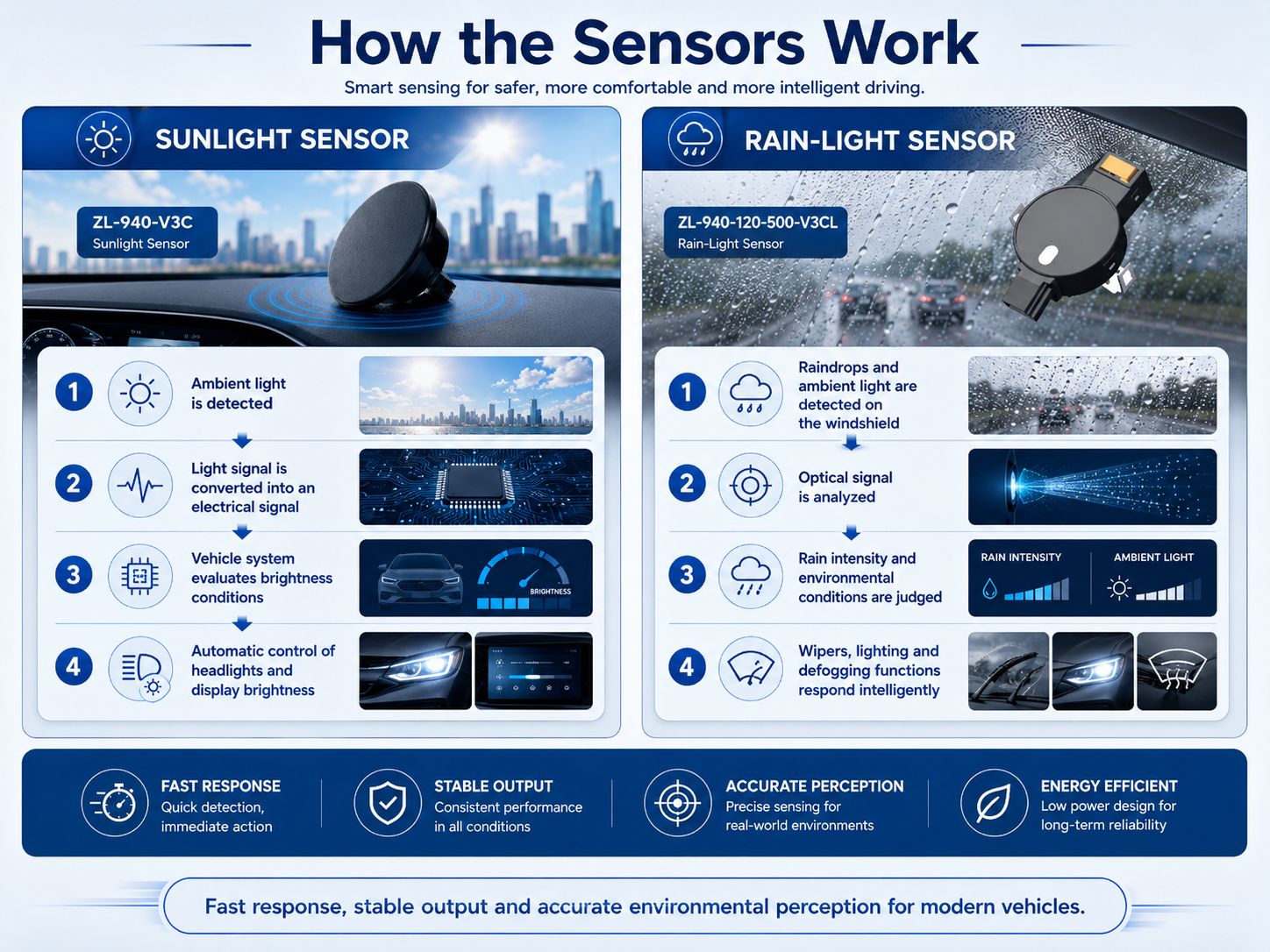
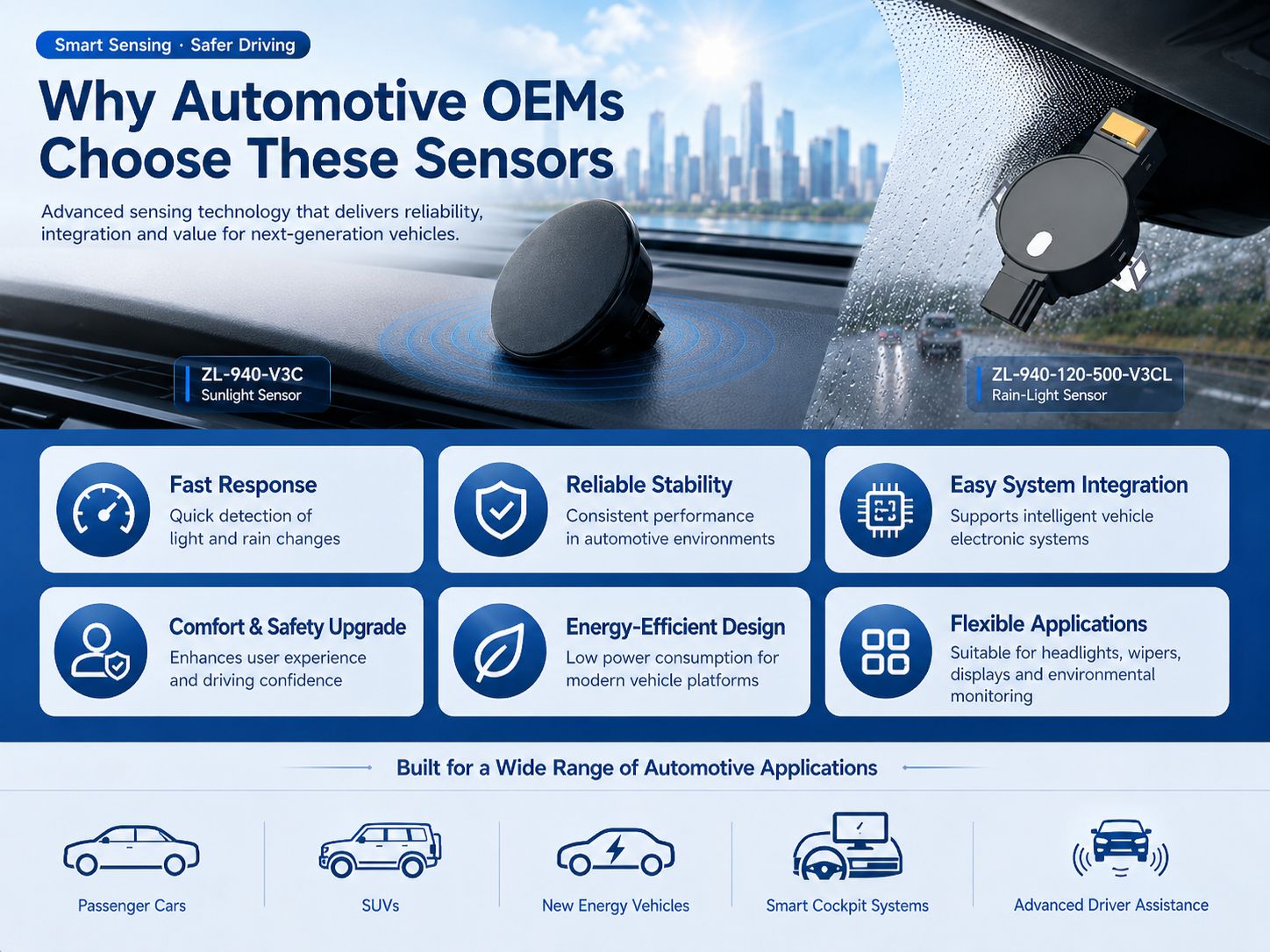
ZL-940-V3C Sunlight Sensor: Helping Vehicles Understand Ambient Light
The ZL-940-V3C sunlight sensor is developed based on the photoelectric effect principle. It is designed to detect changes in external ambient light and convert light signals into electrical signals.
The sensor integrates a photosensitive device, signal processing, communication output and algorithm functions. When the ambient light becomes too weak or too strong, the internal microcontroller determines whether the conditions for turning the vehicle lights on or off are met, and communicates with the vehicle system to control the lighting status.
According to the product specifications, ZL-940-V3C supports LIN2.0 output, a detection range of 0–7000 Lux, DC 9–16V supply voltage, and operates from -40°C to 85°C, making it suitable for automotive ambient light detection applications.
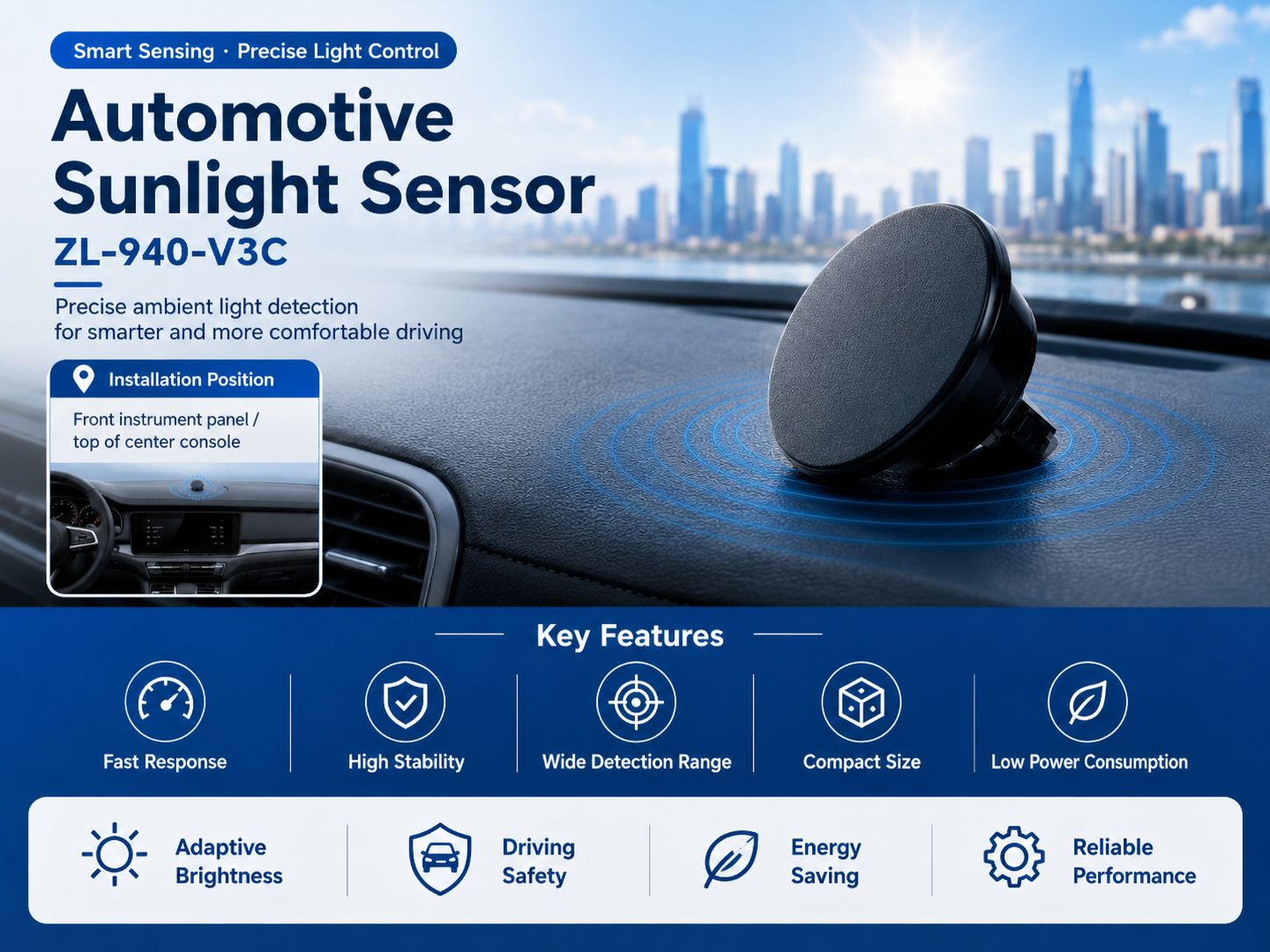
Automatic Headlight Control
When a vehicle enters a tunnel, underground garage, shaded road or night-time environment, the sunlight sensor can quickly detect the change in ambient light.
The vehicle system can then automatically turn on the headlights, improving road visibility and reducing the risk caused by delayed manual operation.
When the vehicle returns to a bright environment, the sensor detects the light increase and the system can automatically turn off the headlights.
This improves:
- driving convenience
- lighting response speed
- road visibility
- safety in tunnels and low-light areas
- user experience in daily driving
Adaptive Cockpit Display Brightness
The ZL-940-V3C is not limited to automatic headlight control. It can also support cockpit display brightness adjustment.
By detecting external light intensity in real time, the vehicle can automatically adjust:
- center control display brightness
- instrument cluster brightness
- HUD brightness
- infotainment screen visibility
In bright sunlight, the screen can increase brightness for better readability. At night, the screen can reduce brightness to avoid glare and eye fatigue.
This helps create a more comfortable and safer visual experience for drivers and passengers.
Rain-Light Sensors: Building All-Weather Vehicle Perception
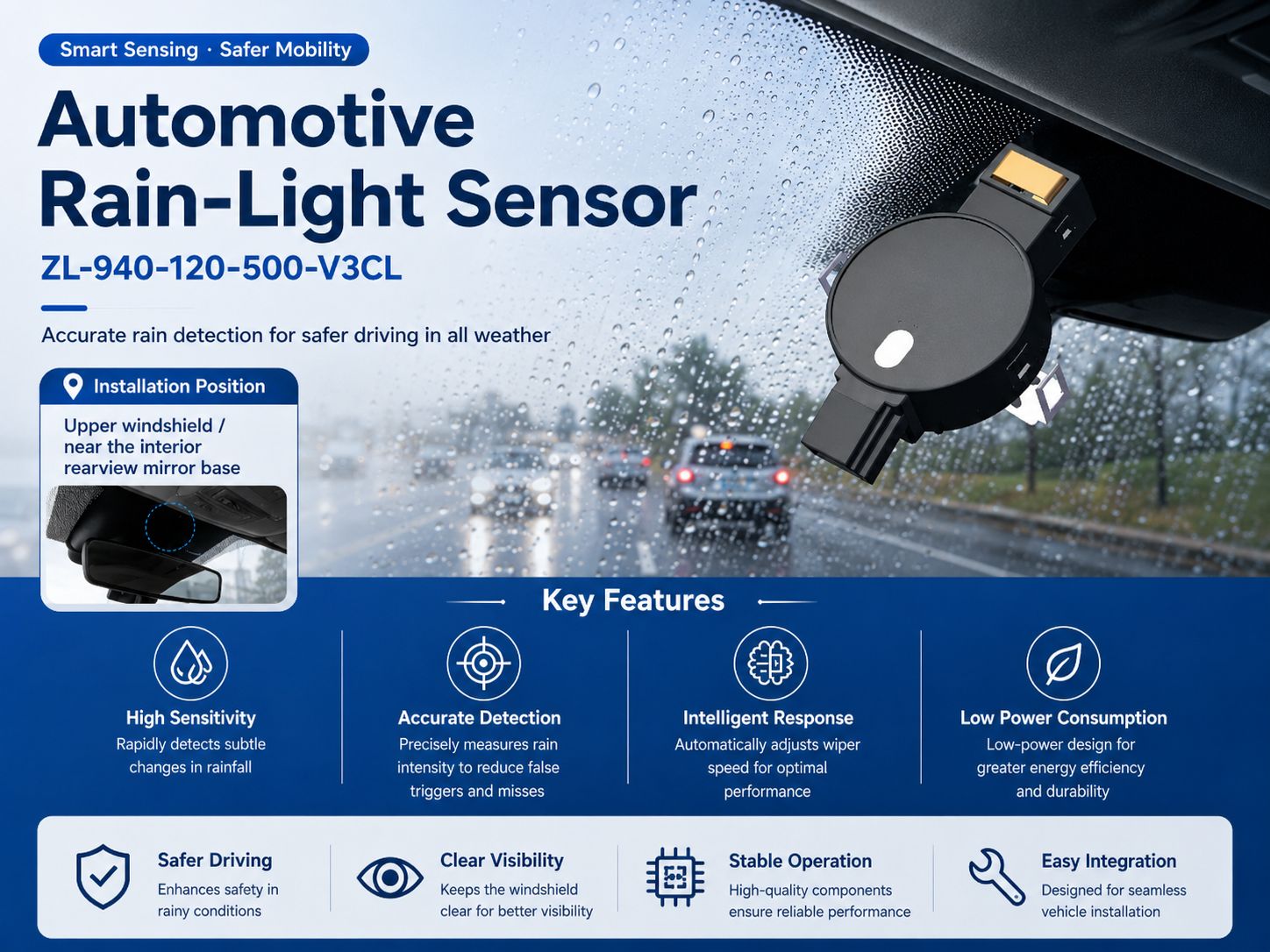
While sunlight sensors focus on ambient light, rain-light sensors expand vehicle perception to rainfall, humidity and fogging risk.
A vehicle rain-light sensor integrates multiple sensing functions, such as:
- ambient light detection
- rain detection
- temperature and humidity detection
- defogging assistance
By combining optical detection and environmental sensing, rain-light sensors help vehicles respond intelligently to changing weather conditions.
Smart Wiper Control
When raindrops appear on the windshield, the rain-light sensor can detect them and send data to the vehicle control system.
The wiper system can then start automatically and adjust wiping frequency according to rainfall intensity.
For example:
- light rain → low-speed wiping
- moderate rain → standard wiping
- heavy rain → high-speed wiping
- rain stops → wipers slow down or stop
This reduces driver workload and helps maintain clear visibility in changing weather.
Automatic Light Linkage in Rain, Fog and Low-Light Conditions
Rainy or foggy weather often reduces visibility even during daytime.
When the sensor detects rain, fogging risk or insufficient ambient light, it can work with the automatic headlight system to support lighting activation, improving vehicle visibility to other road users.
This is especially valuable in:
- rainstorms
- foggy roads
- tunnels
- underground parking areas
- dusk and dawn driving
- low-visibility weather
Defogging and Cabin Comfort Support
In addition to rain and light detection, rain-light sensing solutions can also integrate temperature and humidity monitoring.
By detecting the temperature difference and relative humidity inside and outside the vehicle, the system can estimate fogging risk on the windshield and support automatic defogging control through the HVAC system.
This helps improve:
- windshield visibility
- cabin comfort
- driving safety
- automatic climate control intelligence
Key Advantages for Automotive OEMs and System Integrators
1. Fast Response and High Stability
Driving conditions can change within seconds. A sunlight or rain-light sensor must respond quickly and provide stable signals to the vehicle control system.
The ZL-940-V3C integrates light acquisition, signal processing and algorithm modules, supporting fast reaction and stable operation.
2. Wide Detection Range
The ZL-940-V3C supports a 0–7000 Lux detection range, enabling it to detect different ambient light conditions from weak light to strong sunlight.
This supports applications such as:
- automatic headlights
- external light intensity detection
- display backlight control
- vehicle environment monitoring
3. Automotive Operating Temperature Range
Automotive sensors must operate reliably in both cold and hot environments.
ZL-940-V3C supports an operating temperature range of -40°C to 85°C and storage temperature range of -40°C to 95°C, helping it meet the needs of vehicle installation environments.
4. LIN2.0 Communication Output
ZL-940-V3C provides LIN2.0 output, making it suitable for automotive electronic control system integration.
For system integrators, this supports:
- easier vehicle communication
- reduced wiring complexity
- stable signal transmission
- compatibility with automotive control architecture
5. Compact Size and Low Power Consumption
The sensor features small size and low energy consumption, supporting compact installation and efficient automotive electronic design.
Typical Applications
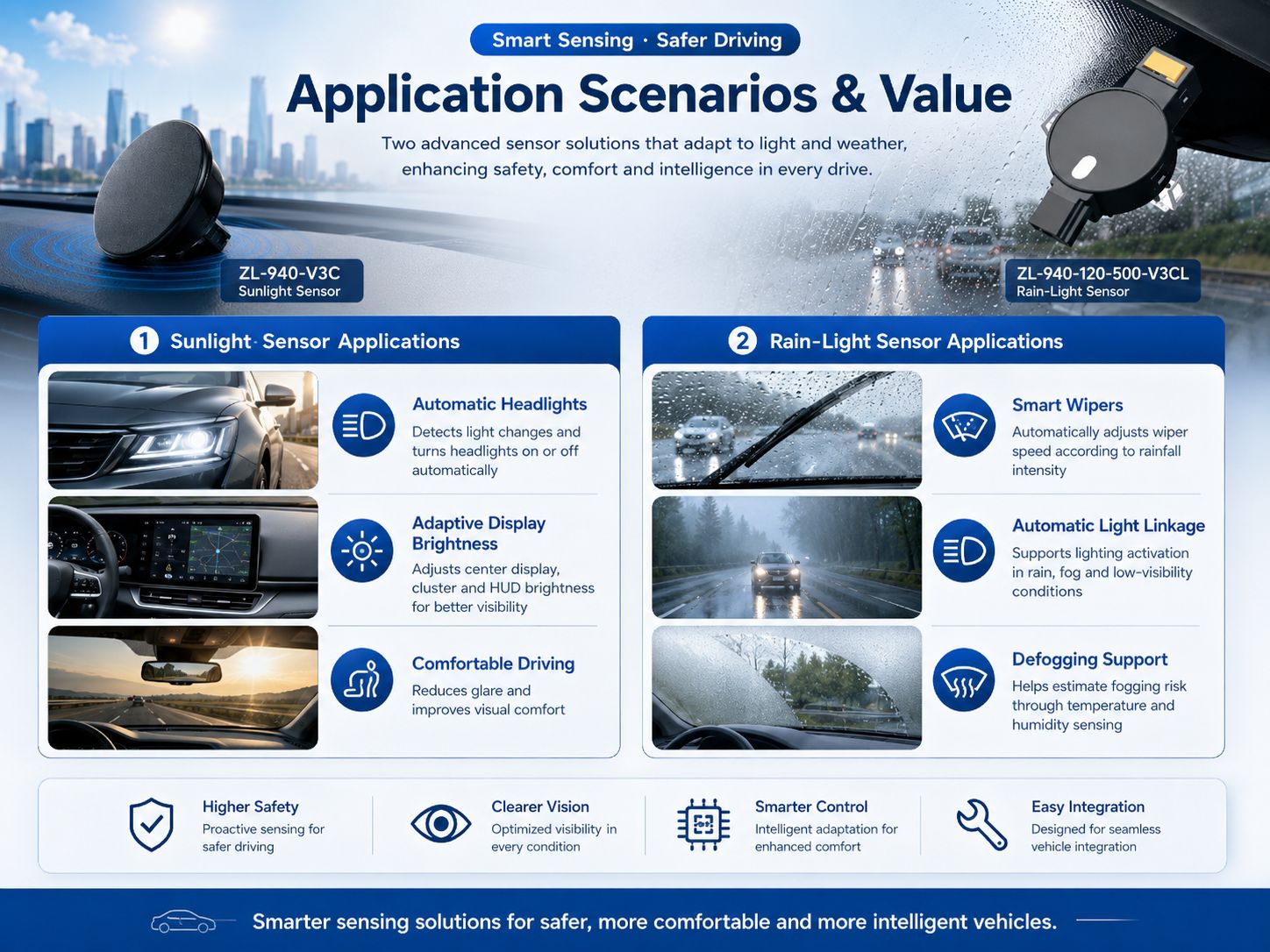
Winsen automotive sunlight and rain-light sensing solutions can be used in:
- automatic headlight control systems
- smart wiper systems
- cockpit display brightness adjustment
- HUD brightness control
- windshield defogging systems
- vehicle environmental monitoring
- intelligent cockpit systems
- automotive comfort and safety systems
Application Value for Vehicle Manufacturers
| Vehicle Function | Sensor Value |
|---|---|
| Automatic headlights | Detects ambient light changes and supports automatic lighting control |
| Smart wipers | Detects rainfall and supports adaptive wiping frequency |
| Display backlight control | Adjusts screen brightness according to ambient light |
| HUD visibility | Helps improve display readability in different lighting environments |
| Defogging control | Supports fogging risk judgment through temperature and humidity sensing |
| Driving safety | Reduces manual operation and improves visibility |
| User experience | Makes driving more comfortable, intelligent and convenient |
From Comfort Function to Intelligent Vehicle Perception
In the past, automatic headlights and automatic wipers were often considered convenience features.
Today, as vehicles move toward higher levels of intelligence, these functions are part of a broader environmental perception system.
Sunlight sensors and rain-light sensors help vehicles understand:
- whether the environment is bright or dark
- whether the windshield is wet
- whether visibility may be reduced
- whether display brightness should be adjusted
- whether defogging is needed
This information supports safer driving and a more intelligent cockpit experience.
FAQ
What is an automotive sunlight sensor?
An automotive sunlight sensor detects ambient light intensity around the vehicle and converts light signals into electrical signals for automatic headlight control, display brightness adjustment and environmental monitoring.
What is the detection principle of ZL-940-V3C?
ZL-940-V3C is based on the photoelectric effect principle and uses a photosensitive device to convert light signals into electrical signals.
What output does ZL-940-V3C support?
ZL-940-V3C supports LIN2.0 output.
What is the detection range of ZL-940-V3C?
The detection range is 0–7000 Lux.
What are the typical applications of the sunlight sensor?
It can be used for exterior light intensity detection, automatic lighting control systems, environmental monitoring and display screen backlight control.
How does a rain-light sensor improve driving safety?
It can detect raindrops, light changes and fogging-related environmental conditions, helping the vehicle automatically control wipers, headlights and defogging systems.
Conclusion: Smarter Perception for Safer Driving
From automatic headlights and smart wipers to adaptive cockpit displays and defogging control, sunlight and rain-light sensors are becoming essential components in modern vehicles.
The ZL-940-V3C automotive sunlight sensor provides fast response, high stability, wide detection range, LIN2.0 output, compact structure and automotive temperature adaptability. It helps vehicles sense light changes more accurately and supports smarter control of lighting and display systems.
As automotive electronics continue to evolve, Winsen will keep developing high-performance and reliable automotive-grade sensor solutions, helping global vehicle manufacturers create safer, more comfortable and more intelligent driving experiences.