Smart Fire Safety Sensors for Labor-Intensive Manufacturing: From Fire Response to Early Risk Prevention
In modern manufacturing, safety management is not only about responding to accidents after they happen. It is increasingly about detecting hidden risks before they develop into visible danger.
For labor-intensive industries such as footwear, apparel, furniture, packaging and light manufacturing, fire safety has always been a critical issue. These industries often feature dense production areas, large numbers of workers, continuous equipment operation and significant storage of raw materials or semi-finished products.
Many fire risks do not begin with open flame. They often start with subtle environmental changes: abnormal temperature rise, local overheating, smoke particles, combustible gas accumulation, poor ventilation or small sparks. If these early signals are not detected in time, the risk may escalate quickly.
This is why smart fire safety systems are moving from simple “fire detection” toward early risk prevention.
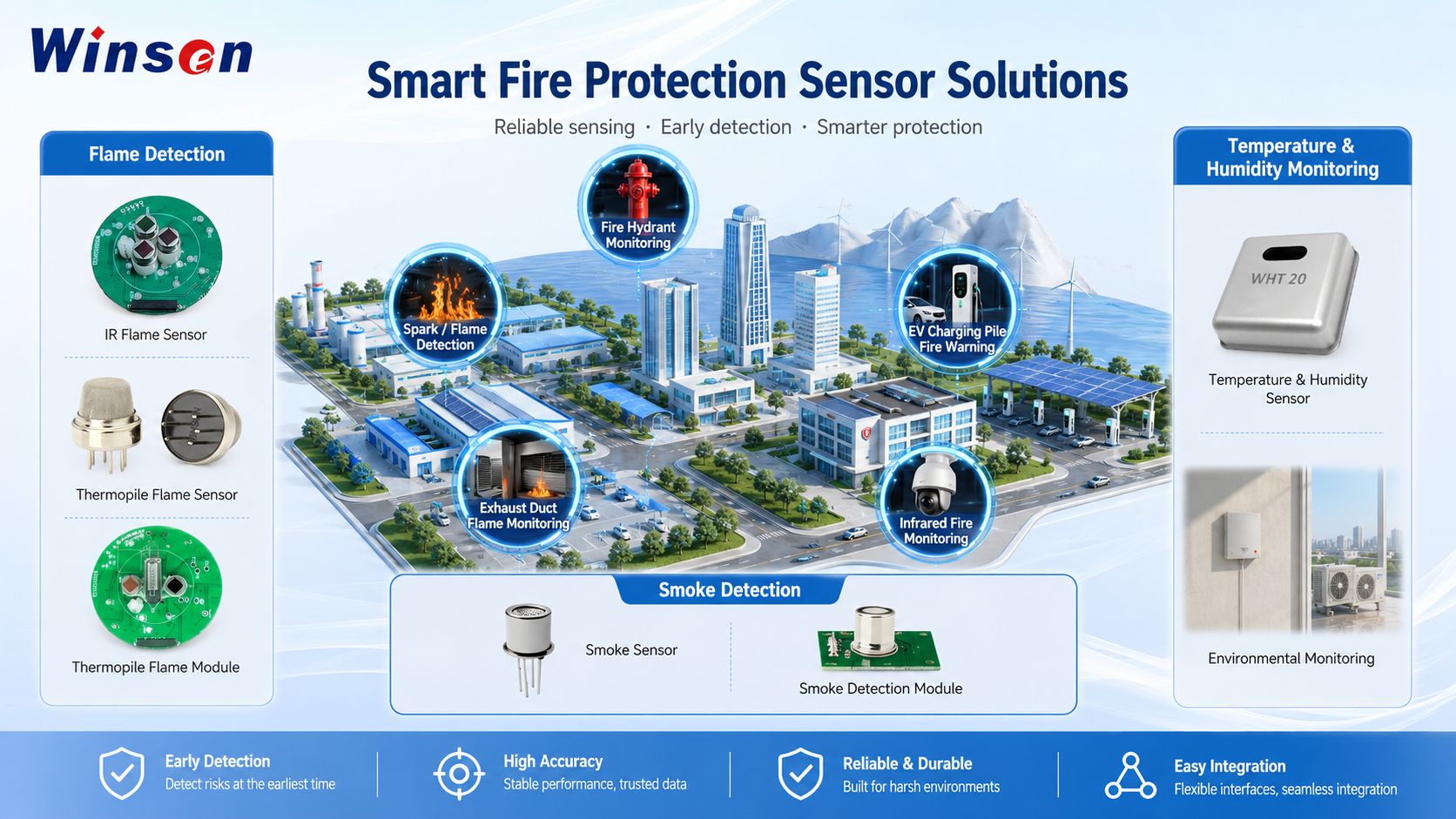
For factories that need continuous safety monitoring, Winsen provides Smart Fire Safety Solutions based on smoke, flame, gas and temperature sensing technologies, helping customers build a more reliable industrial fire early-warning network.
Why Labor-Intensive Factories Face Higher Hidden Fire Risks
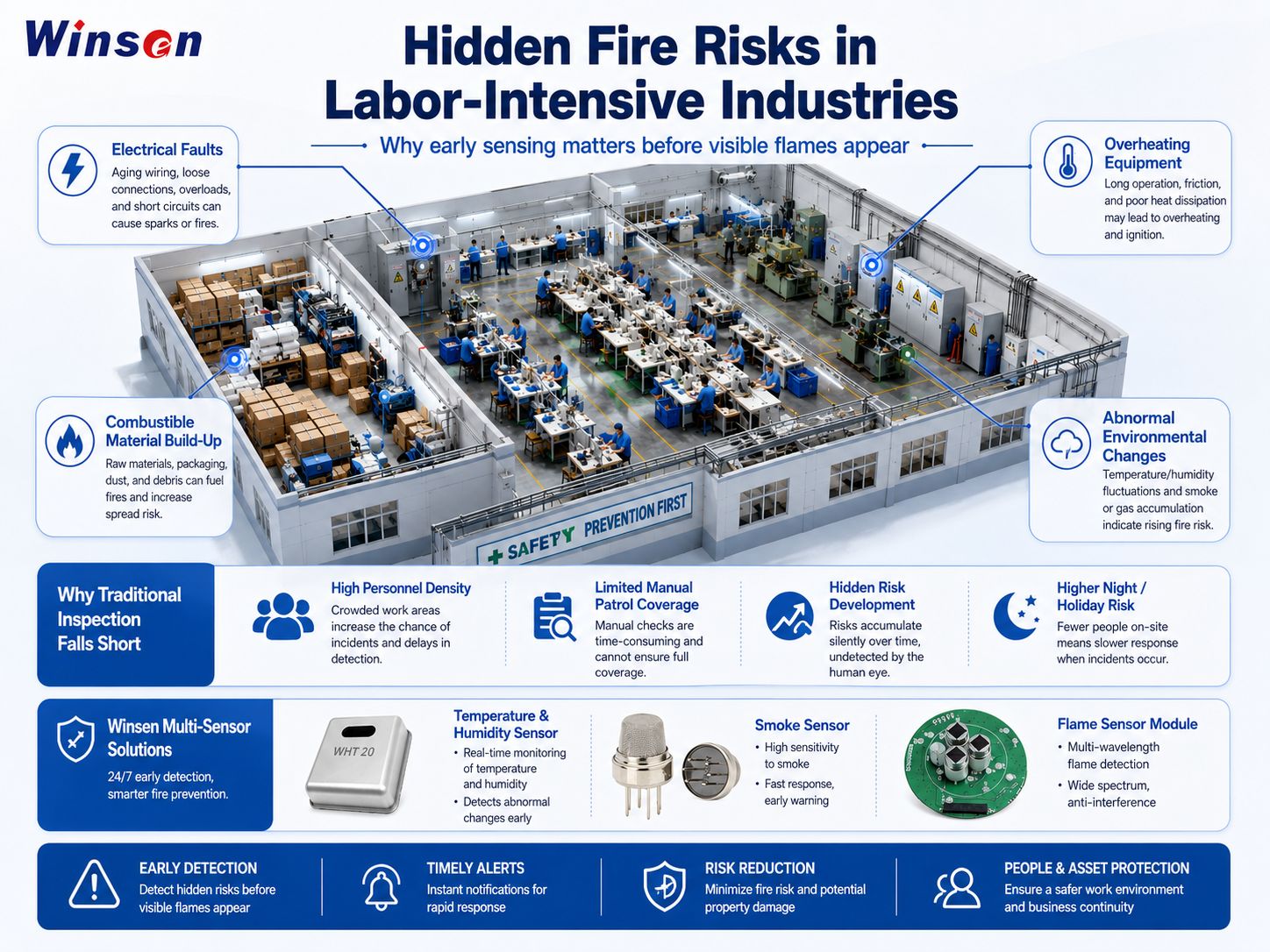
Labor-intensive factories usually contain multiple risk factors in the same production environment.
Raw materials, packaging materials, foam, textiles, adhesives, dust and semi-finished products may increase combustible load. Electrical wiring, motors, heating equipment, compressors and production machines may operate for long periods and generate abnormal heat if aging, overload or poor heat dissipation occurs.
Common hidden risks include:
- aging electrical systems and loose wiring connections
- overheating motors, bearings or heating components
- accumulation of combustible raw materials and packaging
- smoke or dust buildup in poorly ventilated areas
- gas release from adhesives, solvents or chemical processes
- sparks, open flames or local ignition sources
- limited manual inspection coverage, especially at night or during holidays
Traditional manual inspection is important, but it cannot cover every corner 24 hours a day. When risks occur inside equipment, in storage areas, above ceilings, near electrical cabinets or during unattended hours, early detection becomes much more difficult.
The key question is:
Can we detect abnormal changes before a fire becomes visible?
From Fire Detection to Risk Detection
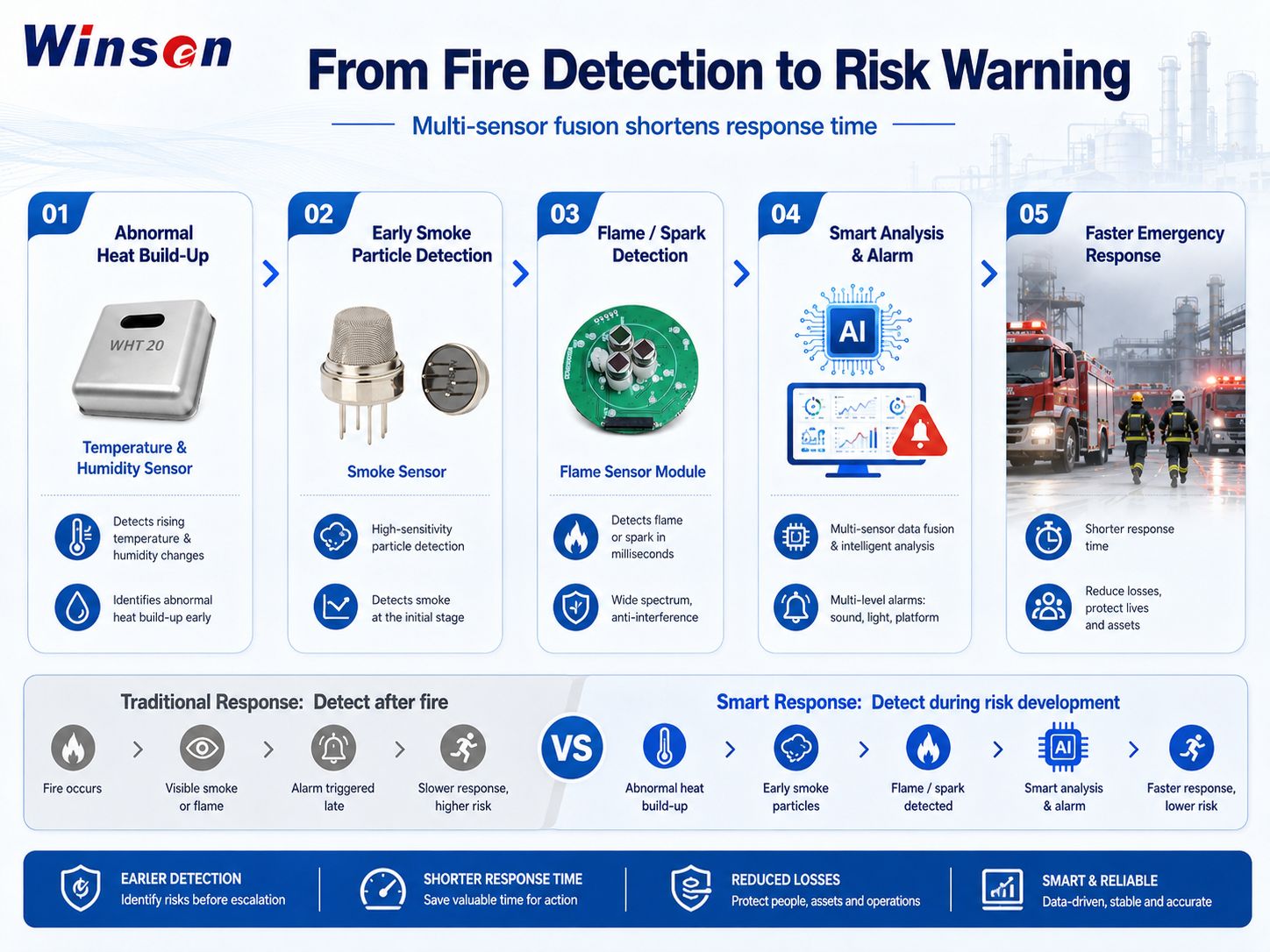
Conventional fire protection systems often focus on whether a fire has already occurred. Modern smart fire safety systems go one step further: they focus on detecting the risk development process.
Before a fire breaks out, there may be several early-stage signals:
Abnormal heat
Equipment, cables or motors may show rising temperature before failure.Smoke particles
Insulation aging, material smoldering or local overheating may generate smoke particles before open flame appears.Hazardous or combustible gas release
Some materials, batteries, adhesives, solvents or chemical processes may release gases under abnormal conditions.Flame or spark appearance
Once flame or spark radiation appears, fast detection and linkage response become critical.
A smart fire safety system can use different sensors to monitor these signals at the same time. By combining temperature, smoke, gas and flame data, the system can better understand environmental changes and improve early-warning accuracy.
This is the transition from single-point alarm to multi-sensor risk prevention.
Temperature Monitoring: Detecting Overheating Before It Escalates
Abnormal temperature rise is often one of the earliest signs of fire risk.
In labor-intensive factories, electrical cabinets, motors, production equipment, bearings, heating components and cable joints may become potential overheating points. If temperature continues to rise without timely intervention, insulation degradation, smoke generation or ignition may occur.
Temperature sensors can help monitor:
- electrical cabinet temperature
- motor and bearing temperature
- production equipment heat buildup
- cable and connector overheating
- heat accumulation in enclosed spaces
By detecting abnormal temperature trends earlier, factories can arrange maintenance before risk develops into an accident.
Smoke Detection: Capturing Early Combustion Signals
Smoke detection is one of the most important parts of fire early warning.
In many cases, smoke particles appear before visible flame. Smoldering materials, overheated cables, aging insulation, packaging materials and dust accumulation may all generate smoke at an early stage.
For smoke detection applications, Winsen ZP13 Smoke Sensor Module can be used in home smoke alarms, industrial smoke alarms and portable smoke detectors. It adopts a semiconductor sensing principle and is designed with high sensitivity, long-term stability, low power consumption and fault self-diagnosis features.([Winsen Electronics][1])
In industrial settings, smoke sensors can be installed in:
- production workshops
- storage rooms
- electrical rooms
- packaging areas
- corridors and ceilings
- equipment compartments
- charging rooms and maintenance areas
Early smoke detection helps reduce response time and gives personnel more time to act.
Flame and Spark Detection: Fast Response for High-Risk Areas
In some high-risk areas, once flame or spark appears, the response time must be extremely short.
Flame sensors detect characteristic radiation generated by flame. They are suitable for applications where open flame, sparks or fast ignition risks must be detected quickly.
Winsen ZRP370 Pyro-electric Flame Sensor Module is based on infrared and ultraviolet detection principles. It integrates pyroelectric sensors, a UV sensor and a high-performance microprocessor, using built-in algorithms to judge fire signals effectively.([Winsen Electronics][2])
Typical application areas include:
- warehouses
- factory workshops
- electrical rooms
- charging piles
- oil storage areas
- chemical storage zones
- dust-prone production areas
- high-fire-risk equipment sections
Flame and spark detection can be used as a fast-response sensing layer in smart fire safety systems.
Gas Detection: Monitoring Combustible and Toxic Risk Factors
Fire safety is not only about smoke and flame. In some factories, gas detection is also important.
Combustible gases, solvent vapors, toxic gases or gases released from abnormal material heating may create additional safety risks. For example, gas accumulation in poorly ventilated areas may increase explosion risk, while toxic gas release may endanger worker safety.
Winsen Industrial Gas Sensor for Safety solutions support toxic and hazardous gas monitoring in industrial environments, and can be used with different sampling methods such as diffusion type and pump suction type according to application requirements.([Winsen Electronics][3])
For combustible gas risk monitoring, Winsen also provides Combustible Gas Sensor solutions covering methane, LPG, natural gas, flammable gases and smoke-related detection needs.([Winsen Electronics][4])
Gas sensors can support monitoring in:
- solvent storage rooms
- adhesive application areas
- fuel gas pipelines
- battery charging or storage zones
- chemical processing areas
- ventilation ducts
- underground or enclosed spaces
By integrating gas detection into fire safety systems, factories can detect more risk signals before they become dangerous.
Multi-Sensor Fusion: A More Complete View of Factory Risk
No single sensor can cover all possible fire risks.
Temperature sensors detect overheating.
Smoke sensors detect early particles.
Gas sensors detect combustible or toxic gas changes.
Flame sensors detect flame or spark radiation.
When these sensors work together, the system can provide a more complete view of factory safety conditions.
A multi-sensor fire safety system can support:
- real-time monitoring
- early warning
- abnormal trend analysis
- alarm linkage
- ventilation or exhaust activation
- power-off or equipment shutdown logic
- remote notification
- data recording and safety management
This helps factories move from passive response to active prevention.
From Manual Inspection to Intelligent Monitoring
Manual inspection remains necessary, but intelligent sensing can make safety management more continuous and more reliable.
In labor-intensive factories, intelligent monitoring can help solve several pain points:
- areas that are difficult for workers to inspect frequently
- night-shift or holiday monitoring gaps
- hidden risks inside equipment or electrical rooms
- early-stage risks that are hard to identify visually
- delayed reporting and response
- lack of historical risk data
With real-time sensor data, factory managers can better understand where risks are developing and respond faster.
This does not replace safety responsibility. Instead, it strengthens the technical foundation of safety management.
Technology Helps, Responsibility Secures Safety
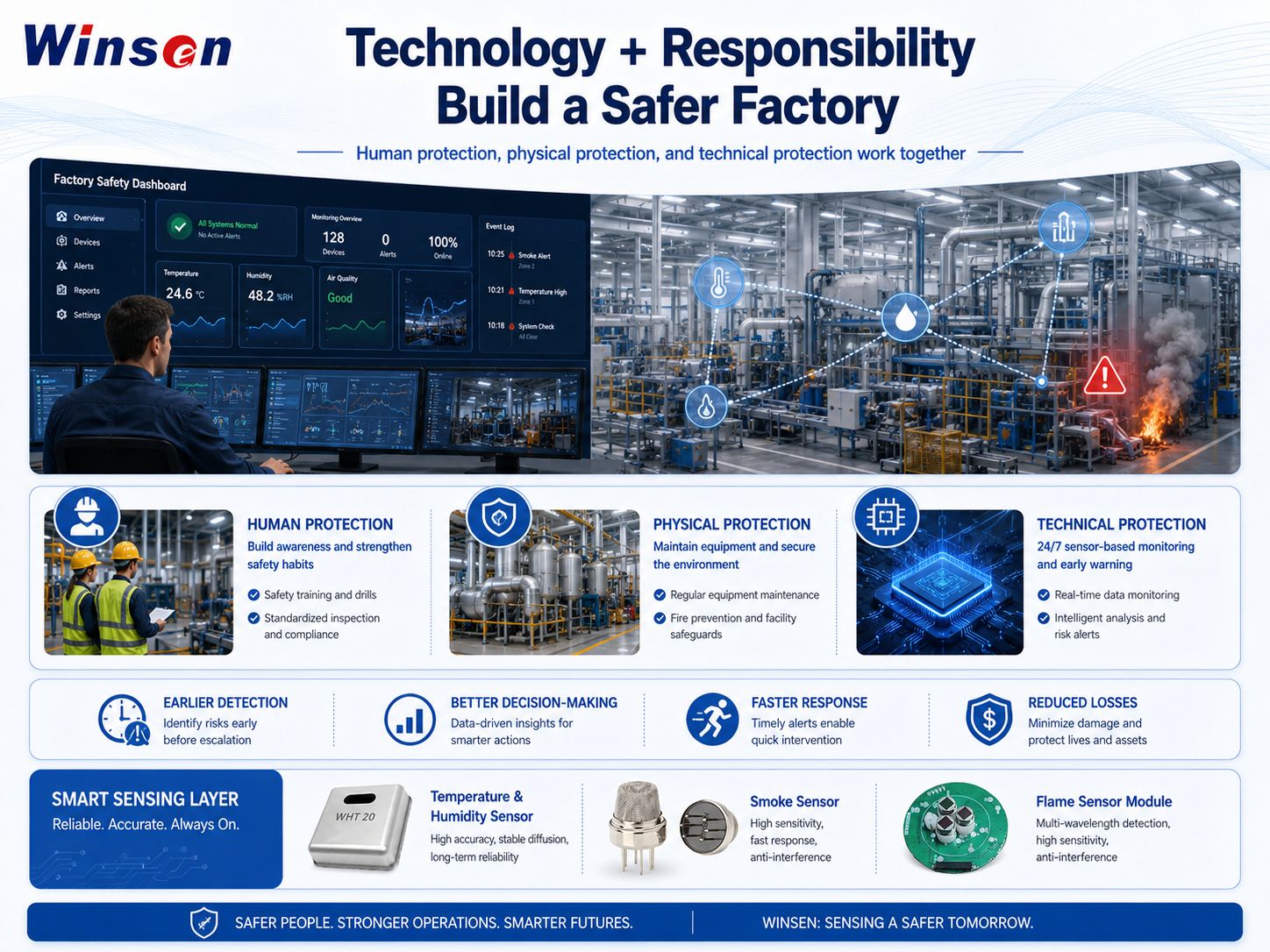
Sensors can detect changes.
Smart systems can improve early warning.
But technology alone cannot replace safety responsibility.
A reliable factory safety system requires cooperation between:
- people
- processes
- equipment
- sensing technology
- emergency plans
- regular maintenance
- safety training
For any enterprise, fire prevention must be built into daily operations. Advanced sensing technologies are tools that help managers see risks earlier, but the final safety result depends on responsible management and timely action.
The goal is not only to detect fire.
The goal is to prevent fire from happening.
Recommended Winsen Sensor Solutions for Industrial Fire Safety
| Risk Type | Recommended Sensor Solution | Application Value |
|---|---|---|
| Smoke particles | ZP13 Smoke Sensor Module | Early smoke detection for industrial smoke alarms and portable smoke detectors |
| Flame / spark radiation | ZRP370 Pyro-electric Flame Sensor Module | Fast flame signal judgment through IR + UV sensing and built-in algorithm |
| Combustible gas leakage | Combustible Gas Sensor Series | Detection of methane, LPG, natural gas and other flammable gases |
| Toxic / hazardous gas risk | Industrial Gas Sensor for Safety | Toxic and hazardous gas monitoring for fixed and portable industrial detectors |
| Full system solution | Winsen Smart Fire Safety Solutions | Multi-sensor fire prevention and detection for industrial and commercial scenarios |
FAQ
Why do labor-intensive factories need smart fire safety sensors?
Labor-intensive factories usually have dense personnel, concentrated production areas, combustible materials and continuous equipment operation. Smart sensors help detect abnormal heat, smoke, gas and flame signals earlier.
What is the difference between fire detection and risk detection?
Fire detection focuses on whether a fire has already occurred. Risk detection focuses on abnormal changes before fire occurs, such as overheating, smoke particles, gas release or sparks.
Which sensors are useful for factory fire early warning?
Typical sensors include temperature sensors, smoke sensors, flame sensors, combustible gas sensors and toxic gas sensors.
Can smoke sensors be used in industrial environments?
Yes. Smoke sensor modules can be used in industrial smoke alarms, portable smoke detectors and workshop monitoring systems, depending on installation requirements.
Why is multi-sensor fusion important?
Different risks produce different signals. Multi-sensor fusion helps improve accuracy by combining temperature, smoke, gas and flame data for a more complete risk judgment.
Can sensors replace factory safety management?
No. Sensors are technical tools for early warning. A reliable safety system also requires training, maintenance, inspection routines, emergency plans and responsible management.
Conclusion: Build a Safer Factory Through Earlier Warning
Every fire accident reminds us that safety management must move forward.
For labor-intensive industries, the key is not only how to respond after a fire occurs, but how to detect risk before it becomes a fire.
By integrating smoke sensors, flame sensors, gas sensors and temperature monitoring technologies, smart fire safety systems can help factories improve early warning, shorten response time and reduce potential losses.
At Winsen, we believe sensing technology should become the “eyes” of industrial safety. With reliable sensor solutions and application-oriented support, we help customers build safer production environments, protect workers and support sustainable manufacturing.