SMX100 Series Miniature Industrial Intelligent Gas Sensors: Ultra-Thin, UART-Ready Detection for CO / H₂S / O₂ / CH₄
The SMX / SMX100 Series Redefines Industrial Gas Detection for Compact Devices
Industrial safety devices have long carried the stereotype of being “bulky” and “brick-like.” But the next generation of safety equipment is moving fast in a new direction:
- smaller size
- higher intelligence
- higher integration
- faster development cycles
- more flexible installation
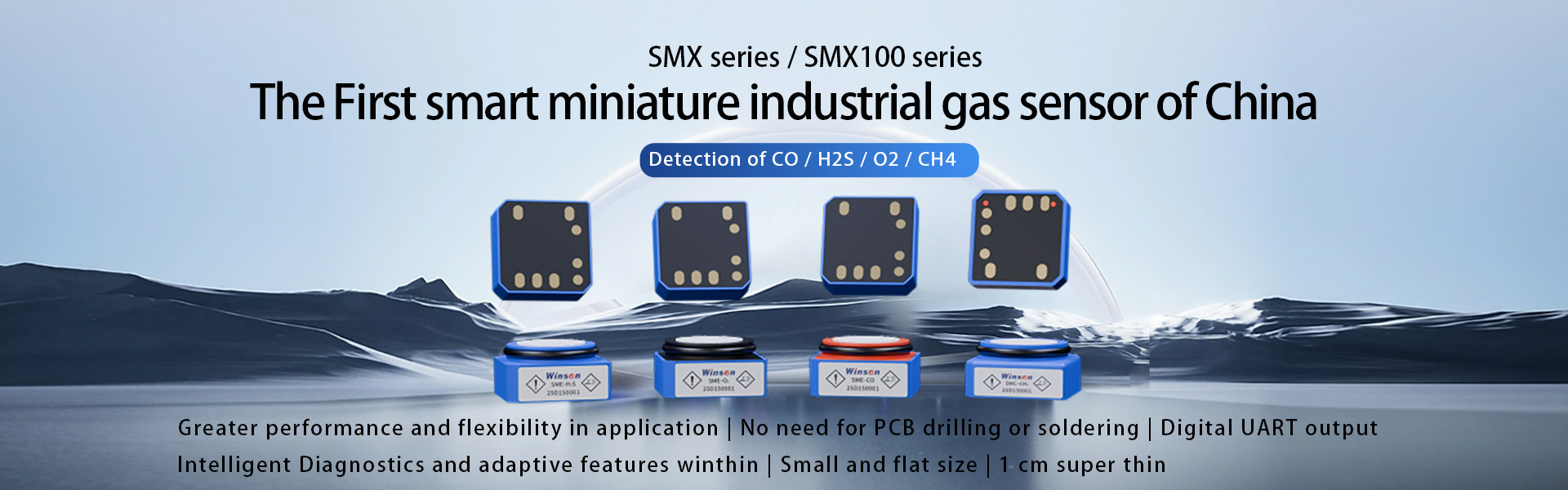
To meet these demands, Winsen introduces a new miniature industrial intelligent gas sensor platform—SMX100 series—built to give portable, wearable, and compact industrial devices a stronger sensing “core” and far more freedom in product design.
On the SMX100 product page, Winsen positions the series as a high-performance universal intelligent sensor that combines three-electrode electrochemical sensors, catalytic sensors, and a high-performance microprocessor, enabling different gas detection configurations through different sensor types.
Why the Industry Needs “True Intelligent Mini Sensors”
Traditional gas detection designs often create multiple integration burdens:
- sensor + analog front-end design (amplification, filtering, drift handling)
- calibration and temperature compensation
- maintenance complexity
- large mechanical footprint
- wiring / PCB assembly constraints
In real industrial deployments—metallurgy, petrochemical, mining, urban pipe corridors, and now even low-altitude aircraft and robots—equipment is becoming smaller while requirements for reliability and diagnostics keep rising.
SMX100 series targets this gap by delivering a compact sensing solution with:
- digital UART output
- built-in intelligent diagnosis and adaptive functions
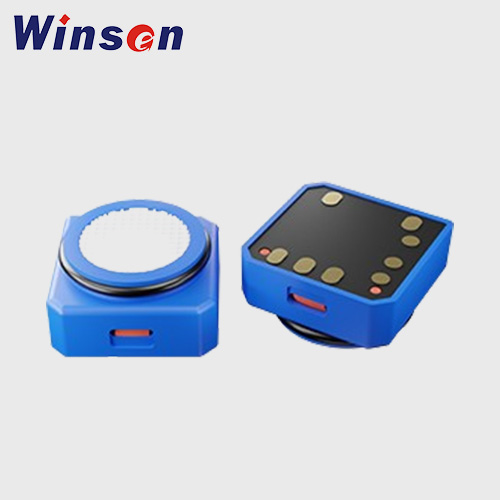
- miniaturized, flattened mechanical design with ~1 cm thickness
- flexible contact-style installation without PCB drilling/welding
Winsen describes SMX100 as a miniature industrial intelligent gas sensor series designed to integrate sensing and processing to shorten design cycles and simplify debugging.
Core design concept (from the official description)
- Uses three-electrode electrochemical sensors (for toxic gases / oxygen) and catalytic sensing (for methane in %LEL form)
- Uses a microprocessor to enable intelligent functions and digital output
- Supports multiple gases by equipping different sensing elements
Target gases (SMX100 platform)
The SMX100 series page lists the target gases as: CO, H₂S, O₂, CH₄.
Key Advantages for Device Makers
1) Ultra-compact, flattened structure (built for tight layouts)
Many portable and wearable designs fail—not because sensing is hard—but because packaging, airflow routing, and assembly are painful. SMX100 is explicitly positioned with a flattened appearance and a thickness of only ~1 cm, helping designers build lighter products without sacrificing industrial capability.
2) Touch-contact installation (no PCB drilling or welding)
SMX100 highlights “no need for PCB drilling or welding,” reducing manufacturing complexity and improving serviceability for field replacement designs.
3) UART digital output + intelligent diagnosis
The series uses UART output mode, and its feature list emphasizes built-in intelligent diagnosis and adaptive functions—important for maintenance efficiency and reliability in harsh field conditions.
4) Shorter development cycle and easier debugging
Because the platform integrates sensor + processing and outputs a digital signal, it can reduce the time required for analog design, tuning, and early-stage debugging. Winsen explicitly states it “greatly shortens the user’s design and development cycle.”
SMX100 Models and Typical Specifications
The SMX100 page lists four product models covering toxic gases, oxygen, and methane (%LEL):
- SME100-CO
- SME100-H₂S
- SME100-O₂
- SMC100-CH₄
Performance snapshot
| Model | Gas | Range | Resolution | T90 |
|---|---|---|---|---|
| SME100-CO | CO | 0.5–1000 ppm | 1 ppm | < 30 s |
| SME100-H₂S | H₂S | 0.5–200 ppm | 0.1 ppm | < 30 s |
| SME100-O₂ | O₂ | 0.6–25 %vol | 0.1 %vol | < 15 s |
| SMC100-CH₄ | CH₄ | 0–100 %LEL | 1 %LEL | < 15 s |
Electrical and environmental conditions
-
Output mode: UART
-
Operating voltage: 3.0–5.0 VDC
-
Operating temperature:
- Continuous: −20°C to +40°C
- Intermittent: −40°C to +60°C
-
Operating humidity: 15–90% RH (no condensation)
-
Expected lifetime: 5 years (in air)
Specs may change; confirm the latest revision before finalizing procurement.
“Calibration-Free” in Real Projects
- The sensor is “fully tested (not calibrated)” before leaving the factory
- The module “will be calibrated before leaving the factory”
- After transportation/storage, it recommends aging and calibration after sensors become stable based on the program and use scenario
Typical Applications (Where Miniaturization Matters)
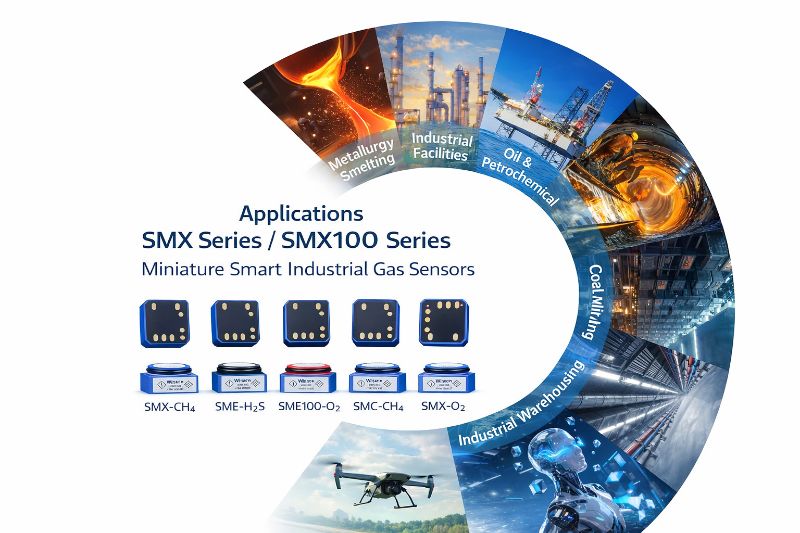
Winsen SMX100 applications including:
- metallurgical smelting
- industrial sites
- petroleum and petrochemical industry
- coal mines
- park warehousing
- urban pipe corridors
- low-altitude aircraft
- humanoid robots
- embodied intelligent agents
These use cases share a common theme: limited space, higher intelligence requirements, and strong demands for reliability.
Where SMX100 Fits Best in Product Design
Portable / wearable gas detectors
If your product requires:
- compact form factor
- digital output integration
- simplified manufacturing and replacement
SMX100’s “flat” structure and UART output are highly aligned.
Online monitoring nodes (distributed IoT sensing)
SMX100’s digital output and flexible installation style support distributed deployments where serviceability and fast replacement reduce downtime.
Smart robotics and low-altitude platforms
Weight, space, and system integration are extremely constrained in:
- drones/low-altitude aircraft
- humanoid robots
- embodied intelligent systems
SMX100 is explicitly positioned for these emerging categories.
Selection Guide: Which Model Should You Use?
Choose based on your hazard scenario:
- SME100-CO → combustion processes, engine rooms, confined spaces, industrial safety monitoring
- SME100-H₂S → petrochemical, wastewater, sewer/pipe corridors, mining, confined space entry monitoring
- SME100-O₂ → oxygen deficiency/enrichment monitoring for confined spaces and industrial safety
- SMC100-CH₄ → methane leak detection and %LEL safety monitoring
FAQ
Does SMX100 support sleep mode?
Winsen states the sensors do not have a built-in sleeping mode, but it can be set in program if needed.
What output does SMX100 provide?
The module uses UART output.
Is the module calibrated before shipment?
Winsen states the module will be calibrated before leaving the factory, while recommending aging/calibration after stabilization for best accuracy in the final device environment.
What is the expected lifetime?
The SMX100 page lists an expected lifetime of 5 years (in air).
What is the operating voltage range?
The SMX100 page lists 3.0–5.0 V DC.