Ultrasonic Oxygen Sensor: The Precision Sensing Core for Oxygen Concentrators and Oxygen Chambers
Sound travels through air, but its speed is not fixed in every gas mixture. When the gas composition changes, the propagation speed of sound changes slightly as well.
An ultrasonic oxygen sensor captures this physical change. It emits ultrasonic waves, measures the time required for the signal to travel from transmitter to receiver, and then calculates oxygen concentration and gas flow based on the time-of-flight difference.
For oxygen concentrators, oxygen chambers, and related oxygen supply equipment, this technology provides real-time, stable, and multi-dimensional sensing capability.
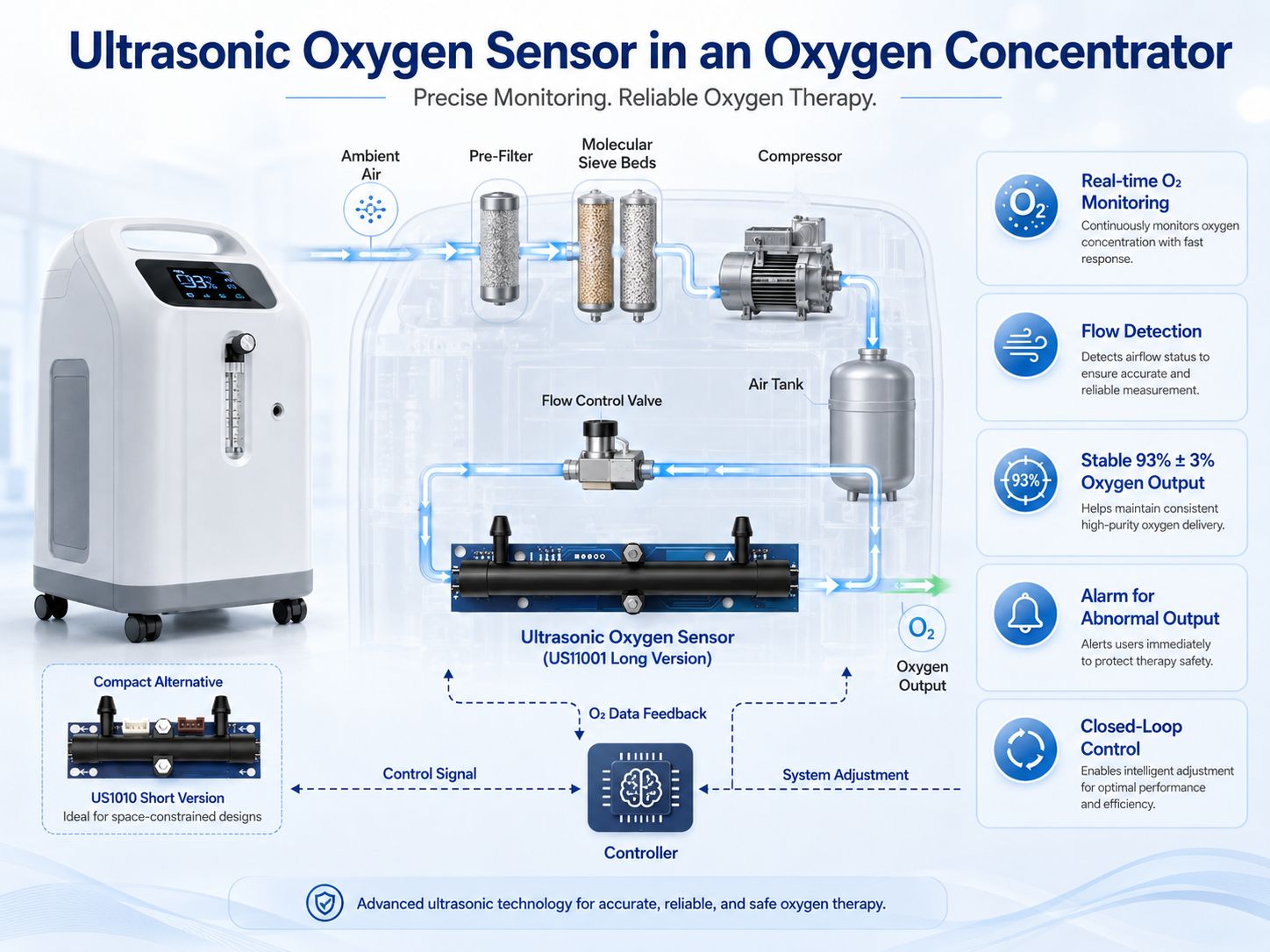
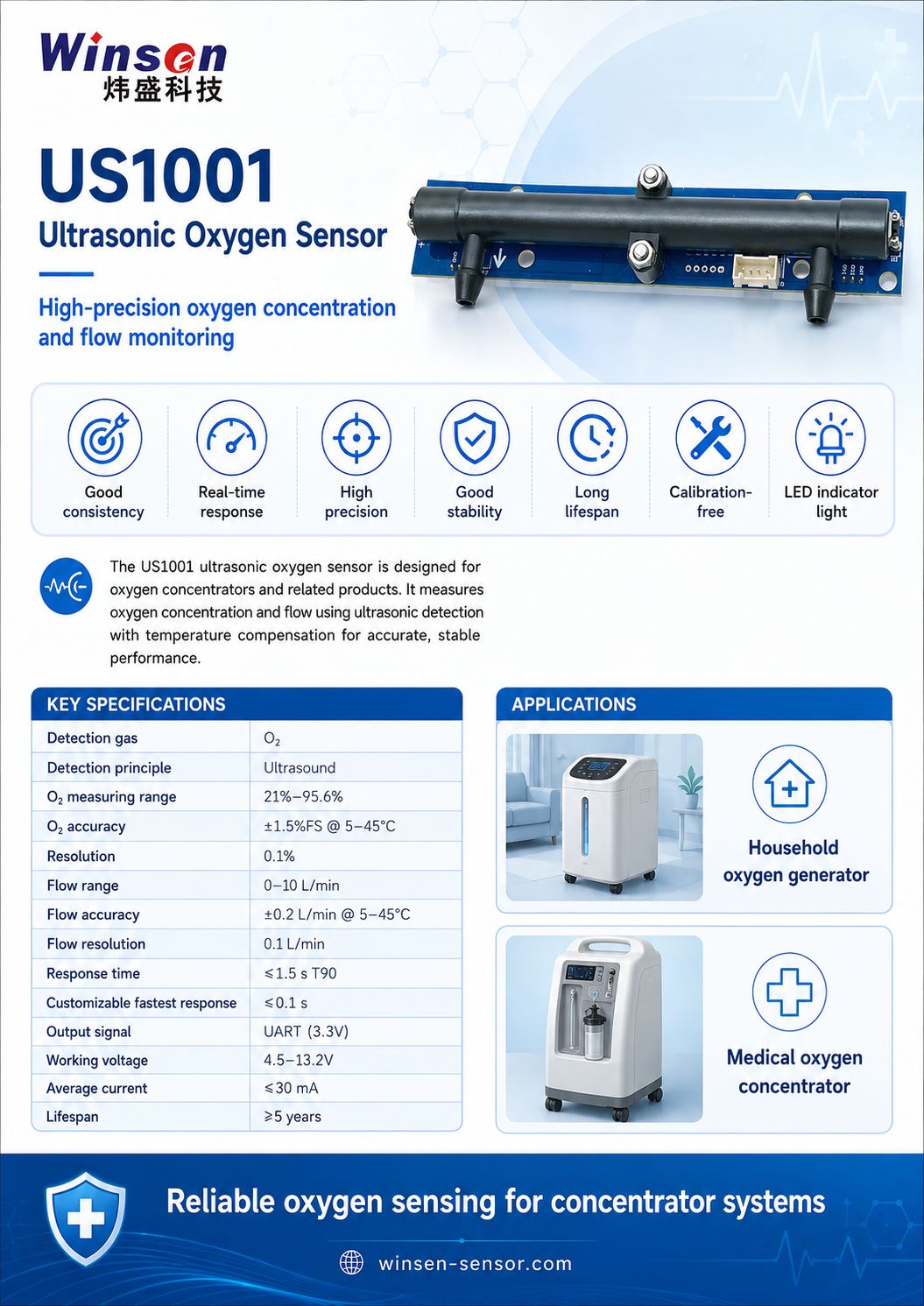
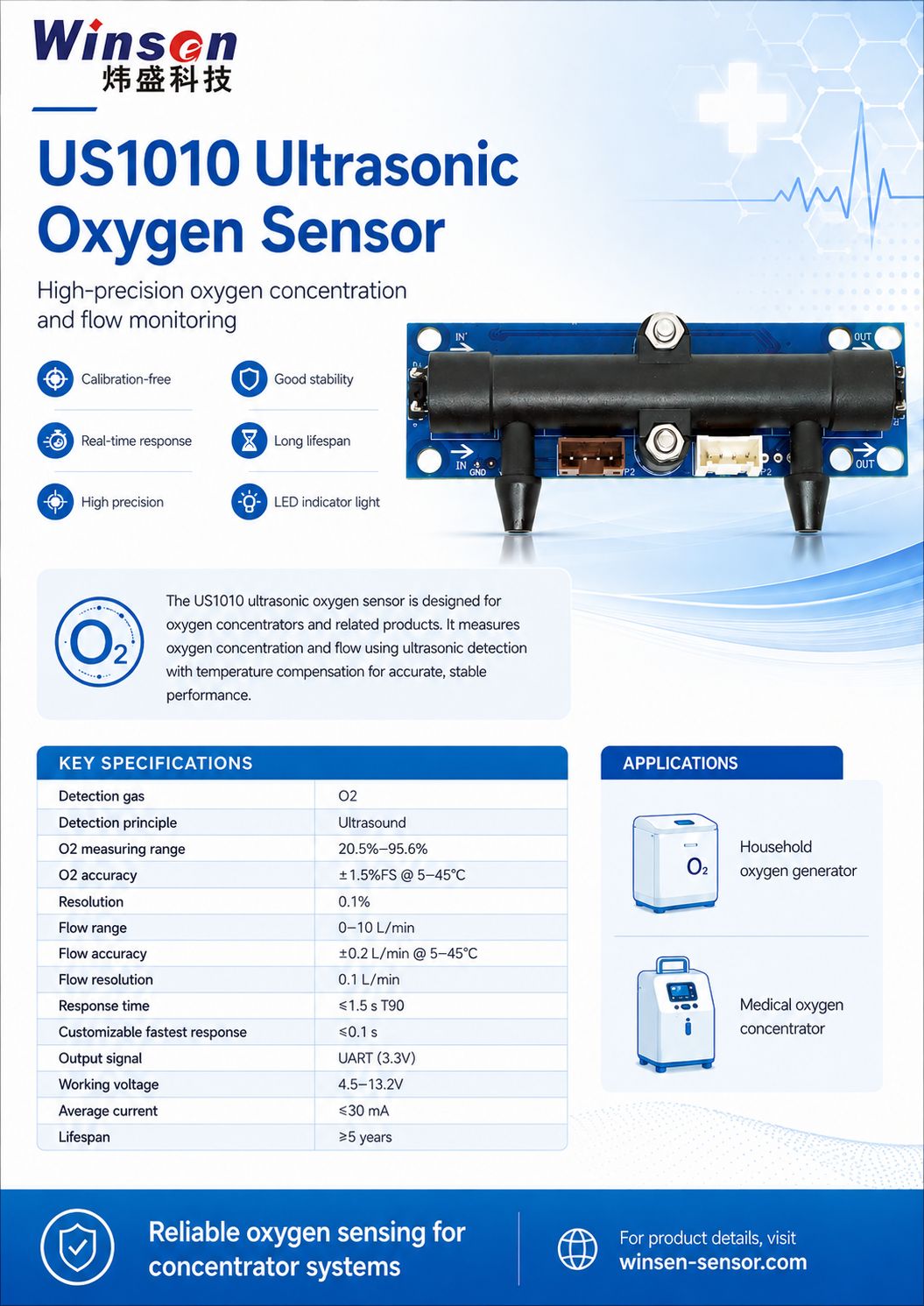
At the center of this solution, our US1001 / US1010 ultrasonic oxygen sensors are designed to measure both oxygen concentration and oxygen flow, helping equipment manufacturers build safer, smarter, and more reliable oxygen systems.
Why Oxygen Monitoring Matters in Oxygen Concentrators
In medical and healthcare oxygen equipment, oxygen is not just a gas. It is part of the treatment process and directly affects user safety.
An oxygen concentrator must maintain stable output oxygen concentration and flow. If oxygen concentration drops, it may indicate:
- molecular sieve aging
- leakage in the air path
- abnormal compressor performance
- filter blockage
- unstable adsorption/desorption cycle
- system control failure
If flow becomes abnormal, it may indicate:
- blocked tubing
- leakage
- unstable user-side demand
- internal flow path problems
Therefore, oxygen equipment needs a sensing component that can monitor both oxygen purity and flow status in real time.
This is exactly where ultrasonic oxygen sensing becomes valuable.
How Ultrasonic Oxygen Sensors Work
An ultrasonic oxygen sensor uses ultrasonic time-of-flight measurement to calculate oxygen concentration and gas flow.
Inside the gas channel, ultrasonic transducers are installed at both ends. They alternately transmit and receive ultrasonic signals. By comparing the propagation time in different directions, the sensor can calculate gas concentration and flow.
1. Oxygen Concentration Measurement
Different gases have different molecular weights and physical properties. As a result, sound travels through different gas mixtures at different speeds.
The sensor measures the transit time of ultrasonic waves in the gas channel. Because the channel length is known, the system can calculate the actual sound velocity in the gas mixture. Based on this sound velocity and built-in algorithms, the sensor outputs the oxygen concentration value.
In simple terms:
Gas composition changes → sound velocity changes → transit time changes → oxygen concentration is calculated.
This method does not consume oxygen or rely on chemical reaction, making it suitable for long-term oxygen concentration monitoring.
2. Oxygen Flow Measurement
For flow measurement, the ultrasonic sensor compares two directions of sound propagation:
- Downstream direction: sound travels with the airflow, so the transit time becomes shorter.
- Upstream direction: sound travels against the airflow, so the transit time becomes longer.
The time difference between these two directions is proportional to gas flow velocity. Through precise calculation, the sensor outputs oxygen flow data.
In simple terms:
Larger airflow → greater time difference → higher calculated flow rate.
This allows one sensor module to output both:
- oxygen concentration
- oxygen flow
This dual-parameter capability is especially useful for oxygen concentrators and oxygen chamber systems.
US1001 & US1010 Ultrasonic Oxygen Sensors
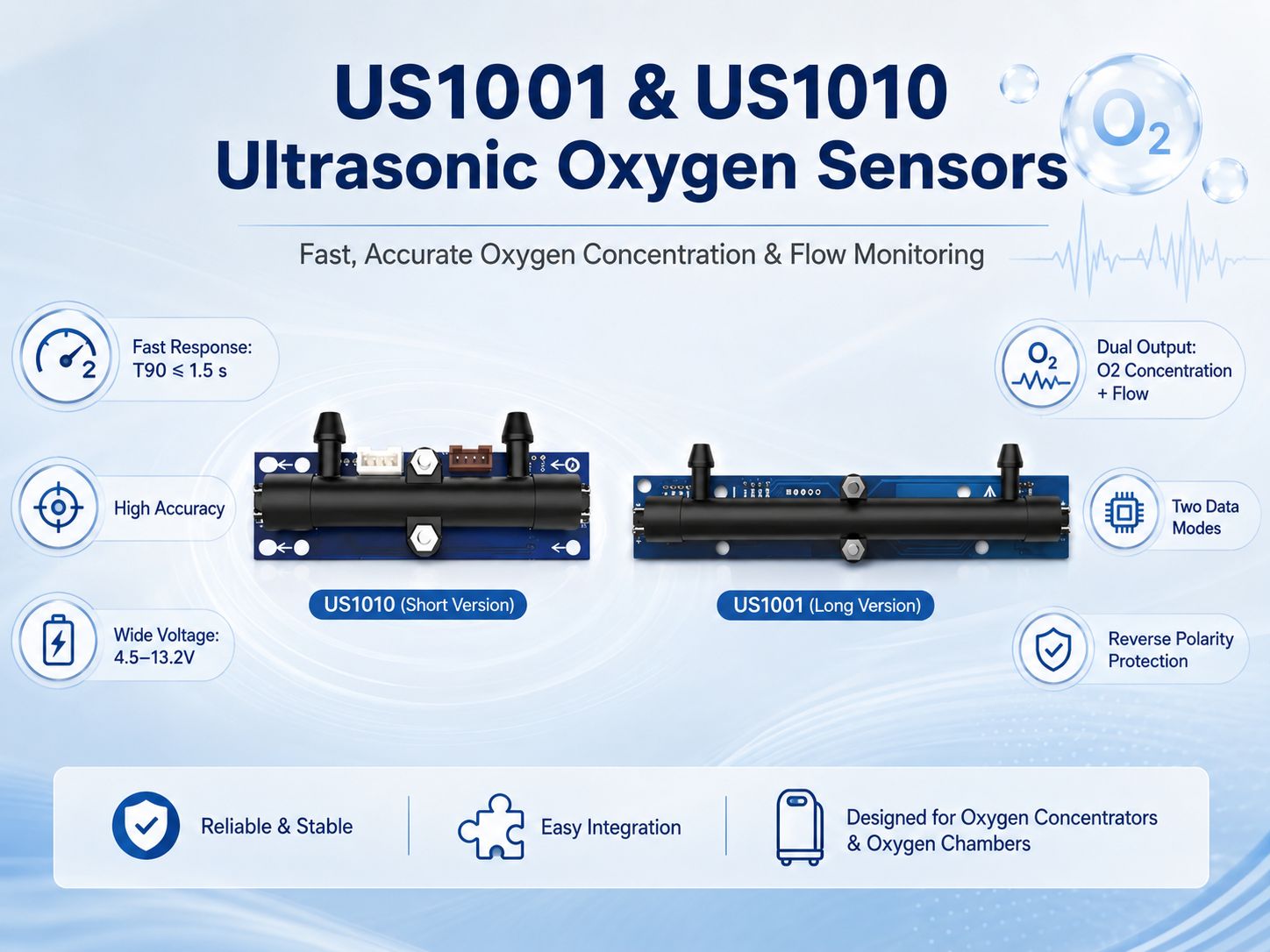
Our US1001 / US1010 ultrasonic oxygen sensors are high-performance, cost-effective oxygen concentration detection modules with flexible customization options.
They are mainly used in:
- oxygen concentrators
- oxygen chambers
- oxygen therapy equipment
- oxygen-enriched environment control systems
- related products requiring oxygen concentration and flow detection
The series includes:
- US1001 ultrasonic oxygen sensor — long version
- US1010 ultrasonic oxygen sensor — short version
This gives equipment manufacturers more flexibility when designing different internal structures and air paths.
Key Advantages of US1001 / US1010
1. Fast Response for Real-Time Control
US1001 / US1010 can output oxygen concentration and flow data at the same time.
The standard response time supports T90 ≤ 1.5s, meeting the response requirements of mainstream oxygen concentrator products. According to customer application needs, factory configuration parameters can be customized, with response speed configurable to as fast as ≤0.1s.
This fast response helps oxygen equipment achieve:
- rapid concentration feedback
- real-time flow monitoring
- faster alarm triggering
- closed-loop oxygen control
- better user safety
2. High Accuracy for Oxygen Concentration and Flow
Accuracy is the foundation of oxygen equipment reliability.
US1001 / US1010 supports:
| Parameter | Accuracy |
|---|---|
| Oxygen concentration | ±1.5%FS @ 5–45°C |
| Flow measurement | ±0.2 L/min @ 5–45°C |
Stable accuracy helps ensure consistent production calibration and reliable terminal performance.
We can also customize factory parameters according to customer requirements, helping customers adapt the sensor to different oxygen concentrator structures, flow channels, and system algorithms.
3. Wide Voltage Input with Reverse Polarity Protection
Oxygen concentrators and related devices may use different power architectures. To improve compatibility, US1001 / US1010 adopts a wide voltage design.
The sensor supports:
- 4.5–13.2V power supply
- reverse polarity protection circuit
This improves system tolerance and reduces the risk of damage caused by wiring errors during production, testing, or installation.
4. Two Data Transmission Modes
US1001 / US1010 supports two data transmission modes:
- active sending mode
- request-response mode
These modes can be configured through factory parameters according to customer requirements.
This allows the sensor to adapt to different host controller strategies, including:
- continuous real-time monitoring
- MCU polling systems
- low-power logic design
- customized communication protocol management
5. Switchable Inlet and Outlet Direction
In real product development, air path direction can vary depending on internal mechanical layout.
US1001 / US1010 supports inlet and outlet direction switching according to customer needs without changing the material structure. This helps shorten material preparation cycles and improves design flexibility for OEM customers.
Application in Oxygen Concentrators
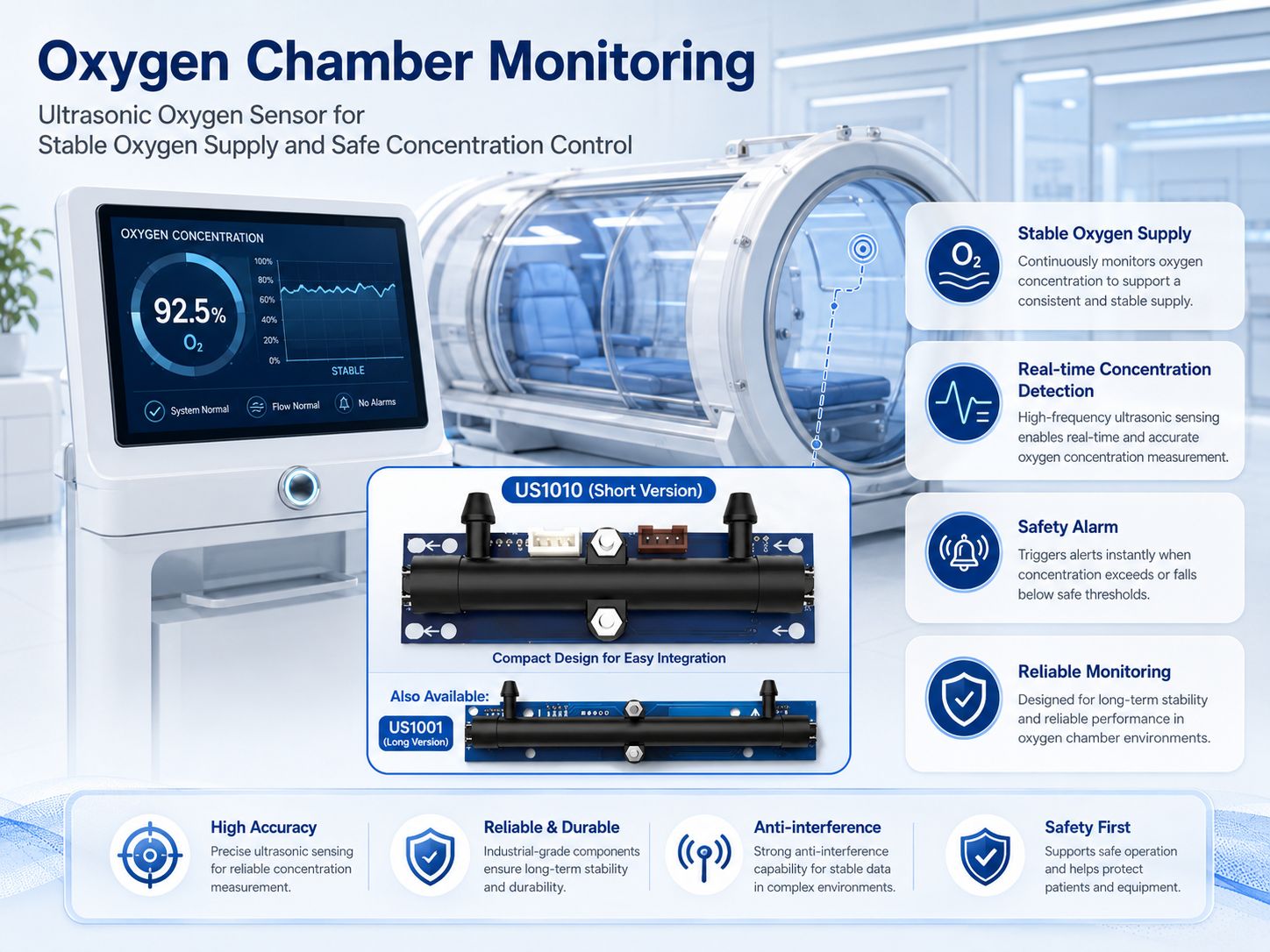
Medical oxygen concentrators require stable oxygen concentration output. In many oxygen concentrator systems, oxygen concentration is expected to remain within the medical oxygen output range, commonly around 93% ± 3%.
The ultrasonic oxygen sensor continuously measures oxygen concentration and flow, helping the host system determine whether oxygen output remains within the required range.
When concentration or flow becomes abnormal, the device can:
- trigger an alarm
- stop operation automatically
- display fault information
- indicate possible pipeline leakage
- indicate molecular sieve failure
- support maintenance diagnosis
In this way, the ultrasonic oxygen sensor becomes a key sensing component for intelligent closed-loop oxygen control.
What the Sensor Helps Detect in Oxygen Concentrators
| Abnormal Condition | Sensor Feedback |
|---|---|
| Molecular sieve aging | Oxygen concentration decreases |
| Pipeline leakage | Flow and concentration become unstable |
| Filter blockage | Flow decreases |
| Compressor abnormality | Flow fluctuation / concentration instability |
| Air path assembly issue | Output data deviates from normal range |
| User-side flow change | Flow value changes in real time |
By combining concentration and flow data, equipment manufacturers can improve fault judgment and make oxygen concentrators smarter and safer.
Application in Oxygen Chambers
An oxygen chamber is an enclosed space that provides an oxygen-enriched environment. It is widely used in medical care, wellness, sports recovery, and oxygen therapy-related scenarios.
In oxygen chamber applications, oxygen concentration monitoring is critical because both excessive and insufficient oxygen concentration may create risk:
- oxygen concentration too low: may affect treatment or user experience
- oxygen concentration too high: may increase safety concerns in enclosed environments
US1001 / US1010 can continuously monitor oxygen concentration and provide real-time data to the control system. When oxygen concentration becomes abnormal, the system can trigger an alarm or adjust oxygen supply to help maintain a stable and safe environment.
Why Ultrasonic Technology Is Suitable for Oxygen Equipment
Compared with some traditional oxygen sensing technologies, ultrasonic sensing has several advantages for oxygen concentrators and oxygen chambers:
No chemical consumption
The ultrasonic method is based on physical measurement of sound propagation. It does not consume electrolyte or rely on chemical reaction during normal measurement.
Dual-parameter output
The sensor can output both oxygen concentration and flow, reducing the need for multiple sensing components in some system designs.
Fast response
Fast measurement feedback supports real-time system control and fault diagnosis.
Good integration flexibility
Wide voltage input, configurable communication modes, and switchable inlet/outlet direction make it easier for OEM customers to adapt the sensor into different product platforms.
US1001 vs US1010: How to Choose
| Model | Structure | Recommended Use |
|---|---|---|
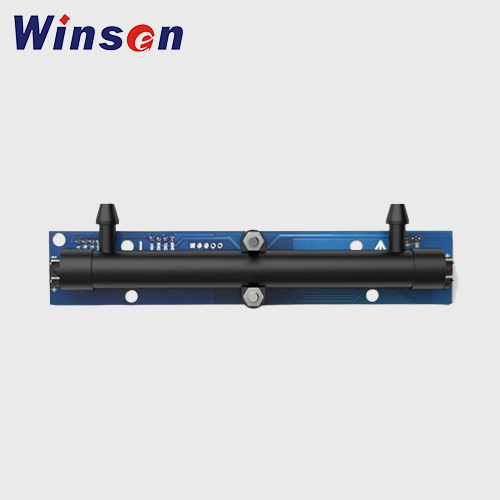
| US1001 | Long version | Suitable for equipment with more internal installation space or specific airflow structure requirements |
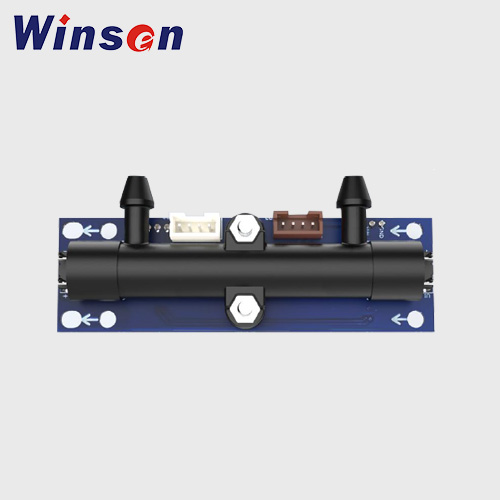
| US1010 | Short version | Suitable for compact oxygen concentrators and space-limited designs |
Both models support oxygen concentration and flow detection. The final selection should be based on:
- installation space
- airflow path design
- required response speed
- communication mode
- power supply design
- production calibration requirements
Integration Suggestions for OEM Customers
To achieve stable performance in terminal equipment, we recommend paying attention to the following points during system design.
1. Keep the air path stable
The gas channel should avoid strong turbulence, leakage, or condensation. A stable air path helps improve measurement consistency.
2. Confirm installation direction early
Because inlet and outlet direction can be configured, confirm the final air path direction during the mechanical design stage to reduce later changes.
3. Match response speed with control logic
For fast oxygen feedback, choose suitable response configuration based on system control requirements. Faster output is useful for alarm and closed-loop control, while standard response may be enough for stable display applications.
4. Use concentration and flow together
Do not rely only on oxygen concentration. Flow data can provide additional insight into tubing blockage, leakage, compressor behavior, and user-side changes.
5. Customize factory parameters when needed
Different oxygen concentrators may have different flow path structures and algorithms. Factory parameter customization can help improve system matching and reduce customer-side debugging workload.
Typical Application Scenarios
- household oxygen concentrators
- medical oxygen concentrators
- portable oxygen concentrator systems
- oxygen chambers
- oxygen-enriched wellness equipment
- oxygen therapy support devices
- oxygen concentration monitoring terminals
- flow and concentration integrated monitoring systems
FAQ
What does an ultrasonic oxygen sensor measure?
It measures oxygen concentration and gas flow by detecting ultrasonic time-of-flight changes in the gas channel.
Can US1001 / US1010 output both concentration and flow?
Yes. The sensor can output oxygen concentration and flow data at the same time.
What is the response time?
The standard response time is T90 ≤ 1.5s. According to customer requirements, factory configuration can support response speed as fast as ≤0.1s.
What is the concentration accuracy?
The oxygen concentration accuracy is ±1.5%FS @ 5–45°C.
What is the flow accuracy?
The flow measurement accuracy is ±0.2 L/min @ 5–45°C.
What power supply does it support?
US1001 / US1010 supports a 4.5–13.2V wide voltage input and includes reverse polarity protection.
Can the communication mode be customized?
Yes. The sensor supports both active sending mode and request-response mode, configurable through factory parameters.
Can the gas inlet and outlet direction be changed?
Yes. The inlet and outlet direction can be switched according to customer requirements without changing the material structure.
Conclusion: A Precise Sensing Core for Oxygen Equipment
In medical and oxygen-related applications, oxygen is not an ordinary gas. It is connected with safety, comfort, treatment effect, and user trust.
The ultrasonic oxygen sensor quietly works inside oxygen equipment, using a pure physical sensing principle to provide real-time oxygen concentration and flow data.
With fast response, high accuracy, wide voltage input, reverse polarity protection, flexible communication modes, switchable inlet/outlet direction, and customizable factory parameters, our US1001 / US1010 ultrasonic oxygen sensors provide a reliable sensing core for oxygen concentrators, oxygen chambers, and related oxygen supply systems.
For equipment manufacturers building the next generation of oxygen products, we are ready to provide sensor selection, parameter customization, and application support.