WINSEN VOC & ODOR-RELATED SENSING

VOC & Odor Monitoring Sensor Solutions for OEMs

Develop intelligent indoor air quality equipment with Winsen MEMS and semiconductor VOC sensor modules. Monitor gaseous air quality changes, support odor-related detection and integrate environmental data into air purifiers, air conditioners, ventilation systems and smart monitoring devices.

VOC Monitoring Odor-Related Sensing VOC Index Air Quality Grades MEMS Technology OEM Integration
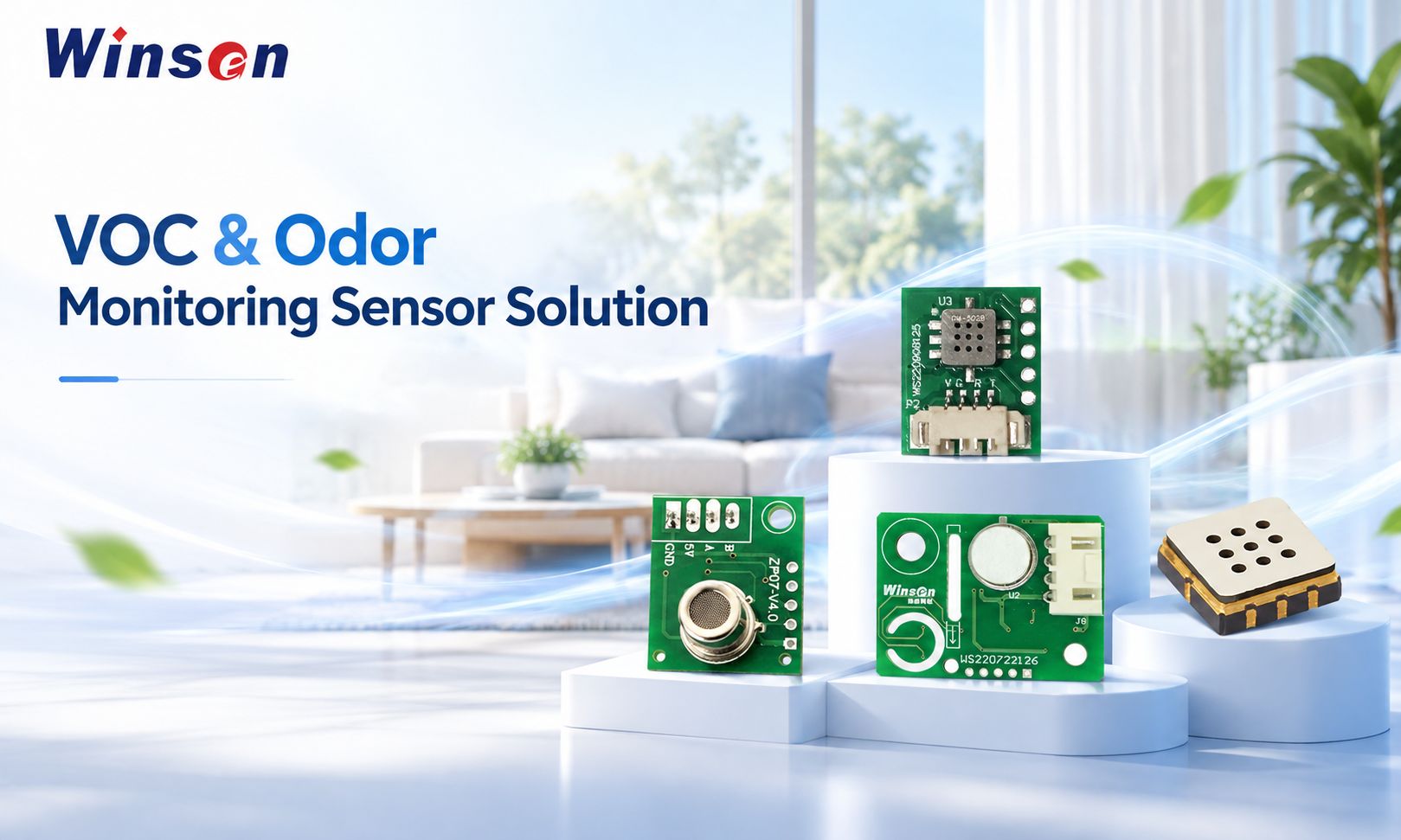
Winsen VOC and odor-related air quality sensor modules in a modern indoor environment
VOC-Related Monitoring

Detect changes in selected gaseous pollutants in indoor environments.

Different Output Formats

Choose concentration-style outputs, VOC indices or air quality grades.

Smart Appliance Integration

Provide sensor inputs to compatible purification and ventilation controls.

Advanced Gas Sensing

Explore MEMS gas arrays for customized odor classification development.

INDOOR GASEOUS AIR QUALITY

Why VOC and Odor-Related Monitoring Matters Indoors

Indoor air contains a changing mixture of gaseous substances. Furniture, surface finishes, household products, cooking and daily activities can influence the concentration of volatile organic compounds and odor-related gases. Environmental sensing helps smart devices track selected changes.

01

Furniture & Interior Materials

Certain furniture finishes, adhesives, paints and other manufactured materials may release organic volatile compounds indoors.

02

Household Cleaning Products

Selected cleaners, solvents and air fresheners can introduce volatile compounds during use and after application.

03

Cooking & Kitchen Activities

Food preparation and cooking may generate different gaseous emissions and odors depending on ingredients and conditions.

04

Daily Indoor Activities

Human activity, fragrance products and other everyday sources can change the indoor gas mixture.

05

Temperature & Humidity

Environmental conditions influence emissions from some materials and the responses of gas sensing elements.

06

Ventilation & Air Treatment

Outdoor-air exchange, filtration and other air-treatment processes may affect the composition of indoor air.

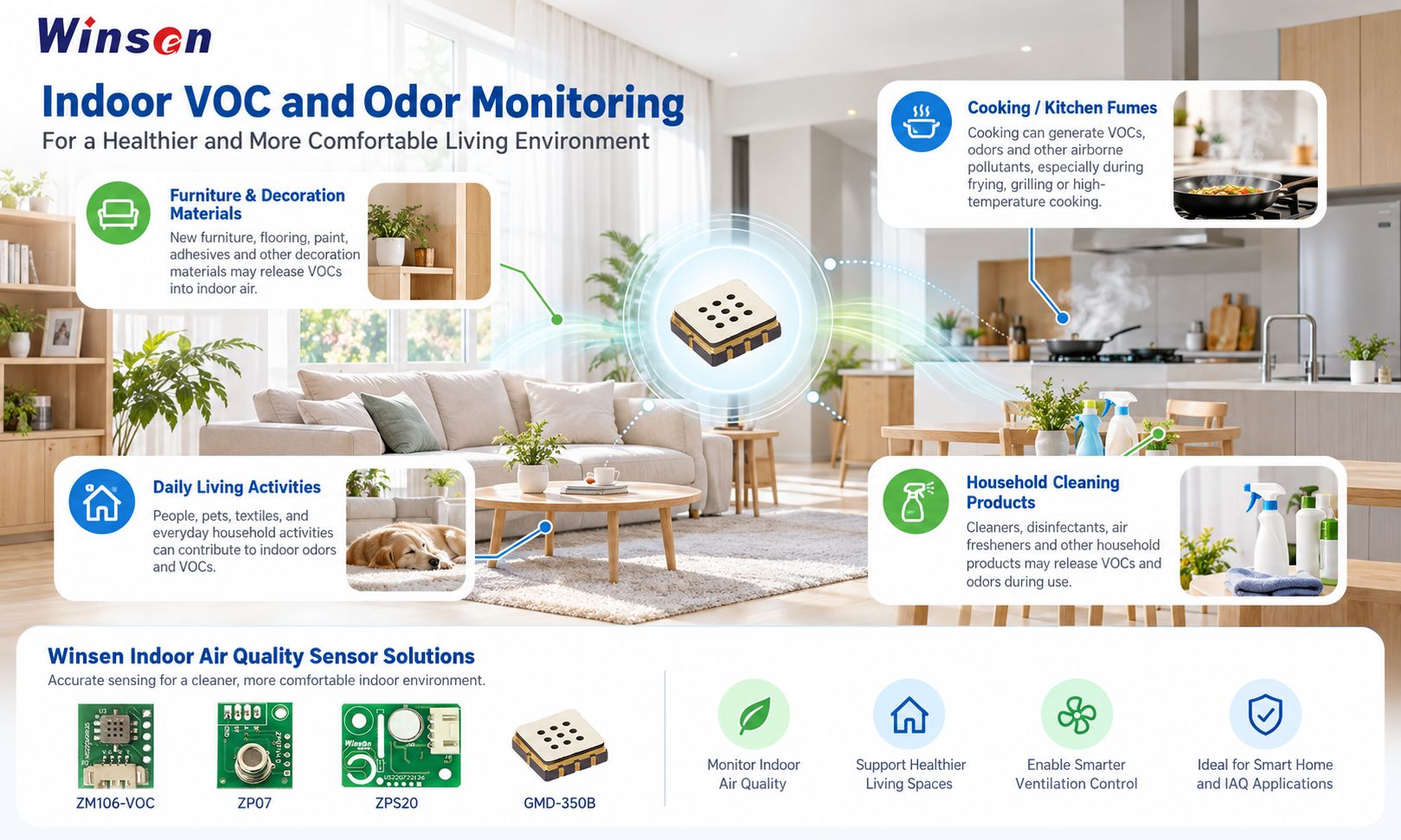
Indoor sources related to VOC and odor monitoring including furniture cleaning products cooking and daily activities
Indoor gas conditions can vary according to materials, activities and ventilation. Not every odor corresponds to a VOC, and not every VOC has a noticeable odor.
UNDERSTANDING GAS MEASUREMENTS

VOC vs. TVOC vs. Odor: What's the Difference?

These terms describe different aspects of indoor air. Understanding the distinction is important when selecting the correct sensing technology and defining what an OEM monitoring device reports.

01 / CHEMICAL CATEGORY

VOC

Volatile organic compounds are a broad class of organic chemicals that can enter indoor air from many sources. Individual VOCs differ in chemical behavior and health-related properties.

02 / COMPOSITE MEASUREMENT

TVOC

Total volatile organic compounds is a method-dependent aggregate measure or estimate. Different sensing techniques, calibration methods and reporting conventions may produce different values.

03 / SENSORY PERCEPTION

Odor

Odor refers to the human perception of smells. Some odor-related gases are VOCs, while others are not. A broad gas sensor cannot automatically identify every odor source.

Choosing the right measurement: A general VOC sensor is useful for monitoring selected gaseous changes. Applications requiring a specific compound, such as formaldehyde, may need a dedicated gas sensing technology.
VOC SENSING TECHNOLOGY

How Semiconductor and MEMS VOC Sensors Work

Winsen's indoor VOC modules use semiconductor gas sensing technologies. Changes in the gas environment affect the sensitive element's electrical response, which is processed by the module to produce model-specific output data.

Sensing Changes in Gaseous Air Quality

Metal-oxide semiconductor gas sensors respond to a range of compounds. MEMS implementations use miniature structures and integrated sensing elements suited to compact electronic products.

  • Gas response: sensitivity depends on the chemical species and sensor material.
  • Signal processing: the module transforms the sensing response into a defined output.
  • Temperature and humidity: environmental conditions can affect sensor behavior.
  • Preheating: modules may require an operating period before stable readings.
  • Cross-sensitivity: responses to multiple gases must be considered in the target application.
WINSEN SENSOR ARCHITECTURES

Select the Output That Fits Your Device

Different sensing modules process gas responses in different ways.

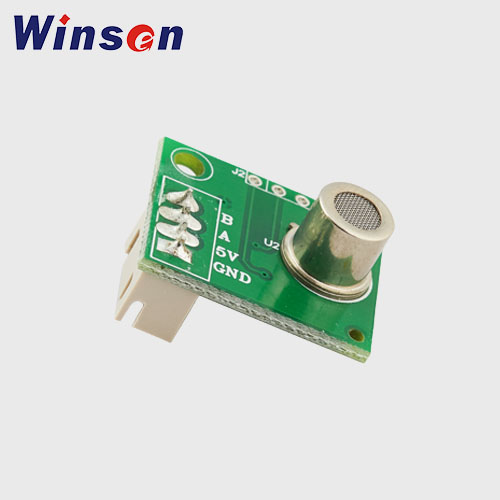
  • ZM106-VOC: digital VOC measurement
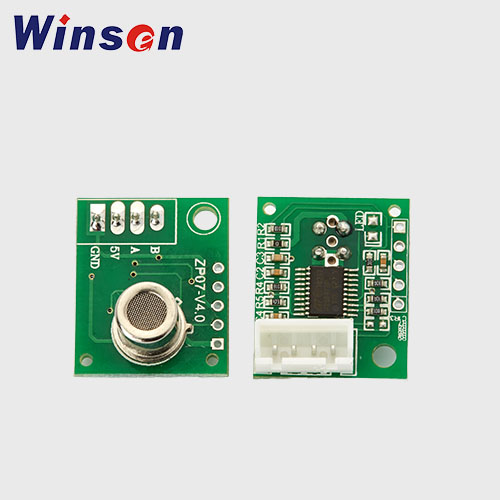
  • ZP07: graded air quality signal
  • ZPS20: VOC measurement and VOC Index
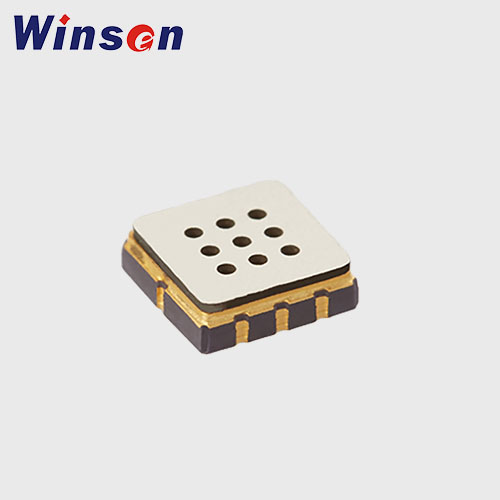
  • GMD-350B: VOC with temperature/humidity
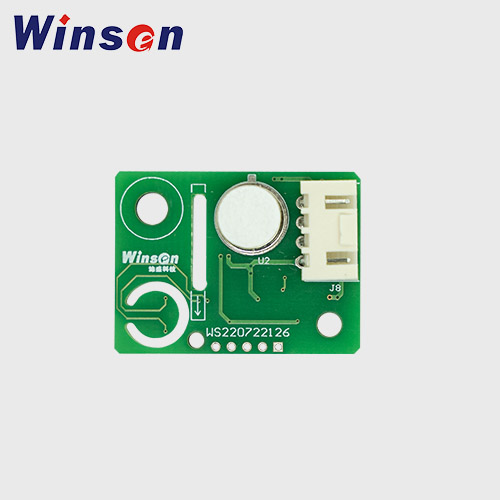
  • ZM101-A: multi-channel gas feature sensing

These outputs serve different OEM product functions and should not be treated as interchangeable.

VOC SENSOR OUTPUTS

VOC Sensor Outputs: Concentration, Index and Air Quality Grades

A key decision in VOC sensor selection is how the module reports its measurement. Winsen offers several formats for different monitoring and control requirements.

mg/m³

VOC Measurement

Some digital modules report a calibrated VOC-related concentration within a specified measurement range.

ZM106-VOC: 0–10 mg/m³
ZPS20: 0–10 mg/m³
ppm

VOC Measurement

Other models report VOC-related measurements in parts per million based on their own calibration and response.

GMD-350B: 0–5 ppm
0–500

VOC Index

An index is a processed air quality signal. It is not directly interchangeable with an absolute VOC concentration measurement.

ZPS20: VOC Index 0–500
0–3

Pollution Grades

Graded signals provide categorized gaseous air quality information for compatible device indicators and control systems.

ZP07: 0–3 Grades
Measurement units: ppm and mg/m³ are not interchangeable without knowing the chemical compound and relevant conditions. Similarly, indices and pollution grades cannot be directly converted into a universal VOC concentration.
SMART AIR QUALITY CONTROL

How VOC Sensors Support Smart Air Purification and Ventilation

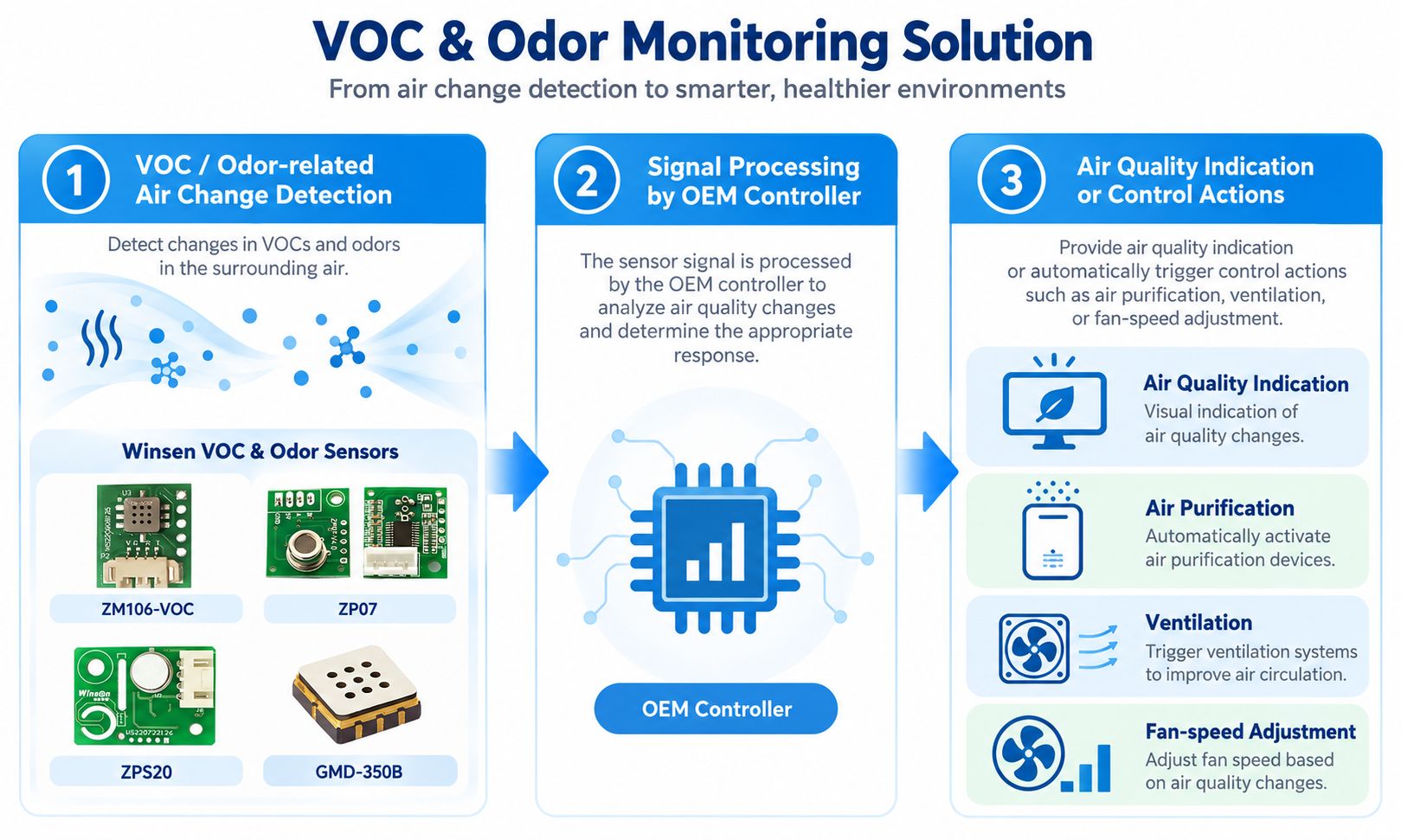
VOC-related measurements can provide an input for compatible smart appliances and ventilation equipment. The finished product's controller determines how sensor data is displayed or used in automatic operation.

STEP 01 / MEASUREMENT

VOC-Related Sensing

The sensor measures selected gaseous environmental changes using its specified sensing method.

STEP 02 / PROCESSING

OEM Controller

A compatible MCU acquires sensor outputs and applies the manufacturer's processing and operating logic.

STEP 03 / RESPONSE

Equipment Functions

The finished device may provide an air quality display, fan-speed adjustment or optional air-treatment and ventilation response.

VOC sensors send measurement signals to an OEM controller for optional air quality indication purification and ventilation control
Example of a sensor-to-controller workflow. Air purification, ventilation and automatic control require suitable functions in the finished equipment.
Equipment functionality: The sensing module supplies measurement data. Actual removal of gaseous pollutants depends on the air-treatment technology and the finished system design.
FEATURED WINSEN VOC SENSORS

Recommended Winsen VOC & Odor-Related Sensor Modules

Choose semiconductor and MEMS sensing modules according to the required VOC-related output, electrical interface and equipment application.

Product selection: ZM106-VOC and ZPS20 provide VOC-related measurements expressed in mg/m³. ZP07 provides pollution grades rather than an equivalent gas concentration output.
ADDITIONAL VOC SENSOR OPTIONS

More Winsen VOC & Multi-Parameter Air Quality Modules

For different OEM architectures, Winsen also offers compact VOC + temperature/humidity modules and integrated air quality sensing products.

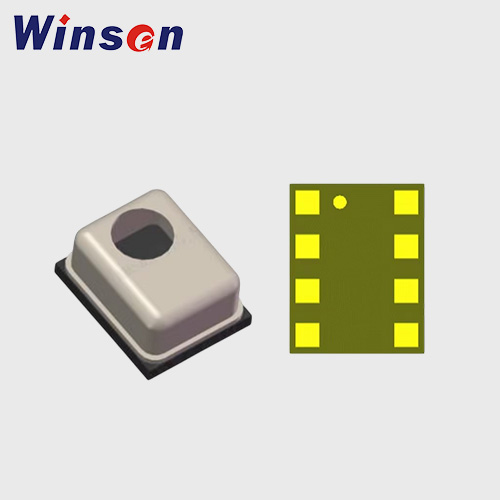
Winsen GMD-350B official MEMS VOC sensing element

GMD-350B

Miniature digital MEMS VOC + temperature and humidity module with selectable UART and I²C interfaces.

Range: 0–5 ppm
Resolution: 0.01 ppm
Voltage: 3–5V
Output: UART / I²C
VIEW PRODUCT →
Winsen ZP16 air quality detection module

ZP16 Air Quality Module

Semiconductor gas module for broad gaseous pollution response in air cleaners and environmental monitoring devices.

Range: 0–10 mg/m³
Resolution: 0.05 mg/m³
Voltage: 5.0 ± 0.2V DC
Output: UART (5V)
VIEW PRODUCT →
ZH10-VHT 4-IN-1 AIR QUALITY MODULE

ZH10-VHT

Compact four-in-one module combining PM2.5, VOC, temperature and humidity measurements for air purifiers and smart appliances.

Parameters: PM2.5 / VOC / T&H
PM2.5: 0–1000 μg/m³
Output: UART / PWM
Size: 38 × 35 × 12 mm
VIEW PRODUCT →
Winsen ZPHS01C VOC version multi-in-one air quality sensor module

ZPHS01C VOC Version

Multi-parameter IAQ module with PM2.5, NDIR CO₂, temperature, humidity and a VOC sensing configuration.

VOC: 4 Grades
CO₂: 400–5000 ppm
PM2.5: 0–1000 μg/m³
Output: UART (TTL)
VIEW PRODUCT →
For ZPHS01C, the HCHO and VOC configurations are alternative versions. The VOC version should be selected when VOC-related monitoring is required.
WINSEN VOC SENSOR PORTFOLIO

Flexible VOC and Odor-Related Sensing for Smart Devices

Winsen offers different semiconductor and MEMS sensor module configurations for OEM manufacturers, from simple air quality indication to integrated environmental monitoring.

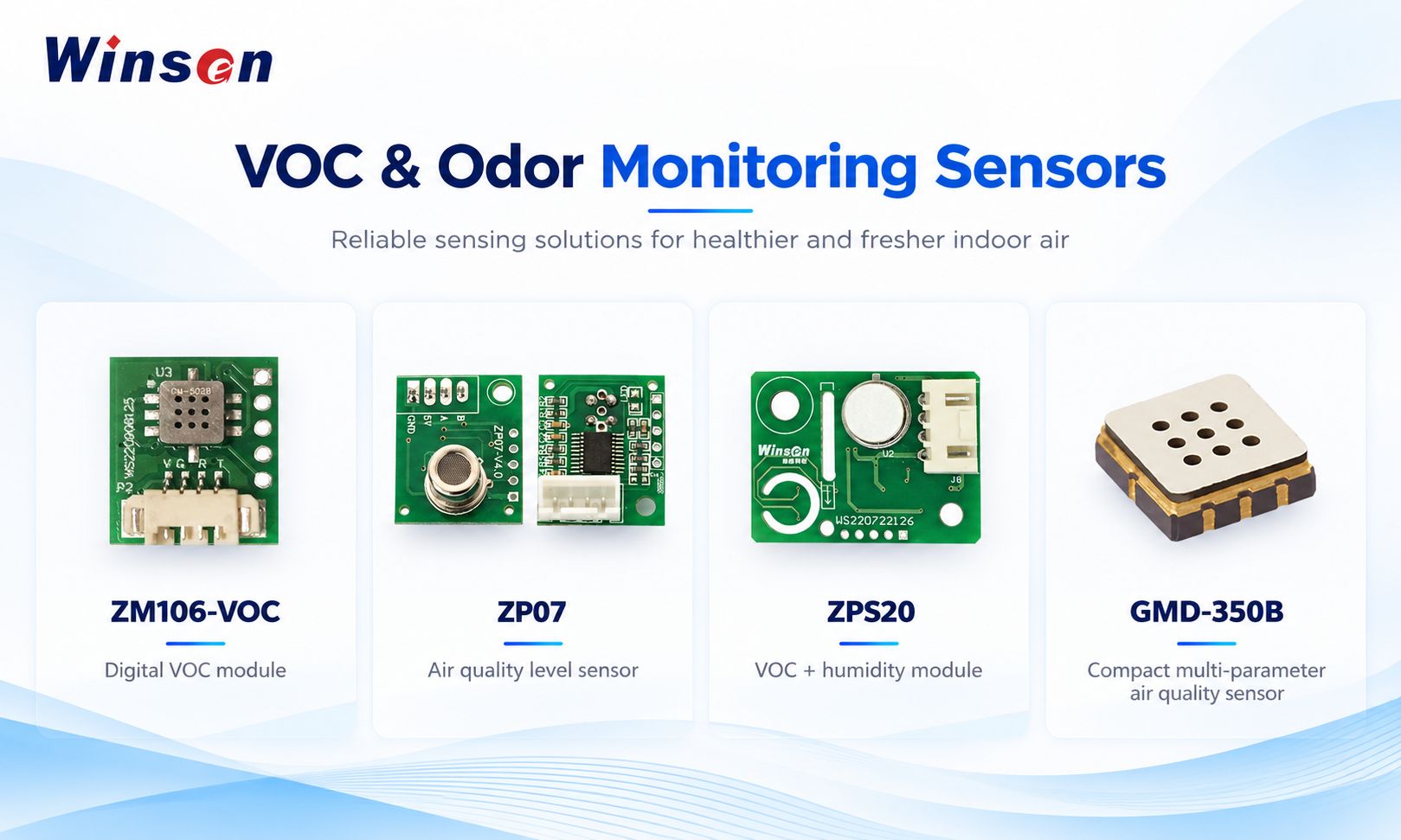
Winsen ZM106-VOC ZP07 ZPS20 and GMD-350B sensor portfolio
Winsen VOC and odor-related sensor products with different module formats, output interfaces and sensing functions.
VOC SENSOR COMPARISON

Winsen VOC & Odor Sensor Comparison Guide

Compare measurement formats, interfaces and integrated sensing functions before choosing a VOC sensor module for your equipment design.

Winsen Model Sensing Functions Output / Range Electrical Interface Recommended OEM Direction
ZM106-VOC MEMS VOC-related gas sensing 0–10 mg/m³ UART (TTL level 3.3V) Digital VOC monitoring for smart air quality devices and appliances.
ZP07 Semiconductor broad gaseous pollution response 0–3 Pollution Grades TTL level Air quality grading, indicator and compatible appliance control applications.
ZPS20 VOC + Temperature + Humidity 0–10 mg/m³; VOC Index 0–500 I²C Smart environmental devices requiring multiple parameters.
GMD-350B VOC + Temperature + Humidity 0–5 ppm UART / I²C Compact digital sensing for embedded and portable devices.
ZP16 Semiconductor gaseous pollution response 0–10 mg/m³ UART (5V) Air cleaners, ventilation and monitoring equipment.
ZH10-VHT PM2.5, VOC, Temperature, Humidity PM2.5: 0–1000 μg/m³; VOC sensing UART / PWM Compact integrated sensing for smart air purifiers and appliances.
ZPHS01C VOC Version PM2.5, CO₂, VOC, Temperature, Humidity VOC: 4 Grades UART (TTL) Multi-parameter IAQ monitors and environmental equipment.
ZM101-A Six-channel MEMS gas sensor array Multi-gas sensing and feature acquisition UART Customized gas-pattern analysis and electronic nose development.
Understanding gas outputs: Values from different technologies cannot be compared solely by their numerical ranges. Sensor selection also depends on target gases, calibration, interference and application conditions.
OEM PRODUCT SELECTION

Which VOC Sensor Is Right for Your Application?

Start with the sensing function required by the finished product. Then select the module based on its output, interface, power and integration requirements.

OEM Requirement Suggested Winsen Sensor Selection Focus
Digital VOC Monitoring ZM106-VOC MEMS semiconductor sensing with a digital UART output.
Air Quality Grade Indication ZP07 0–3 grade pollution signal for compatible smart appliance controls.
VOC + Temperature + Humidity ZPS20 / GMD-350B Compare index, measurement unit, operating voltage and communication interface.
PM2.5 + VOC + T&H ZH10-VHT Compact module combining particle and gaseous environmental measurements.
VOC + Direct CO₂ + PM2.5 ZPHS01C VOC Version Integrated CO₂, particle and VOC-related monitoring.
Multi-Gas Pattern Analysis ZM101-A Six-channel gas array for algorithm-based classification projects.
Dedicated Formaldehyde Concentration ZE08K-CH2O Use a dedicated HCHO sensing module when formaldehyde is the target measurement.
ADVANCED GAS PATTERN SENSING

Electronic Nose Technology for Advanced Odor Recognition

Applications requiring gas-pattern recognition may need more than a single broad-response VOC sensing element. Multi-channel MEMS gas arrays offer additional data for customized analysis and classification systems.

Official Winsen ZM101-A AI-Nose six-channel MEMS gas sensing array
MULTI-CHANNEL MEMS SENSOR ARRAY

ZM101-A AI-Nose

The ZM101-A integrates six MEMS gas sensor channels and supports selectable multi-channel operating modes. It can provide gas response features for customized algorithm development and task-specific classification.

Potential applications include smart appliances, environmental monitoring and specialized gas-pattern recognition systems.

Six MEMS Channels Multi-Gas Sensing DC 3.3V UART AI Algorithm Integration
Odor classification: Reliable identification of specific gas mixtures or odor categories depends on representative training data, algorithm development and application-level validation. A multi-channel array does not automatically identify every odor.
OEM INTEGRATION SUPPORT

Engineering Considerations for VOC & Odor Sensor Integration

Reliable VOC-related sensing depends on the module, sampling environment, enclosure design, electronics and device-level processing. OEMs should evaluate these factors together rather than relying on the sensor specification alone.

Representative Air Sampling

Ensure that the sensing element receives air representative of the area or air stream being monitored.

Warm-Up & Stabilization

Semiconductor VOC modules may require a warm-up period before measurement. Timing varies by model.

Temperature & Humidity

Evaluate environmental influences on sensing, including humidity changes, electronics heat and condensation.

Gas Cross-Sensitivity

VOC-related modules may respond to alcohol, cleaning agents and other interfering gases in the environment.

Baseline & Data Processing

Consider baseline behavior, calibration, measurement units and signal handling in the completed device.

Electrical Interfaces

Match working voltage, UART, I²C or other model-specific outputs to the host controller.

OEM device performance: Air-quality thresholds, automatic fan responses and displayed classifications should be developed around the selected sensor's actual measurement behavior and the finished equipment requirements.
VOC SENSOR APPLICATIONS

VOC & Odor-Related Sensor Applications

Winsen VOC and semiconductor air quality modules are suitable for evaluation in different smart indoor environmental equipment designs.

Smart Air Purifiers

VOC-related sensing for air quality displays and compatible purification control functions.

Smart Air Conditioners

Gaseous air quality monitoring for connected air conditioning and selected smart AC functions.

Fresh Air Ventilation

Gaseous pollution information for ventilation-related monitoring and compatible controllers.

Indoor Air Quality Monitors

VOC concentration-style, index or grade measurements for environmental monitoring devices.

Smart Household Appliances

Compact gas sensing modules for intelligent appliances and integrated air quality functions.

Electronic Nose Systems

Multi-channel gas-response acquisition for customized odor-related classification development.

MORE WINSEN IAQ SOLUTIONS

Explore More Indoor Air Quality Sensor Solutions

Winsen offers environmental sensing technologies for VOC monitoring and broader indoor air quality applications.

For dedicated HCHO concentration measurement, explore Indoor Formaldehyde Monitoring Sensors . For integrated gas, particle and environmental measurements, discover Multi-in-One IAQ Sensor Modules . Our Indoor Air Quality Monitor Solutions also provide sensing options for complete monitoring equipment development.

FREQUENTLY ASKED QUESTIONS

VOC & Odor Monitoring Sensor FAQs

Common questions about VOC detection, sensor outputs, odor-related monitoring and OEM integration.

What is a VOC sensor?

A VOC sensor responds to selected volatile organic compounds in the surrounding air. Depending on the module, the response may be reported as a calibrated concentration-style value, index or pollution grade.

What is the difference between VOC and TVOC?

VOC refers to individual volatile organic compounds as a chemical category. TVOC refers to a method-dependent aggregate measurement or estimate covering multiple compounds.

Can a VOC sensor detect odors?

Some VOC sensors respond to gases associated with certain odors. However, they do not identify every odor source or distinguish every compound.

Are VOC Index and VOC concentration the same?

No. VOC concentration-style measurements and VOC Index outputs represent different reporting formats. The index cannot automatically be interpreted as a universal ppm or mg/m³ concentration.

What is the difference between ZM106-VOC and ZP07?

ZM106-VOC is a MEMS digital module with a 0–10 mg/m³ VOC-related measuring range. ZP07 provides a 0–3 grade gaseous pollution signal rather than the same type of concentration output.

What is the difference between ZPS20 and GMD-350B?

Both provide VOC, temperature and humidity sensing. ZPS20 has I²C output with 0–10 mg/m³ and VOC Index 0–500. GMD-350B offers UART/I²C output with a 0–5 ppm VOC-related range.

Can a general VOC sensor replace a formaldehyde sensor?

Not when specific formaldehyde concentration measurement is required. A dedicated HCHO sensor is appropriate for applications requiring formaldehyde as an individual target gas.

Can VOC sensors control an air purifier automatically?

VOC sensor data can be used by a compatible OEM controller to support automatic equipment operation. The actual control functions and purification performance depend on the finished device.

Can an electronic nose identify specific odors?

A multi-channel electronic nose can support gas-pattern classification for defined applications. Identification requires representative samples, suitable algorithms and validation.

Does Winsen support VOC sensor OEM integration?

Winsen provides VOC and gaseous air quality modules with different output types and integrated sensing functions for equipment manufacturers.

Find the Right VOC & Odor Sensor for Your OEM Project

Tell us your target sensing gases, required measurement format, electrical interface, module dimensions and equipment application. Winsen can help you evaluate suitable semiconductor, MEMS and integrated air quality sensing options for your project.

Leading gas sensing Solution supplier

Our Hot Products

ANY QUESTIONS?

Frequent Asked Questions

Professional manufacturer of gas sensors, global sensing solutions provider with over 30 years of experience. Top quality guarantee, Excellent service, Customized products, Fast delivery!

Reference lead times: 1-15 days after receiving deposit depending on volume. The actual lead time can be confirmed with Winsen Order Processing Dept.

Winsen will recommend the most appropriate way of transportation (express, air, sea, train, etc.) according to customer's requirement on cost and time.

T/T, Paypal, West Union, Credit Card, etc.

MOQ is different depending on product models. Please contact Winsen sales for details.

Customer LOGO and packing design are acceptable.
Customized design and function will be provided without extra charge (including molding fee).

Sample order is acceptable and the fees will be borne by buyer.

Winsen has a complete and strict flow for offline sensors: aging-reject defective-sampling inspection-issue reports-finished ingoing...outgoing.

All Winsen products go through strict inspections and tests to make sure they are 100% qualified before shipping out.

ppm: parts per million
ppb: parts per billion
VOL: volume ratio
LEL: lower explosive limit
NDIR: Non-Dispersive Infra-Red

CONTACT US

LET'S TALK

Request Consultation