LEL and UEL: The Complete Guide to Explosive Limits, %LEL, and Gas Detection
LEL (Lower Explosive Limit) and UEL (Upper Explosive Limit) are the two numbers that define when a combustible gas/air mixture can ignite. If you work with natural gas, LPG, hydrogen, solvents, or industrial hydrocarbons, understanding these limits is essential for hazard assessments, hot-work permits, confined-space entry, ventilation design, and gas detector alarm settings.
This article consolidates the key topics commonly covered by high-ranking safety and gas-detection references—definitions, %LEL interpretation, typical gas tables, factors that shift limits.
What Do LEL and UEL Mean?
LEL (Lower Explosive Limit) = the minimum concentration of a flammable gas/vapor in air that can ignite.
UEL (Upper Explosive Limit) = the maximum concentration of a flammable gas/vapor in air that can ignite.
- Below LEL: mixture is too “lean” (not enough fuel) → won’t ignite
- Between LEL and UEL: mixture is ignitable → flammable/explosive range
- Above UEL: mixture is too “rich” (not enough oxygen) → may not ignite until it dilutes with air
Important: “Above UEL” is not safe in real life. As a gas cloud mixes with air, it can pass back through the flammable range.
LEL/UEL vs LFL/UFL (Are they the same?)
You’ll also see LFL/UFL (Lower/Upper Flammable Limit). In most workplace contexts, LEL ≈ LFL and UEL ≈ UFL, and the terms are often used interchangeably.
Why Gas Detectors Use %LEL (And How to Interpret It)
Most combustible gas detectors display %LEL (percent of the lower explosive limit).
- 100% LEL = gas concentration equals the LEL (the minimum ignition threshold)
- 10% LEL = one-tenth of the LEL (early warning level)
In confined-space guidance, 10% LEL is commonly treated as a hazard threshold for flammable atmospheres (but “below 10%” is not automatically safe—context matters).
Quick conversion: %LEL → volume %
If a detector is calibrated for a specific gas, you can estimate gas concentration in % volume:
Volume% = (%LEL ÷ 100) × LEL(vol%)
Example (Methane): Methane LEL is ~5% vol.
A reading of 25% LEL ≈ 0.25 × 5% = 1.25% vol methane.
Online LEL to volume: https://quickconver.com/lel-to-vol/
This is useful when you need to compare against process specs, ventilation calculations, or sensor ranges.
Typical LEL and UEL Values for Common Gases (Reference Table)
Values vary slightly by test method, temperature, and pressure, but the numbers below are widely used as practical references.
| Gas | LEL (% vol) | UEL (% vol) | Notes |
|---|---|---|---|
| Methane (Natural Gas) | ~5.0 | ~15 | Lighter than air |
| Propane (LPG) | ~2.1 | ~9.5 | Heavier than air |
| n-Butane | ~1.86 | ~8.41 | Heavier than air |
| Hydrogen | ~4.0 | ~75 | Very wide flammable range |
| Carbon Monoxide | ~12 | ~75 | Toxic + flammable |
| Ethylene | ~2.7 | ~36 | Common petrochemical gas |
These ranges are commonly published in engineering references and gas-safety tables.
What Controls Whether a Gas Mix Ignites?
Many top safety guides frame ignition risk using the “fire triangle” (or explosion triangle):
- Fuel (combustible gas/vapor)
- Oxidizer (usually oxygen in air)
- Ignition source (spark, hot surface, static discharge)
All three must exist at the same time for ignition to occur.
Factors That Change LEL and UEL
High-ranking references consistently emphasize that explosive limits are not fixed constants—they depend on conditions.
1) Temperature
As temperature increases, the flammable range usually widens (LEL tends to decrease; UEL tends to increase).
2) Pressure
Higher pressure often widens the flammable range, and can make ignition easier in certain mixtures.
3) Oxygen concentration (air vs oxygen-enriched vs inerted)
- Oxygen-enriched atmospheres generally make ignition easier (broader flammable range).
- Inerting (reducing oxygen using nitrogen/CO₂) is a recognized explosion-prevention approach; it’s discussed in process safety standards and technical literature.
4) Gas mixtures (multi-fuel atmospheres)
If multiple flammable gases are present (e.g., methane + propane), the combined LEL can be estimated using Le Chatelier’s mixing rule (widely referenced in safety engineering).
How LEL and UEL Are Determined
Safety Data Sheets (SDS) typically list explosive limits measured under standard test conditions. Common standards include:
- ASTM E681: determines lower and upper concentration limits of flammability for chemicals that can form flammable mixtures in air at atmospheric pressure (and can include inert dilution gases).
- EN 1839: European methods for determining explosion limits and limiting oxygen concentration (LOC) for gases/vapors and mixtures, up to specified temperature ranges.
- Historical foundational datasets (e.g., U.S. Bureau of Mines work) are widely referenced in flammability literature.
Practical takeaway: Always treat LEL/UEL values as condition-dependent, and rely on your specific SDS + site conditions + applicable standards.
Alarm Setpoints: Where 10% LEL Fits
A common approach is two-stage alarming:
- Low alarm: early warning → start ventilation, alert personnel
- High alarm: urgent → shutdown/interlocks, isolate fuel, stop ignition sources, evacuate response
In some regulatory guidance for certain confined-space/hot-work contexts, atmospheres ≥10% LEL are considered hazardous.
But: “<10% LEL” does not automatically mean safe—because:
- pockets of higher concentration can exist (stratification)
- ventilation changes can move a cloud into the flammable range
- oxygen enrichment changes flammability behavior
- sensor placement and response time matter
LEL/UEL vs Flash Point vs Autoignition Temperature (Common Confusion)
These terms show up together in safety documentation, but they mean different things:
- LEL/UEL: concentration limits in air for ignition range (gas/vapor + air mix)
- Flash point: lowest temperature at which a liquid produces enough vapor to form an ignitable mixture above its surface (for liquids).
- Autoignition temperature (AIT): temperature at which a substance can ignite without an external spark/flame (hot surface ignition concept).
Gas Detection and Standards: What “Good Practice” Looks Like
For fixed and portable detectors used to measure flammable gas/vapor concentrations in air—especially in potentially explosive atmospheres—international standards define performance expectations (construction, testing, and methods). IEC 60079-29-1 is a core reference in this area.
Most guidance also emphasizes that safety depends heavily on selection, installation, calibration, and maintenance—not just the instrument itself.
Sensor technology (how detectors actually measure %LEL)
Common approaches include:
- Catalytic (pellistor): robust, widely used; needs oxygen; can be poisoned by certain compounds
- Infrared (NDIR): excellent for many hydrocarbons; typically not for hydrogen
- MOS (semiconductor): compact and cost-effective; may need compensation for humidity/VOCs depending on use case
Practical Site Guidance: Placement Still Beats “Better Specs”
Even the best detector can underperform if installed in the wrong location.
Place detectors based on gas behavior
- Lighter-than-air gases (e.g., methane, hydrogen): mount high
- Heavier-than-air gases (e.g., propane, butane): mount low
- Consider airflow (vents, fans, doors) to avoid dilution zones and dead pockets
OEM / Product Design: Embedding %LEL Sensing Into Your Equipment
If you manufacture gas alarms, HVAC safety monitors, smart kitchen systems, industrial transmitters, or IoT safety gateways, a well-integrated combustible sensor can make your product more competitive—especially when you support multiple gases and deployment environments.
Why many OEMs choose a supplier with breadth
- Multiple sensing principles (catalytic / IR / MOS / TDLAS) to match market needs
- Stable supply + calibration support
- Integration-friendly formats (elements / modules / transmitters)
- Documentation for warm-up, drift, and compensation behavior
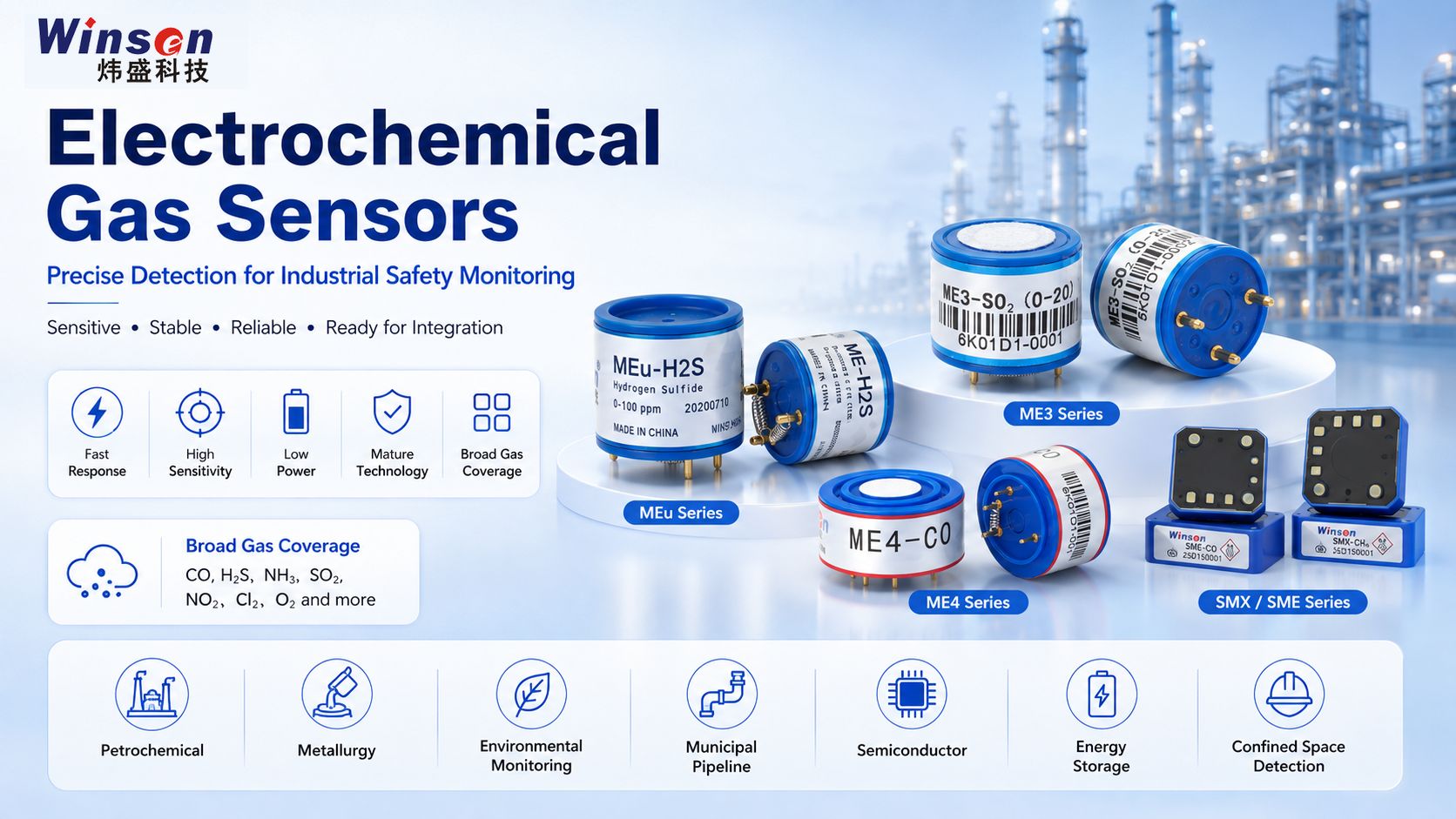
If you share your target gas (CH₄/LPG/H₂), range (%LEL), environment (indoor/outdoor), and required interface (analog/RS485/UART), Winsen can recommend a suitable sensing approach and support OEM/ODM customization, selection, and integration.
Winsen Combustible Sensor Options: https://www.winsen-sensor.com/combusitable-sensor/
FAQs
What is the difference between LEL and UEL?
LEL is the minimum concentration in air that can ignite; UEL is the maximum concentration in air that can ignite. Between them is the flammable range.
Is a gas mixture above UEL safe?
Not necessarily. A “rich” cloud can become explosive as it mixes with air and passes back through the flammable range.
Why do detectors alarm at 10% LEL?
10% LEL is commonly used as an early hazard threshold in certain safety guidance (especially for confined spaces), but it does not guarantee safety—site conditions and codes matter.
Do LEL/UEL values change with temperature?
Yes. Flammable range often widens with higher temperature (LEL down, UEL up in many cases).
What standard defines performance for flammable gas detectors?
IEC 60079-29-1 is a widely referenced standard for detectors measuring flammable gas/vapor concentrations in air (portable, transportable, fixed).