ME4-Cl2 Potentiostatic Electrochemical Chlorine (Cl₂) Sensor: Accurate, Stable Monitoring for Industrial Safety
In chemical plants, pharmaceutical workshops, and wastewater treatment facilities, chlorine gas (Cl₂) is a “double-edged sword”: essential for many processes, but dangerous even at low concentrations. Reliable chlorine monitoring isn’t just about “detecting something”—it’s about getting accurate, stable, trustworthy data you can act on.
The ME4-Cl2 potentiostatic electrochemical chlorine sensor is designed for industrial-grade Cl₂ detection, helping teams identify early leaks, reduce false alarms, and maintain long-term measurement stability.
Why Chlorine Monitoring Is So Demanding in Real Sites
Typical chlorine risk points include:
- Chemical reactors / pipelines / valves / storage tanks (leak and accumulation risk)
- Pharma production ventilation outlets (process safety + compliance needs)
- Wastewater treatment dosing areas & monitoring points (continuous safety monitoring)
- Water treatment rooms, labs, public facilities (localized hazard control)
Because chlorine is highly reactive and irritating, many organizations set alarm strategies aligned with occupational exposure guidance. For example, OSHA lists a 1 ppm ceiling for general industry chlorine exposure, and ACGIH publishes more conservative guidance (values can differ by jurisdiction and are updated over time).
Proven Measurement Principle: Potentiostatic Electrochemical Sensing
How it works (simple and reliable)
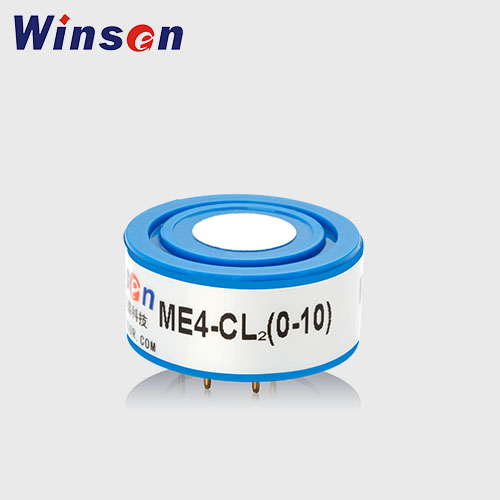
ME4-Cl2 uses a constant-potential (potentiostatic) electrochemical principle:
- Chlorine diffuses into the sensor.
- A specific electrochemical reaction occurs at the working electrode.
- The reaction generates a micro-current.
- That current is directly proportional to chlorine concentration (per Faraday’s law).
- Your instrument converts the current into real-time Cl₂ ppm.
This approach avoids “indirect inference.” The signal is rooted in fundamental electrochemistry, improving objectivity and traceability.
Key Performance Traits Built for Industrial Use
Industrial users typically care about three things: accuracy, stability, durability. ME4-Cl2 is designed around those priorities:
High sensitivity + fast response
Detect early-stage, low-level chlorine leaks quickly to create a larger response window for ventilation and mitigation. (Typical response time is specified as T90 ≤ 60 s.)
Strong anti-interference design
In complex sites, gases like ozone (O₃) or nitrogen dioxide (NO₂) may exist. ME4-Cl2 is designed to reduce cross-interference risk, supporting more trustworthy alarms.
Long-term stability for continuous monitoring
Material and process optimization help maintain stable output over long operating periods—reducing calibration frequency and total maintenance cost.
Wide linear range + low power
Electrochemical sensing is naturally low-power and suits both fixed detectors and portable instruments—especially where continuous operation matters.
Where ME4-Cl2 Fits Best
Chemical production safety
- Continuous monitoring around pipes, flanges, valves, storage
- Early leak detection to prevent escalation
Pharmaceutical manufacturing
- Environmental safety for areas involving chlorine processes
- Helps support EHS compliance monitoring
Environmental monitoring & wastewater treatment
- Boundary emission checks
- Air quality assessment points near chlorine dosing and handling areas
Public facilities & laboratories
- Water treatment rooms, lab exhaust zones, chlorine storage cabinets
(These application categories match Winsen’s published positioning for ME4-Cl2 in chemical, medical/pharma, and environmental protection contexts.)
Technical Specifications (Typical)
Below are key parameters commonly referenced for ME4-Cl2 (always verify the exact revision / version with the latest datasheet and your calibration conditions):
| Parameter | Typical value |
|---|---|
| Target gas | Chlorine (Cl₂) |
| Detection principle | Electrochemical (potentiostatic) |
| Detection range | 0–20 ppm |
| Maximum range | up to 250 ppm |
| Resolution | 0.1 ppm |
| Response time (T90) | ≤ 60 s |
| Sensitivity | (1 ± 0.25) μA/ppm |
| Bias voltage | 0 mV |
| Recommended load resistance | 10 Ω |
| Operating temperature | −20 °C to 50 °C |
| Humidity | 15–90% RH (non-condensing) |
| Typical service life | 2 years |
Note: It’s best to confirm the exact range option you need at ordering time.
Practical Alarm Strategy (Industry-aligned)
Because chlorine exposure limits differ by standard and jurisdiction, many safety systems use a two-stage alarm:
- Low alarm: early warning (enhanced ventilation + inspection)
- High alarm: evacuation / emergency response logic
When setting thresholds, reference your applicable regulations and internal EHS policy. OSHA and ACGIH publish chlorine exposure guidance that is often used as a baseline for risk assessments.
FAQ
1) What does “potentiostatic electrochemical” mean?
It means the sensor maintains a controlled electrode potential so the target gas reaction produces a stable micro-current proportional to concentration—excellent for quantitative ppm monitoring.
2) Is ME4-Cl2 suitable for fixed gas detectors?
Yes. It’s positioned for industrial safety applications and supports continuous monitoring with low power consumption.
3) Can it detect very small chlorine leaks?
It provides 0.1 ppm resolution and is designed for high sensitivity, which helps catch early leak signals.
4) What affects accuracy in the field?
Temperature, humidity (especially condensation), airflow/diffusion conditions, installation position, and calibration quality can all impact real-world results. Winsen also notes humidity outside the recommended range and high-humidity/high-temperature exposure can affect life.
5) How often should I calibrate?
It depends on exposure, duty cycle, and site conditions. Many industrial users calibrate on a schedule (e.g., monthly/quarterly) and also after events like sensor replacement, long storage, or exposure to unusual contaminants.
6) What is the expected service life?
Typical lifespan is listed as 2 years under specified conditions.
7) What detection range should I choose?
For safety leak detection, lower ranges improve sensitivity around alarm points; for process control or higher-concentration scenarios, higher ranges may be preferred. Share your target ppm level, environment, and enclosure/airflow details to select the best fit.
8) Can Winsen support customization or integration help?
Yes—Winsen indicates customization and technical consultation support, especially for volume projects (design, function, branding, packaging).
Ready to Build a Reliable Cl₂ Detection Solution?
If you’re designing or upgrading:
- fixed chlorine gas detectors
- portable safety monitors
- ventilation-linked safety systems
- plant boundary monitoring nodes
…the ME4-Cl2 sensor is a solid foundation for accurate chlorine measurement using a proven potentiostatic electrochemical principle. Share your target range, alarm strategy, environment (temp/RH), and device form factor, and we can recommend a practical configuration (sensor + front-end + calibration approach) for stable long-term operation.