Why Temperature and Humidity Sensors Are Becoming Standard Components Across Smart Devices
Temperature and humidity may appear to be basic environmental parameters, but they directly influence equipment performance, control accuracy, energy efficiency and long-term reliability.
In HVAC systems, the data determines how equipment balances comfort and energy use. In automotive electronics, it supports cabin climate control and defogging strategies. In industrial production, environmental changes may affect process stability, equipment operation and product consistency.
As devices become smarter and more automated, temperature and humidity sensors are evolving from secondary monitoring components into essential sensing elements for closed-loop control and intelligent decision-making.
To support these changing requirements, Winsen provides MEMS temperature and humidity sensors and integrated modules for home appliances, automotive electronics, industrial control, environmental monitoring and medical equipment.
Temperature and Humidity Data Is Influencing More Equipment Functions
Modern equipment does not simply measure environmental conditions for display. It increasingly uses temperature and humidity data to make operating decisions.
A smart device may use this data to:
- adjust heating, cooling or dehumidification output;
- control fresh-air ventilation;
- prevent condensation;
- protect electronic components;
- maintain stable manufacturing conditions;
- improve occupant comfort;
- reduce unnecessary energy consumption;
- detect abnormal environmental changes.
This means measurement quality directly affects the performance of the complete system.
A slow or unstable sensor may cause delayed control. Excessive drift may lead to inaccurate operation after long-term use. Poor product consistency may also increase calibration and quality-control workloads during mass production.
For equipment manufacturers, a suitable temperature and humidity sensor must therefore provide more than basic measurement. It should also offer fast response, stable output, compact size, low power consumption and reliable batch consistency.
Why MEMS Technology Is Changing Environmental Sensing
MEMS technology allows the sensing element and signal-processing functions to be integrated into a highly compact package.
A MEMS capacitive humidity element detects changes in environmental relative humidity, while an integrated temperature element provides simultaneous temperature measurement. The sensor then processes the signals and delivers calibrated digital data to the host controller.
Compared with larger or less-integrated sensing solutions, MEMS temperature and humidity sensors can provide several important advantages:
- compact dimensions for space-limited products;
- low power consumption;
- fast environmental response;
- digital output for easier system integration;
- high production consistency;
- suitability for automated SMT assembly;
- stable performance in long-term monitoring applications.
These characteristics make MEMS sensors particularly suitable for modern electronic products that need accurate sensing without increasing system size or development complexity.
Winsen MEMS Temperature and Humidity Sensor Solutions
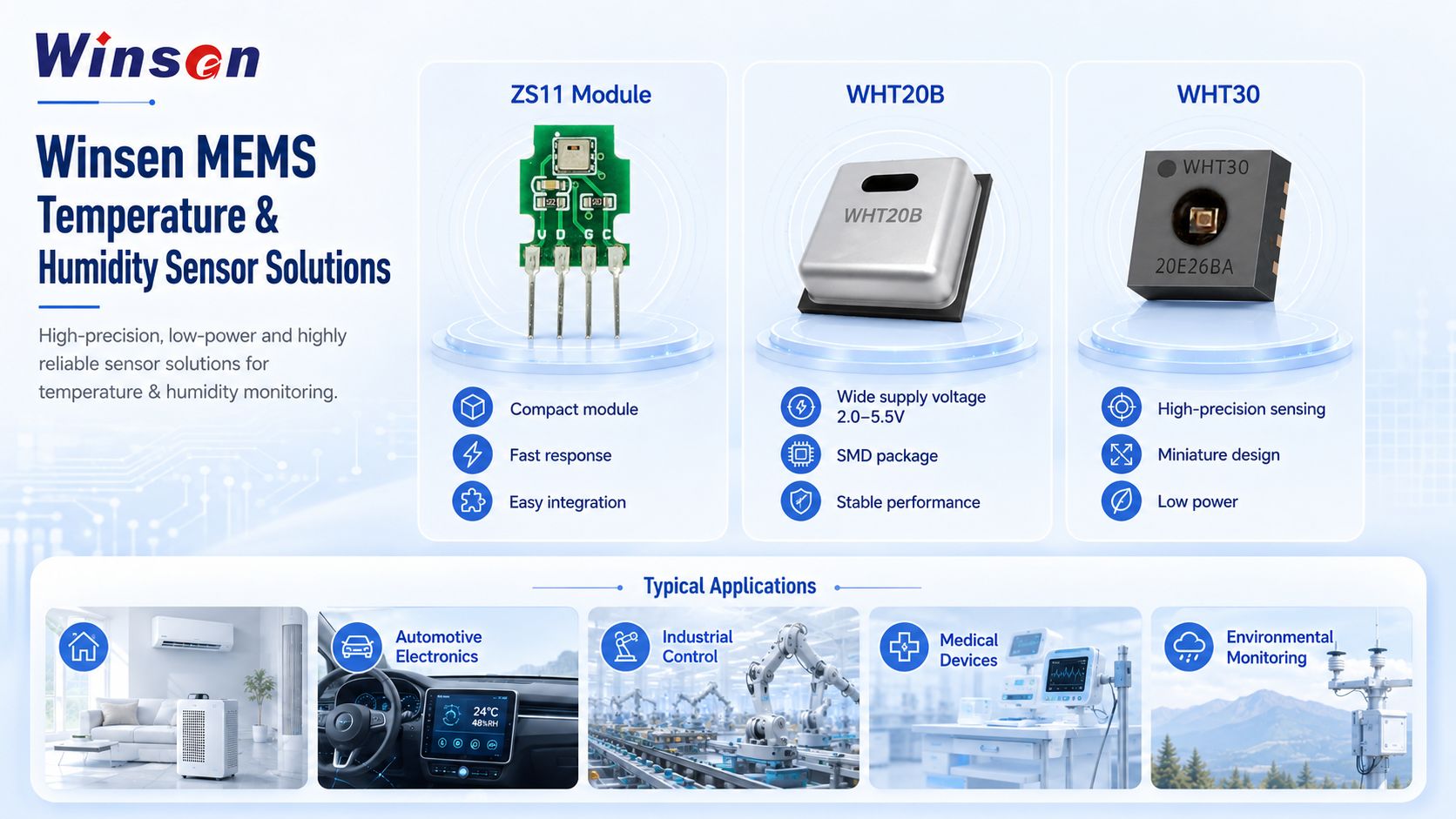
Winsen offers multiple product formats to support different accuracy, size, integration and application requirements.
WHT20: High-Accuracy Environmental Sensing
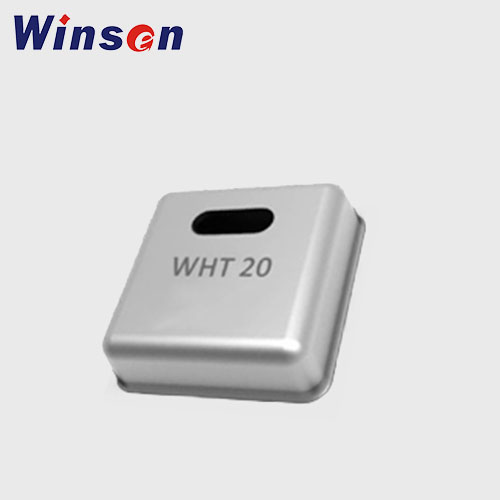
The WHT20 integrates an ASIC, a MEMS capacitive humidity sensing element and a temperature sensor in a compact SMD package. It outputs calibrated temperature and humidity data through a standard I²C interface.
Its compact 3.0 × 3.0 × 1.0 mm structure is suitable for reflow soldering and automated production. The typical accuracy reaches ±2.0% RH for humidity and ±0.3°C for temperature, while the supported supply range is 2.0–5.5 V.
The WHT20 is suitable for applications requiring higher environmental measurement accuracy, including:
- premium HVAC equipment;
- smart thermostats;
- dehumidifiers;
- environmental monitoring terminals;
- medical equipment;
- automotive environmental control;
- data loggers and weather stations.
Because every device is calibrated before delivery, customers can reduce additional calibration work during system development and production.
WHT30: Compact Single-Chip Integration
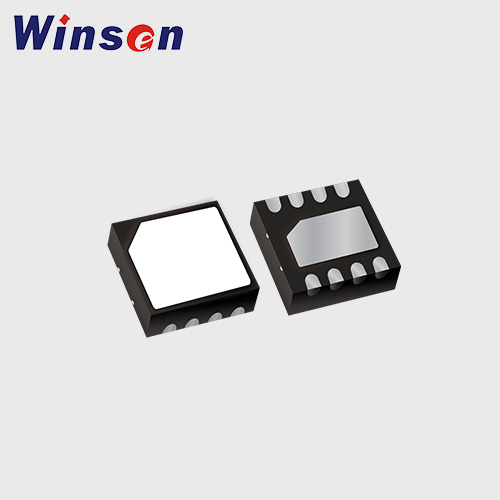
The WHT30 is a new-generation single-chip integrated temperature and humidity sensor developed using Winsen’s MEMS design and weak-signal detection platforms.
Its humidity-sensitive element is integrated on a silicon-based CMOS wafer, helping reduce multi-chip signal transmission interference, decrease chip area and improve packaging reliability. The sensor uses a compact 2.5 × 2.5 × 0.9 mm DFN package and supports I²C communication speeds up to 1 MHz.
Key characteristics include:
- typical accuracy of ±3% RH and ±0.5°C;
- full-range calibration and temperature compensation;
- two selectable I²C addresses;
- integrated 16-bit ADC;
- measurement time as low as 2.5 ms;
- high reliability and long-term stability.
WHT30 is especially valuable for highly integrated consumer electronics, compact controllers, automotive systems and mass-produced smart devices where PCB space and communication efficiency are important.
ZS11: A Ready-to-Integrate Temperature and Humidity Module
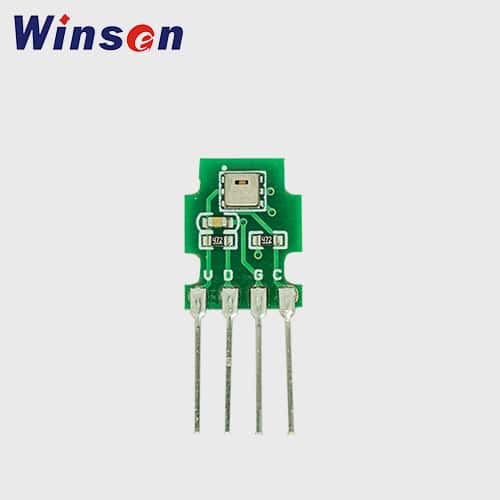
The ZS11 combines a dedicated ASIC, a silicon-based capacitive humidity sensor and an on-chip temperature sensor. It provides calibrated temperature and humidity data through a standard I²C digital interface.
Its key benefits include:
- factory calibration;
- quick response;
- strong anti-interference capability;
- wide supply-voltage adaptability;
- stable performance under high-temperature and high-humidity conditions;
- easier integration into complete equipment.
ZS11 is suitable for customers who prefer a more application-ready sensing solution rather than developing the sensing and signal-processing circuit entirely from the component level.
Key Application Areas
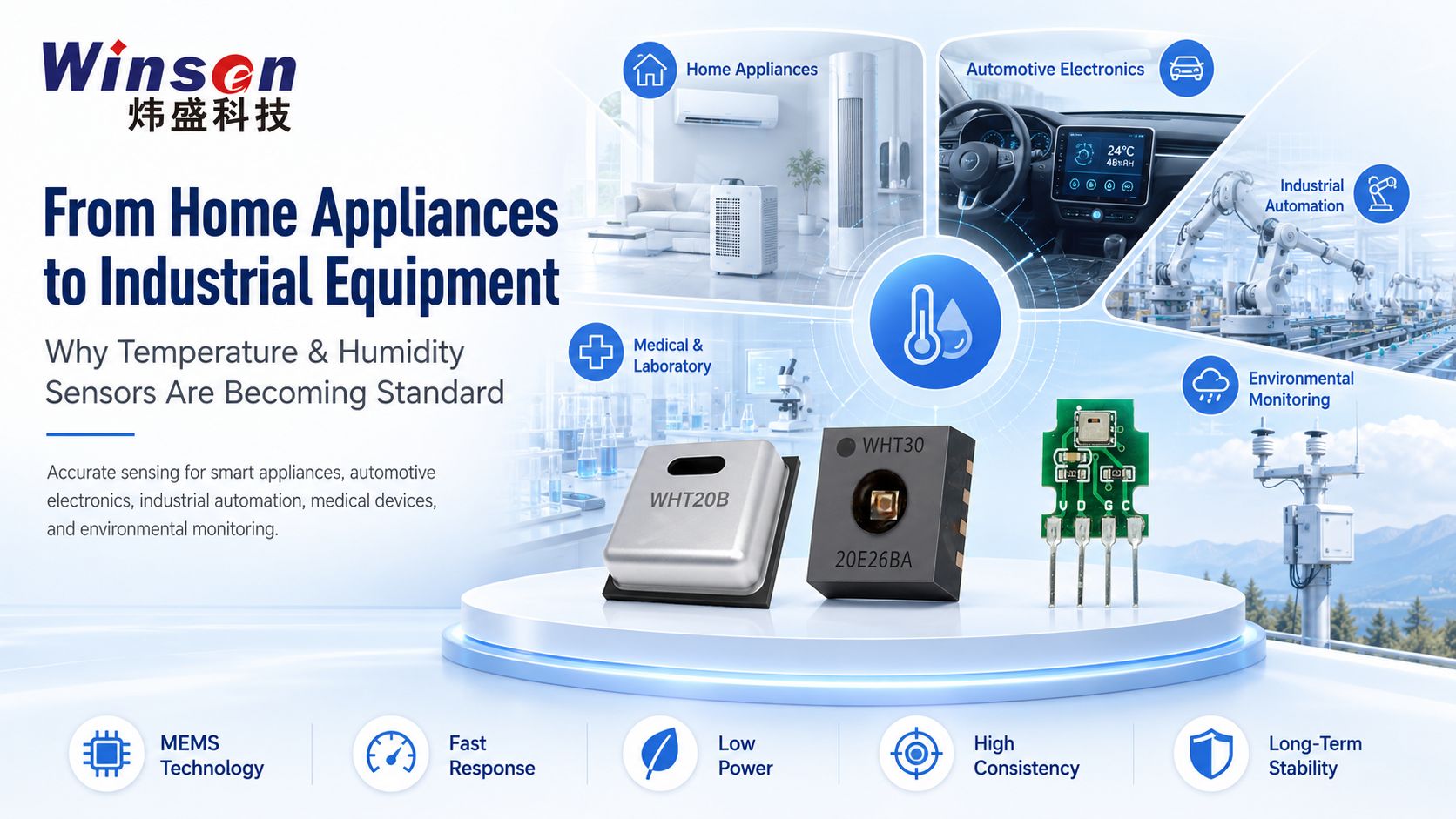
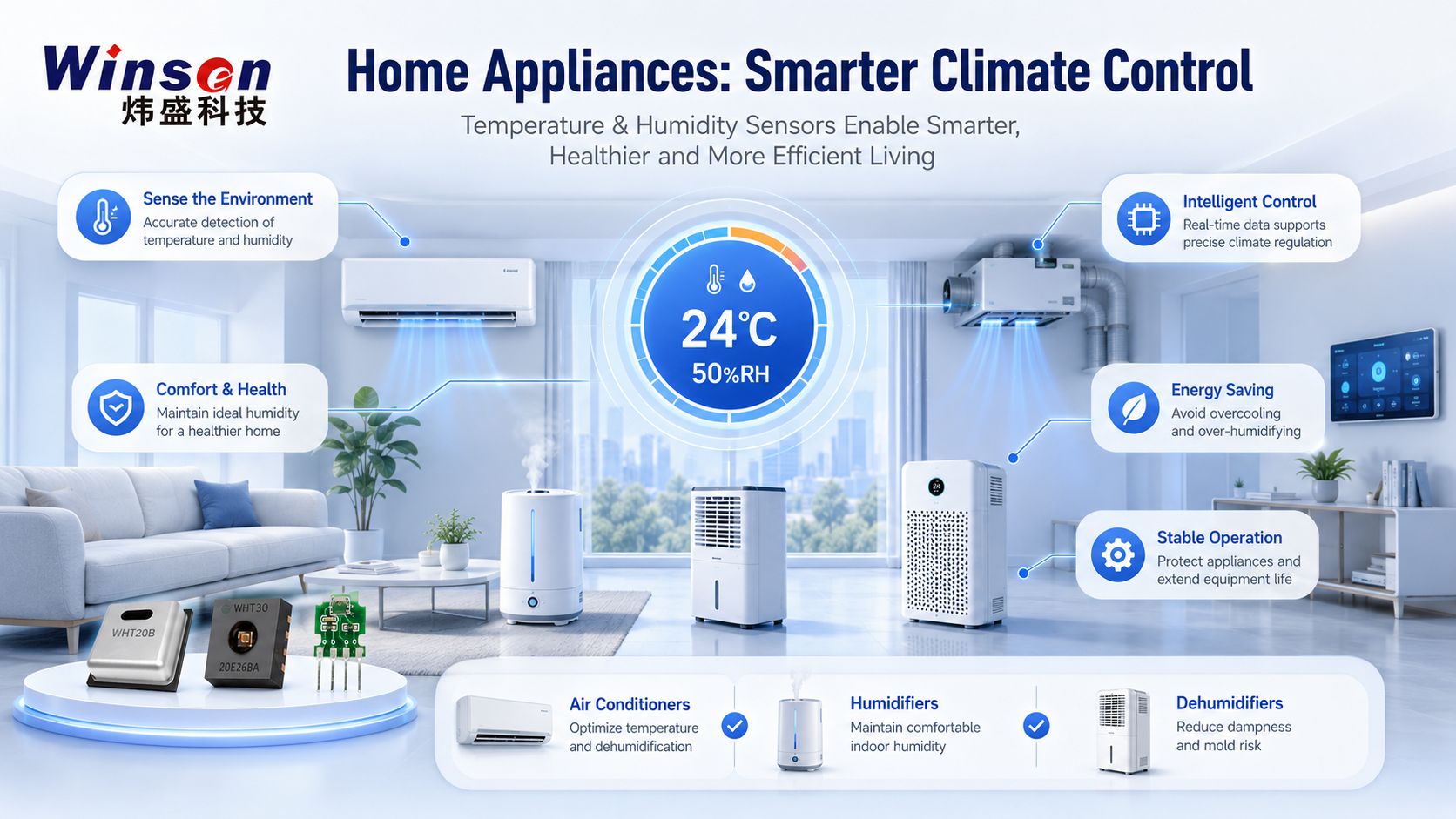
HVAC and Smart Home Appliances
Air conditioners, fresh-air systems, dehumidifiers and smart thermostats depend on accurate temperature and humidity data to regulate indoor conditions.
The sensor data can help the system determine:
- whether cooling or heating output should be adjusted;
- whether dehumidification is required;
- whether fresh-air ventilation should increase;
- whether condensation risk is developing;
- whether the target comfort level has been reached.
This enables HVAC equipment to move from fixed operation toward demand-based intelligent control.
Typical applications include:
- residential air conditioners;
- heat pumps;
- fresh-air systems;
- humidifiers and dehumidifiers;
- smart thermostats;
- air purifiers;
- room environmental monitors.
Winsen lists home appliances, HVAC systems, humidity control equipment and smart thermostats among the main application fields for its MEMS temperature and humidity products.
Automotive Electronics
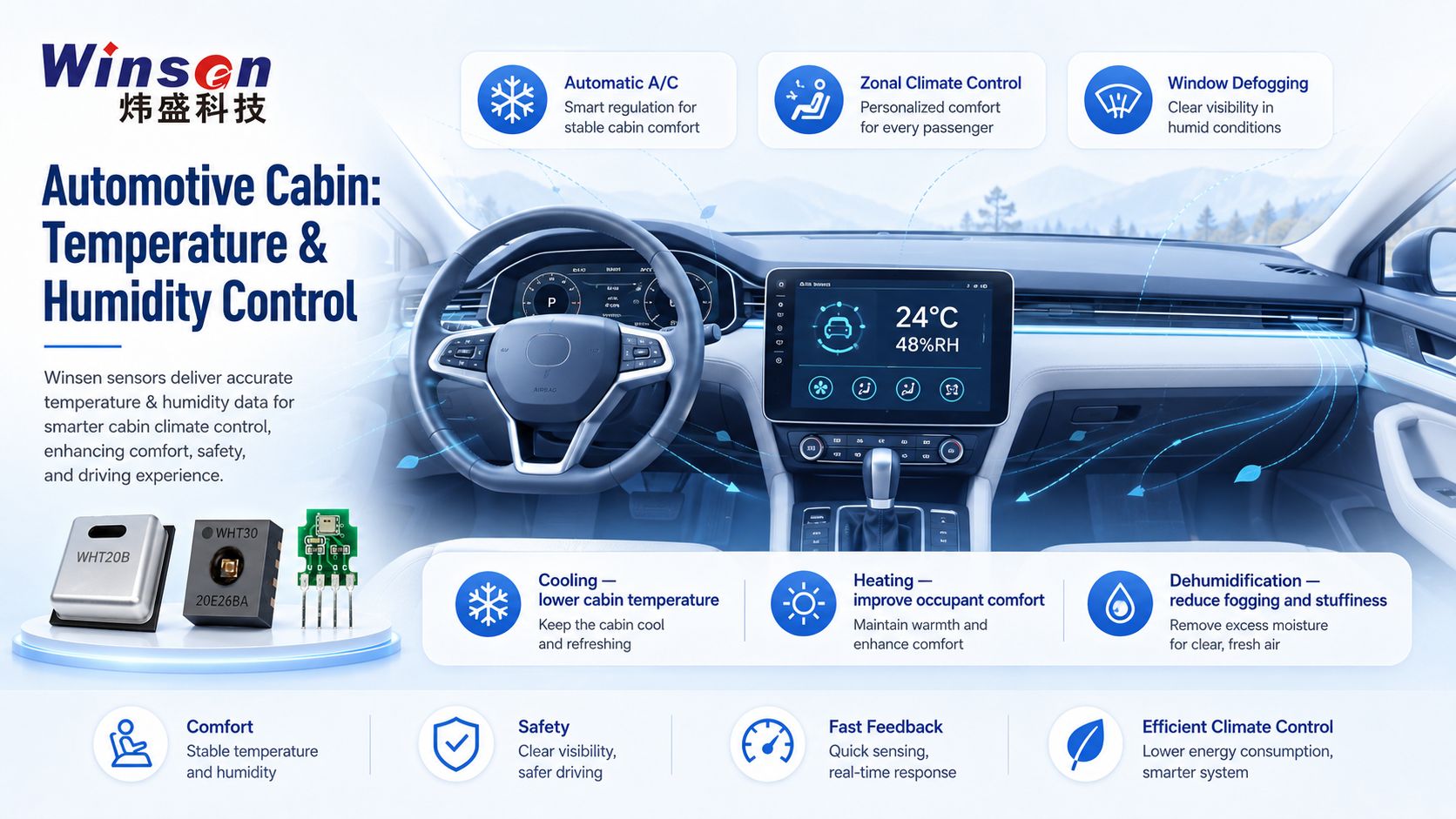
Temperature and humidity sensing supports multiple functions inside modern vehicles.
In cabin climate-control systems, environmental data helps the HVAC controller balance passenger comfort and energy consumption. Humidity information can also support windshield condensation prediction and automatic defogging strategies.
Typical applications include:
- automotive air-conditioning control;
- cabin environmental monitoring;
- windshield defogging systems;
- seat and localized climate control;
- in-vehicle air-quality systems;
- battery and electronics compartment monitoring.
Compact MEMS packaging makes the sensing element easier to integrate into dashboards, HVAC ducts, control units and distributed automotive electronic systems.
Industrial Automation and Process Control
Industrial environments frequently require stable temperature and humidity conditions.
Excessive humidity may cause condensation, corrosion or insulation degradation. Low humidity may increase electrostatic-discharge risk. Temperature changes can affect manufacturing processes, storage conditions and measurement accuracy.
Temperature and humidity sensors can therefore support:
- production-line environmental monitoring;
- electrical cabinet protection;
- warehouse condition monitoring;
- cleanroom control;
- industrial equipment diagnostics;
- semiconductor and electronics manufacturing;
- automated control systems.
Continuous environmental sensing gives industrial controllers reliable data for alarms, ventilation, dehumidification and process adjustment.
Medical, Laboratory and Environmental Monitoring
Medical devices, laboratories, data loggers and weather stations generally require stable, traceable environmental data.
Typical applications include:
- medical equipment;
- pharmaceutical storage;
- laboratory environmental control;
- incubators;
- environmental data loggers;
- weather stations;
- portable monitoring devices.
Winsen’s official product information identifies medical equipment, testing instruments, data loggers and weather stations as typical application areas for its temperature and humidity sensors.
How to Select the Right Temperature and Humidity Sensor
Different devices require different combinations of accuracy, size, interface and system integration.
| Selection Factor | Questions to Consider |
|---|---|
| Accuracy | What temperature and humidity error can the system accept? |
| Response time | Does the equipment need to react quickly to environmental changes? |
| Package size | How much PCB and enclosure space is available? |
| Output interface | Is a standard I²C digital output required? |
| Supply voltage | What voltage platform does the control system use? |
| Operating environment | Will the sensor face high humidity, condensation or wide temperatures? |
| Production method | Is the product intended for automated SMT assembly? |
| Long-term stability | How frequently can the finished equipment be calibrated or serviced? |
| Product form | Is a sensing IC or a ready-to-integrate module more appropriate? |
Recommended Product Positioning
Choose WHT20 when:
- higher temperature and humidity accuracy is required;
- the product needs a compact SMD component;
- factory-calibrated digital output is preferred;
- long-term environmental monitoring is important.
Choose WHT30 when:
- PCB space is extremely limited;
- fast digital communication is needed;
- a single-chip integrated structure is preferred;
- the project requires mass-production consistency and compact design.
Choose ZS11 when:
- customers need an easier-to-integrate sensor module;
- quick product development is a priority;
- strong performance in high-humidity environments is required;
- standard digital output can simplify the host system.
Integration Considerations for OEM Equipment
The performance of the finished device depends not only on the sensor itself, but also on installation and structural design.
Ensure Adequate Air Exchange
The sensor should be positioned where environmental air can reach the sensing area without being blocked by the enclosure.
An overly sealed installation may slow response and cause the measured value to differ from the actual surrounding environment.
Keep the Sensor Away from Local Heat Sources
Power components, processors, displays, motors and heating elements may create localized temperature gradients.
The sensor should be positioned away from these heat sources or thermally isolated to avoid measuring internal component heat instead of the intended environment.
Consider Condensation and High-Humidity Exposure
Long-term exposure beyond the recommended environmental range may cause temporary drift or accelerate sensor aging. Product structure, airflow and condensation protection should therefore be considered during equipment design.
Use the Correct Package for Production
SMD sensors such as WHT20 and WHT30 are suitable for automated reflow-soldering processes, helping manufacturers improve assembly efficiency and batch consistency.
From Environmental Monitoring to Intelligent Decision-Making
The role of temperature and humidity sensors is changing.
They are no longer used only to display environmental values. Their data is increasingly connected to intelligent controllers, algorithms and cloud platforms to support:
- automated equipment adjustment;
- energy-management strategies;
- abnormal-condition alarms;
- predictive maintenance;
- environmental trend analysis;
- coordinated operation with other sensors.
As smart homes, connected vehicles and industrial IoT systems continue to develop, temperature and humidity sensing will become an even more fundamental part of intelligent equipment architecture.
Conclusion
From household appliances and automotive electronics to industrial automation, medical equipment and environmental monitoring, accurate temperature and humidity data is becoming essential for stable and intelligent operation.
MEMS technology provides the compact size, fast response, low power consumption, production consistency and digital integration required by modern equipment.
With the WHT20, WHT30 and ZS11 product platforms, Winsen provides flexible temperature and humidity sensing options for different levels of accuracy, miniaturization and system integration.
For OEM manufacturers developing the next generation of smart devices, reliable environmental sensing is not simply an additional feature. It is the data foundation for precise control, energy efficiency and long-term product reliability.