The Next Smart Upgrade for Induction Cookers
IR “Black Tech” Temperature Sensing for a New Level of Frying, Searing, Boiling & Safety
As smart-home appliances become mainstream, modern induction cookers are no longer judged only by power rating. Users (and brands) increasingly demand two things at the same time:
- Safer cooking (prevent dry boiling, oil overheating, and runaway temperatures)
- More precise temperature control (repeatable cooking results, not “heat by feel”)
That’s why non-contact infrared temperature sensors—especially digital thermopile sensors—are steadily replacing traditional contact-based NTC methods in high-end induction designs. They deliver fast response and accurate surface temperature measurement without touching the pot or food.
Why Traditional Induction Cookers Still “Cook by Feel” (and Why It’s Risky)
Many conventional induction cookers use an NTC thermistor attached beneath the ceramic/glass panel. This measures the panel temperature, not the pot-bottom temperature directly.
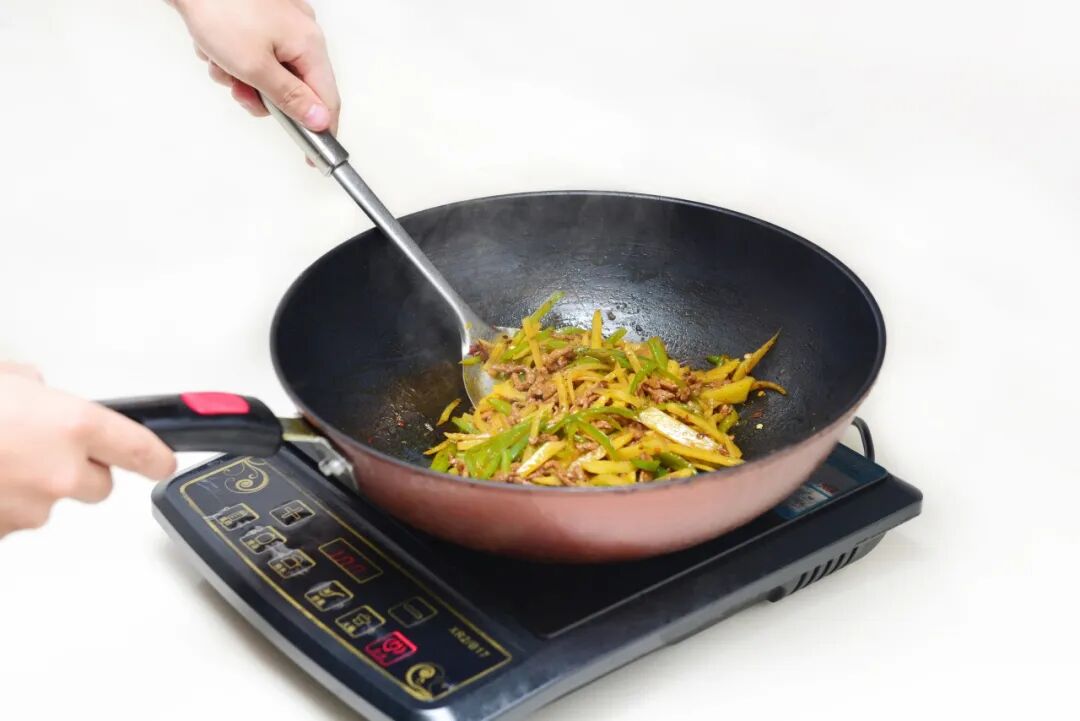
The problem is physics:
- Heat must conduct through the panel first → measurement lag
- The panel has its own heat storage → readings can be biased by residual heat
- Rapid temperature events (like oil heating) can outpace the sensor feedback → overheating risk
This lag doesn’t just affect taste. It can contribute to dry-boil scenarios, burnt cookware, or overheating oil—especially when users are distracted.
How IR Thermopile Temperature Sensors “See” the Real Temperature (Without Contact)
Any object above absolute zero emits infrared radiation. A thermopile converts that radiation into an electrical signal based on the Seebeck principle (multiple thermocouples in series). Winsen’s digital thermopile design integrates the thermopile, temperature compensation, and ASIC processing so the sensor can output a temperature value quickly and reliably.
Why this matters for induction cookers
With the right optical path (window/filter design), an IR sensor can observe the pot bottom’s thermal radiation and provide:
- Faster feedback than panel conduction
- More direct temperature control for cooking algorithms
- Better safety triggers for abnormal temperature spikes
What This Enables: From “Power Control” to “Temperature Control” Cooking
When the cooker has real-time pot temperature data, it can move beyond basic power steps and unlock true temperature modes such as:
- Rice cooking: stable temperature curves → more even texture
- Soup simmering: avoids violent boiling; holds gentle simmer
- Oil temperature control: consistent frying; fewer burnt batches
- Searing & stir-fry: quick stabilization after adding cold ingredients
- Fermentation / proofing / low-temp cooking: stable gentle heat for dough and specialty recipes
And most importantly: anti dry-boil protection—detecting abnormal temperature rise and cutting power before the situation escalates.
Winsen RTT-D7211 Series: Digital Thermopile Temperature Sensor for Non-Contact Measurement
For appliance designers, a big adoption barrier is integration complexity. The RTT-D7211 series is positioned to reduce that friction by providing a fully integrated digital thermopile solution with I²C output and internal temperature compensation.
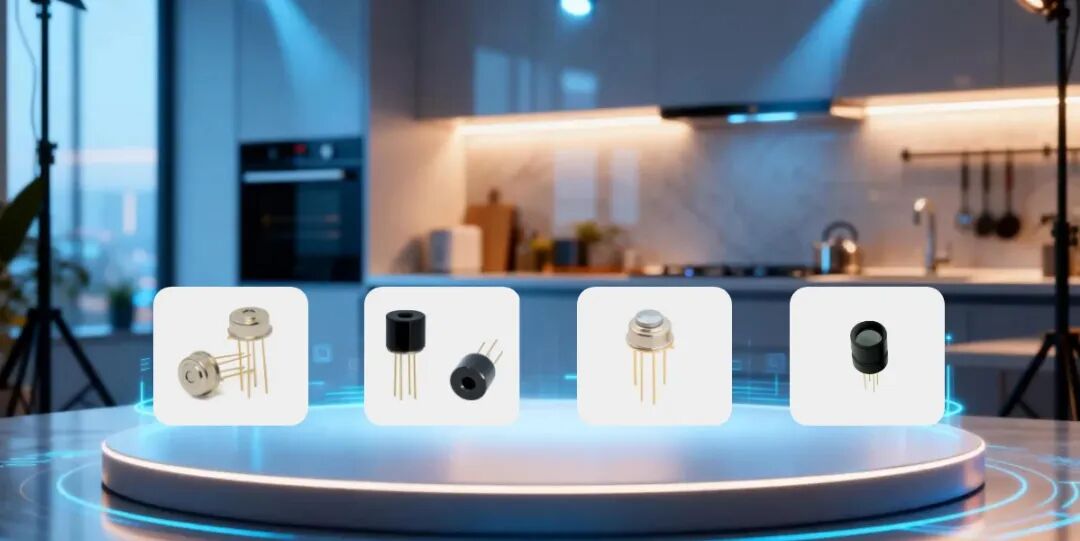
Key highlights
- Non-contact thermopile temperature sensing, Seebeck principle
- Detection / measurement range: –20 to 250 °C
- I²C output + internal temperature self-compensation
- Single supply: 2.6–5.5 V
- Adjustable sampling speed: 16-step configurable, including 0.02 Hz to 2 kHz
- Built-in ADC: high precision 20-bit sigma-delta ADC (ENOB up to 16 bits)
- Accuracy (reference): ±1 °C below 100 °C, and ±2% above 100 °C
- Field of view example: 54°; filter wavelength range 5.5–14 µm
- Low power current (reference): listed as 300 µA
Note: Specifications can change; confirm the latest revision before design freeze.
Quick Comparison: NTC vs IR Thermopile in Induction Cookers
| Item | NTC (contact under panel) | IR Thermopile (non-contact) |
|---|---|---|
| What is measured | Panel temperature (indirect) | Pot-bottom radiation temperature (direct path) |
| Response | Slower due to conduction lag | Fast feedback (sensor/algorithm dependent) |
| Control quality | “Power steps” feel; overshoot risk | Enables stable temperature modes |
| Dry-boil protection | Often late detection | Earlier abnormal rise detection potential |
| Integration | Simple but limited | Needs optical path + algorithm tuning |
| User experience | More “by feel” | More repeatable cooking results |
Integration Tips for Appliance Engineers
If you’re designing an induction cooker around IR temperature control, these are the practical details that separate “works in lab” from “works in kitchen”:
1) Optical path design (window/filter + field of view)
A thermopile measures what it “sees.” Make sure the sensor’s FOV targets the correct area of the pot bottom, and design the window/filter path to match the sensor’s response band (RTT-D7211 references 5.5–14 µm).
2) Emissivity and pot material variation
Different cookware finishes radiate differently. A good control system needs emissivity handling—either by calibration profiles or adaptive algorithms.
3) Ambient compensation and thermal isolation
Even with internal temperature compensation, the sensor environment matters. Keep the sensor away from hot airflow and provide mechanical design that reduces self-heating effects.
4) Safety logic should be graded (not binary)
Instead of only “alarm + cut,” use staged control:
- reduce power → stabilize temperature → alarm if abnormal rise continues → shutdown
5) Factory calibration + algorithm = product-level performance
RTT-D7211 is described as calibrated before leaving the factory and includes internal processing that converts thermopile signals to temperature data.
In real products, additional system-level calibration is still recommended (cooktop structure, window, distance, and cookware profiles all matter).
Why This Can Also Help Cost Optimization (Not Just Performance)
A modern IR thermopile solution can reduce the need for complex external conditioning circuits because of on-sensor integration (thermopile + compensation + ASIC).
With more accurate temperature control, manufacturers may gain flexibility in thermal margin design and system tuning—helping balance performance targets and BOM strategy (subject to full product verification).
FAQ
Can IR temperature sensors really prevent dry boiling?
They can help significantly by detecting rapid abnormal temperature rise earlier than panel-based sensing—especially when paired with well-designed control logic.
Where is the sensor installed in an induction cooker?
Typically beneath the cooktop surface, using a designed optical path (window/filter/geometry) so the sensor observes the pot bottom reliably.
What interface does RTT-D7211 use?
RTT-D7211 is listed with I²C output and internal temperature self-compensation.
What temperature range does RTT-D7211 support?
The product page lists a –20 to 250 °C measurement range.
Is it fast enough for frying and stir-fry control?
Thermopile-based sensing is designed for quick detection of temperature changes, and RTT-D7211 includes configurable sampling rates up to high-speed settings (0.02 Hz–2 kHz listed).
Actual cooking performance depends on total system loop design (sampling + filtering + control algorithm).