Electrical Conductivity vs TDS: What's the Difference in Water Quality Measurement?
Electrical conductivity (EC) and total dissolved solids (TDS) are two commonly used parameters in water quality monitoring. Both provide information about dissolved substances in water, but they describe different properties and are not interchangeable.
EC measures the ability of water to conduct electricity, primarily influenced by dissolved ions. TDS represents the concentration of dissolved substances, generally expressed as milligrams per liter (mg/L) or parts per million (ppm).
Understanding the difference between EC and TDS is important when selecting water quality sensors for industrial water treatment, reverse osmosis systems, drinking water purifiers, laboratory instruments, and other water monitoring equipment.
This guide explains how EC and TDS are measured, how conductivity can be used to estimate TDS, and how to select suitable Winsen conductivity and TDS sensor products.
What Is the Difference Between EC and TDS?
Electrical conductivity and total dissolved solids are related water quality parameters, but they measure different characteristics.
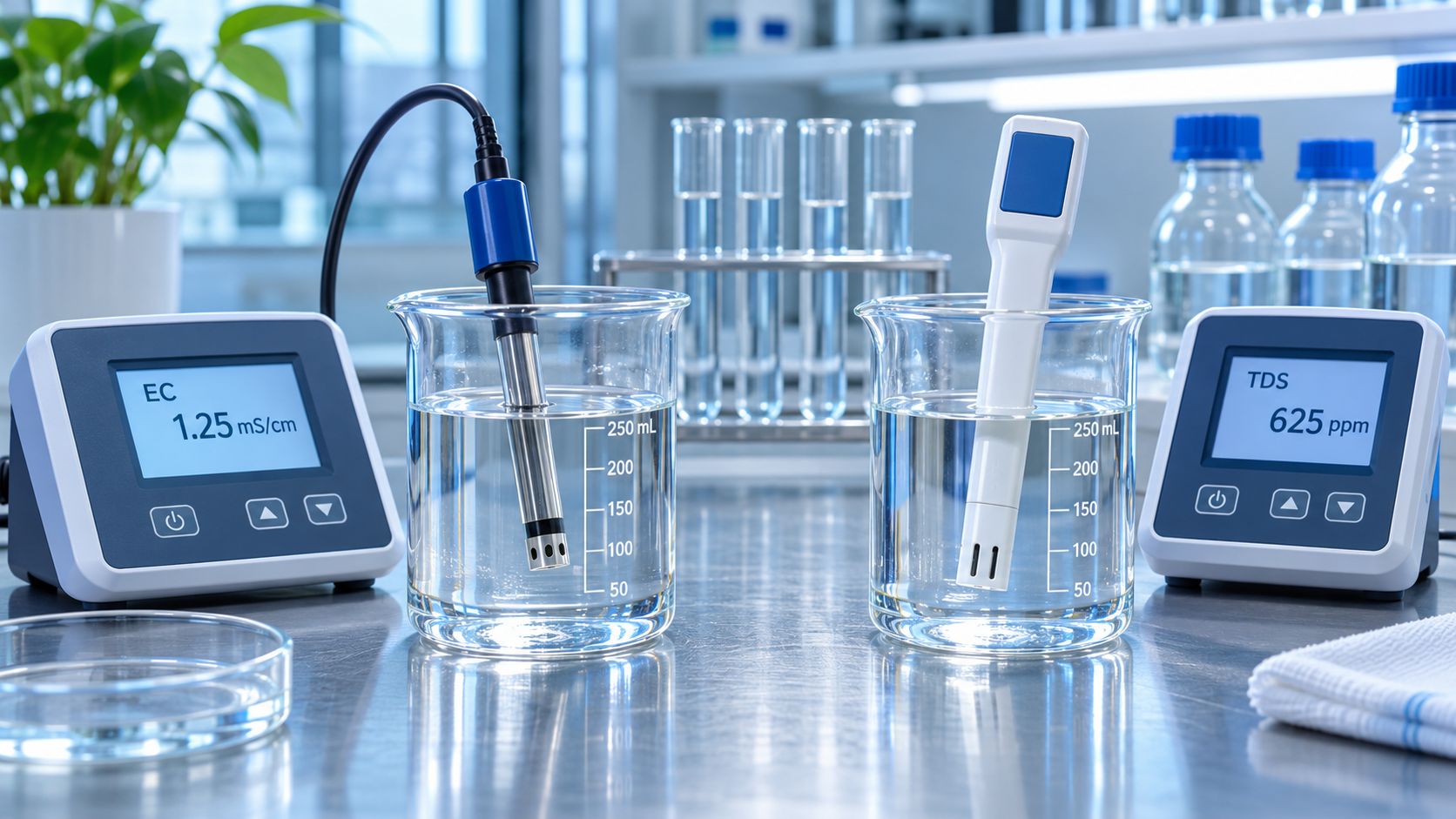
EC measures how easily an electrical current passes through water due to the presence of dissolved ions. TDS describes the total concentration of dissolved substances in water, which can be determined through laboratory analysis or estimated using conductivity measurements.
The main difference is that EC measures electrical conductivity, while TDS describes dissolved material concentration.
| Comparison | Electrical Conductivity (EC) | Total Dissolved Solids (TDS) |
|---|---|---|
| Full Name | Electrical Conductivity | Total Dissolved Solids |
| Measurement Object | Electrical conductivity of water | Concentration of dissolved substances |
| Measurement Units | μS/cm, mS/cm | mg/L, ppm |
| Measurement Principle | Electrical conductance measurement | Gravimetric analysis or conductivity-based estimation |
| Main Influencing Factors | Ion concentration, ionic mobility, temperature and solution composition | Types and concentrations of dissolved substances |
| Typical Applications | Industrial water treatment, pure water, RO systems and cooling towers | Drinking water purifiers, water quality meters and laboratory testing |
In practical applications, EC is often preferred for monitoring changes in ionic content, while TDS is commonly used when equipment needs to display an estimated dissolved solids concentration.
What Is Electrical Conductivity in Water?
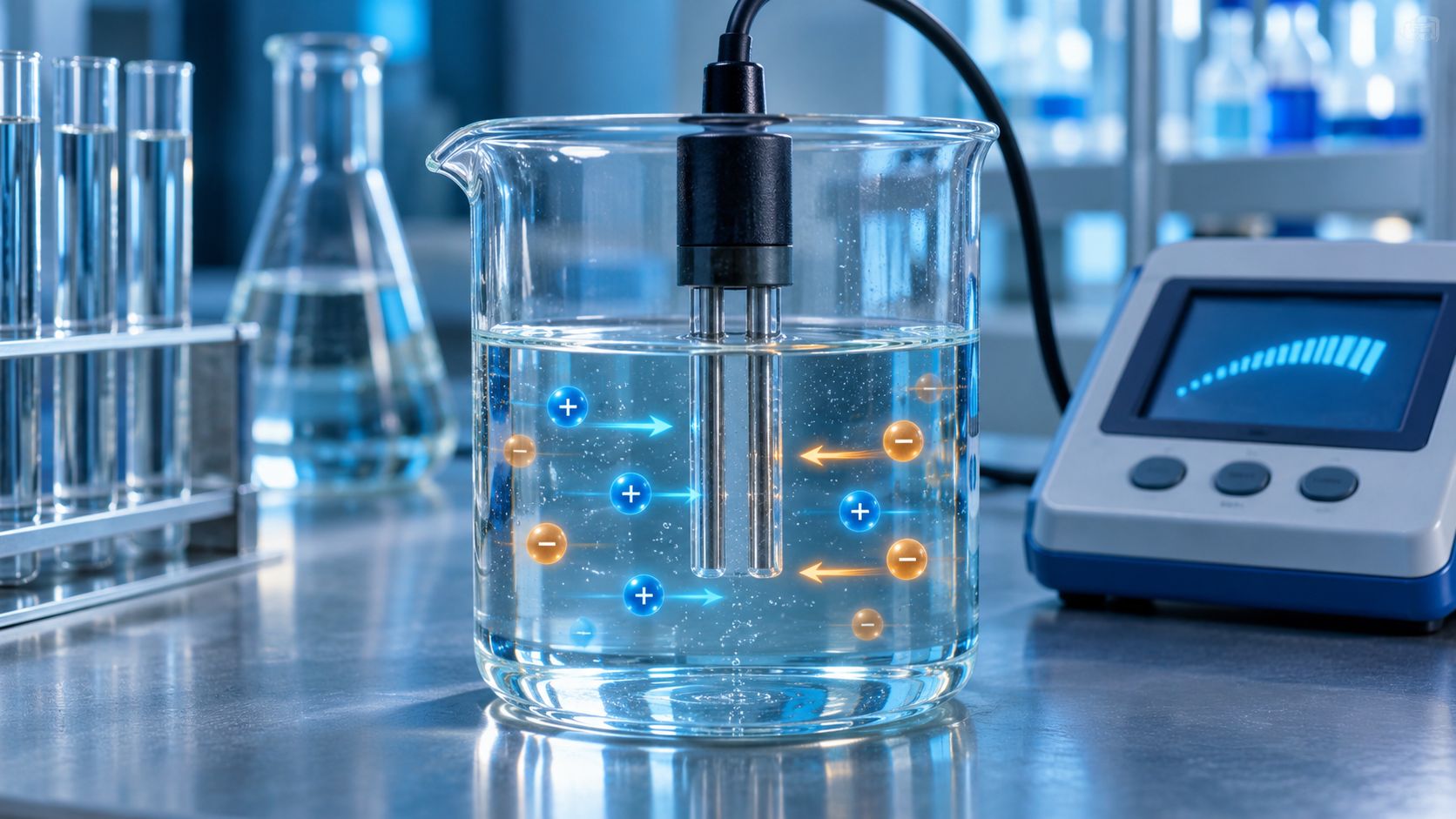
Electrical conductivity describes the ability of water to carry an electrical current. In aqueous solutions, this ability is mainly associated with dissolved ions such as sodium, calcium, magnesium, chloride and sulfate.
When these substances dissolve in water, they can form positively and negatively charged ions. These ions move through the solution and carry electrical charge when an electric field is applied.
Generally, water containing more mobile dissolved ions has higher electrical conductivity, although the relationship also depends on ion type, concentration and temperature.
How Is Electrical Conductivity Measured?
Conductivity sensors measure the electrical properties of a water sample using electrodes and an electrical measurement circuit.
The electrical conductance of a solution is related to its resistance. By considering the sensor cell geometry and electrical characteristics, the measurement system calculates the conductivity of the solution.
Conductivity is commonly expressed using the following units:
- μS/cm: Microsiemens per centimeter, commonly used for low-conductivity water.
- mS/cm: Millisiemens per centimeter, commonly used for higher-conductivity solutions.
1 mS/cm equals 1,000 μS/cm.
What Does EC Tell You About Water Quality?
Conductivity provides an overall indication of the presence and combined influence of dissolved ions in water.
It is particularly useful for identifying changes in water quality during industrial processes and treatment operations.
- Pure water systems: Monitor changes in low-conductivity water.
- Reverse osmosis systems: Evaluate changes in permeate conductivity.
- Cooling towers: Monitor conductivity changes associated with dissolved ionic substances and water concentration.
- Industrial water treatment: Track conductivity trends during different treatment stages.
However, EC cannot identify individual ions or determine the exact concentration of every dissolved substance. Additional analytical methods are needed when the chemical composition of water must be identified.
What Is Total Dissolved Solids (TDS)?
Total dissolved solids refer to the concentration of dissolved substances in water. These substances may include inorganic salts, minerals and certain dissolved organic materials.
TDS is commonly expressed in mg/L or ppm and is widely used in drinking water monitoring, water purification equipment and laboratory water quality analysis.

How Is TDS Measured?
There are two common approaches to determining TDS.
1. Gravimetric Measurement
Gravimetric analysis is a direct laboratory method for determining TDS.
A measured water sample is filtered to remove suspended particles. The filtrate is then evaporated, and the remaining residue is dried and weighed according to the applicable analytical procedure.
The mass of the remaining dissolved residue is used to calculate the TDS concentration of the original water sample.
This method provides a direct analytical determination of dissolved solids, although it requires laboratory equipment, sample preparation and processing time.
2. Conductivity-Based TDS Estimation
Many commercial TDS meters estimate TDS using an electrical conductivity measurement and a conversion factor.
Because dissolved ions contribute to electrical conductivity, EC can provide a useful basis for estimating dissolved solids in water when the relationship between the sample composition and conductivity is understood.
This approach is convenient for portable meters and continuous monitoring equipment, but the displayed TDS value is an estimate rather than a direct gravimetric measurement.
How Is EC Converted into TDS?
Conductivity-based TDS estimation generally uses an empirical conversion factor to convert electrical conductivity into an estimated dissolved solids concentration.
The commonly used calculation is:
TDS (mg/L) ≈ EC at 25°C (μS/cm) × K
K = TDS conversion factor
The conversion factor depends on the chemical composition of the water and the relationship established between conductivity and measured TDS.
Example of EC to TDS Conversion
Assume that a water sample has an electrical conductivity of 1,000 μS/cm and that a conversion factor of 0.65 is selected for illustration.
TDS = 1,000 × 0.65 = 650 mg/L
The estimated TDS concentration is therefore 650 mg/L.
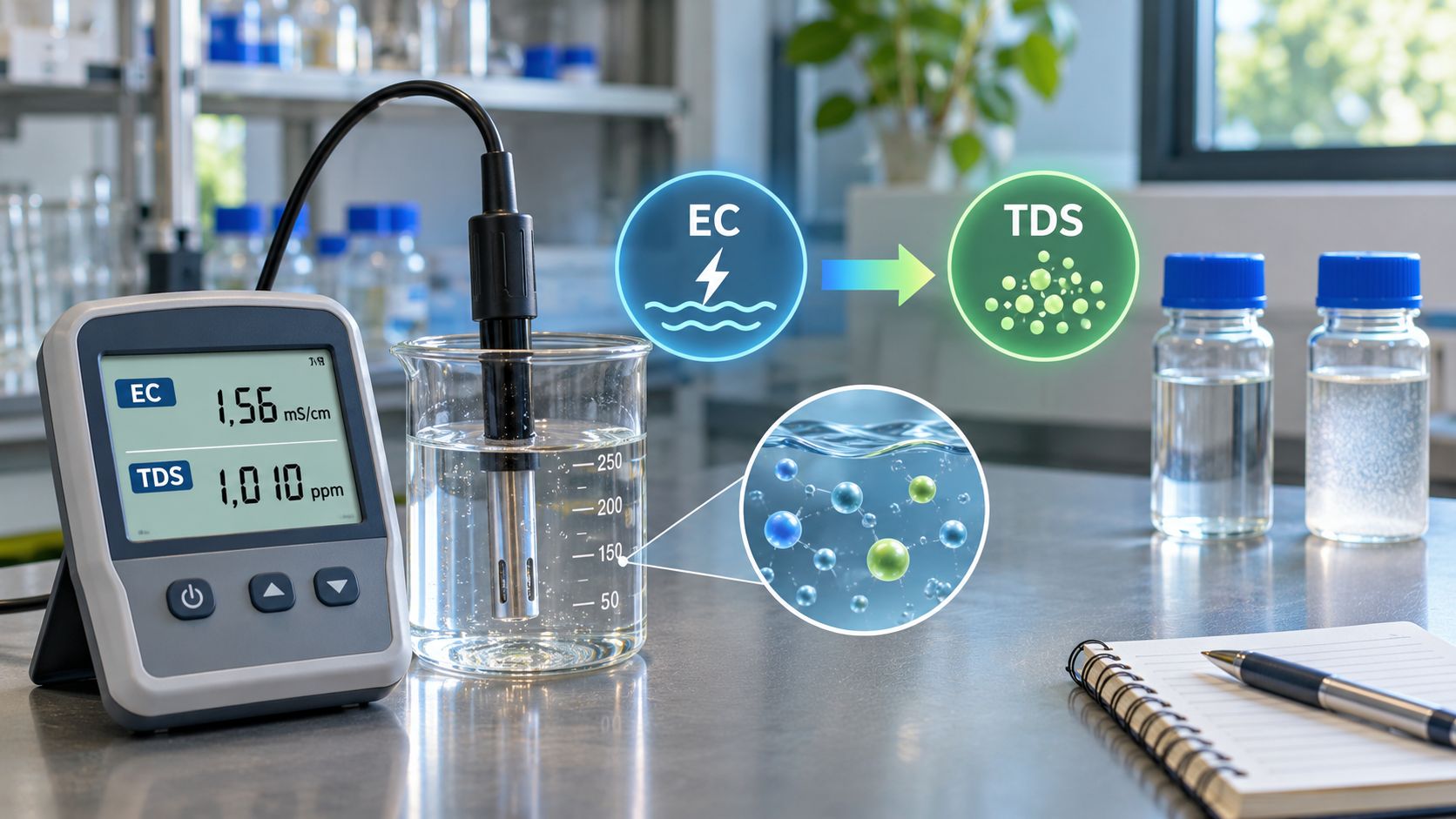
This calculation demonstrates the conversion process. The factor of 0.65 is an example, not a universal value for all water samples.
Why Does the TDS Conversion Factor Matter?
The relationship between EC and TDS depends on the types and relative concentrations of dissolved substances in the water.
Different ions have different electrical charges and mobilities. Consequently, two water samples with similar TDS concentrations may have different conductivity values.
1. Different Dissolved Ions Produce Different Conductivity
Sodium, calcium, magnesium, chloride, sulfate and bicarbonate contribute differently to the electrical conductivity of water.
The ionic composition of a sample therefore influences the conversion factor used to estimate TDS from EC.
2. Water Sources Have Different Chemical Compositions
Drinking water, groundwater, industrial process water and wastewater can contain different combinations of dissolved substances.
A conversion factor calibrated for one water source may not provide the same accuracy when applied to another water source with a different chemical composition.
3. Calibration Improves Estimation Accuracy
For applications requiring better agreement between conductivity-based TDS readings and laboratory measurements, the conversion factor can be established using paired EC and gravimetric TDS results from representative water samples.
This is particularly important in industrial processes where water composition may change over time.
How Does Temperature Affect EC and TDS Measurements?
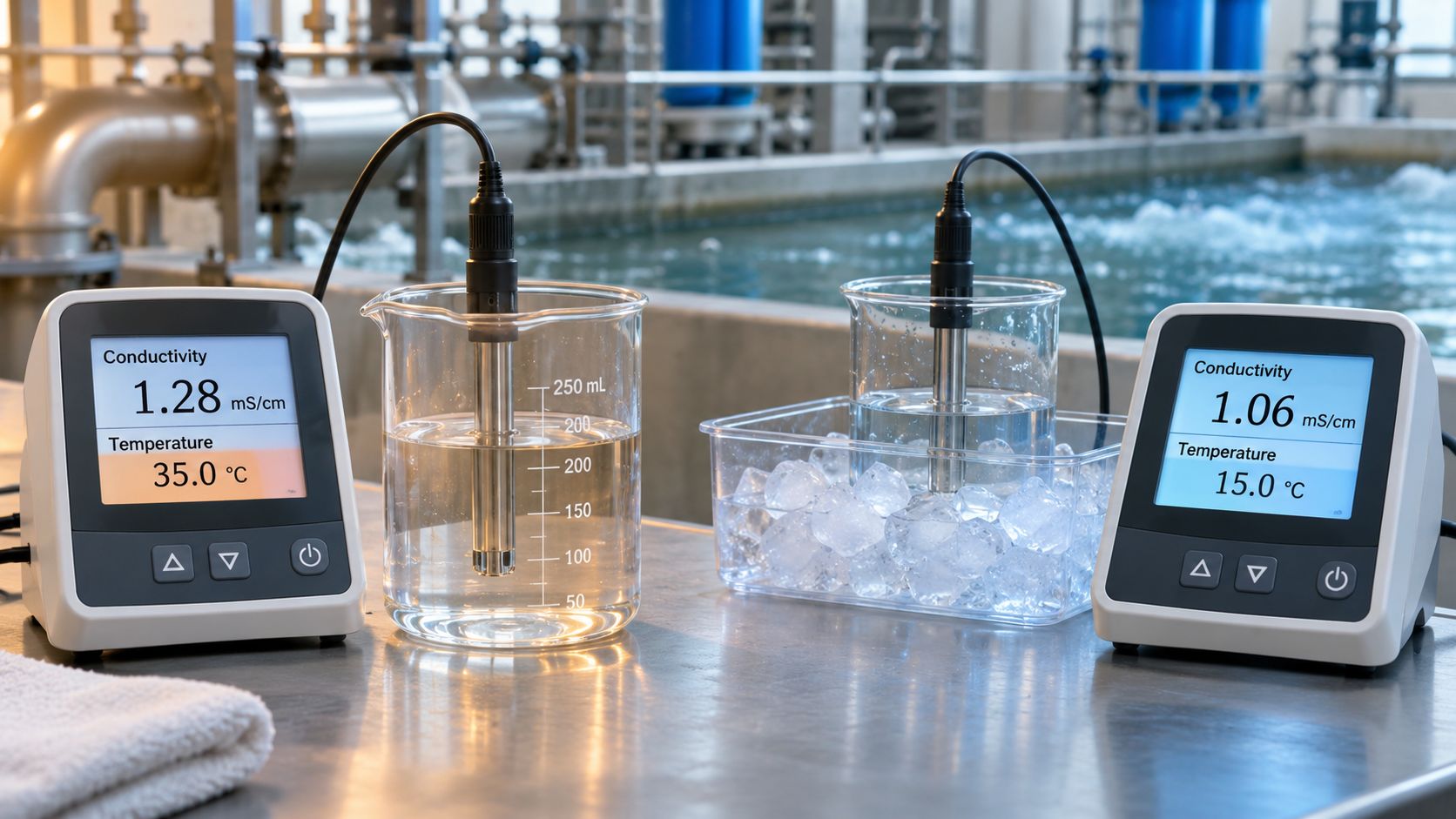
Temperature is an important factor in electrical conductivity measurement.
As water temperature increases, the mobility of dissolved ions generally increases, which can result in higher measured electrical conductivity. The temperature dependence varies according to the ionic composition of the solution.
Why Is Temperature Compensation Necessary?
Conductivity measurements are often normalized to a reference temperature of 25°C so that measurements taken under different temperature conditions can be compared more consistently.
Many conductivity meters and monitoring systems include automatic temperature compensation. The compensation algorithm and temperature coefficient should be appropriate for the water being measured.
Temperature and TDS Estimation
When TDS is estimated from conductivity, temperature-related changes in EC can also affect the calculated TDS value.
For reliable monitoring, the measurement system should account for temperature effects before applying the selected TDS conversion factor.
For applications involving varying water temperatures, integrated temperature measurement can provide additional information for measurement correction and system monitoring.
EC Sensor vs TDS Sensor: Which One Should You Choose?
The choice between an EC sensor and a TDS sensor depends on the parameter required by the application, the expected measurement range and the monitoring system design.
When Should You Choose an EC Sensor?
An EC sensor is appropriate when the equipment needs to measure electrical conductivity directly and monitor changes in dissolved ionic content.
- Industrial pure water: Monitor low conductivity in purified water systems.
- Reverse osmosis: Monitor conductivity changes in RO water.
- Cooling towers: Monitor circulating water conductivity for water treatment and blowdown control strategies.
- Industrial process water: Monitor conductivity trends during production and water treatment.
For more information about industrial applications, explore the Industrial Pure Water and RO Water Conductivity Monitoring Solution and Cooling Tower Conductivity Monitoring Solution.
When Should You Choose a TDS Sensor?
A TDS-oriented sensor or module is suitable for equipment that needs to display or monitor dissolved solids concentration.
- Drinking water purifiers: Provide TDS monitoring information for water purification equipment.
- Household water quality devices: Display estimated dissolved solids values.
- Laboratory instruments: Support water quality measurement and analysis.
- OEM water equipment: Integrate TDS measurement into water monitoring and control systems.
Explore the Water Purifier TDS and Temperature Monitoring Solution for more information about TDS monitoring in drinking water equipment.
EC vs TDS Sensor Selection Comparison
| Selection Requirement | Recommended Measurement |
|---|---|
| Low-conductivity pure water monitoring | EC |
| Industrial process water conductivity monitoring | EC |
| RO water conductivity monitoring | EC |
| Cooling tower circulating water monitoring | EC |
| Drinking water purifier TDS display | TDS |
| Integrated TDS and temperature monitoring | TDS + Temperature |
Winsen EC and TDS Sensor Solutions
Winsen provides electrical conductivity sensors and TDS water quality modules for industrial water treatment, pure water equipment, drinking water purifiers and OEM water quality monitoring systems.
Different models offer different measurement ranges and output interfaces to support different equipment integration requirements.
Electrical Conductivity Sensors
ZW-C101 Electrical Conductivity Sensor
ZW-C101 is an electrical conductivity water quality sensor designed for monitoring conductivity in different water applications.
- Measurement range: 0–20,000 μS/cm
- Output signal: 4–20 mA / RS485
- Response time: ≤30 s (T90)
- Accuracy: ≤±3%
ZW-C102 Conductivity Sensor
ZW-C102 is designed for monitoring low-conductivity aqueous solutions. Its official applications include pure water and RO water quality equipment, industrial water use and environmental water quality monitoring.
- Measurement range: 0 to 20 μS/cm
- Resolution: 0.01 μS/cm
- Accuracy: ±1.5% F.S.
- Output signal: 0.8–4 V (linear)
- Wetted material: SUS316L
ZW-C1021 Conductivity Sensor
ZW-C1021 provides two conductivity measurement ranges and an RS485 output interface for compatible water quality monitoring systems.
- Measurement ranges: 0–20 / 0–200 μS/cm
- Resolution: 0.01 / 0.1 μS/cm
- Accuracy: ≤±3% F.S.
- Output signal: RS485
- Operating temperature: -40 to 85°C
TDS and Temperature Sensors
ZW-TS101 Temperature + TDS Detection Module
ZW-TS101 is a digital water quality module designed to detect TDS and water temperature. It provides an integrated option for water purifier equipment and laboratory water quality instruments.
- Measurement targets: TDS + Temperature
- Temperature range: 0–100°C
- Output signal: RS485 (5V level)
- Response time: ≤20 s
MW-TDS110 TDS Water Quality Sensor
MW-TDS110 is an online water quality sensor for TDS detection. It is suitable for water purifier equipment, laboratory research and other TDS monitoring applications.
- Measurement range: 0–2000 ppm
- Measurement accuracy: ±5% F.S.
- Operating temperature: ≤70°C
- Operating voltage: ≤5.0 V
Winsen EC and TDS Product Overview
| Model | Measurement Target | Measurement Range | Output | Typical Application |
|---|---|---|---|---|
| ZW-C101 | EC | 0–20,000 μS/cm | 4–20 mA / RS485 | Industrial water monitoring |
| ZW-C102 | EC | 0–20 μS/cm | 0.8–4 V | Pure water and RO systems |
| ZW-C1021 | EC | 0–20 / 0–200 μS/cm | RS485 | Low-range conductivity monitoring |
| ZW-TS101 | TDS + Temperature | Refer to product specifications | RS485 (5V level) | Water purifier and laboratory equipment |
| MW-TDS110 | TDS | 0–2000 ppm | Refer to product specifications | Water purifier and TDS monitoring |
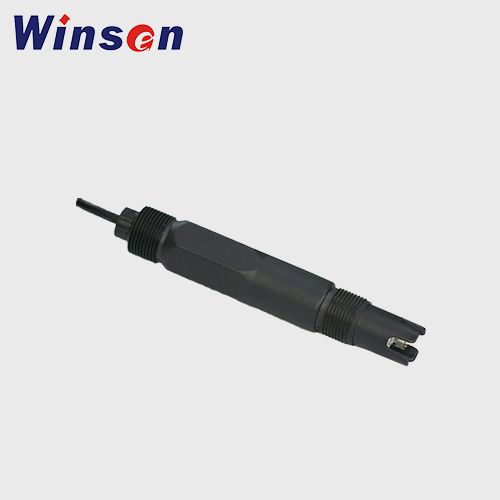

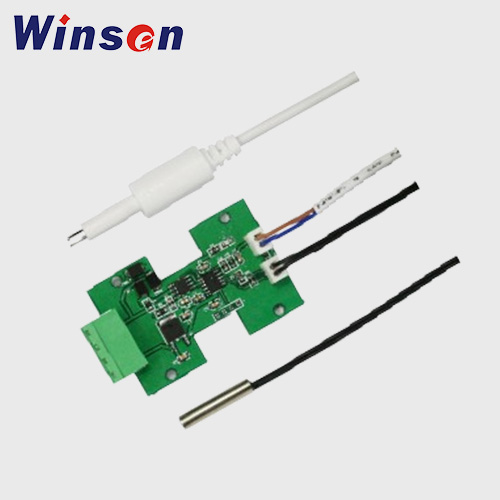
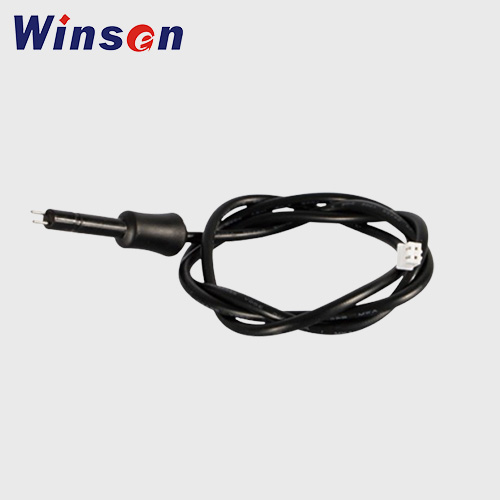
Looking for a conductivity or TDS sensor for your water quality equipment? Explore the complete Winsen Water Quality Sensor product range to find suitable measurement solutions for your application.
Applications of EC and TDS Monitoring
EC and TDS measurements are used across a wide range of water treatment and monitoring applications.
Industrial Pure Water and RO Water Systems
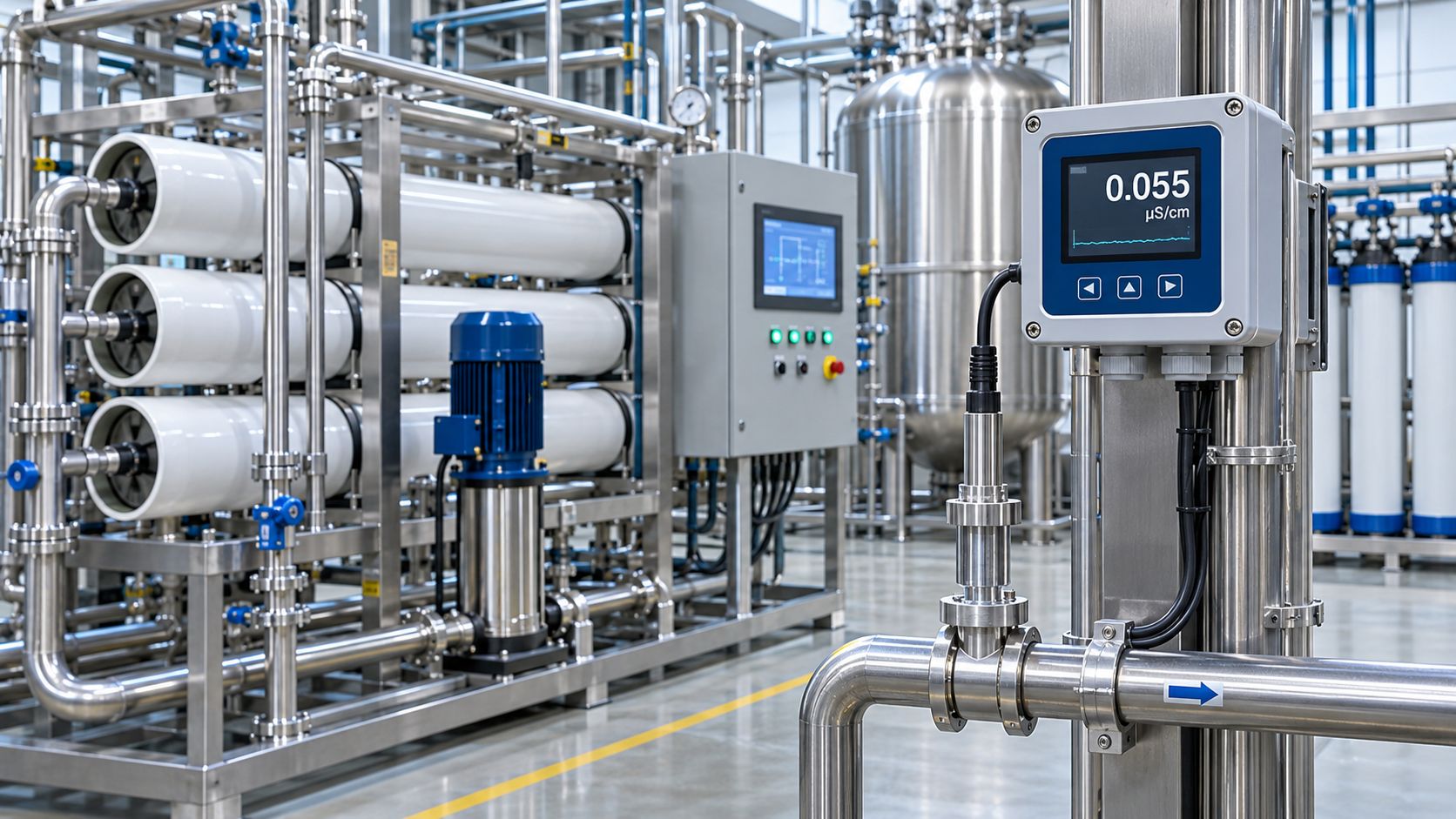
Low-range conductivity monitoring is important in industrial pure water and reverse osmosis systems. Changes in conductivity can provide information about variations in dissolved ionic content and help operators evaluate water treatment performance.
ZW-C102 and ZW-C1021 provide low-range conductivity measurement options for compatible equipment designs.
Cooling Tower Water Monitoring
Conductivity monitoring is commonly used in cooling tower water treatment. As water evaporates during operation, dissolved substances can become more concentrated in the circulating water.
Conductivity measurements can be used as an input for monitoring concentration trends and supporting blowdown control strategies.
Drinking Water Purifiers
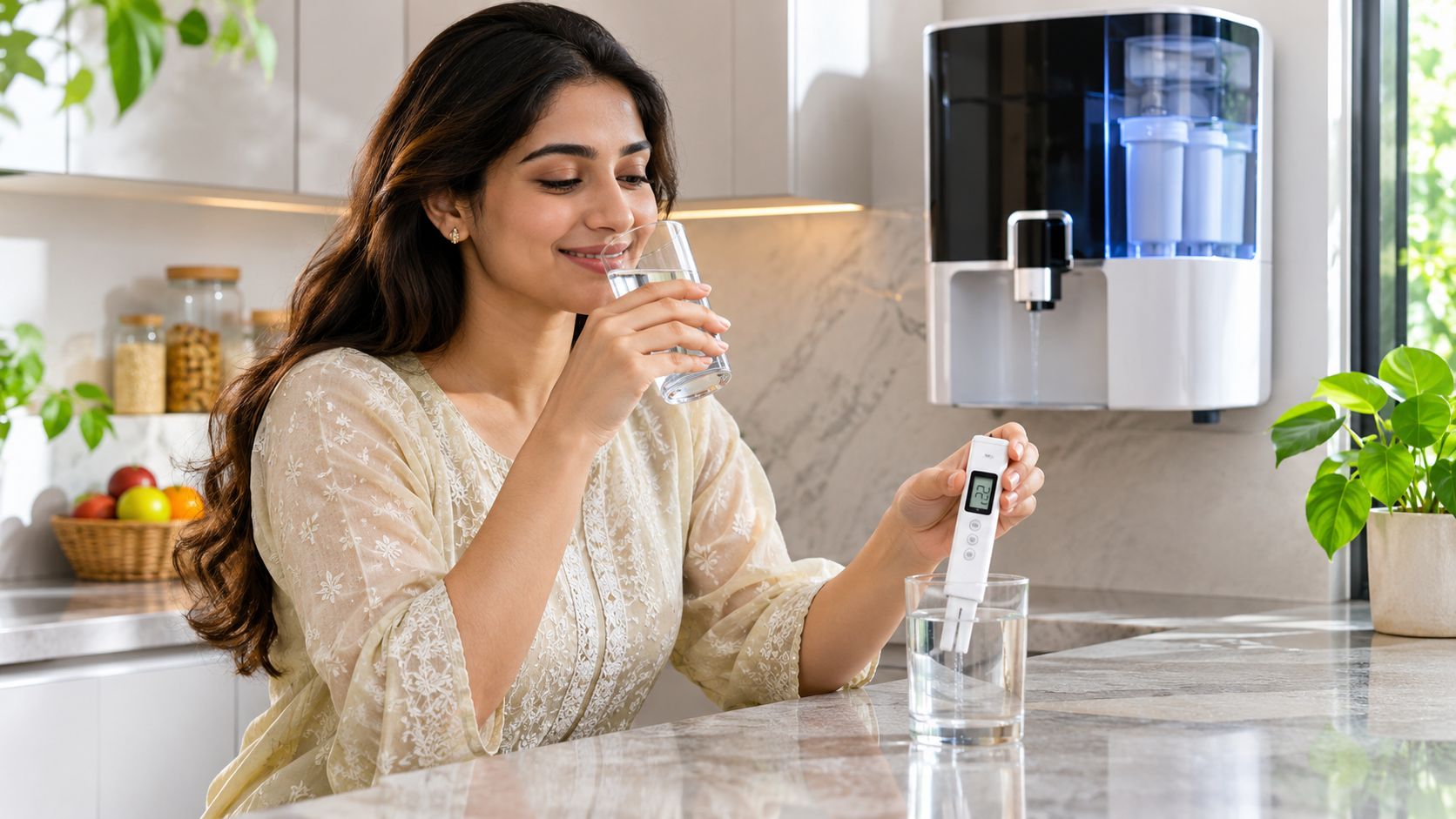
TDS monitoring is commonly integrated into drinking water purifier equipment to display changes in dissolved solids estimates.
Temperature and TDS measurement modules can provide additional monitoring information for water purifier manufacturers and OEM equipment developers.
Laboratory Water Quality Instruments
Laboratory instruments may combine conductivity, TDS and temperature measurement to support water sample analysis and general water quality monitoring.
Frequently Asked Questions About EC and TDS
1. Are EC and TDS the same?
No. EC measures the ability of water to conduct electricity, while TDS represents the concentration of dissolved substances. They are related, but they are not interchangeable measurements.
2. Can TDS be calculated from electrical conductivity?
Yes. TDS can be estimated from conductivity using an empirical conversion factor. However, the factor depends on the water composition, and the result may differ from a direct laboratory TDS measurement.
3. What is a normal EC value for drinking water?
There is no single EC value that applies to every drinking water source. Conductivity depends on dissolved ion concentrations and the composition of the water. The appropriate measurement range should be determined according to the water source and monitoring purpose.
4. Does a low TDS value mean water is safe to drink?
Not necessarily. TDS indicates the concentration of dissolved substances but does not identify specific contaminants, microorganisms or other potential health hazards. Drinking water safety requires appropriate testing of relevant physical, chemical and microbiological parameters.
5. Why does EC change when water temperature changes?
Temperature affects the mobility of dissolved ions. Higher temperatures generally increase electrical conductivity. Temperature compensation is therefore important when comparing conductivity measurements under different temperature conditions.
6. Which is better for RO water monitoring, EC or TDS?
EC is particularly useful for monitoring low-conductivity RO water because it directly measures the electrical conductivity of the water. TDS can also provide an estimated dissolved solids value when a suitable conversion factor is used.
7. What is the difference between ZW-C102 and ZW-C1021?
ZW-C102 has a measurement range of 0–20 μS/cm and a linear 0.8–4 V output. ZW-C1021 offers 0–20 / 0–200 μS/cm measurement ranges and RS485 output. The appropriate model depends on the required measurement range and equipment interface.
8. Can one sensor measure both TDS and temperature?
Yes. Winsen ZW-TS101 is designed for TDS and temperature detection, providing an integrated measurement option for water purifier equipment and laboratory instruments.
Explore More Winsen Water Quality Monitoring Solutions
Understanding the relationship between electrical conductivity and TDS helps equipment manufacturers select appropriate water quality measurement technologies.
Whether your application involves industrial pure water, reverse osmosis systems, cooling towers, drinking water purifiers or laboratory instruments, Winsen provides conductivity sensors and TDS modules for different measurement requirements.
- Explore Winsen Water Quality Sensors
- Learn More About Water Quality Monitoring
- Industrial Pure Water and RO Water Monitoring
- Cooling Tower Conductivity Monitoring
- Water Purifier TDS and Temperature Monitoring
Contact Winsen to discuss your water quality measurement requirements, sensor selection and OEM integration needs.